

Fun Facts about September
- Birthstone: Sapphire
- Flower: Asters and Morning Glory
- Zodiac signs: Virgo and Libra
- September derives its name from the Latin word “septem,” which means “seven”. This is because, in the original Roman calendar, September was actually the seventh month of the year. It was only later that the calendar was adjusted to include the months of January and February.
- September in the Northern Hemisphere is similar to March in the Southern Hemisphere.
- Monday, September 4th, is Labor Day. Stock and bond markets are closed.
- The first day of fall this year is Saturday, September 23rd.
- Football gets into full swing!!
Stocks played two different halves in their August game. The first half was abysmal as the S&P 500 lost about five percent of its value but then it rallied in the second half of the month to finish down less than two percent. By the way, the average return of the S&P 500 in August since 1928 has been 0.6%, which makes sense since August includes the dog days of summer, with little activity in the financial world.
The S&P 500 dropped 1.7% during the month of August but is still up 18% for the year.
Stocks are still getting a lot of competition from high-yielding money market accounts and CDs, which are paying over 5% on an annualized basis. You can make a case that rates have peaked here and if so, would help provide stocks with another leg up.
With most earnings reports already in the books for the second quarter of 2023, the only real catalyst that we know of that can move the markets in the near-term is the Federal Reserve. We might need the help because September is historically the worst month for stocks, with the S&P 500 returning an average of -1.1% in this month since 1928.
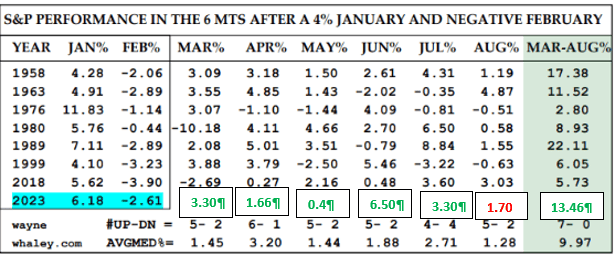
We reached the end of our test to see if history repeats itself. As we know, there have been seven instances where a January with a 4% or higher return was followed by a negative February. 2023 is now the eighth. For each one of these years, the following six months had an average gain of almost 10%. This year, the total return for those six months ended up being 13.46%. Still undefeated!
Take a look at the Outlook section below to see what events could move the markets over the short term.
Bond prices headed lower for a second straight month in August as fears grew that the Fed will continue to raise short-term interest rates higher before the end of the year. This came mostly from the speeches given by many of the Federal Reserve members at their annual Jackson Hole, WY retreat this past month. However, recent data coming out contradicts some of their statements and investors are betting that they will follow the data.
The 10-year US Treasury note yield moved higher again in August, closing the month at 4.09%. The 30-year bond yield did the same, closing the month at 4.21%. Although these yields have been increasing, they continue to remain below the yields of short-term treasuries. For example, the 6-month T-bill is currently yielding 5.51%, confirming a strong inversion of the yield curve and one of the best indicators of an impending recession. The good news is that the gap is narrowing and if the Fed holds off on raising short-term rates for a while, we could see the yield curve revert back to its normal shape and possibly avoid a damaging recession.
Bond buyers should continue to focus on bonds with short-term maturities. I would keep maturities under 18 months and just plan on holding these bonds to maturity. That way, you won’t have to worry about selling at a discount if interest rates head higher. If rates do start to drop, you can sell the bonds at a profit since their price will rise as their yield drops.
Savings rates are still drifting higher. Banks are trying to compete with treasury bonds and high-yield money market accounts for depositors’ cash. Brick and mortar banks are having a tough time trying to match the rates that the online-only banks are offering. This is causing some balance sheet pain for those smaller, regional banks that lent out mortgages in the 2-3% range a few years ago. They are losing money on those loans right now and could exacerbate their shrinking profit margins when they have to raise their depositors’ savings rates to help retain those customers. This is all good stuff for risk-averse investors and for our emergency reserves accounts. But do your research if you plan on investing in the smaller, regional banks.
Now, take a look at the top rates for CDs and money market accounts (MMA):
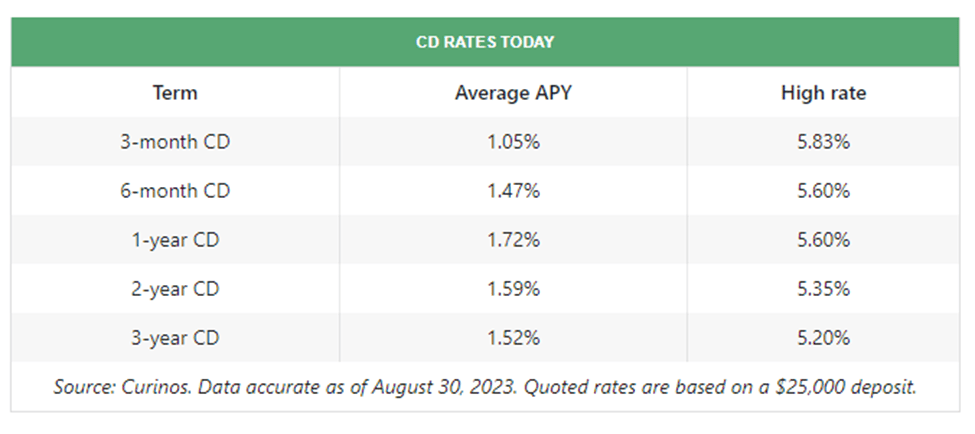
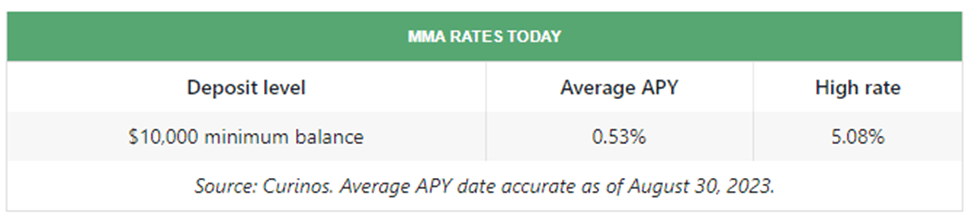
As you can see, the best 1-year CD interest rate is peaking at 5.60%. The 5-year CD rate (not shown above) high watermark right now is at 4.67%. These rates are still inverted, just like the yield curve, meaning they are paying a higher rate to borrow your money for a shorter time period, which isn’t normal. These yield inversions are lasting longer than normal and have a lot to do with the Federal Reserve continuing to hike short-term rates as well as recession fears keeping pressure on long-term rates. That said, if you’re looking for a place to park your savings or emergency spending money, just buy short-term CDs, 1 year or less, and reevaluate when they mature. If you’d rather have more liquidity, look into an MMA (yielding as high as 5.08% currently). Keep the total under $250,000 per person at any one bank to ensure you are fully covered by the FDIC. CDs and MMAs have become nice alternatives for risk-averse investors and have drawn money away from stocks because of their relatively high rates that carry virtually no risk.
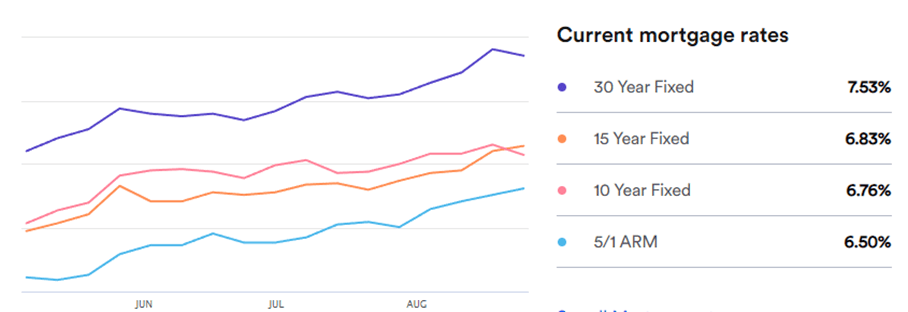
Mortgage rates continued climbing and remain at their highest levels in over twenty years. Currently, the 30-year rate sits at 7.53%, a bit higher than what it was a month ago, at 7.23%. Nobody with a 2-4% mortgage rate is moving that doesn’t have to move. If they are, they are going to be downsizing and paying cash. This bodes well for homebuilders because they are the only ones selling houses. Also, home building material prices have come down quite a bit, which will help both the builders and the home buyers. However, it is a tough market for existing home sales because of the lack of inventory and the lack of buyers, both due to very high mortgage rates.
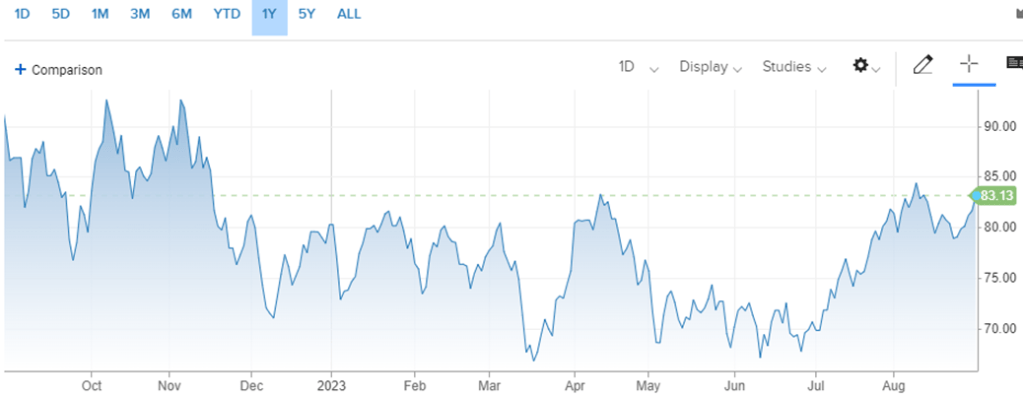
Oil prices headed higher once again in August, as demand and supply cuts take their toll. Also, there are signs of the Chinese economy bottoming out, which will put more upward pressure on prices. High oil prices are one of the sticky points of an otherwise shrinking inflation trend. For the month, the price for a barrel of oil settled around 83.06, up from $81.50 at the beginning of August. Prices have breached the upper limit of the goldilocks range of oil prices ($55 to $70 per barrel range), so we’ll see if that puts some pressure on consumption here in the U.S. as well as worldwide. As always, the best cure for high oil prices is high oil prices.
Here’s a look at the one-year chart for U.S. oil. Would love to see it head back below $70:
Gasoline prices moved slightly higher in August for the second month in a row. Lots of people traveling and OPEC continuing to close the spouts are the main factors keeping gas prices high. This is one of the stickier points of inflation right now, even as prices subside in other sectors of the economy. Regular unleaded gasoline is now averaging $3.83 per gallon, up $0.05 from last month. Mississippi has the cheapest gas for the fifth month in a row, at $3.31 a gallon. California has the most expensive gasoline at $5.30 per gallon. FYI, a year ago, we were paying $3.84.
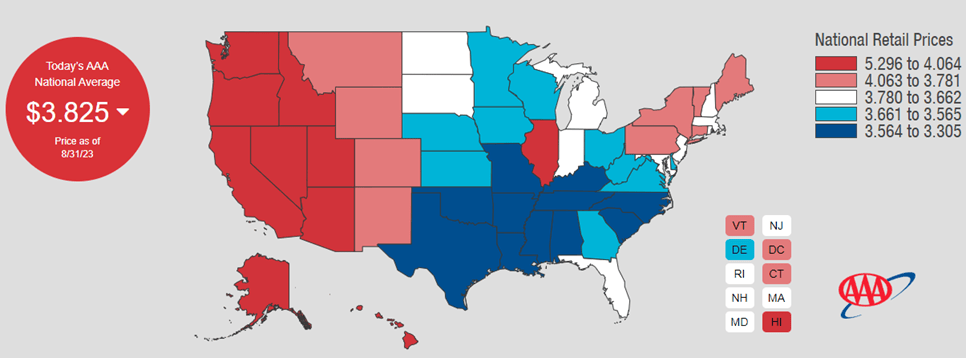
Check out the prices at the pump in your area: AAA Gas Prices.
Outlook
Events on the horizon that could move the markets in the near term:
- Fed & Inflation: Data continues to come in showing signs of inflation easing up. Also, there are certain areas of the economy that are slowing down as high interest rates established by the Fed are having their desired effect. Based on this information coming in recently, it appears that they will pause any rate hikes at their next meeting this month. This is a positive catalyst for stocks and bonds but could be baked in the cake already. We’ll just have to wait and see until after they meet on the twentieth of this month.
Joe Baker, CFP®
Baker Asset Management, LLC
joebaker@bakerassetmanagement.com


Go Bills!
LikeLike
Ha! Was just in Buffalo to see a pre-season game. Lived there for about 8 years and my son was born there so we are huge Bills’ fans!
LikeLike