
If you are fortunate enough to be a beneficiary of an IRA, there are some important things that you should know before doing anything with it. The options available to you will depend on several factors, including the type of account you inherited, when you inherited it, your relationship to the deceased, and at what age the death occurred. But one wrong decision could lead to expensive consequences, mainly due to how inherited IRAs are taxed. So, let’s get right into what you should know about inheriting an IRA.
First, let’s review the definition of an inherited IRA, which is sometimes referred to as a beneficiary IRA. It is an IRA opened when you inherit any type of IRA: Traditional, Roth, SEP-IRA, SIMPLE IRA, and even an inherited IRA.
Now, let’s classify what type of beneficiary that you can be:
Beneficiary classifications – These categories are a key determinant of what options are available to you when you inherit an IRA:
- Eligible designated beneficiaries (EDBs)
- Surviving spouse
- Disabled or chronically ill individual
- An individual that is not more than 10 years younger than the IRA owner
- Minor children
- Certain trusts
- Non-eligible designated beneficiaries (a.k.a. Designated Beneficiaries)
- An individual that doesn’t meet the requirements for an eligible designated beneficiary (e.g., an adult child)
- Certain trusts
- Non-designated beneficiaries
- Charities
- Estates
- Certain Trusts
Finally, let’s list the distribution options of the inherited IRA:
- Lump-sum method – The beneficiary withdraws the entire balance of the account at once. Depending on the original retirement account type, the withdrawal may be subject to income taxes. For Roth IRAs, a lump-sum withdrawal will be tax-free so long as the 5-year rule has been met. All beneficiaries have the option to use the lump-sum method of distribution.
- 5-year method – The beneficiary of an inherited IRA must distribute the entire balance of the account within five years of the death of the original owner.
- 10-year method – This option requires the beneficiary of an inherited IRA to distribute the entire balance of the account within 10 years of the death of the original owner. If the original account owner was subject to RMDs at their passing (i.e., over age 73), then the beneficiary would have to continue those RMDs in years 1-9 and then ensure the account balance is fully distributed by the end of year 10.
- Life expectancy method – The beneficiary of an inherited IRA must take RMDs each year. The life expectancy factor used to determine RMDs depends on your relationship with the original account owner and the age at death. This distribution method is an option for most IRA beneficiaries, but not all.
Are you confused yet? Hopefully, this flow chart can help you out a little bit:
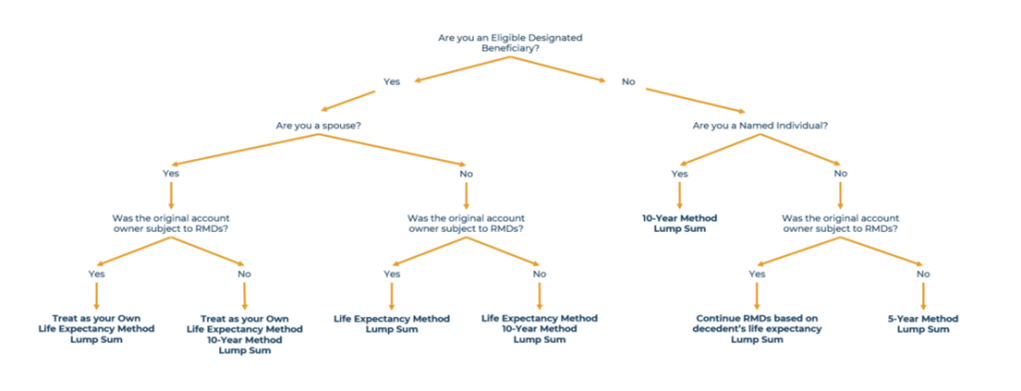
In the majority of cases, beneficiaries are either the spouse or the children of the owner of the IRA that they will inherit. For beneficiaries that are the spouse of the owner of the IRA that is inherited, the most popular option is to simply roll the inherited IRA into your own IRA. That way, you can treat it as your own and these complex rules go away. For adult children that are beneficiaries, you’ll most likely want to take the 10-year method to minimize the tax impact (except for Roth IRAs) each year. In the Roth case, if you don’t need the money, then you should just leave it in there and let it grow for 10 more years before withdrawing it all at once, all tax-free.
These rules are complex and should be discussed with your financial adviser and/or your accountant before taking any action if you inherit an IRA. As always, please let me know if you have any questions.
Joe Baker, CFP®
Baker Asset Management, LLC
joebaker@bakerassetmanagement.com

