

Fun Facts about October
- Birthstone: Opal and Tourmaline
- Flower: Marigold and Cosmos
- Zodiac signs: Libra and Scorpio
- October comes from the Latin word octo which means eight. In ancient Rome, October was the eighth month of the year. When the Gregorian calendar was adopted, it became the tenth month of the year, but it has retained its original name.
- October in the Northern Hemisphere is similar to April in the Southern Hemisphere.
- Monday, October 9th, is Columbus Day. Stock and bond markets are open.
- Tuesday, October 31st is Halloween!
Stocks stuck to their historical performance of negative returns in the month of September, marking their worst month of the year so far. The weight of more interest rate hikes and the possibility of a government shutdown was too much to bear this past month.
The S&P 500 dropped for the second month in a row, finishing down 4.9%. For the year, it is still up, but only about 13%. Historically, October has been pretty flat, averaging just a small positive gain of+0.60%.
With interest rates this high and the ongoing stock market volatility, investors don’t mind putting some of their cash into bonds or even CDs that are getting over 5% annualized interest. That’s pretty tough competition for stocks.
Q3 earnings will be coming out in earnest in the next few weeks. I am sure that we will be hearing company execs talking about the negative effects of high interest rates on their revenue, but their stock prices will move based on what they think will happen over the next six months or so. I am sure the Federal Reserve will be listening as well.
Take a look at the Outlook section below to see what events could move the markets over the short term.
Bond prices headed lower for a third straight month in September across the entire bond universe for the same reasons as stocks: higher interest rates and a possible government shutdown. Even with data pointing to inflation coming down, the Fed continues to push for higher rates by its members when they are out at speaking events.
The 10-year US Treasury note yield moved almost a half of a percentage point higher in September, closing the month at 4.58%. The 30-year bond yield rose the same amount as well, closing the month at 4.71%. Although these yields have been increasing, they continue to remain below the yields of short-term treasuries. For example, the 6-month T-bill is currently yielding 5.55%. The good news is that the gap is narrowing between long-term and short-term bond yields. If the Fed holds off on raising short-term rates for a while, we could see the yield curve revert back to its normal shape and possibly avoid a damaging recession.
Bond buyers should continue to focus on bonds with short-term maturities. I would keep maturities under 18 months and just plan on holding these bonds to maturity. That way, you won’t have to worry about selling at a discount if interest rates head higher. If rates do start to drop, you can sell the bonds at a profit since their price will rise as their yield drops.
Savings rates continue to head higher, which is great for our risk-averse investors out there and for anyone with cash in savings, money market, and CD accounts. These rates are a legitimate alternative to stocks and bonds and will keep pressure on those markets until we see this trend reverse.
Now, take a look at the top rates for CDs and money market accounts (MMA):
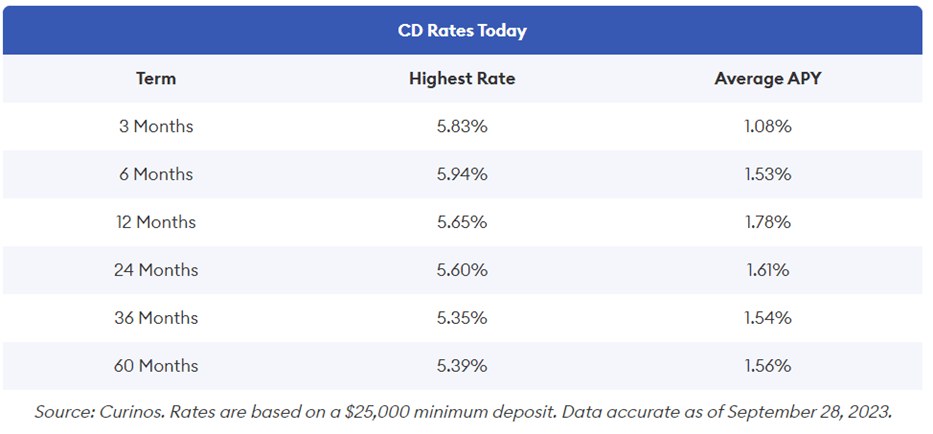
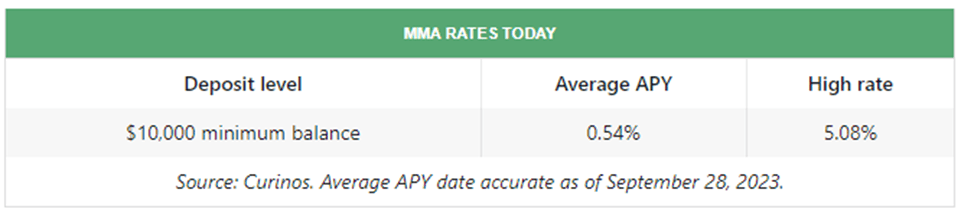
As you can see, the best 1-year CD interest rate is peaking at 5.65%. The best 5-year CD rate right now is at 5.39%. These rates are still inverted, but are narrowing their spread, which means that they are normalizing. We are getting closer to the point where buying longer-term maturity bonds and CDs will make sense but for now, I would still put my savings or emergency spending money into short-term CDs, 1 year or less, and reevaluate when they mature. If you’d rather have more liquidity, look into an MMA (yielding over 5% currently). Keep the total under $250,000 per person at any one bank to ensure you are fully covered by the FDIC. As I mentioned above, CDs and MMAs have become nice alternatives for risk-averse investors and have drawn money away from stocks because of their relatively high rates that carry virtually no risk.
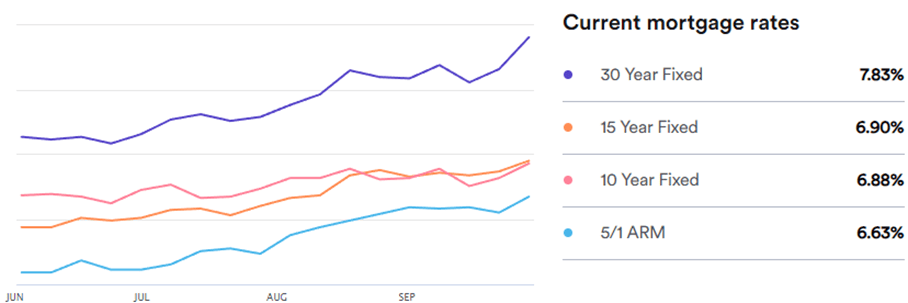
Mortgage rates are jumping higher again, hitting levels not seen since 2000. Currently, the 30-year rate sits at 7.83%, a bit higher than what it was a month ago, at 7.58%.
Not surprisingly, pending home sales for August dropped 7.1% from the month before, and were down 18.7% on a yearly basis, according to the National Association of Realtors. Every region in the country recorded a monthly and year-over-year drop. These elevated mortgage rates are keeping homeowners from selling and pricing out buyers as well. Fed, please take note.
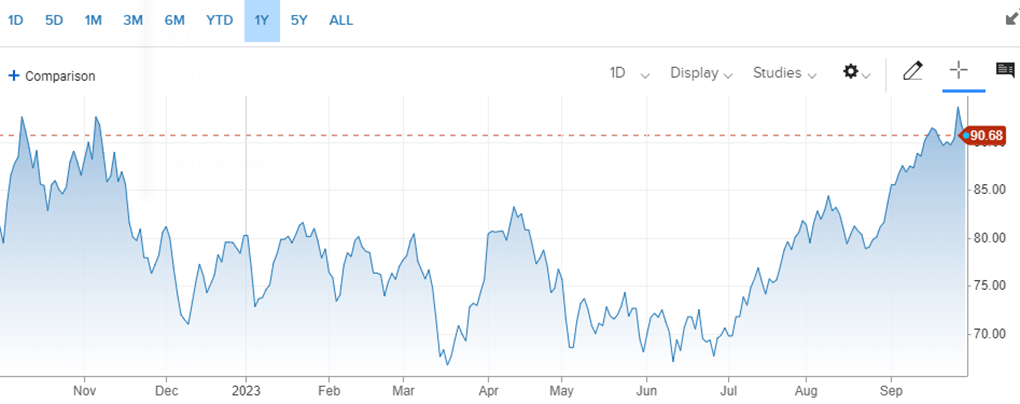
Oil prices continued to move higher in September, as supplies dry up here and globally. This is a bad sign for lowering inflation as it is a primary input cost for almost all goods and services. For the month, the price for a barrel of oil settled around $90.70, up from $83.06 at the beginning of September and about where they were a year ago. Prices are reaching a point that could cause some demand destruction, which would help turn prices lower. As always, the best cure for high oil prices is high oil prices.
Here’s a look at the one-year chart for U.S. oil. Would love to see it head back below $70:
Gasoline prices remained flat in September. I felt like gas prices never came down as much as oil prices did in the summer so it’s possible that this rise in oil prices was already factored into gas prices. Regardless, prices are high, and it is the one price that is constantly displayed and that consumers equate with inflation. Regular unleaded gasoline is now averaging $3.83 per gallon, same as last month. Mississippi is hanging in there with the cheapest gas for the sixth month in a row, at $3.25 a gallon. California has the most expensive gasoline at $6.08 per gallon. FYI, a year ago, we were paying $3.78.
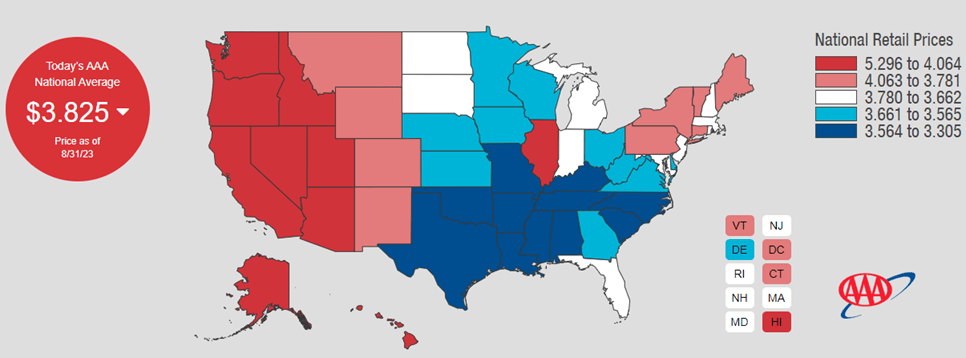
Check out the prices at the pump in your area: AAA Gas Prices.
Outlook
Events on the horizon that could move the markets in the near term:
- Fed & Inflation: There’s no doubt now that the Fed’s actions to curb inflation are working. It’s very expensive to borrow money right now. That leads to less buying by both businesses and individuals. Less demand then leads to lower prices. We are not there yet, especially when it comes to travel and leisure, but I am starting to see deals out there, indicating sellers trying to attract buyers. The Fed held off on raising rates at their last meeting in September but have mentioned that they plan on raising rates again this year. That pause had little effect on the markets as it was already priced in. Now, the markets are expecting another rate hike this year and the recent market declines indicate that this Fed action is already being priced in. A nice upside surprise for the markets would be if they did not raise rates again this year. Time to wait and see once more.
- Government shutdown: Congress is such a mess. It’s like two stubborn kids that won’t play nice. Anyway, if the government does shut down, as it has many times before, it typically does not have any real impact on the markets. Remember the last shutdown in 2018? Me either! The timing of this one, combined with a prolonged auto workers strike, could actually help do the work of the Federal Reserve, by slowing the economy, thereby reducing inflation. The problem is the data to show this may not be available because the government will be shut down. This may cause some near-term volatility in the markets but should be an overall positive catalyst for stocks and bonds.
Joe Baker, CFP®
Baker Asset Management, LLC
joebaker@bakerassetmanagement.com

