
From 2009 until halfway through 2022, if you wanted to get any kind of decent return on your money and keep it liquid, you had to invest in stocks, plain and simple. That’s because the Federal Reserve had dropped interest rates to zero to get our economy restarted after the worst financial crisis this country had experienced since the Great Depression. This meant that bonds, money market accounts, savings accounts and CDs were paying almost no interest during that period. So, investors looking for meaningful gains had to find them in the stock market. This strategy turned out working quite well but investors did have to take on much more risk than what they would have in a more normal interest-rate environment.
Well, times have changed. Since last year, interest rates have gone up considerably and are at a point now where we can invest in a variety of fixed income assets that carry very low risk but offer a meaningful rate of return. In fact, if you are apprehensive about the stock market currently, it would make sense to change your portfolio holdings to include some bonds and/or CDs, especially with the rates that are being offered currently.
With that said, take a look at some current yields in the fixed income markets:
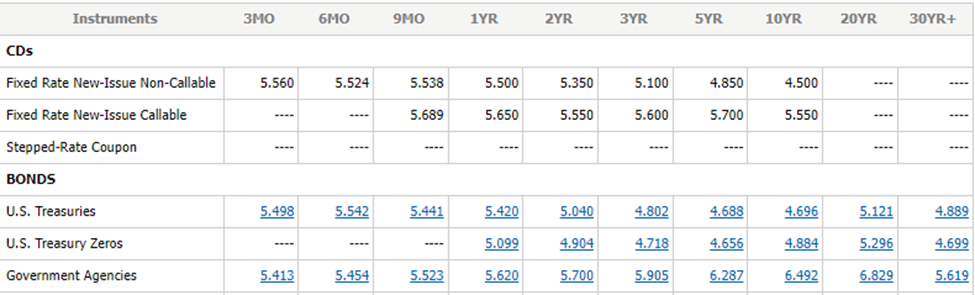
As you can see, most of the above assets that mature in under two years are paying at or near 5.5%. That is not bad for a near risk-free investment. Plus, you can now have a more balanced portfolio (mix of bonds and stocks) versus everything piled into the stock market. It’s also not a bad strategy to ladder your fixed income investments based on maturities. This means spread your fixed income allocation across CDs and bonds with different maturity dates so you can always have money liquid (available) in case you need it or for other investment opportunities. If you don’t, then you can just roll that money into more bonds/CDs with later maturities.
Everyone’s situation is different, so don’t look for a cookie cutter solution to your portfolio allocation. If you need to, work with an investment adviser to construct your portfolio to meet your financial goals.
Please comment or send an email if you have any questions.
Joe Baker, CFP®
Baker Asset Management, LLC
joebaker@bakerassetmanagement.com

