BAM Blog

How Stocks Fare Compared To Inflation

Depending on who you ask, inflation can be good or bad for the stock market. Both can be true, in my opinion. When we have prices going up, that usually means that the economy is expanding because the demand for products is increasing. This equates to higher earnings for companies which investors like, so they buy those companies’ stocks. However, if prices rise too fast, that spooks almost everybody, including the Federal Reserve. This could cause higher loan rates and higher wages, which could hurt companies’ expansion efforts and profit margins, respectively. This would, subsequently, put downward pressure on stock prices.

Currently, it seems like we are in this scenario of a rapid rise in prices. This is due to both a huge increase in demand as well as a lack of supply, both caused by the pandemic, hence the volatility in the stock market over the last few months.

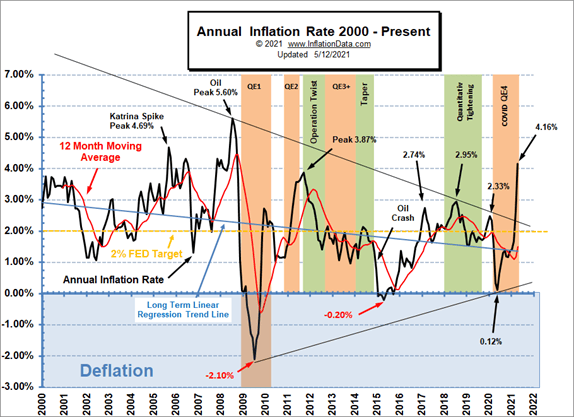
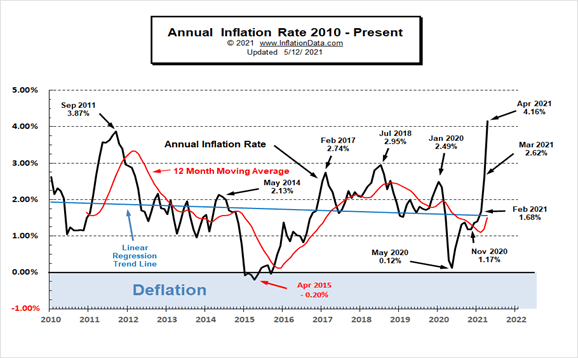
The chart above shows the annual inflation rate in the U.S. in the 21st century. This graph has a ton of information but is a little busy so here is a less-detailed version that only shows from 2010 to present day:

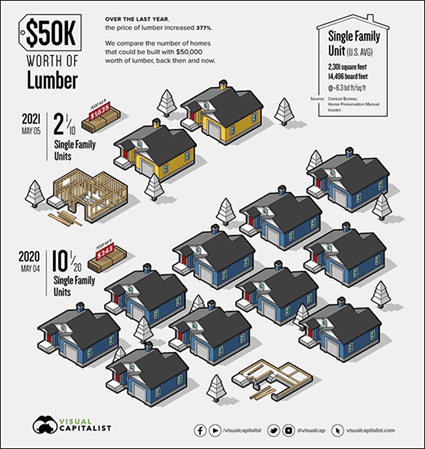
As you can see, investors and the Fed are worried about the vertical climb over on the right-hand side of the graph. The following illustration is a great example of the type of price increases that this graph represents:

So, last year in May, a builder could have bought $50k worth of lumber and built a little over 10 houses with it. This May, that $50k would only buy enough lumber to build just 2.1 houses!
I’m hoping this inflation curve will start to come down a little as our supply chain gets back up to speed to catch up with the strong demand that we are seeing as everything gets back to normal.
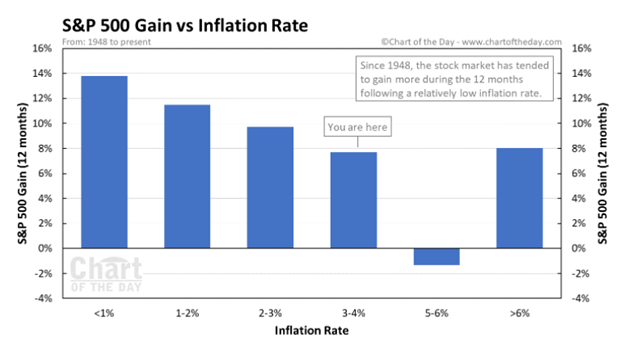
Regardless, inflation is always going to be around and the whole point of this blog is to show how stock prices correlate with inflation. I found this graph to be the simplest way to show that relationship:

This graph shows how the S&P 500 index performed following various inflation rates. For the most part, stocks did well when inflation was very low. Even when inflation rates were up above 4%, the following 12 months weren’t that bad for stocks. Keep this in mind when listening to the financial news.

Interesting factoids:

  • The lowest U.S. inflation rate since 1948 occurred in August 1949 and clocked in at a -3.0%.
  • The highest U.S. inflation rate since 1948 occurred in March and April of 1980 with a rate of 14.6%.

Let me know if you have any questions.

Joe Baker, CFP®

Baker Asset Management, LLC

joebaker@bakerassetmanagement.com

Back To Normal For Retirement Plan Withdrawals

The CARES Act of 2020 allowed retirement plan participants and IRA owners to withdraw from their accounts much more than was normally permitted. It also allowed the taxes owed on those withdrawals to be spread over 3 years and waived the 10% penalty if they were under age 59 ½. Finally, it waived the required minimum distributions for those over the age of 72. Well, all good things must come to an end.

Those withdrawal rules have now reverted back to pre-covid times. Here’s the deal:

  • Any withdrawals that you take from your IRA, or a retirement plan if the plan allows it, are added to your income for that year.
  • If you’re under age 59 ½ when you take the withdrawal, you will be hit with a 10% tax penalty on top of the normal income taxes due.
  • Required minimum distributions (RMDs) must be taken from your IRA or a company-sponsored retirement plan once you turn age 72.
  • RMDs are not required to be taken from a retirement plan if you are still working where the plan is, even past the age of 72, unless you are an owner of the company.

Because there are so many exceptions and caveats to these rules, it is best to consult with a tax expert before taking any action. Let me know if you have any questions!

Joe Baker, CFP®

Baker Asset Management, LLC

joebaker@bakerassetmanagement.com

Monthly Update – May 2021

Fun Facts about May

  • Birthstone: Emerald
  • Flower: Lily of the Valley
  • Zodiac signs: Taurus and Gemini
  • The month of May was named for the Greek goddess Maia. She was the goddess of fertility.
  • It is the third and last month of the season of spring.
  • May in the Northern Hemisphere is similar to November in the Southern Hemisphere.
  • The Indianapolis 500 car race is held each year during this month.
  • The Kentucky Derby, the world’s most famous horse race, is held on the first Saturday of May.

Stocks moved higher for the third month in a row. The S&P 500 rose over 5% in April and is now up nearly 12% for the year. Fears of inflation have caused the biggest ripples in the market’s upward moving wave, but those fears have been assuaged by the Federal Reserve sticking to their guns to keep easy money flowing to continue the economic recovery from the pandemic.

Earnings for the country’s biggest corporations were fantastic in the first quarter of 2021 compared to the same time period a year ago. That shouldn’t have been too surprising since the pandemic had shut everything down last year at that time.

Expectations for companies to continue to do well as we try and put the pandemic behind us are being set pretty high and are already being reflected in their stock prices. Sometimes this sets the markets up for a little let down so don’t be surprised if we have a pause in the market’s upward momentum in the short term.

Having said that, we have some nice positive forces acting on certain sectors of the economy that should minimize any pullbacks that we might have. For instance, the pent-up demand for travel and spending on vacations is going to go ballistic this year (restaurants, hotels, airlines, etc.). Also, the influx of funds from the government on infrastructure spending will be a boon for the markets as well (tech, materials, heavy machinery, etc.).

Take a look at the Outlook section below to see what events could move the markets over the short term.

Bond prices reversed course and headed higher as worries of inflation eased, stopping a 4-month trend of lower bond prices. I don’t think this move will last much longer as the economy continues to heat up with everything reopening. We should see bond prices return to heading lower gradually over the rest of the year. Because of this, longer maturity bonds are not going to be the best investment right now. I would still try and keep your bond maturities short, no more than 2 years, to lower your portfolio risk.

The 10-year US Treasury note is now yielding 1.63% and the 30-year bond is at 2.30%, both lower from last month. These rates have taken a pause in going up but it’s a good bet that they’ll resume their upward trajectory shortly. Still, the best option for investment income is high-quality stocks that pay dividends.

Interest rates took a breather from floating higher and most ended lower for the month of April. As I said above regarding bond prices, I don’t expect this trend to hold, and we should see rates rise over the course of the rest of the year.

On the savings side, most rates remained flat to slightly lower.

Currently, the average savings account is paying 0.27%, slightly lower than last month. This rate is still incredibly low and certainly not the best place to park all of your money.

The 1-year CD interest rate is now averaging 0.50%, the same as last month. The 5-year CD rate is the same as last month as well, currently at 0.69%.

Mortgage rates paused their inevitable move higher by slightly dipping in April. Rates continue to remain incredibly low, which is great news for home buyers, real estate investors and refinancers. Currently, the 30-year rate is at 3.11%, lower than it was last month (3.25%). Demand remains very strong for both new and existing homes. Material prices to build new homes are skyrocketing as demand increases with Covid in retreat. Existing homes for sale are being bought sight unseen and with multiple bids in many areas of the country. Mortgage rates are not the problem when we see home sales drop.

Oil prices jumped 7.5% in April after a short pause in March. The price for a barrel of oil in the U.S. closed April at $63.58. The combination of upbeat economic data and good earnings from the oil companies helped spur the move up.

Demand should continue to pick up as travel increases and the economy recovers from the pandemic shutdown. This will keep a floor under oil and gas prices until we get back to normal.

Gasoline prices moved higher once again in April. Prices at the pump are averaging about $2.90 per gallon, about 3 cents higher than a month ago. Mississippi has a wicked streak going with the cheapest fuel once again, at $2.57. California, which will never win the cheapest fuel award, has broached the $4 a gallon ($4.02) mark. FYI, a year ago, we were paying $1.77.

Check out the prices at the pump in your area: Gas Buddy.

Outlook

Events on the horizon that could move the markets in the near term:

  • Infrastructure Bill: Negotiations are continuing, and everyone is hoping for a compromise before Congress goes on recess in August for a month. This is a big bill and it’s going to take a while to hammer out the details that everyone can agree on so it can be signed into law. The market is already pricing in some of bill’s proposals to make it to the president’s desk by late summer. It should be a net positive for the stock market.
  • Coronavirus: News of the pandemic has fallen off the front page, which is good news because that means we are getting back to normal. Over 43% of the country has received at least one dose, up from 28% one month ago. But we are seeing a slowdown in the vaccination rate even though there are plenty of shots available in most of the country. There is still a small percentage that aren’t getting their second shot to complete their vaccination and there is a bigger percentage that are just against it for whatever reasons. Regardless, we are much closer to getting back to normal every day and people are ready to get out and enjoy life, which is always good for the economy and the markets.

Joe Baker, CFP®

Baker Asset Management, LLC

joebaker@bakerassetmanagement.com

Covid Update

In this post, I wanted to take a look at where we are on the road to recovery from the pandemic here in the U.S.

Here’s some notable data points related to covid-19:

  • Over 25% of the US population has been fully vaccinated.
  • Nearly 40% has received at least one dose.
  • Unfortunately, we are still averaging about 670 deaths per day, but that number is getting smaller and is much improved from the 3,000+ deaths we were experiencing on a daily basis at the beginning of this year.
  • All adults across the country are now eligible for the vaccine.

As a result of our progress in getting people vaccinated, local and state governments have begun easing restrictions on travel, gatherings, and businesses, particularly in the food/beverage and travel/entertainment industries. And it seems like everyone is taking advantage of this return to normalcy. It is very hard to get a parking spot to go to the beach near me or to get a reservation at a restaurant or a hotel in the Charleston area. Also, on a recent trip I made to Arizona, the planes were packed to capacity and I was hearing the oversold announcements for flights once again!

This increased activity has had some negative consequences for the consumer: higher prices, particularly for gas, air travel, and hotels. But I don’t think anyone is complaining right now after this last year in isolation.

Most businesses are implementing a plan to transition back to working in the office, at least for some personnel. Schools are planning to return to normal, in-person classes in the fall. Sports and entertainment venues are planning on full spectator attendance as well. Case in point: I am going to see a bunch of 80’s hair bands in Nashville this summer in a packed Tennessee Titans’ stadium in Nashville. However, you may need to be vaccinated to attend. For example, the Buffalo Bills and Buffalo Sabres are allowing full attendance this fall but you will have to show proof of vaccination to get in.

The rest of this year will be very interesting as we try to return to somewhat normal lives and routines. But the progress that we’ve made so far is very promising.

Let me know if you have any questions!

Joe Baker, CFP®

Baker Asset Management, LLC

joebaker@bakerassetmanagement.com

1 Easy Way To Reduce Your 2020 Taxes

2020 is in the history books now (thank you!) but there is still a quick and easy way to reduce your taxable income for last year:

Make a tax-deductible contribution to your IRA.

If you qualify, an IRA contribution can be a great way to reduce your 2020 taxes. You are allowed to contribute up to $6,000, or even more if you are an old-timer like me: $7,000 for people age 50 and over.

Plus, if you are married, you can double up the amount with a spousal IRA. So, say that you are married and over age 50, you can contribute $14,000 to your IRAs. This would save you $3,500 in federal taxes if you were in the 25% tax bracket. Not too shabby.

If you are not covered by a retirement plan at work, you can deduct the full amount of your contribution, regardless of how much money you make.

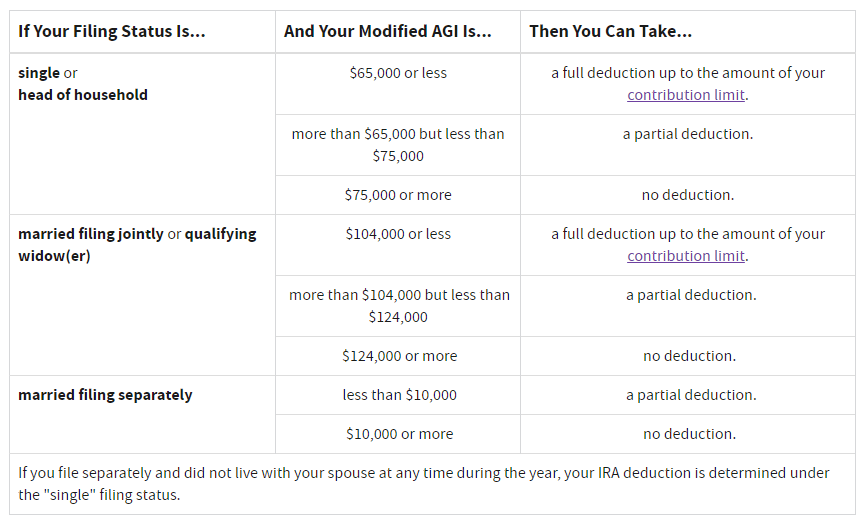
If you do have a retirement plan at work, there are restrictions and limitations to qualify for the full deduction.  Here’s a table that summarizes these rules. They are confusing so feel free to shoot me an email with any questions.

2020 Traditional IRA deduction limits

If you’re self-employed, you can sock away a lot more by opening up a Simplified Employee Pension (SEP) plan before filing your taxes.  For 2020, you can contribute up to $57,000, depending on your income.

Finally, you have until May 17, 2021 to fund your IRA for 2020 since the IRA extended the 2020 tax filing deadline.

Let me know if you have any questions!

Joe Baker, CFP®

Baker Asset Management, LLC

joebaker@bakerassetmanagement.com

Monthly Update – April 2021

Fun Facts about April

  • Birthstone: Diamond
  • Flower: Daisy and the sweet pea
  • Zodiac signs: Aries and Taurus
  • April 1 is All Fools’ Day—otherwise known as “April Fools’ Day.”
  • In the Southern Hemisphere, April is the same as October in the Northern Hemisphere.
  • The Boston Marathon is held during April.
  • In Ancient Rome the month of April was sacred to the goddess Venus.
  • In England, there are many cuckoo festivals. The arrival of the cuckoo bird in April is a signal that spring has arrived.

Stocks continued their climb for the second month in a row. The S&P 500 rose over 4% in March and is now up 5.8% for the year, not too shabby. With that said, there are signs of a changing of the guard in the stock market leaders. The big tech companies that benefited from the stay-at-home rules of the pandemic are now not so hot and are giving way to the downtrodden air travel, leisure, and entertainment sectors. In fact, many of the stock prices of companies in these industries have already factored in a fully open economy so be careful if you are looking to invest in one of these areas.

The markets have been getting pushed and pulled, most recently, by rapidly changing interest rates, good and bad news on the pandemic front, and favorable reports of the economy getting back on track.

Regarding the pandemic, in last month’s update, I said that we were close to 2 million doses per day. We are now at 3 million per day. We’re also seeing an increase in the number of new cases as well, due to more contagious variants as well as reduced restrictions by states and local municipalities. But overall, there is light at the end of the tunnel. Thanks again to everyone from the researchers to the needle makers to the frontline workers stabbing us!

There is another big market catalyst coming in the form of a monster infrastructure bill that the White House is laying out this week. I’ll touch on this and the other market forces mentioned above in more detail below.

Take a look at the Outlook section below to see what events could move the markets over the short term.

Bond prices dropped across the board once again as worries of inflation increased among investors. This was expected and may continue for a while as the world starts to reopen. March was the fourth month in a row for falling prices. Not a good sign for holders of bonds with long maturities. If you are a bond buyer and this trend continues, try and keep your bond maturities short, no more than 2 years, to reign in some of the risk in your portfolio.

The 10-year US Treasury note is now yielding 1.72% and the 30-year bond is at 2.42%, both much higher from last month. These rates rising could become a problem if the 10 year gets close to 3% and/or the 30 year gets near 5%. For now, the best option is still high-quality stocks that pay dividends. These rates should be monitored closely if you’re concerned about a market selloff in stocks (who isn’t?).

Interest rates, as expected, rose once again as the goal of reaching herd immunity becomes more realistic. Rates are still very low, but they seemed to have bottomed out and are marching onward and upward.

On the savings side, most rates moved slightly down even though bond rates went sharply higher.

Currently, the average savings account is paying 0.29%, slightly higher than last month. This rate is still incredibly low and not the best place to park all of your money.

The 1-year CD interest rate is now averaging 0.49%, lower than the 0.52% it was yielding a month ago. The 5-year CD rate is lower as well, currently at 0.68%.

Mortgage rates moved higher once again in March, but still continue to remain incredibly low, which is great news for home buyers, real estate investors and refinancers. Currently, the 30-year rate is at 3.25%, a bit higher than it was last month (3.14%). Demand remains very strong for homes as inventories continue to diminish. Material prices to build new homes are much higher than this time last year. For instance, lumber prices are 234% higher than last April and copper prices have almost doubled in the same time period. It is still a seller’s market in the housing sector as these low rates, high material costs, and low inventory are keeping housing prices high.

Oil prices simmered down a little in March after a big runup to start the year off. The price for a barrel of oil in the U.S. dropped about 2% to $60.44. This broke a 4-month string of higher prices. I’m surprised prices didn’t keep moving up, especially after that big ship tried to pull a U-turn in the middle of the Suez Canal.

Demand should continue to pick up as travel increases and the economy recovers from the pandemic shutdown. This will put a floor under oil and gas prices until we get back to normal.

Gasoline prices moved higher once again in March. Prices at the pump are averaging about $2.87 per gallon, about 15 cents higher than a month ago. Mississippi has the cheapest fuel again, at $2.59. California, which will never win the cheapest fuel award, is approaching $4 a gallon ($3.90). FYI, a year ago, we were paying $2.00.

Check out the prices at the pump in your area: Gas Buddy.

Outlook

Events on the horizon that could move the markets in the near term:

  • Infrastructure Bill: The Covid relief was put into law and the stimulus checks have been hitting bank accounts for the past few weeks. Now Biden and his team are going to try and sell a huge infrastructure plan to the American people and Congress. I’ll talk about this more over the next month since the final version will most likely be very different than what is currently being proposed. Regardless, this will be a net positive for stocks.
  • Coronavirus: We continue to corral this virus with shots in the arm coming in at 3 million per day now. Over 28% of the country has received at least one dose. Good stuff. Also, a majority of states are now allowing any adult to get the vaccine. However, there is still a lack of supply in many regions. I know here in Charleston, SC, it is still pretty tough to get an appointment. The good news is that there are more and more vaccine shipments everyday so the supply issue could be resolved sooner than later. I’m ready to remove this event off of the Outlook section.

Joe Baker, CFP®

Baker Asset Management, LLC

joebaker@bakerassetmanagement.com

Are Social Security Benefits Taxable?

This question pops up quite a bit when discussing retirement with friends and/or clients. The short answer is yes, social security benefits are taxable. Of course, when dealing with the U.S. Tax Code, trying to figure out how much that you have to pay is complicated, to say the least.

To start, the IRS uses your combined income to determine taxes on your social security benefits. Your combined income is your adjusted gross income + nontaxable interest + half of your social security benefits. If you have no other income except from social security, then you won’t have to pay any federal taxes. For everyone else, here’s how to know if your social security benefits are taxable:

  • For individuals:
    • If you have a combined income between $25,000 and $34,000, you are taxed on 50% of your social security benefit.
    • If your combined income exceeds $34,000, 85% of your social security benefit could be taxable.
  • For married couples:
    • Married couples are taxed on 50% of their social security benefits if their combined income is between $32,000 and $44,000.
    • Up to 85% of social security benefits is taxable for married couples with a combined income that exceeds $44,000.

As you can see from above, the threshold is very low before you’ll be paying taxes on your benefits. On the state level, only 13 states tax social security benefits: Colorado, Connecticut, Kansas, Minnesota, Missouri, Montana, Nebraska, New Mexico, North Dakota, Rhode Island, Utah, Vermont, and West Virginia. By the way, WV is off this list in 2022.

Please let me know if you have any questions.

Joe Baker, CFP®

Baker Asset Management, LLC

joebaker@bakerassetmanagement.com
One Year Ago – A Look Back

Note: Last March, I sent this out to all of the participants in the 401k plans that I advise on. We were just realizing how bad the pandemic was and would be. I think the following is still relevant and applicable to most crises that cause markets to plummet. Hopefully, everyone stuck to their plan and continued to invest through these past, very tumultuous, twelve months.

Technically, this isn’t a tip or trick for how to use the 401k website, but it could be the most important tip that I’ll ever give you about saving for your retirement.

We all know how far and how fast the stock market has dropped over the past month.  The amount of the drop is as deep, or in some industries, worse than what happened in the tech wreck of 2000 and the Great Recession in 2008.  The speed of the drop surpassed anything that I have seen in my 23 years as an investment adviser.  Remember, we were just at all-time highs only 1 month ago!

Will we recover like we did in the past? Yes, we will.  It may take longer, as this is something that we haven’t dealt with since 1918 (Spanish Flu), but we will make it.

If you believe this, then you should be confident in continuing to invest in your future by keeping your contributions flowing into your 401k account.  As 401k participants, you are adding to your account every paycheck. So, during times like these when the market has gone way down, you are buying a lot more shares of the same investment than you were just a few weeks ago.  This is Investing 101: Buying Low.  Prices of the main stock indexes are at the same value as they were in 2017, so if you wished that you had started investing sooner, consider this a mulligan!

I have been fielding a lot of calls, emails, and texts about whether or not to put everything in the money market fund or stop contributions.  I know everyone’s situation is different but you can use the following as a general guide if you haven’t gotten in touch with me yet:

Anyone that will not need the money in their 401k account for at least 2 years, should continue to invest in a properly diversified portfolio (mix of different stocks, bonds, etc.) based on their risk tolerance and their time horizon. Even if you plan on retiring in a few years but don’t plan on needing all of your money in the account, just put the amount that you think you’ll need for the next few years in the money market fund.  With interest rates as low as they are and will likely stay that way for a while, having some of your investments in stocks that have the chance to grow at a greater rate than inflation is a prudent move. Finally, a picture is worth a thousand words:

Please let me know if you have any questions.

Joe Baker, CFP®

Baker Asset Management, LLC

joebaker@bakerassetmanagement.com
Why The Stock Market Isn’t The Same As The Economy

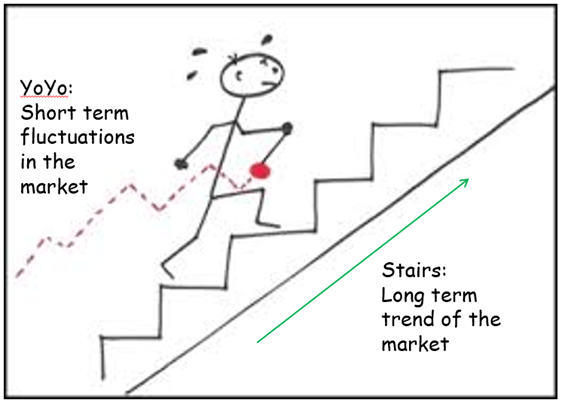
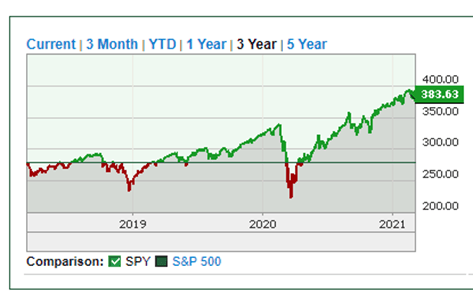
Looking at the 3-year chart, above, of the S&P 500 exchange-traded fund (SPY), you can see when the covid pandemic hit the stock market in early 2020. Since then, it has stair-stepped its way onward and upward to reach all-time highs. In contrast, when looking at several economic indicators during the same timeframe, such as GDP, wages, and employment, you would think that the stock market would not be doing nearly as well. How can so many stocks be doing so well when so many people are out of work and so many businesses have been shut down or their operations severely curtailed?

There are as many reasons out there as there are economists to explain this dichotomy, but I think understanding what the stock market is can be the simplest explanation. The stock market is forward-looking, meaning today’s value is based on what investors believe their stock prices will do in the future. This is why a company’s stock will go up even when they have never made a penny of profit. For the current pandemic situation, industries such as the airlines, cruise ships, and hotels have been particularly hit hard. Yet, many of these companies have seen their stock prices rise to pre-covid levels even as they teeter on the brink of bankruptcy. I think the following chart illustrates why the stock market isn’t the same as the economy.

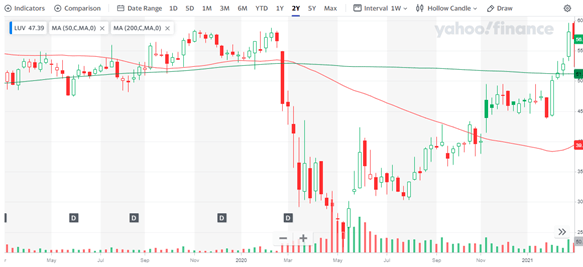
This is a chart of the stock price of Southwest Airlines (LUV) over the last 2 years. Even though the airline industry has been one of the hardest hit sectors of our economy due to covid, LUV’s stock price is about where it was before covid. This is because investors believe that people will start flying again in the near future. They don’t care that they are losing money hand over fist and are still taking government stimulus money to survive. By the way, my last flight on Southwest a few weeks ago had every seat filled.

In summary, the stock market is a measure of what investors believe the economy will be doing in the future. The economy is what is happening right now and much of the time these two are not in sync with each other. That detachment can linger for a lot longer than seems possible.

Please let me know if you have any questions.

Joe Baker, CFP®

Baker Asset Management, LLC

joebaker@bakerassetmanagement.com
Monthly Update – March 2021

Fun Facts about March

  • Birthstone: aquamarine and bloodstone
  • Flower: daffodil
  • Zodiac signs: Pisces and Aries
  • The name March comes from the Roman god of war, Mars. For many years, March, being the start of spring, was also the start of the New Year.
  • March 8 is International Women’s Day, which is a day that not only celebrates the achievements of women and the progress made toward women’s rights, but also brings attention to ongoing struggles for equality around the world.
  • March 14 is the start of Daylight-Saving Time, which begins at 2:00 A.M. that day. If your area observes it, don’t forget to “spring forward” and set the clocks one hour ahead, or you may find yourself an hour late to everything!
  • March 17 is St. Patrick’s Day. According to folklore, folks wear a shamrock on St. Patrick’s Day because the saint used its three leaves to explain the Trinity.
  • March 20 brings about the March equinox—also called the vernal or spring equinox in the Northern Hemisphere—marking the beginning of spring. In the Southern Hemisphere, this date marks the autumnal equinox and the beginning of fall. On this day, the Sun stands directly over Earth’s equator.
  • March 27 is the start of Passover, which begins at sundown on this day.

Stocks managed to muster a little comeback after starting off the year in the red. The S&P 500 rose almost 3% in February and is now positive for the year by 2.2%.

All sorts of good news is coming out with our battle against covid. We’re getting close to almost 2 million doses per day which should get us to herd immunity by October. But with vaccine production ramping up, we could see herd immunity sooner than that. I’m thinking around July (fingers crossed). There is definitely optimism in the air. Cruise bookings are jumping as well as air travel. I recently flew down to Florida and all 4 planes that I flew on had every seat filled.

Regarding the pandemic, we’re obviously not out of the woods by any means, but there is plenty of good data coming out that indicates we are much closer to getting back to some sort of normal.

Take a look at the Outlook section below to see what events could move the markets over the short term.

Bond prices continue to drop as the world starts to reopen. February was the third month in a row for falling prices. This trend should continue as our economy gets back to a more normal mode. Not a good sign for holders of bonds with long maturities. If you are a bond buyer and this trend continues, try and keep your bond maturities short, no more than 2 years, to reign in some of the risk in your portfolio.

The 10-year US Treasury note is yielding 1.46% and the 30-year bond is at 2.18%, both much higher from last month. It’s starting to get interesting because rates may keep rising to a point that bonds will look as attractive as stocks. This could cause a stock market selloff, so it is something to monitor closely.

Interest rates rose once again as the goal of reaching herd immunity becomes more realistic. Rates are still very low, but they seemed to have bottomed out and are marching onward and upward.

On the savings side, most rates moved slightly down even though bond rates went sharply higher.

Currently, the average savings account is paying 0.26%, slightly lower than last month. Although it is safe, it’s not the place to put all of your retirement savings, that’s for sure.

The 1-year CD interest rate is now averaging 0.52%, about the same it was yielding a month ago. The 5-year CD rate is flat as well, still at 0.69%.

Mortgage rates rose smartly, but still continue to remain incredibly low, which is great news for home buyers, real estate investors and refinancers. Currently, the 30-year rate is at 3.14%, notably higher than the 2.86% it was charging last month. Demand remains very strong for homes as inventories continue to diminish. It is definitely a seller’s market in the housing sector as these low rates are enticing first time homebuyers as well as city workers moving out to the burbs in response to work-at-home options.

Oil prices really shot up in February in response to the increased demand as the world starts moving around again. This was the fourth month in a row of higher prices, with prices jumping 18% in February.

Travel is continuing to pick up, especially by air, and as more vaccines get into people’s arms, the more confident people will be to travel, which should boost prices even more.

Gasoline prices moved higher in February, as expected. Prices at the pump are averaging about $2.72 per gallon, about 30 cents higher than a month ago. Mississippi has the cheapest fuel again, at $2.38. FYI, a year ago, we were paying $2.46.

Check out the prices at the pump in your area: Gas Buddy.

Outlook

Events on the horizon that could move the markets in the near term:

  • More Stimulus: Still waiting. The bill has passed in the House of Representatives and now goes to the Senate with the hopes of becoming law by mid-March. I feel like this is pretty much baked into the cake already, at least the stimulus payments anyway. If it fails to pass or passes with reduced stimulus payments, we could see a short-term selloff in the markets.
  • Coronavirus: We’re making incredible progress on the vaccination front. Another vaccine has been approved (Johnson & Johnson) and this one requires only 1 shot. We are up to 1.74 million doses per day and a total of 75.2 million doses have been given so far. This puts us close to 10% of the population being vaccinated. Herd immunity is expected to be reached in early fall. I believe it could be earlier once we get this third vaccine in the pipeline. Really good news all around. Let’s keep it going.
  • Trade Wars/Tariffs: Right now, it looks like Biden is putting this on the back burner. I have to disagree. These tariffs are putting a hurting on our economy. A recent study shows that the tariffs have cost the U.S. 245,000 jobs since they were implemented. Tariffs might have worked 150 years ago but in today’s global economy, they benefit neither party. Get rid of them and stop the bleeding. This will be a nice boost for the markets if we get rid of them.

Joe Baker, CFP®

Baker Asset Management, LLC

joebaker@bakerassetmanagement.com