
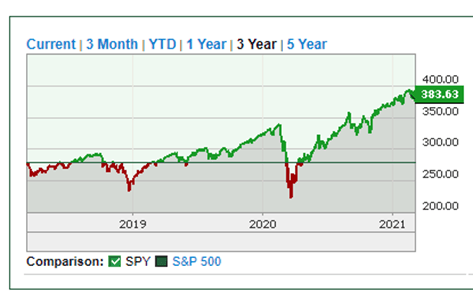
Looking at the 3-year chart, above, of the S&P 500 exchange-traded fund (SPY), you can see when the covid pandemic hit the stock market in early 2020. Since then, it has stair-stepped its way onward and upward to reach all-time highs. In contrast, when looking at several economic indicators during the same timeframe, such as GDP, wages, and employment, you would think that the stock market would not be doing nearly as well. How can so many stocks be doing so well when so many people are out of work and so many businesses have been shut down or their operations severely curtailed?
There are as many reasons out there as there are economists to explain this dichotomy, but I think understanding what the stock market is can be the simplest explanation. The stock market is forward-looking, meaning today’s value is based on what investors believe their stock prices will do in the future. This is why a company’s stock will go up even when they have never made a penny of profit. For the current pandemic situation, industries such as the airlines, cruise ships, and hotels have been particularly hit hard. Yet, many of these companies have seen their stock prices rise to pre-covid levels even as they teeter on the brink of bankruptcy. I think the following chart illustrates why the stock market isn’t the same as the economy.
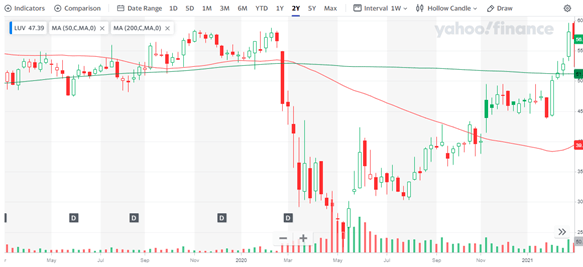
This is a chart of the stock price of Southwest Airlines (LUV) over the last 2 years. Even though the airline industry has been one of the hardest hit sectors of our economy due to covid, LUV’s stock price is about where it was before covid. This is because investors believe that people will start flying again in the near future. They don’t care that they are losing money hand over fist and are still taking government stimulus money to survive. By the way, my last flight on Southwest a few weeks ago had every seat filled.
In summary, the stock market is a measure of what investors believe the economy will be doing in the future. The economy is what is happening right now and much of the time these two are not in sync with each other. That detachment can linger for a lot longer than seems possible.
Please let me know if you have any questions.
Joe Baker, CFP®
Baker Asset Management, LLC
joebaker@bakerassetmanagement.com

