
Depending on who you ask, inflation can be good or bad for the stock market. Both can be true, in my opinion. When we have prices going up, that usually means that the economy is expanding because the demand for products is increasing. This equates to higher earnings for companies which investors like, so they buy those companies’ stocks. However, if prices rise too fast, that spooks almost everybody, including the Federal Reserve. This could cause higher loan rates and higher wages, which could hurt companies’ expansion efforts and profit margins, respectively. This would, subsequently, put downward pressure on stock prices.
Currently, it seems like we are in this scenario of a rapid rise in prices. This is due to both a huge increase in demand as well as a lack of supply, both caused by the pandemic, hence the volatility in the stock market over the last few months.
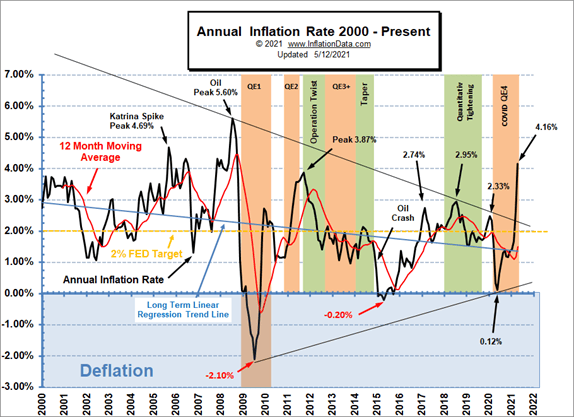
The chart above shows the annual inflation rate in the U.S. in the 21st century. This graph has a ton of information but is a little busy so here is a less-detailed version that only shows from 2010 to present day:
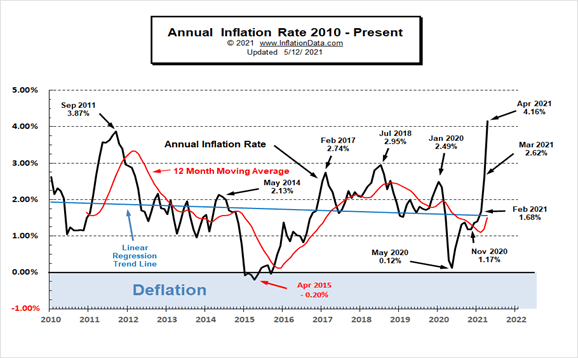
As you can see, investors and the Fed are worried about the vertical climb over on the right-hand side of the graph. The following illustration is a great example of the type of price increases that this graph represents:
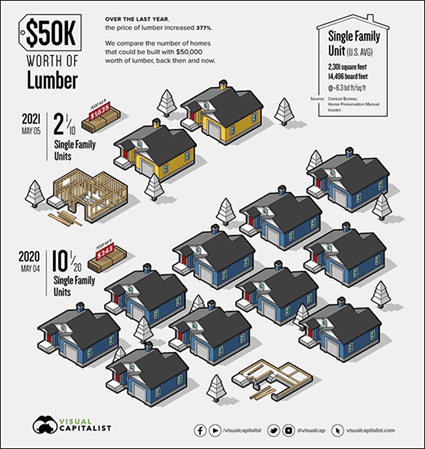
So, last year in May, a builder could have bought $50k worth of lumber and built a little over 10 houses with it. This May, that $50k would only buy enough lumber to build just 2.1 houses!
I’m hoping this inflation curve will start to come down a little as our supply chain gets back up to speed to catch up with the strong demand that we are seeing as everything gets back to normal.
Regardless, inflation is always going to be around and the whole point of this blog is to show how stock prices correlate with inflation. I found this graph to be the simplest way to show that relationship:
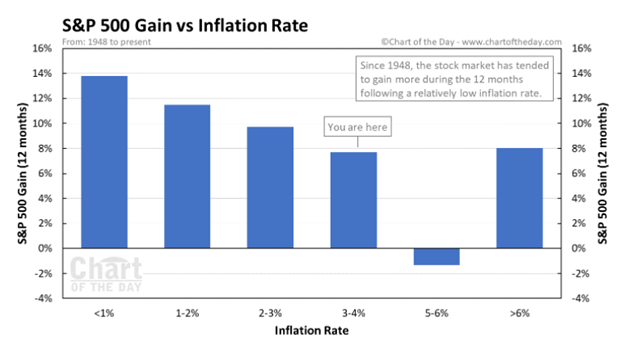
This graph shows how the S&P 500 index performed following various inflation rates. For the most part, stocks did well when inflation was very low. Even when inflation rates were up above 4%, the following 12 months weren’t that bad for stocks. Keep this in mind when listening to the financial news.
Interesting factoids:
- The lowest U.S. inflation rate since 1948 occurred in August 1949 and clocked in at a -3.0%.
- The highest U.S. inflation rate since 1948 occurred in March and April of 1980 with a rate of 14.6%.
Let me know if you have any questions.
Joe Baker, CFP®
Baker Asset Management, LLC
joebaker@bakerassetmanagement.com

