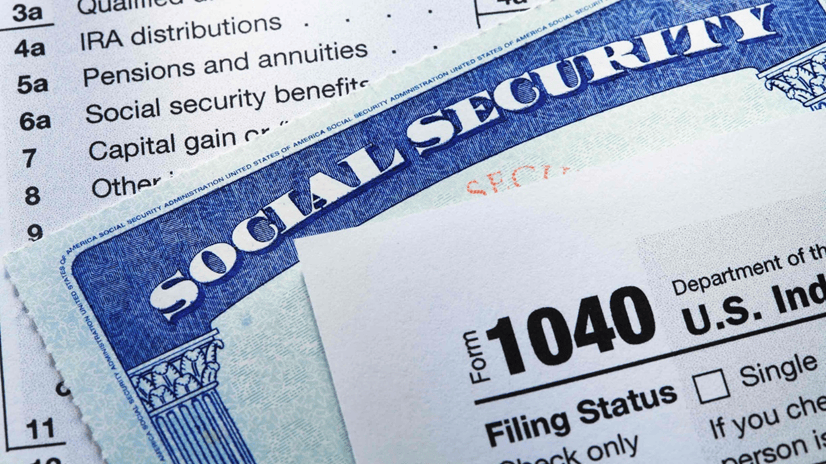
This question pops up quite a bit when discussing retirement with friends and/or clients. The short answer is yes, social security benefits are taxable. Of course, when dealing with the U.S. Tax Code, trying to figure out how much that you have to pay is complicated, to say the least.
To start, the IRS uses your combined income to determine taxes on your social security benefits. Your combined income is calculated as follows:
your adjusted gross income + nontaxable interest + half of your social security benefits.
If you have no other income except from social security, then you won’t have to pay any federal taxes. For everyone else, here’s how to know if your social security benefits are taxable:
For individuals:
If you have a combined income between $25,000 and $34,000, you are taxed on 50% of your social security benefit.
If your combined income exceeds $34,000, 85% of your social security benefit could be taxable.
For married couples:
Married couples are taxed on 50% of their social security benefits if their combined income is between $32,000 and $44,000.
Up to 85% of social security benefits is taxable for married couples with a combined income that exceeds $44,000.
As you can see from above, the threshold is very low before you’ll be paying taxes on your benefits. To summarize, if you have annual income of over $34,000 (filing as single) or $44,000 (filing as married), you’ll be paying tax on 85% of your social security benefits.
On the state level, only 11 states tax social security benefits: Colorado, Connecticut, Kansas, Minnesota, Missouri, Montana, Nebraska, New Mexico, Rhode Island, Utah, and Vermont.
Please comment or send an email if you have any questions. Thanks!
2022 is in the rearview mirror but there is still time to reduce your taxable income for last year:
Make a tax-deductible contribution to your IRA.
If you qualify, an IRA contribution can be a great way to reduce your 2022 taxes. You are allowed to contribute up to $6,000. If you are age 50 or older, you can add an extra $1,000 for a total of $7,000. You basically just had to have worked last year (have earned income) to qualify to make an IRA contribution.
Plus, if you are married, you can double up the amount with a spousal IRA.
If you are not covered by a retirement plan at work, you can deduct the full amount of your contribution, regardless of how much money you make.
If you do have a retirement plan at work, there are restrictions and limitations to qualify for the full deduction. Here’s a table that summarizes these rules. They are confusing so feel free to shoot me an email with any questions.
2022 Traditional IRA deduction limits
Filing Status
Modified adjusted gross income (MAGI)
Deduction Limit
Single individuals
≤ $68,000
Full deduction up to the amount of your contribution limit
> $68,000 but < $78,000
Partial deduction
≥ $78,000
No deduction
Married (filing joint returns)
≤ $109,000
Full deduction up to the amount of your contribution limit
> $109,000 but < $129,000
Partial deduction
≥ $129,000
No deduction
Married (filing separately)*
< $10,000
Partial deduction
≥ $10,000
No deduction
If you’re self-employed, you can sock away a lot more by opening up a Simplified Employee Pension (SEP) plan before filing your taxes. For 2022, you can contribute up to $61,000, depending on your income.
Please comment or send an email if you have any questions. Thanks!
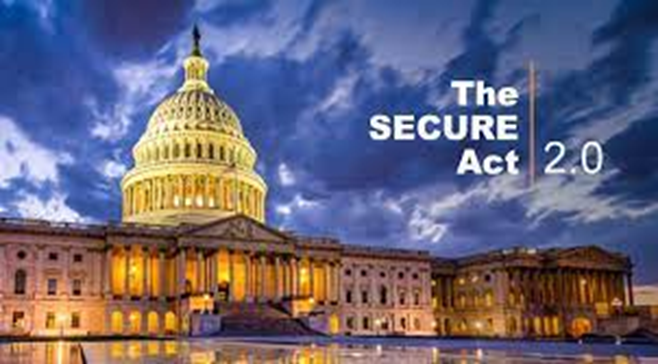
The SECURE 2.0 became law at the end of 2022 and its intent is to improve retirement security for American workers. Much of the law is focused on helping workers save more for retirement and most of those items don’t go into effect until 2024, at the earliest. But there are some big changes effective this year that affect people already retired or about to retire.
Here is a quick summary:
Age to Start Required Minimum Distributions: The age for required minimum distributions is increased to 73. This has increased 1 year from age 72. So, if you are turning 72 in 2023, you can now wait until April 1st of 2025 to start taking your required minimum withdrawals.
Penalty For Not Taking Your Required Minimum Distribution: Before SECURE 2.0, failing to take a RMD could lead to one of the steepest penalties in the entire tax code, as missing a RMD or not taking a big enough RMD triggered a 50% excise tax on the distribution shortfall. SECURE 2.0 reduces the penalty to 25% in all cases. In addition, the penalty drops down to 10% if the necessary RMD is taken by the end of the second year following the year it was due.
Required Minimum Distributions for Roth 401k and 403b accounts: The new law removes pre-death RMDs from Roth accounts, like Roth 401ks and Roth 403b accounts. Moving forward, those accounts won’t be subject to the RMD rules before the account holder dies. This was put in so theses accounts would be treated the same way Roth IRAs are for RMD purposes.
Please comment or send an email if you have any questions. Thanks!
January’s equivalent in the Southern Hemisphere is July.
Sunday, January 1st is, of course, New Year’s Day. Since it falls on a weekend, it will be observed on Monday, January 2nd. The stock market, banks, and government offices will be closed that Monday, but most stores will be open for business.
Monday, January 16th, is Martin Luther King, Jr. Day. Again, the stock market, banks, and government offices will be closed that Monday, but most stores will be open for business.
Stocks did not have the Santa Claus rally that investors had hoped for in December. Unfortunately, the biggest catalyst for stock prices right now is the actions of the Federal Reserve and they did not make the markets jolly during the holiday season. This past month put a merciful end to a brutal year for most major stock indices. In fact, this was the worst year for stocks since 2008.
For the month of December, the S&P 500 dropped about 6%. It closed 2022 down almost 20%.
With the mid-term elections out of the way, investors are squarely focused on the Federal Reserve. Their last meeting in December showed some flexibility in their current strategy of raising short-term interest rates at an unprecedented rate to combat inflation. The data rolling in shows that their strategy is working. Now, we have to wait until their next meeting at the end of January to see if they will switch to a less aggressive approach. If they don’t, I suspect stocks will take another leg down. However, if they do go to a wait-and-see strategy, we could have nice rally on our hands.
We also have annual earnings for 2022 that will start to come out in January and should be lower than expected but are most likely already reflected in stock prices.
Take a look at the Outlook section below to see what events could move the markets over the short term.
Bond prices dropped precipitously in December after peaking in the early part of the month. This peak and subsequent drop happened right after the Federal Reserve meeting in mid-December when they reiterated their intent to squash inflation. Yields subsequently rose through the end of the month as they move in the opposite direction of bond prices.
The 10-year US Treasury note moved up in December, closing at 3.88%. The 30-year bond yield ended higher as well, closing the month at 3.98%, just above the yield of the 10-year note once again. These yields are still well below the short-term treasuries. For example, the 6-month T-bill is currently yielding almost 4.77%.
It looks like we are going to be hovering in place around these prices/yields until the Fed pivots in the other direction on interest rates. Regardless, bond buyers should stick to purchasing individual bonds with maturities less than 2 years.
Savings rates continued their one year plus march higher (14 consecutive months). This is fantastic for risk-averse savers and for our emergency spending accounts.
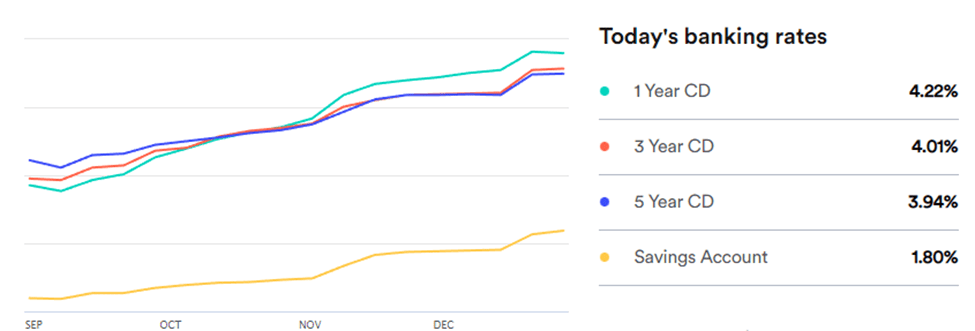
Currently, the average savings account is paying 1.80%, up from 1.51% last month. Another nice jump!
The 1-year CD interest rate is now averaging 4.22%, up from 3.85% last month. The 5-year CD rate is currently at 3.94%, up from 3.65% last month. These rates are still inverted, just like the yield curve, meaning they are paying a higher rate to borrow your money for a shorter time period, which isn’t normal. These inversions typically do not last longer than six months. That said, just buy short-term CDs, 1 year or less, and reevaluate when they mature. CDs are becoming a nice alternative for risk-averse investors and have drawn money away from stocks because of these decent rates that carry virtually no risk. I wouldn’t mind if these rates stayed this high but then that means that inflation is staying high as well, which is no good in the long run.
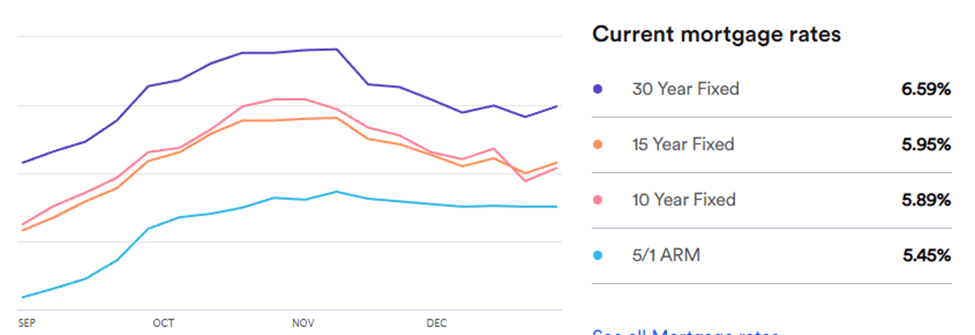
Mortgage rates continue to trend downward after peaking in November (see chart below). Currently, the 30-year rate sits at 6.59%, down from 6.81% a month ago. Home prices have been falling since July as mortgage rates rose and recession concerns intensify. Home builders’ confidence readings have dropped for 12 months in a row. Another data point to convince the Fed to pause rate hikes.
Oilprices continued to drop in December as fears of an economic slowdown trumped the restart of China’s economic engine. For the month, the price for a barrel of oil settled at $80.51, $3.50 less than it was at the beginning of November. For the year, oil ended up about 4.5%.
We’re getting back down to what I like to call the sweet spot for oil prices, between $55 and $70 per barrel. This price range is profitable enough for oil companies and tolerable for businesses and consumers when converted to diesel and gasoline. This downtrend in oil prices should be well noted by the Federal Reserve and hopefully they will cease and desist on raising rates further.
Gasoline prices fell again throughout December, continuing their downward trend since early summer. Regular unleaded gasoline is now averaging $3.20 per gallon, down $0.30 from last month. Sixteen states are below the $3 per gallon mark, with Georgia having the cheapest gas, at $2.76 a gallon. Hawaii has the most expensive gasoline at $5.02 per gallon. FYI, a year ago, we were paying $3.29.
Check out the prices at the pump in your area: AAA Gas Prices.
Outlook
Events on the horizon that could move the markets in the near term:
Fed & Inflation: The Fed held their last meeting in December and raised rates once again. The good news is that they only raised by 50 basis points versus the 75 basis points that they had been doing in each of the previous four meetings. More importantly, they talked about the need to stay on track to curb inflation but that they will also be looking at the data and adjusting their magnitude of increases accordingly. Inflation has already peaked, based on data that continues to support that conclusion. I really would like the Fed to take a step back and allow these rate increases to get into the economy’s blood stream a little more before considering raising rates again.
Russia Invasion of Ukraine: Russia keeps hammering Ukraine and Ukraine keeps punching back. This war has definitely gone on longer than anyone expected, especially Putin. Because of its lengthy duration, only a major change in this stalemate of a war, like an end to it, will move the markets significantly.
China Reopening: China has relaxed its covid restrictions and is preparing to reopen its borders in early January. As expected, they are getting hit hard with new covid cases, probably similar to when we started to reopen back in late 2021. It may not be as bad for them since most of the population has been vaccinated. It will be interesting to follow how the disease spreads throughout the country and how they handle it. This reopening of the world’s second largest economy should be viewed as a net positive for the stock markets in general.
Thinking about year-end tax planning is about as much fun as waiting in line at the DMV, but it’s something that could save you some money so it’s always a good thing to take a look at your financials before the end of the year.
Below are some items that may help you lower your 2022 taxes:
1. Spend any leftover cash that is in your flexible spending accounts.
If you have a Flexible Spending Account and have money left, get caught up on your doctor’s visits! While the old “use it or lose it” rule may not still apply, you may only be able to carry over $570 worth of unused money left in your 2022 FSA account at the end of the year. Your plan may also extend the amount of time you’re able to use your funds to 2 1/2 months after the end of the plan year.
2. Max out your retirement plan contributions to lower your taxable income.
Lowering your taxable income means paying less tax and it could also reduce the amount of Social Security subject to tax or any net investment income tax.
Contributing to a pre-tax retirement plan lowers both your adjustable gross income (front of the 1040 form) and your taxable income (back of the 1040 form). These plans include 401(k)s, 403(b)s, deductible IRAs, SIMPLE IRAs and SEPs. You have until Dec. 31st to make contributions to 401(k)s and 403(b)s for 2022. But for most other plans and IRAs, you can wait until when you file your taxes to make the contribution.
3. Sell your investment losers.
If you have realized capital gains this year, you might want to sell some of your losers in your stock, bond, or real estate portfolio to realize a loss before year end. This strategy, called “tax loss harvesting”, can reduce the amount of capital gains subject to tax. If your losses exceed your gains, you can apply $3,000 of that against your regular income. Any extra will then be passed to the next tax year. However, don’t sell just for the tax benefit. Make sure it makes sense based on your overall investment strategy.
4. Update paycheck withholding.
Tax reform and paycheck withholding changes almost always upset the balance that you want between the size of your tax refund and the size of your paycheck. Whenever there are changes to the tax code that affect your take home pay, you need to update your W-4 with your employer so you can continue to get the balance you want. For this year, it’s too late in the year to meaningfully impact your 2022 return, but updating your W-4 now means you can start off 2023 just how you want.
Please comment or send an email if you have any questions. Thanks!
This is the time of year that many investors sell some loser investments to offset their income or other capital gains, sometimes referred to as tax-loss harvesting. There is an obscure tax rule, known as the wash sale rule, that could affect how the IRS views these trades. So, here is a brief summary of how the wash sale rule works.
The wash sale rule was designed to discourage people from selling securities at a loss simply to claim a tax benefit.
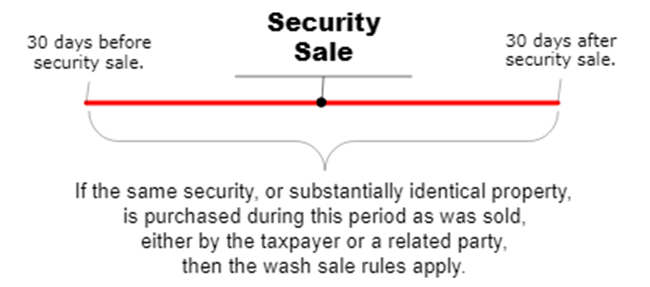
A wash sale occurs when an investment is sold at a loss and, within a period of 30 days before or 30 days after the sale, the identical or “substantially identical” investment is purchased again.
Under such circumstances, that loss will be “disallowed” and may not be considered in calculating a taxpayer’s losses for income tax purposes.
An example is the easiest way to explain this rule:
Suppose Joe has a taxable brokerage account that holds 50 shares of XYZ stock with a cost basis of $500 because he bought the stock when it cost $10 per share. The stock is worth only $5 per share on July 31, and he sells all 50 shares for a total sales proceeds of $250. Joe now has a realized capital loss of $250.
If Joe purchases new shares in XYZ within 30 calendar days before the sale or up to 30 calendar days after the sale, his capital loss can’t be used to offset income or capital gains for that tax year but is deferred until he sells the new, replacement shares.
As you can see in the example, you temporarily lose the tax benefit of the realized loss, but you get it back when you eventually sell the newly purchased shares because you add the original capital loss to the new purchase price to establish your actual cost basis for the newly purchased shares. The only time that you lose the loss permanently is when you sell an investment in a taxable account, and you buy it back in an IRA.
If it sounds confusing, don’t worry. It is. That’s our tax code.
Please comment or send an email if you have any questions. Thanks!
The Federal Reserve meets one more time this year and it could be the most watched Fed meeting in recent history. Most economists are expecting them to alter their current strategy of raising short-term interest rates at an unprecedented clip of 75 basis points (0.75%) per meeting, like they have done the last four times that they have met. The consensus is that they will raise rates only 50 basis points.
Well, if they need any more evidence that they should stop raising rates at such a fast pace, here are a few things that should convince them.
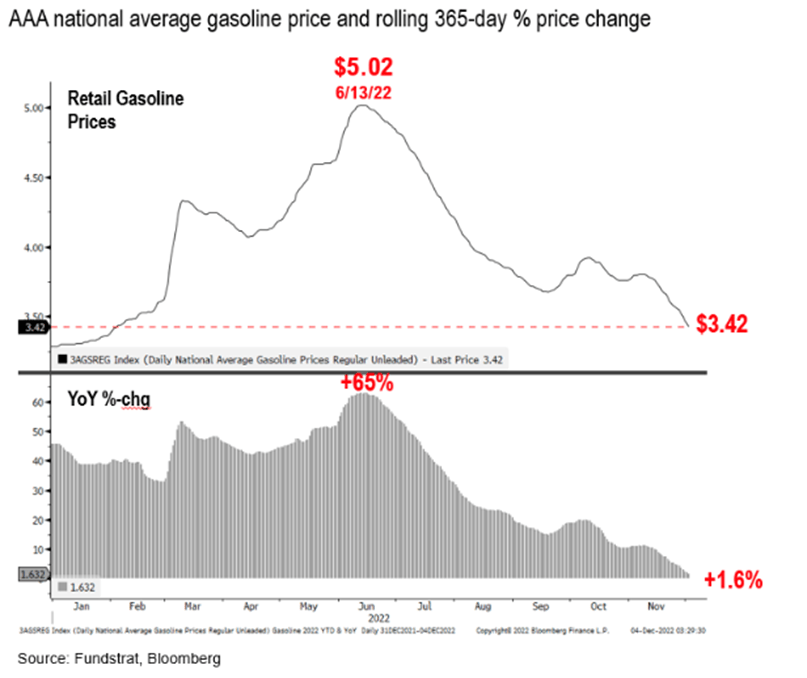
Gasoline prices back to where they started in 2022.
Amazingly, the entire gasoline price surge in 2022 has been all but erased.
Although the Fed typically excludes energy prices when watching inflation, rising prices at the pump garner the most attention from the public and the press, so it certainly contributes to the perception of high inflation.
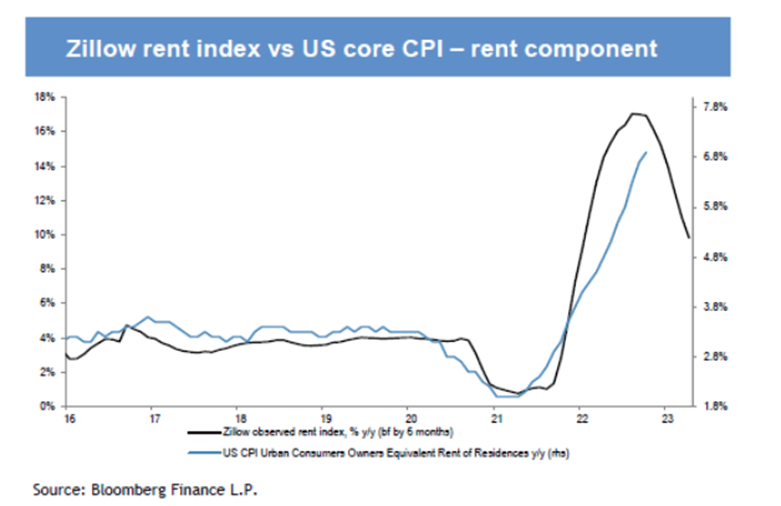
Rents and home prices are dropping in a meaningful manner.
The Fed uses the blue line, which lags the real-time data by about 6 months. Why they don’t use real-time data for this component is a mystery to me. Regardless, they know rents are coming down, which was one of their arguments to keep raising rates at such a high rate.
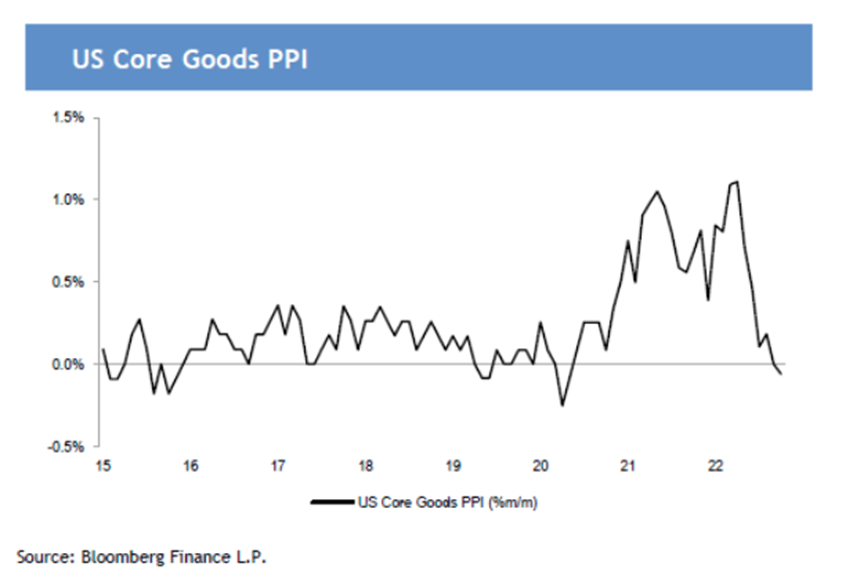
Producer Price Index (PPI) is dropping significantly.
The PPI is basically the inflation measurement at the wholesale level. This is the price of goods and services before they go up for sale to the consumers. It makes sense that if the wholesale prices are coming down, then consumer prices should be dropping as well, especially if a company wants to stay competitive.
If these trends continue, it should be an easy decision for the Federal Reserve to pump the brakes on interest rate hikes when they meet next week.
Please comment or send an email if you have any questions. Thanks!
December’s equivalent in the Southern Hemisphere is June.
Wednesday, December 7th is National Pearl Harbor Remembrance Day.
December 18th marks the beginning of Hanukkah.
Wednesday, December 21st is the Winter Solstice—the astronomical first day of winter in the Northern Hemisphere and first day of summer in the Southern Hemisphere.
Sunday, December 25th is Christmas Day, a Christian holiday commemorating the birth of Jesus Christ.
Stocks did not disappoint in November, rising smartly as signs of slowing inflation continue to emerge. This, of course, forces The Federal Reserve to rethink their strategy of aggressive interest rate hikes. In fact, as I am writing this, Fed Chair Powell was speaking at a conference and mentioned that smaller rate hikes could start in December. This triggered a nice rally on the last day of November and could be the start of a Santa Claus rally into the end of the year.
For the month of November, the S&P 500 gained a little over 5%. For the year, it is still down about 14%.
The mid-term elections produced a split Congress, which is a positive for the markets. Also, we are now in a period of bad news for Main Street is good news for Wall Street. For example, the one area that the Fed is worried about is wage inflation but with the recent hiring freezes and layoffs hitting the economy, the Fed is rethinking their strategy of aggressive interest rate hikes, which is bad for people losing their jobs but is a big positive for stocks and bonds.
Take a look at the Outlook section below to see what events could move the markets over the short term.
Bond prices went higher across the board as signs of lower inflation and slowing economic growth showed up in several economic reports. The trend in higher yields may have bottomed this past month with raw material prices coming down, housing prices continuing to drop, excess inventory in stores, and layoffs risings. Now, with the Fed mentioning smaller rate increase potentially at their next meeting in December, we could see a bottom put in on bond prices for the next few months.
The 10-year US Treasury note dropped below the 4% level in November, closing at 3.71%. The 30-year bond yield dropped as well, closing the month at 3.79%, just above the yield of the 10-year note.
This pop in bond prices could be a one-off event or could be the beginning of a new trend. We will have to see over the coming months, but I believe we are putting in a bottom for bond prices, if we haven’t already in November, and should see higher prices and lower yields over the next few months. Regardless, bond buyers should stick to purchasing individual bonds with maturities less than 2 years.
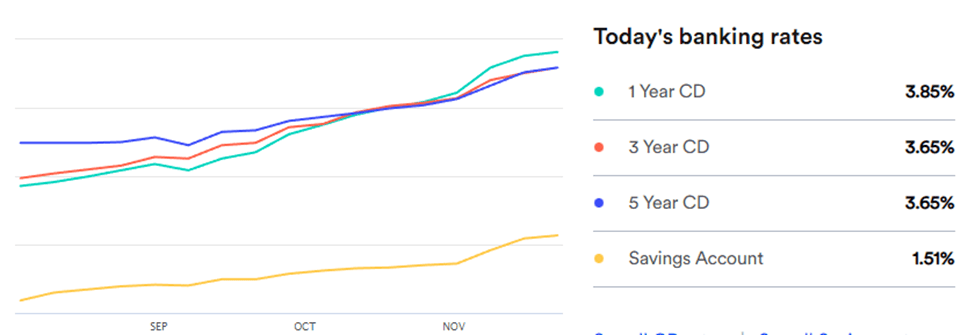
Savings rates are higher once again (13 months in a row!) as interest rates rise across the board. We’re finally getting paid something to put our money in money market and savings accounts.
Currently, the average savings account is paying 1.51%, up from 1.13% last month. A nice jump and much better than the 0.10% the banks were paying us just about a year ago.
The 1-year CD interest rate is now averaging 3.85%, up from 3.21% last month. The 5-year CD rate is currently at 3.65%, up from 3.17% last month. These rates are inverted, just like the yield curve, meaning they are paying a higher rate to borrow your money for a shorter time period, which isn’t normal. These inversions typically do not last longer than six months. CDs are becoming a nice alternative for risk-averse investors and have drawn money away from stocks because of these decent rates that carry virtually no risk. I wouldn’t mind if these rates stayed this high but then that means that inflation is staying high as well, which is no good in the long run.
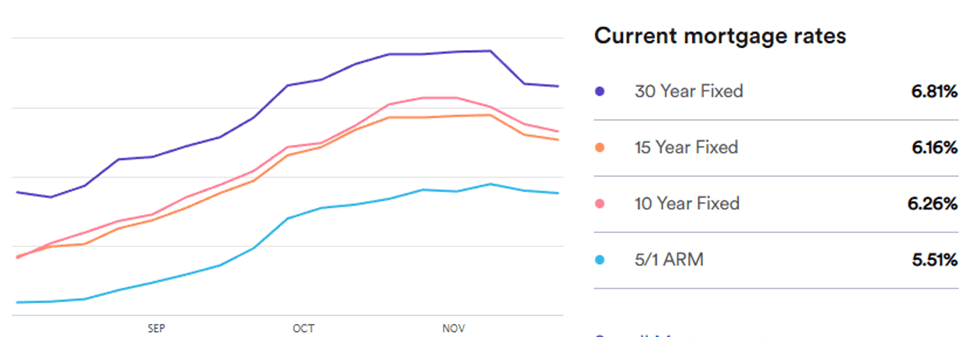
Mortgage rates appear to have peaked in November and are starting to roll over (see chart below). Currently, the 30-year rate sits at 6.81%, down from 7.20% a month ago. Home prices continue to fall across the country as buyers shun the larger mortgage payments for both new and existing homes. Mortgage applications are down 41% from one year ago. Home builders were even offering Black Friday discounts to lure new homebuyers in November. Home prices peaked in June and now it has quickly become a buyers’ market in the U.S. Even more incentive for the Fed to pause rate hikes.
Oilprices headed back down in November even with OPEC and Russia promising to cut production. For the month, the price for a barrel of oil settled at $80.59, $6 less than it was at the beginning of November. For the year, oil is now up only about 4.5%.
The downward trend in oil prices is largely due to the worldwide recession that we are currently in. The good news is that these lower prices should help in reducing producer costs and subsequently, consumer prices.
Gasoline prices fell again throughout November, continuing their downward trend since early summer. Regular unleaded gasoline is now averaging $3.50 per gallon, down $0.26 from last month. A handful of states are below the $3 per gallon mark, with Texas having the cheapest gas, at $2.85 a gallon. Hawaii has the most expensive gasoline at $5.20 per gallon. FYI, a year ago, we were paying $3.40.
Check out the prices at the pump in your area: AAA Gas Prices.
Outlook
Events on the horizon that could move the markets in the near term:
Fed & Inflation: The Fed raised short-term rates by another 75 basis points at their last meeting in November as expected, but it’s what they said afterwards that helped boost stock and bond prices. There was more consensus among its members to reduce the magnitude of the rate increases going forward. So, maybe just raising 50 basis points in December versus the 75 that they had been planning is their goal. The data coming in keeps pointing to inflation already peaking so a change in the Fed strategy could be coming this month when they meet for the last time of the year, which could spark an end-of-year rally for stocks and bonds.
Mid-Term Elections: Republicans were able to take over the House of Representatives (HOR) but could not do the same in the Senate, surprisingly. Still, having a split Congress will create political gridlock between the Capitol and the White House. This means that there will probably be no changes in tax laws, trade laws, and other issues that could affect the economy in a major way. This always bodes well for stocks because it removes the uncertainty of what the government can change.
Russia Invasion of Ukraine: Russia has stepped up attacks on Ukraine’s infrastructure, knocking out critical energy and water supplies for the battered country. Still, Ukraine states that 70% of their power needs are being met, which is good news. I feel like Putin has gone too far at this point to call it quits. So, it looks like he’ll take this mess through the winter in hopes of breaking the spirit of the Ukraine people. They won’t give in, based on what I’ve seen from them. In the end, the wild card is Putin and what he might resort to if he thinks he can’t win this war conventionally. This is a big, ongoing uncertainty for the markets.
Supply Chain Status: According to some data, it’s back to normal. The Kansas City Fed shows that the outlook for supplier delivery time has hit its lowest level on record. This is great news. Of course, we have something else to worry about now: a national railroad strike. This could happen in early December and could cost the U.S. economy about $2 billion a day. Plus, we are in the midst of a huge diesel fuel shortage, which affects ships, trucks, and trains in the supply chain. To summarize, we are still not out of the woods on fixing our supply chains, but they are getting better.
For the last 14 years or so, if investors wanted to make any sort of decent return on their money, they had to buy stocks because high-quality corporate and government bonds were paying next to nothing in interest. Rates had been abnormally low for well over a decade until this year when inflation really started to accelerate as a result of coming out of the pandemic. Now, we have bond yields that can compete with inflation as well as stocks and the best deal going right now is short-term U.S government bonds.
This has really created some healthy competition for stocks. For example, I can buy a U.S. Treasury bond that matures in June of next year that yields 4.5%. Compare that to a high-quality stock that pays a 4% dividend. The bond is a near risk-free investment (unless our country collapses) if held to maturity whereas the stock could be at a lower or higher price at the time that the bond matures next year. For many risk-averse investors, this is a no brainer to buy U.S. government bonds versus stocks in today’s interest-rate environment.
The key to this strategy is to buy individual bonds with short-term maturities (less than 18 months) versus bond mutual funds or bond ETFs. That’s because with individual bonds, you know exactly how long you need to hold the bond to get back 100% of your original investment. With most bond mutual funds and ETFs, the maturity date is open-ended because they continually have to buy bonds as money comes into the fund. This becomes a problem when interest rates rise. Regarding short versus long-term maturities, buying bonds that mature within the next 18 months means less time that you have to keep your money locked up in those bonds. That’s important for investors who might need the money for other purposes or who think that rates will rise and want to reinvest in higher yielding bonds.
An unintended benefit of buying short-term bonds right now is that the yield curve is inverted, meaning short-term bonds are paying higher interest rates that longer term bonds, which is not normal. For instance, a 20-year U.S. bond is paying 4.3% right now compared to that bond we mentioned above that matures next June and is paying 4.5%.
The takeaway here is that short-term bonds can finally be considered again in your investment portfolios as a viable alternative to stocks.
Please comment or send an email if you have any questions. Thanks!
November is the last full month of the autumn season in the Northern Hemisphere. Its Southern Hemisphere equivalent is May.
November 6th at 2am is the end of Daylight-Saving Time . Set your clocks back one hour on Saturday night at bedtime!
November 8th is Election Day. Don’t forget to vote in state and federal elections! Every vote counts.
November 11th is Veterans Day. This holiday honors all military veterans, both living and dead.
November 24th is Thanksgiving Day.
Stocks rebounded nicely in October as economic data provided some hope that the Federal Reserve might ease up on raising interest rates. Also, earnings reports for Q3 showed signs that the U.S. economy is still doing well and might avoid a deep and lengthy recession. For the month of October, the S&P 500 gained a little over 8%. For the year, it is still down almost 19%. Hopes for a year-end rally will hinge mostly on the last two Federal Reserve meetings this year, one of which starts tomorrow.
Since 2009, stocks have been the only game in town if you wanted to have liquidity and get any kind of return on your investment. Now, with interest rates much higher, investors can invest in government bonds, CDs, and savings accounts and earn a decent rate of return with no risk. Because of this increased competition, stocks are now going to have to provide the potential for higher returns to compete with these bonds and savings accounts.
Q3 earnings so far have surprised to the upside, which is welcoming news for equity investors. Everyone has been expecting poor performance for Q3, with the exception of the fossil fuels energy sector. About 150 companies in the S&P 500 will report earnings this week. Add to that, the mid-term elections and several economic reports on top of the Fed meeting in the next few days and you have a lot of market-moving news in the headlines.
Seasonally, we are entering a positive period for the stock market over the next six months. Hopefully, it will hold true once again.
Take a look at the Outlook section below to see what events could move the markets over the short term.
Bond prices were a mixed bag this past month with high-quality corporate and government bonds moving lower while high-yield, or junk, bonds moved higher. The trend in yields continues to be positive so prices should trend lower. High yield bonds sometimes track with stock prices so that could explain the disparity in price movements between the different classes of bonds.
The 10-year US Treasury note stayed above 4% for most of the second half of October and eventually closed the month at 4.08%. The 30-year bond yield leapt past the 10-year bond yield, closing October at 4.20%, fighting to get back to a more normal yield curve.
You might not know it, but it has been a treacherous year for bond investors, too. If you had bought the iShares 20+ Year Treasury Bond ETF (TLT) at the beginning of 2022, you would be down over 35% for the year. This is because these types of ETFs and most bond mutual funds have no maturity date. They just keep buying bonds and in a rising interest-rate environment, bond prices keep going down. That is why I recommend buying individual bonds or ETFs that have a defined maturity date and holding them until they mature.
Savings rates continue to climb (12 months in a row!) as interest rates rise across the board. We’re finally getting paid something to put our money in money market and savings accounts.
Currently, the average savings account is paying 1.13%, up from 1.02% last month. Not great, but better than the 0.10% the banks were paying us just about a year ago.
The 1-year CD interest rate is now averaging 3.21%, up from 2.80% last month. The 5-year CD rate is currently at 3.17%, up from 2.97% last month. These rates are inverted, just like the yield curve, meaning they are paying a higher rate to borrow your money for a shorter time period, which isn’t normal. These inversions typically do not last longer than six months. CDs are becoming a nice alternative for risk-averse investors. I wouldn’t mind if these rates stayed this high but then that means that inflation is staying high as well, which is no good in the long run.
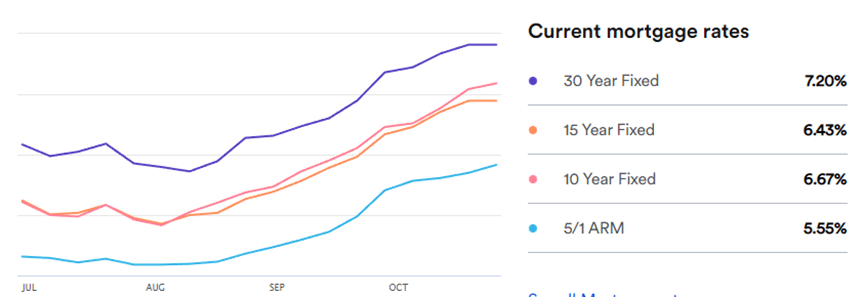
Mortgage rates continued their march higher, in step with other lending rates. They reached their highest levels of the year in October, even as demand wanes for new home loans and refinanced mortgages. Currently, the 30-year rate sits at 7.20%, up from 6.83% a month ago. Home prices continue to fall across the country as buyers shun the larger mortgage payments for both new and existing homes. Home builders are painting a bleak picture for their businesses as well for 2023. That said, I would think mortgage rates have to be leveling off due to weak demand, but I said the same thing last month and they are still heading higher. However, the trend in rates does seem to be leveling off now, looking at the graph below:
Oilprices reversed their downtrend in October and headed higher to finish the month. OPEC cutting production and Russia’s war with Ukraine provided support for oil prices. In October, the price for a barrel of oil settled at $89.11, $10 more than it was at the beginning of the month. For the year, oil is now up about 15.7%.
This rise doesn’t help the call for the Fed to hold back on raising interest rates, since oil and its many derivatives are an input cost for almost every product made or grown. Also, as far as air travel goes, there doesn’t seem to be any curb in demand for flying, at least from my recent experiences traveling this past month.
Gasoline prices dropped slightly in October, continuing their downward trend since early summer. Regular unleaded gasoline is now averaging $3.76 per gallon, down just $0.02 from last month. Georgia now has the cheapest gas, at $3.15 a gallon. California has the most expensive gasoline at $5.54 per gallon. FYI, a year ago, we were paying $3.40.
Check out the prices at the pump in your area: AAA Gas Prices.
Outlook
Events on the horizon that could move the markets in the near term:
Fed & Inflation: All eyes are on the Fed this week as they meet once again. It’s almost a lock that they will raise rates by another 75 basis points again and that’s already factored into stock and bond prices right now. What they do going forward will be what moves the markets. Hopefully, they will take a break and let these higher rates work their way into the economy. There are still plenty of jobs out there and I think that is the data point that the Fed is most concerned with. At this point, I believe more damage will be done by raising rates than by taking a pause. Any pause or change in the Fed’s strategy would be a positive catalyst for stocks and bonds.
Mid-Term Elections: As I discussed in my blog earlier this month regarding mid-term elections, it is almost a certainty that the Republicans will take control of Congress which will create political gridlock between the Capitol and the White House. This means that there will probably be no changes in tax laws, trade laws, and other issues that could affect a company’s performance. This always bodes well for stocks because it removes that uncertainty.
Russia Invasion of Ukraine: Ukraine has recaptured many regions that Russia had occupied earlier in this war. Many able-bodied Russians have been fleeing their homeland as Putin forces them to join the military. Russia continues to launch missile attacks on Ukraine’s infrastructure, leaving many cities without power. Still, Ukraine is holding on. The wild card is Putin and what he might resort to if he has to keep retreating. This is a big uncertainty for the markets.
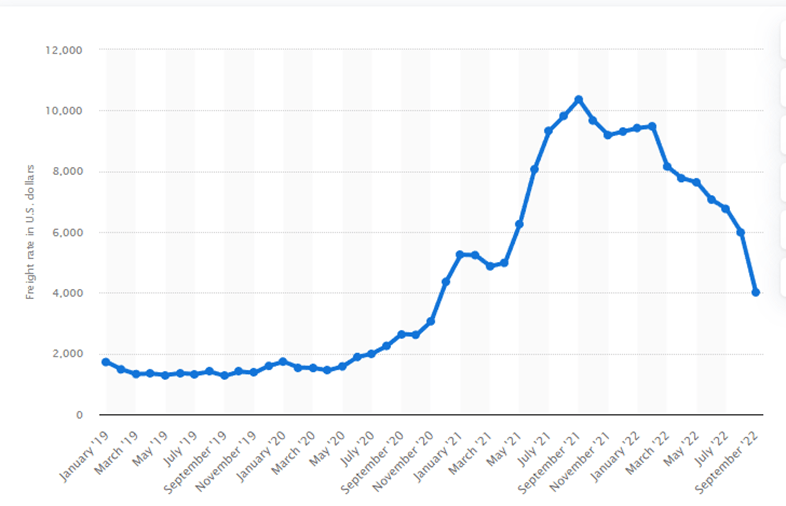
Supply Chain Status: Supply chains continue to mend across the country. But now, we have a big issue with diesel inventories, the fuel that powers the world’s supply chains. Supplies are at record lows right now. With winter coming, oil that’s used to make diesel may be used to make heating oil for homes as well. That could put an even bigger drain on inventories. A very cold winter could reverse this downtrend in freight rates as seen in the chart below:
Global container freight rate index from January 2019 to September 2022(in U.S. dollars)