

Fun Facts about November
- Birthstone: Topaz and citrine
- Flower: Chrysanthemum
- Zodiac signs: Scorpio and Sagittarius
- November is the last full month of the autumn season in the Northern Hemisphere. Its Southern Hemisphere equivalent is May.
- November 6th at 2am is the end of Daylight-Saving Time . Set your clocks back one hour on Saturday night at bedtime!
- November 8th is Election Day. Don’t forget to vote in state and federal elections! Every vote counts.
- November 11th is Veterans Day. This holiday honors all military veterans, both living and dead.
- November 24th is Thanksgiving Day.
Stocks rebounded nicely in October as economic data provided some hope that the Federal Reserve might ease up on raising interest rates. Also, earnings reports for Q3 showed signs that the U.S. economy is still doing well and might avoid a deep and lengthy recession. For the month of October, the S&P 500 gained a little over 8%. For the year, it is still down almost 19%. Hopes for a year-end rally will hinge mostly on the last two Federal Reserve meetings this year, one of which starts tomorrow.
Since 2009, stocks have been the only game in town if you wanted to have liquidity and get any kind of return on your investment. Now, with interest rates much higher, investors can invest in government bonds, CDs, and savings accounts and earn a decent rate of return with no risk. Because of this increased competition, stocks are now going to have to provide the potential for higher returns to compete with these bonds and savings accounts.
Q3 earnings so far have surprised to the upside, which is welcoming news for equity investors. Everyone has been expecting poor performance for Q3, with the exception of the fossil fuels energy sector. About 150 companies in the S&P 500 will report earnings this week. Add to that, the mid-term elections and several economic reports on top of the Fed meeting in the next few days and you have a lot of market-moving news in the headlines.
Seasonally, we are entering a positive period for the stock market over the next six months. Hopefully, it will hold true once again.
Take a look at the Outlook section below to see what events could move the markets over the short term.
Bond prices were a mixed bag this past month with high-quality corporate and government bonds moving lower while high-yield, or junk, bonds moved higher. The trend in yields continues to be positive so prices should trend lower. High yield bonds sometimes track with stock prices so that could explain the disparity in price movements between the different classes of bonds.
The 10-year US Treasury note stayed above 4% for most of the second half of October and eventually closed the month at 4.08%. The 30-year bond yield leapt past the 10-year bond yield, closing October at 4.20%, fighting to get back to a more normal yield curve.
You might not know it, but it has been a treacherous year for bond investors, too. If you had bought the iShares 20+ Year Treasury Bond ETF (TLT) at the beginning of 2022, you would be down over 35% for the year. This is because these types of ETFs and most bond mutual funds have no maturity date. They just keep buying bonds and in a rising interest-rate environment, bond prices keep going down. That is why I recommend buying individual bonds or ETFs that have a defined maturity date and holding them until they mature.
Savings rates continue to climb (12 months in a row!) as interest rates rise across the board. We’re finally getting paid something to put our money in money market and savings accounts.
Currently, the average savings account is paying 1.13%, up from 1.02% last month. Not great, but better than the 0.10% the banks were paying us just about a year ago.
The 1-year CD interest rate is now averaging 3.21%, up from 2.80% last month. The 5-year CD rate is currently at 3.17%, up from 2.97% last month. These rates are inverted, just like the yield curve, meaning they are paying a higher rate to borrow your money for a shorter time period, which isn’t normal. These inversions typically do not last longer than six months. CDs are becoming a nice alternative for risk-averse investors. I wouldn’t mind if these rates stayed this high but then that means that inflation is staying high as well, which is no good in the long run.
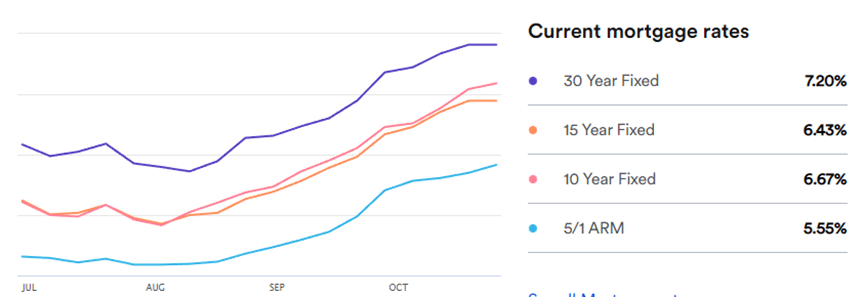
Mortgage rates continued their march higher, in step with other lending rates. They reached their highest levels of the year in October, even as demand wanes for new home loans and refinanced mortgages. Currently, the 30-year rate sits at 7.20%, up from 6.83% a month ago. Home prices continue to fall across the country as buyers shun the larger mortgage payments for both new and existing homes. Home builders are painting a bleak picture for their businesses as well for 2023. That said, I would think mortgage rates have to be leveling off due to weak demand, but I said the same thing last month and they are still heading higher. However, the trend in rates does seem to be leveling off now, looking at the graph below:
Oil prices reversed their downtrend in October and headed higher to finish the month. OPEC cutting production and Russia’s war with Ukraine provided support for oil prices. In October, the price for a barrel of oil settled at $89.11, $10 more than it was at the beginning of the month. For the year, oil is now up about 15.7%.
This rise doesn’t help the call for the Fed to hold back on raising interest rates, since oil and its many derivatives are an input cost for almost every product made or grown. Also, as far as air travel goes, there doesn’t seem to be any curb in demand for flying, at least from my recent experiences traveling this past month.
Gasoline prices dropped slightly in October, continuing their downward trend since early summer. Regular unleaded gasoline is now averaging $3.76 per gallon, down just $0.02 from last month. Georgia now has the cheapest gas, at $3.15 a gallon. California has the most expensive gasoline at $5.54 per gallon. FYI, a year ago, we were paying $3.40.
Check out the prices at the pump in your area: AAA Gas Prices.
Outlook
Events on the horizon that could move the markets in the near term:
- Fed & Inflation: All eyes are on the Fed this week as they meet once again. It’s almost a lock that they will raise rates by another 75 basis points again and that’s already factored into stock and bond prices right now. What they do going forward will be what moves the markets. Hopefully, they will take a break and let these higher rates work their way into the economy. There are still plenty of jobs out there and I think that is the data point that the Fed is most concerned with. At this point, I believe more damage will be done by raising rates than by taking a pause. Any pause or change in the Fed’s strategy would be a positive catalyst for stocks and bonds.
- Mid-Term Elections: As I discussed in my blog earlier this month regarding mid-term elections, it is almost a certainty that the Republicans will take control of Congress which will create political gridlock between the Capitol and the White House. This means that there will probably be no changes in tax laws, trade laws, and other issues that could affect a company’s performance. This always bodes well for stocks because it removes that uncertainty.
- Russia Invasion of Ukraine: Ukraine has recaptured many regions that Russia had occupied earlier in this war. Many able-bodied Russians have been fleeing their homeland as Putin forces them to join the military. Russia continues to launch missile attacks on Ukraine’s infrastructure, leaving many cities without power. Still, Ukraine is holding on. The wild card is Putin and what he might resort to if he has to keep retreating. This is a big uncertainty for the markets.
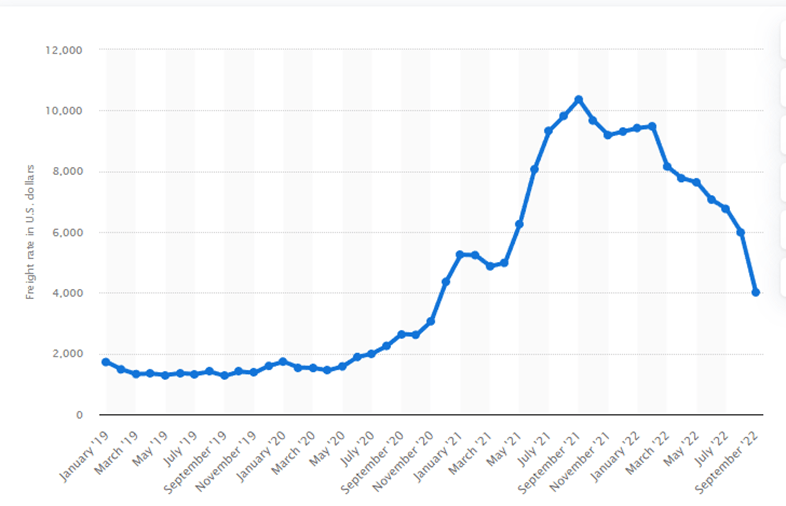
- Supply Chain Status: Supply chains continue to mend across the country. But now, we have a big issue with diesel inventories, the fuel that powers the world’s supply chains. Supplies are at record lows right now. With winter coming, oil that’s used to make diesel may be used to make heating oil for homes as well. That could put an even bigger drain on inventories. A very cold winter could reverse this downtrend in freight rates as seen in the chart below:
Global container freight rate index from January 2019 to September 2022(in U.S. dollars)
Joe Baker, CFP®
Baker Asset Management, LLC
joebaker@bakerassetmanagement.com

