

Fun Facts about January
- Birthstone: Garnet
- Flower: carnation and snowdrop
- Zodiac signs: Capricorn and Aquarius
- January’s equivalent in the Southern Hemisphere is July.
- Sunday, January 1st is, of course, New Year’s Day. Since it falls on a weekend, it will be observed on Monday, January 2nd. The stock market, banks, and government offices will be closed that Monday, but most stores will be open for business.
- Monday, January 16th, is Martin Luther King, Jr. Day. Again, the stock market, banks, and government offices will be closed that Monday, but most stores will be open for business.
Stocks did not have the Santa Claus rally that investors had hoped for in December. Unfortunately, the biggest catalyst for stock prices right now is the actions of the Federal Reserve and they did not make the markets jolly during the holiday season. This past month put a merciful end to a brutal year for most major stock indices. In fact, this was the worst year for stocks since 2008.
For the month of December, the S&P 500 dropped about 6%. It closed 2022 down almost 20%.
With the mid-term elections out of the way, investors are squarely focused on the Federal Reserve. Their last meeting in December showed some flexibility in their current strategy of raising short-term interest rates at an unprecedented rate to combat inflation. The data rolling in shows that their strategy is working. Now, we have to wait until their next meeting at the end of January to see if they will switch to a less aggressive approach. If they don’t, I suspect stocks will take another leg down. However, if they do go to a wait-and-see strategy, we could have nice rally on our hands.
We also have annual earnings for 2022 that will start to come out in January and should be lower than expected but are most likely already reflected in stock prices.
Take a look at the Outlook section below to see what events could move the markets over the short term.
Bond prices dropped precipitously in December after peaking in the early part of the month. This peak and subsequent drop happened right after the Federal Reserve meeting in mid-December when they reiterated their intent to squash inflation. Yields subsequently rose through the end of the month as they move in the opposite direction of bond prices.
The 10-year US Treasury note moved up in December, closing at 3.88%. The 30-year bond yield ended higher as well, closing the month at 3.98%, just above the yield of the 10-year note once again. These yields are still well below the short-term treasuries. For example, the 6-month T-bill is currently yielding almost 4.77%.
It looks like we are going to be hovering in place around these prices/yields until the Fed pivots in the other direction on interest rates. Regardless, bond buyers should stick to purchasing individual bonds with maturities less than 2 years.
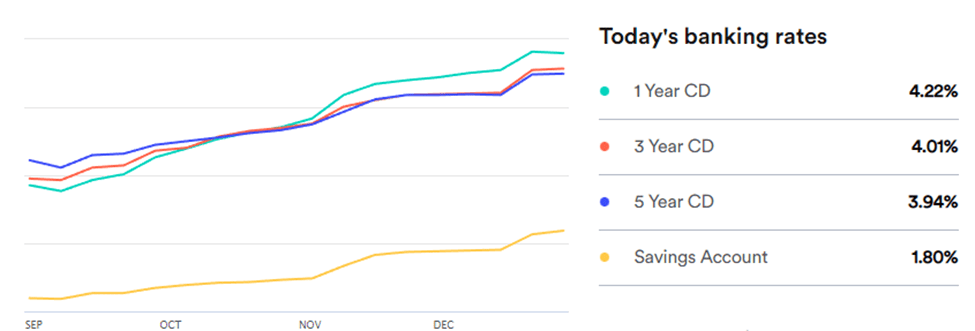
Savings rates continued their one year plus march higher (14 consecutive months). This is fantastic for risk-averse savers and for our emergency spending accounts.
Currently, the average savings account is paying 1.80%, up from 1.51% last month. Another nice jump!
The 1-year CD interest rate is now averaging 4.22%, up from 3.85% last month. The 5-year CD rate is currently at 3.94%, up from 3.65% last month. These rates are still inverted, just like the yield curve, meaning they are paying a higher rate to borrow your money for a shorter time period, which isn’t normal. These inversions typically do not last longer than six months. That said, just buy short-term CDs, 1 year or less, and reevaluate when they mature. CDs are becoming a nice alternative for risk-averse investors and have drawn money away from stocks because of these decent rates that carry virtually no risk. I wouldn’t mind if these rates stayed this high but then that means that inflation is staying high as well, which is no good in the long run.
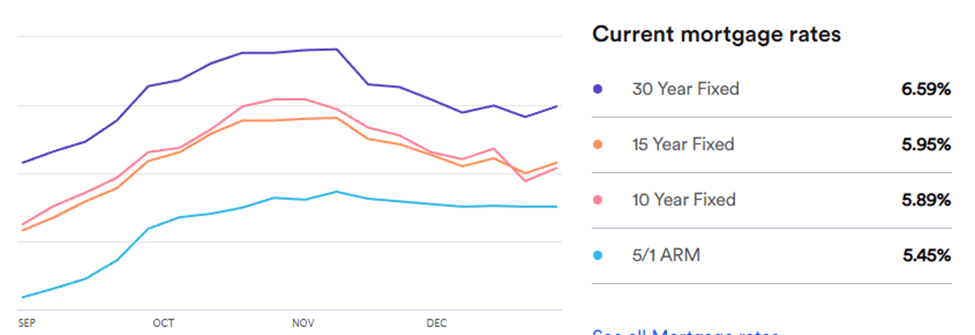
Mortgage rates continue to trend downward after peaking in November (see chart below). Currently, the 30-year rate sits at 6.59%, down from 6.81% a month ago. Home prices have been falling since July as mortgage rates rose and recession concerns intensify. Home builders’ confidence readings have dropped for 12 months in a row. Another data point to convince the Fed to pause rate hikes.
Oil prices continued to drop in December as fears of an economic slowdown trumped the restart of China’s economic engine. For the month, the price for a barrel of oil settled at $80.51, $3.50 less than it was at the beginning of November. For the year, oil ended up about 4.5%.
We’re getting back down to what I like to call the sweet spot for oil prices, between $55 and $70 per barrel. This price range is profitable enough for oil companies and tolerable for businesses and consumers when converted to diesel and gasoline. This downtrend in oil prices should be well noted by the Federal Reserve and hopefully they will cease and desist on raising rates further.
Gasoline prices fell again throughout December, continuing their downward trend since early summer. Regular unleaded gasoline is now averaging $3.20 per gallon, down $0.30 from last month. Sixteen states are below the $3 per gallon mark, with Georgia having the cheapest gas, at $2.76 a gallon. Hawaii has the most expensive gasoline at $5.02 per gallon. FYI, a year ago, we were paying $3.29.
Check out the prices at the pump in your area: AAA Gas Prices.
Outlook
Events on the horizon that could move the markets in the near term:
- Fed & Inflation: The Fed held their last meeting in December and raised rates once again. The good news is that they only raised by 50 basis points versus the 75 basis points that they had been doing in each of the previous four meetings. More importantly, they talked about the need to stay on track to curb inflation but that they will also be looking at the data and adjusting their magnitude of increases accordingly. Inflation has already peaked, based on data that continues to support that conclusion. I really would like the Fed to take a step back and allow these rate increases to get into the economy’s blood stream a little more before considering raising rates again.
- Russia Invasion of Ukraine: Russia keeps hammering Ukraine and Ukraine keeps punching back. This war has definitely gone on longer than anyone expected, especially Putin. Because of its lengthy duration, only a major change in this stalemate of a war, like an end to it, will move the markets significantly.
- China Reopening: China has relaxed its covid restrictions and is preparing to reopen its borders in early January. As expected, they are getting hit hard with new covid cases, probably similar to when we started to reopen back in late 2021. It may not be as bad for them since most of the population has been vaccinated. It will be interesting to follow how the disease spreads throughout the country and how they handle it. This reopening of the world’s second largest economy should be viewed as a net positive for the stock markets in general.
Joe Baker, CFP®
Baker Asset Management, LLC
joebaker@bakerassetmanagement.com

