

Fun Facts about December
- Birthstone: Turquoise or Zircon
- Flower: Narcissus or Holly
- Zodiac signs: Sagittarius and Capricorn
- December’s equivalent in the Southern Hemisphere is June.
- Wednesday, December 7th is National Pearl Harbor Remembrance Day.
- December 18th marks the beginning of Hanukkah.
- Wednesday, December 21st is the Winter Solstice—the astronomical first day of winter in the Northern Hemisphere and first day of summer in the Southern Hemisphere.
- Sunday, December 25th is Christmas Day, a Christian holiday commemorating the birth of Jesus Christ.
Stocks did not disappoint in November, rising smartly as signs of slowing inflation continue to emerge. This, of course, forces The Federal Reserve to rethink their strategy of aggressive interest rate hikes. In fact, as I am writing this, Fed Chair Powell was speaking at a conference and mentioned that smaller rate hikes could start in December. This triggered a nice rally on the last day of November and could be the start of a Santa Claus rally into the end of the year.
For the month of November, the S&P 500 gained a little over 5%. For the year, it is still down about 14%.
The mid-term elections produced a split Congress, which is a positive for the markets. Also, we are now in a period of bad news for Main Street is good news for Wall Street. For example, the one area that the Fed is worried about is wage inflation but with the recent hiring freezes and layoffs hitting the economy, the Fed is rethinking their strategy of aggressive interest rate hikes, which is bad for people losing their jobs but is a big positive for stocks and bonds.
Take a look at the Outlook section below to see what events could move the markets over the short term.
Bond prices went higher across the board as signs of lower inflation and slowing economic growth showed up in several economic reports. The trend in higher yields may have bottomed this past month with raw material prices coming down, housing prices continuing to drop, excess inventory in stores, and layoffs risings. Now, with the Fed mentioning smaller rate increase potentially at their next meeting in December, we could see a bottom put in on bond prices for the next few months.
The 10-year US Treasury note dropped below the 4% level in November, closing at 3.71%. The 30-year bond yield dropped as well, closing the month at 3.79%, just above the yield of the 10-year note.
This pop in bond prices could be a one-off event or could be the beginning of a new trend. We will have to see over the coming months, but I believe we are putting in a bottom for bond prices, if we haven’t already in November, and should see higher prices and lower yields over the next few months. Regardless, bond buyers should stick to purchasing individual bonds with maturities less than 2 years.
Savings rates are higher once again (13 months in a row!) as interest rates rise across the board. We’re finally getting paid something to put our money in money market and savings accounts.
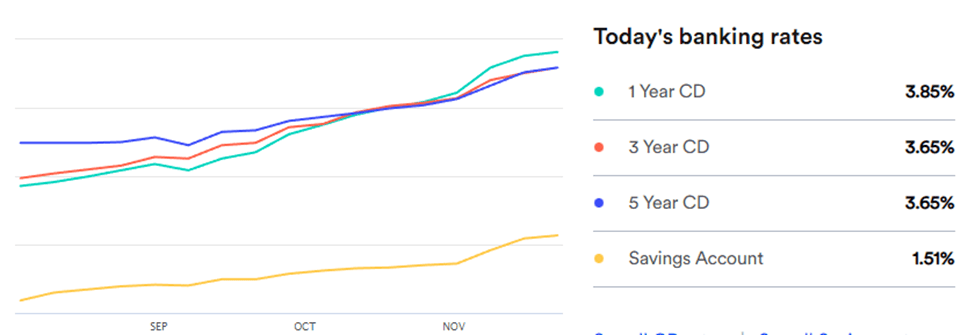
Currently, the average savings account is paying 1.51%, up from 1.13% last month. A nice jump and much better than the 0.10% the banks were paying us just about a year ago.
The 1-year CD interest rate is now averaging 3.85%, up from 3.21% last month. The 5-year CD rate is currently at 3.65%, up from 3.17% last month. These rates are inverted, just like the yield curve, meaning they are paying a higher rate to borrow your money for a shorter time period, which isn’t normal. These inversions typically do not last longer than six months. CDs are becoming a nice alternative for risk-averse investors and have drawn money away from stocks because of these decent rates that carry virtually no risk. I wouldn’t mind if these rates stayed this high but then that means that inflation is staying high as well, which is no good in the long run.
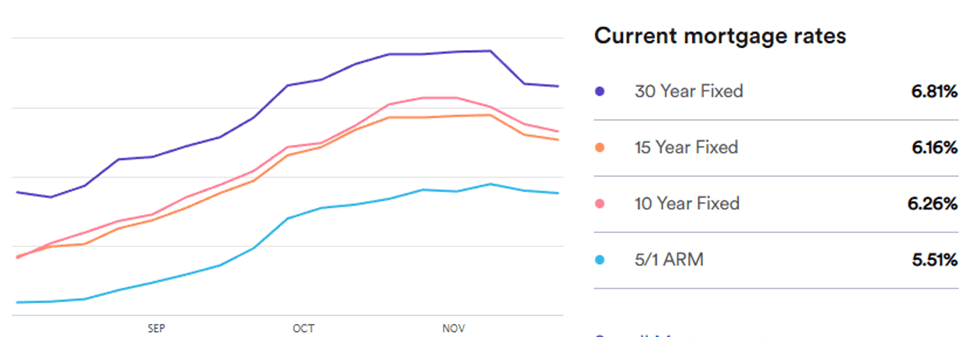
Mortgage rates appear to have peaked in November and are starting to roll over (see chart below). Currently, the 30-year rate sits at 6.81%, down from 7.20% a month ago. Home prices continue to fall across the country as buyers shun the larger mortgage payments for both new and existing homes. Mortgage applications are down 41% from one year ago. Home builders were even offering Black Friday discounts to lure new homebuyers in November. Home prices peaked in June and now it has quickly become a buyers’ market in the U.S. Even more incentive for the Fed to pause rate hikes.
Oil prices headed back down in November even with OPEC and Russia promising to cut production. For the month, the price for a barrel of oil settled at $80.59, $6 less than it was at the beginning of November. For the year, oil is now up only about 4.5%.
The downward trend in oil prices is largely due to the worldwide recession that we are currently in. The good news is that these lower prices should help in reducing producer costs and subsequently, consumer prices.
Gasoline prices fell again throughout November, continuing their downward trend since early summer. Regular unleaded gasoline is now averaging $3.50 per gallon, down $0.26 from last month. A handful of states are below the $3 per gallon mark, with Texas having the cheapest gas, at $2.85 a gallon. Hawaii has the most expensive gasoline at $5.20 per gallon. FYI, a year ago, we were paying $3.40.
Check out the prices at the pump in your area: AAA Gas Prices.
Outlook
Events on the horizon that could move the markets in the near term:
- Fed & Inflation: The Fed raised short-term rates by another 75 basis points at their last meeting in November as expected, but it’s what they said afterwards that helped boost stock and bond prices. There was more consensus among its members to reduce the magnitude of the rate increases going forward. So, maybe just raising 50 basis points in December versus the 75 that they had been planning is their goal. The data coming in keeps pointing to inflation already peaking so a change in the Fed strategy could be coming this month when they meet for the last time of the year, which could spark an end-of-year rally for stocks and bonds.
- Mid-Term Elections: Republicans were able to take over the House of Representatives (HOR) but could not do the same in the Senate, surprisingly. Still, having a split Congress will create political gridlock between the Capitol and the White House. This means that there will probably be no changes in tax laws, trade laws, and other issues that could affect the economy in a major way. This always bodes well for stocks because it removes the uncertainty of what the government can change.
- Russia Invasion of Ukraine: Russia has stepped up attacks on Ukraine’s infrastructure, knocking out critical energy and water supplies for the battered country. Still, Ukraine states that 70% of their power needs are being met, which is good news. I feel like Putin has gone too far at this point to call it quits. So, it looks like he’ll take this mess through the winter in hopes of breaking the spirit of the Ukraine people. They won’t give in, based on what I’ve seen from them. In the end, the wild card is Putin and what he might resort to if he thinks he can’t win this war conventionally. This is a big, ongoing uncertainty for the markets.
- Supply Chain Status: According to some data, it’s back to normal. The Kansas City Fed shows that the outlook for supplier delivery time has hit its lowest level on record. This is great news. Of course, we have something else to worry about now: a national railroad strike. This could happen in early December and could cost the U.S. economy about $2 billion a day. Plus, we are in the midst of a huge diesel fuel shortage, which affects ships, trucks, and trains in the supply chain. To summarize, we are still not out of the woods on fixing our supply chains, but they are getting better.
Joe Baker, CFP®
Baker Asset Management, LLC
joebaker@bakerassetmanagement.com

