
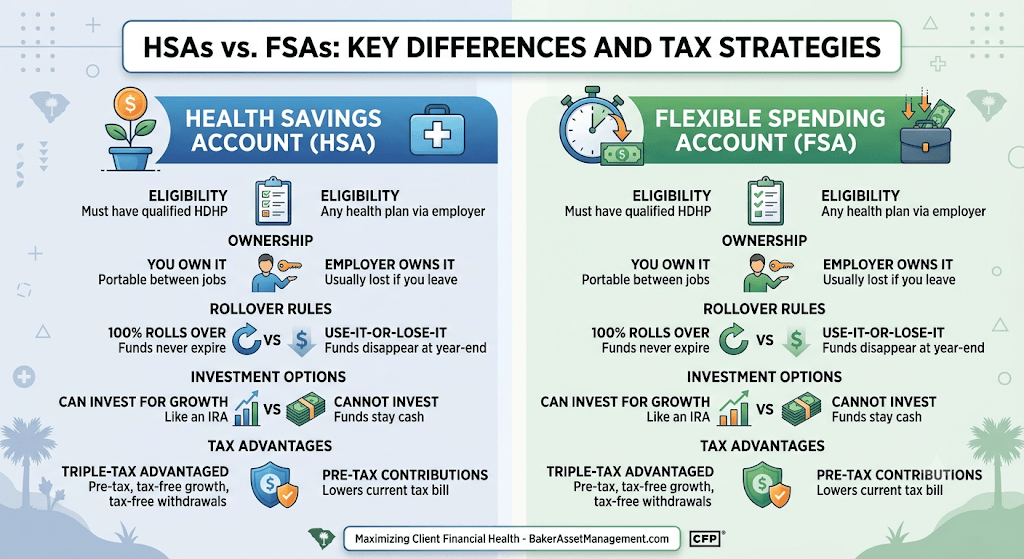
Back in May, I broke down the powerful wealth-building advantages of Health Savings Accounts (HSAs). While that post focused strictly on HSAs, today I want to compare them directly with Flexible Spending Accounts (FSAs). Both accounts allow you to pay for qualified medical expenses using tax-free dollars, but their underlying rules governing ownership, rollover capabilities, and investment growth potential make them vastly different financial tools.
Understanding how to leverage each account—and navigating the updated limits—can significantly lower your annual tax bill while building a dedicated reserve for future medical costs.
HSAs vs. FSAs At-a-Glance
While both accounts deliver immediate tax relief, their structure and long-term utility differ substantially:
| Feature | Health Savings Account (HSA) | Flexible Spending Account (FSA) |
| Health Plan Requirement | Must be enrolled in a qualified High Deductible Health Plan (HDHP). | Available with most employer-sponsored health plans. |
| 2026 Contribution Limit | $4,400 (Self-Only) / $8,750 (Family) | $3,400 per employee |
| Catch-Up Contribution (Age 55+) | Additional $1,000 annually | Not applicable |
| Account Ownership & Portability | You own it. Retained if you change jobs or retire. | Employer owns it. Generally lost upon job departure. |
| Unused Funds Rule | 100% Roll-Over. Balances accumulate indefinitely. | Use-It-or-Lose-It. Subject to carryover caps or grace periods. |
| Investment Options | Funds can be invested in stocks, bonds, and mutual funds. | Cash-only holding account (no investment component). |
The Triple-Tax Advantage of the HSA: The Ultimate Stealth Wealth Tool
For taxpayers looking to maximize tax efficiency, an HSA is often superior to traditional retirement accounts due to its unique triple-tax advantage:
- Tax-Deductible / Pre-Tax Contributions: Contributions made via payroll deduction reduce your gross income (and bypass FICA taxes) or can be claimed as a deduction on your income tax return.
- Tax-Free Growth: Capital gains, dividends, and interest generated inside an HSA grow completely free of federal and state income taxes.
- Tax-Free Withdrawals: Distributions used for qualified medical expenses—ranging from doctor copays to dental care and prescription eyewear—are tax-free at any age.
Strategic Retirement Angle: Once you reach age 65, an HSA functions similarly to a Traditional IRA. You can withdraw funds for non-medical expenses subject to standard income tax without penalty. However, if used for medical expenses in retirement, distributions remain 100% tax-free.
Navigating the FSA “Use-It-or-Lose-It” Trap
Flexible Spending Accounts are valuable employer-provided benefits, but they carry strict timeline constraints. If you do not spend your allocated FSA dollars within the plan year, you risk forfeiting those funds back to your employer.
Employers typically choose one of two relief mechanisms allowed by the IRS:
- The Carryover Provision: Employers may allow employees to carry over up to $680 of unused 2026 FSA funds into 2027.
- The Grace Period Provision: Employers can grant up to 2.5 additional months (typically until March 15th) following the end of the plan year on December 31st to spend remaining funds.
Note: Employers are permitted to offer either the carryover option OR the grace period, but not both.
Actionable Tax Strategies for Individuals and Business Owners
1. The HSA “Shoebox Strategy” (Long-Term Compounding)
If your cash flow permits, pay current out-of-pocket medical expenses using external cash rather than tapping your HSA. Save and digitize every medical receipt. Because the IRS imposes no time limit on when you must reimburse yourself from an HSA, you can let your HSA balance compound tax-free in growth investments for 10 to 20 years, then reimburse yourself tax-free in retirement using your saved receipts.
2. Confirm HDHP Qualification Rules for 2026
To contribute to an HSA in 2026, your health insurance plan must meet specific minimum deductible thresholds:
- Self-Only Minimum Deductible: $1,700 (Max Out-of-Pocket: $8,500)
- Family Minimum Deductible: $3,400 (Max Out-of-Pocket: $17,000)
3. Utilize a Limited-Purpose FSA Alongside an HSA
If your employer offers a Limited-Purpose FSA (restricted strictly to vision and dental expenses), you can contribute to both an HSA and an FSA simultaneously. This preserves your full HSA balance for long-term investment while funding predictable vision and dental costs with pre-tax FSA dollars.
4. Maximize Contributions Before the Tax Filing Deadline
You have until the federal tax filing deadline (typically April 15th) of the following year to make prior-year HSA contributions.
The Bottom Line
While an FSA is a practical tool for funding immediate, predictable healthcare costs within a single calendar year, an HSA is a powerful wealth-building instrument that should be integrated directly into your long-term retirement and tax strategy.
Please comment or send an email if you have any questions.
Joe Baker, CFP®
Baker Asset Management, LLC
joebaker@bakerassetmanagement.com

