
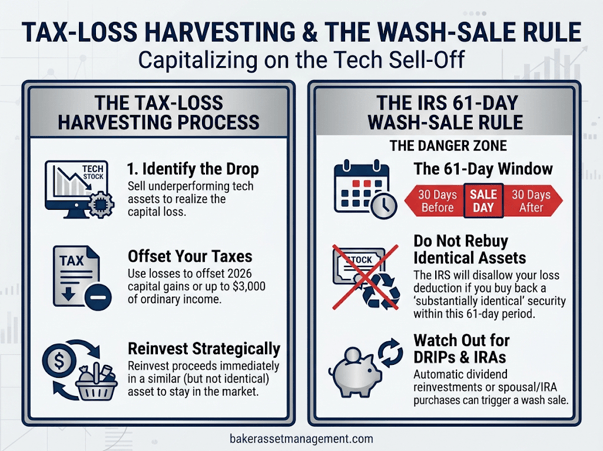
The recent sell-off in the stock market, particularly the tech sector, has created a strategic window to lower your 2026 tax bill by harvesting capital losses. However, to actually realize these tax savings, you must strictly navigate the IRS wash-sale rule to avoid disqualifying your deductions.
How the Strategy Works
Tax-loss harvesting means selling underperforming positions at a loss. Those losses first offset capital gains realized this year, and short-term and long-term gains and losses are netted under IRS rules. If losses exceed gains, up to $3,000 of the excess ($1,500 if married filing separately) can offset ordinary income, and the rest carries forward to future years. To count for 2026, the sale must be completed by December 31, 2026. If you want to keep your exposure to the market for a possible rebound, you can’t simply sell at a loss and buy the same security right back.
The 61-Day Wash-Sale Window
Under the wash-sale rule, your loss is disallowed if you buy a “substantially identical” security within a 61-day window: 30 days before the sale, the day of the sale, and 30 days after. The window can span year-end, so a repurchase in early January can still wash a late-December sale.
If the replacement shares are bought in a taxable account, the disallowed loss is deferred rather than lost. It is added to the cost basis of the new shares, and the holding period carries over. If the replacement shares are bought in an IRA or Roth IRA, however, the loss is permanently forfeited. Under Rev. Rul. 2008-5, the IRA gets no basis increase, so you can never recover the deduction.
How to Maintain Market Exposure Compliantly
To harvest a loss without triggering a wash sale, move into a similar but not identical investment. For example, you could sell a specific stock or mutual fund at a loss and put the proceeds into a broad ETF that tracks a different index. This keeps you invested while preserving the tax benefit.
Be careful, though. “Substantially identical” is a facts-and-circumstances test that the IRS has never precisely defined. Publication 550 says securities of different corporations are generally not substantially identical, and funds tracking different indexes are commonly treated as distinct. A replacement fund with nearly the same holdings as the one you sold is a gray area, and swapping one S&P 500 fund for another is the classic risky case.
Compliance Checks Before You Trade
- Turn off DRIPs: Automatic dividend reinvestments within 30 days before or after your sale count as purchases and can wash part of your loss. Also watch for other automatic buys, such as 401(k) contributions, ESPP purchases, or RSU vesting.
- Monitor all related accounts: The rule reaches beyond the account where you sold. A wash sale can be triggered if your spouse buys the same security, if you buy it in your IRA (or your spouse’s), or if an entity you control buys it.
- Wait 31 days: To get your original position back, wait until day 31 after the sale to repurchase it.
Please comment or send an email if you have any questions.
Joe Baker, CFP®
Baker Asset Management, LLC
joebaker@bakerassetmanagement.com

