When We Can Return To Normal

I’m writing about the covid vaccine progress again because it is still the most influential force on, not only the financial world, but on humanity itself. We are almost a full year into this pandemic and everyone wants to get back to some sort of normalcy. There has been some nice progress towards this goal already in 2021 with vaccine shots in the arm going in at a rate of 4.7 million per day worldwide and 1.5 million per day in the U.S. Big props to the health care workers and everyone working in the vaccine supply chain for cranking these shots out!

The road to getting back to normal is built on herd immunity. This occurs when enough people become immune to covid to make its spread unlikely.  The percentage of the population that becomes immune to the disease, whether through vaccination or previous infections, has to reach about 75%, according to infectious disease experts.

There is a great site administered by Bloomberg that allows us to track the vaccination rate and when we can get to herd immunity. For instance, the UK can get to herd immunity in about 6 months based on their current rate. For Indonesia, Russia, and Canada, the timeline is more than 10 years 😳.

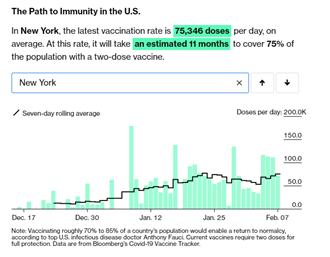
For the U.S., it will take about 10 months to get a 2-dose vaccine into 75% of our population. This timeline should decrease as we continue to ramp up the inoculation rate. Also, with the Pfizer vaccine being just a 1 dose remedy, this should help reduce this timeline immensely once it gets approved (hopefully soon!).

You can even drill down to see when your state will hit herd immunity. Here is New York:

If we can jack up the vax rate as expected, we should be looking at some kind of normal in the early fall (pleeeease!).

Let me know if you have any questions.

Joe Baker, CFP®

Baker Asset Management, LLC

joebaker@bakerassetmanagement.com

Monthly Update – February 2021

Fun Facts about February

  • Birthstone: Amethyst
  • Flower: Primrose
  • Zodiac signs: Aquarius and Pisces
  • February was added to the Roman calendar in 713 BC. The length of the month changed over time and, at one time, it had as few as 23 days. When Julius Caesar remade the Roman calendar, the month was assigned 28 days during normal years and 29 days during leap years which occur every four years. 2020 was our last leap year.
  • In the Southern Hemisphere, February is a summer month the equivalent to August.
  • The month is named for the Latin word, februum, which means purification.
  • February is Black History month.
  • Notable days in February include: Groundhoug, Valentine’s, President’s, Mardi Gras, and Ash Wednesday.

Stocks took a breather in January after a nice run to close out 2020. The S&P 500 index slid down by 1% to start off 2021.

Vaccine rollout is starting to smooth out with help from the new administration and the private sector. Also, the big drops in covid cases across the country is positive news for the stock market as well. Still, there are some negative forces that are putting a damper on stocks. One is the variant strains of the virus that are popping up across the globe that may be more resistant to the current vaccines. Another is the insane market action in the most heavily shorted stocks, such as Gamestop and AMC Entertainment, to name a few. Although this is perfectly legit trading, it certainly scares investors that stock prices can be manipulated so easily. When investors are scared, they sell. The good news (except for the holders of these stocks) is that this will be short lived.

Take a look at the Outlook section below to see what events could move the markets over the short term.

Bond prices dropped for a second straight month in January as rates rose on good news of more vaccine rollouts. If you are a bond buyer and this trend continues, try and keep your bond maturities short, no more than 2 years, to reign in some of the risk in your portfolio.

The 10-year US Treasury note is yielding 1.09% and the 30-year bond is at 1.86%, both higher from last month. Who’s buying these bonds with such low interest payments? Just not worth it for me.

Interest rates climbed a bit in January as hopes of an economic rebound gained footing with the increased deployment of covid vaccines throughout the country. Even with this bump in rates, they are still extremely low, which is great for borrowers but just horrible for savers.

On the savings side, most rates remained relatively flat over the last month despite a rise in government bond rates.

Currently, the average savings account is paying 0.28%, slightly lower than last month. Although it is safe, it’s not the place to put all of your retirement savings, that’s for sure.

The 1-year CD interest rate is now averaging 0.53%, the same it was yielding a month ago. The 5-year CD rate is flat as well, now at 0.69% from 0.70%.

As of December 2020, the average savings rate across the U.S. is 13.7%, which is about twice the normal rate but much lower than the high it reached back in April of 34%. The money saved by staying home due to the pandemic is keeping this savings rate elevated for the time being. We should see this drop over the next couple of readings since the rate will account for holiday spending and holiday travel expenses. Here is a great chart that shows the average U.S. savings rate all the way back to 1959. You’ll see that our current savings rate hasn’t been consistently this high since the mid 70’s.

Mortgage rates continue to remain incredibly low, which is great news for home buyers, real estate investors and refinancers. Currently, the 30-year rate is at 2.86%, 9 basis points lower than a month ago. Demand remains very strong for homes as inventories continue to diminish. It is definitely a seller’s market in the housing sector as these low rates are enticing first time homebuyers as well as city workers moving out to the burbs in response to work-at-home options.

Oil prices ticked higher again for the third consecutive month as the global economy tries to get back on track. U.S. crude went up about 8% in January. One reason for the increase is the high probability of an output cut by OPEC in February.

Travel is continuing to pick up, especially by air, and as more vaccines get into people’s arms, the more confident people will be to travel, which should boost prices even more.

Gasoline prices moved higher in December, as expected. Prices at the pump are averaging about $2.42 per gallon, about 17 cents higher than a month ago. Mississippi has the cheapest fuel again, at $2.11. FYI, a year ago, we were paying $2.50.

Check out the prices at the pump in your area: Gas Buddy.

Outlook

Events on the horizon that could move the markets in the near term:

  • More Stimulus: Even though the democrats control both houses of Congress and the White House, it will still be difficult to pass a bipartisan covid relief stimulus package. There is definitely consensus that more needs to be done but how much is the hurdle that they have to overcome to get something passed soon. If they can get something done, it could give the markets the boost that it needs.
  • Coronavirus: We saw the spike in January that we expected after the holidays. But now, positive cases are dropping significantly and hopefully hospitalization and death rates will follow. I recently blogged about progress on the vaccine front. You can read about that here. As I said earlier, we’re getting good news on the vaccination rate but we’re also getting bad news on the mutated strains that are popping up all over the world. These positive and negative forces will continue to create market swings until we get a majority of our population vaccinated.
  • Trade Wars/Tariffs: Although very important to our economy, it sounds like this topic is going to the back burner until we get a handle on the pandemic.

Joe Baker, CFP®

Baker Asset Management, LLC

joebaker@bakerassetmanagement.com

Covid Vaccines Are Ramping Up!

We are finally starting to see some progress in getting vaccines into people’s arms. Currently, the U.S. is administering more than 1 million shots on an average day with the hopes of that increasing significantly as more vaccines are approved and produced.

Reports from across the country are indicating that we are seeing sustained reductions in new cases, more than 30% in many areas. In fact, 45 states are seeing sustained reductions in new cases. For example, California, which averaged more than 44,000 cases a day at its peak, is now adding about 25,000 cases most days.

Deaths usually follow changes in cases so we should start to see a significant drop in daily deaths and hospitalizations as well in the near future.

Here are some resources to help you track the fight to control this pandemic:

The improvements that we have seen in the last week regarding vaccinations and drops in cases and deaths bode well for the economy recovering sooner than later, particularly for the hardest hit sectors, such as the tourism, lodging, food and beverage, and airline industries, just to name a few.

Let me know if you have any questions!

Joe Baker, CFP®

Baker Asset Management, LLC

joebaker@bakerassetmanagement.com

You Can Still Reduce Your 2020 Taxes

2020 is in the rearview mirror but there is still time to reduce your taxable income for last year:

Make a tax-deductible contribution to your IRA.

If you qualify, an IRA contribution can be a great way to reduce your 2020 taxes.  You are allowed to contribute up to $6,000, or even more if you are an old-timer like me: $7,000 for people age 50 and over. You basically just have to be still working (have earned income) to qualify to make an IRA contribution.

Plus, if you are married, you can double up the amount with a spousal IRA.

If you are not covered by a retirement plan at work, you can deduct the full amount of your contribution, regardless of how much money you make.

If you do have a retirement plan at work, there are restrictions and limitations to qualify for the full deduction.  Here’s a table that summarizes these rules. They are confusing so feel free to shoot me an email with any questions.

2020 Traditional IRA deduction limits

Filing StatusModified adjusted gross income (MAGI)Deduction Limit
Single individuals≤ $65,000Full deduction up to the amount of your contribution limit
> $65,000 but < $75,000Partial deduction
≥ $75,000No deduction
Married (filing joint returns)≤ $104,000Full deduction up to the amount of your contribution limit
> $104,000 but < $124,000Partial deduction
≥ $124,000No deduction
Married (filing separately)*Not eligibleFull deduction up to the amount of your contribution limit
< $10,000Partial deduction
≥ $10,000No deduction

If you’re self-employed, you can sock away a lot more by opening up a Simplified Employee Pension (SEP) plan before filing your taxes.  For 2020, you can contribute up to $57,000, depending on your income.

Let me know if you have any questions!

Joe Baker, CFP®

Baker Asset Management, LLC

joebaker@bakerassetmanagement.com

Paying The Tax On Your Covid IRA Withdrawal

If you were one of the many millions of people in the U.S. that were financially affected by the Covid pandemic in 2020, then you had the option of withdrawing money from your IRA, 401k, or other retirement plan, without penalty, to help with that. However, if you did take advantage of this opportunity, you still have to pay taxes on that money.

The Coronavirus Aid, Relief, and Economic Security (CARES) Act that was passed in 2020 allowed you to withdraw up to $100,000 from your retirement plan(s). It also allowed you to spread that distribution over 3 years to minimize the tax consequences. So, for instance, if you withdrew $75,000 from your IRA in 2020, you could spread that “income” over 3 years (2020, 20221, and 2022) to minimize the tax consequences. Also, it does not need to be spread evenly over those 3 years, either. You can wait until you file your 2022 taxes before claiming that distribution as income if you want.

If you want to minimize your taxes, you have to figure out if your income is going to be much different in any of those 3 years. For example, if you think 2020 will be your lowest income year, then you should claim the biggest chunk of your distribution in 2020, without bumping you into the next tax bracket.

If you don’t want to pay any taxes, all you have to do is pay back into your IRA the amount that you withdrew before you file your taxes in 2022. You can pay it back little by little or all at once.

You should definitely consult with a tax expert to help you figure out your plan of action.

Please let me know if you have any questions.

Joe Baker, CFP®

Baker Asset Management, LLC

joebaker@bakerassetmanagement.com

Monthly Update – January 2021

Happy New Year! (and good riddance 2020)

Fun Facts about January

  • Birthstone: Garnet
  • Flower: Carnation
  • Zodiac signs: Capricorn and Aquarius
  • January was named after the Roman god Janus. Janus is also the Roman word for door. The god, Janus, had two faces which allowed him to look forwards into the coming year and backwards into the past year.
  • On average, it is the coldest month of the year in the Northern Hemisphere.
  • In the Southern Hemisphere January is a summer month the equivalent of July.
  • Martin Luther King Jr. Day is always on the 3rd Monday in January (January 18th this year).

Stocks continued their post-election/vaccine/Santa Claus rally in December after a huge November bounce. The S&P 500 index 4% for the month of December and finished the year at a very impressive 16%, especially for 2020!

I think that we saw a healthy appetite for stocks again this past month because of a few things. First, we saw vaccines go into people’s arms, which signaled there will be an end to this pandemic. Second, the election was certified at the beginning of December, providing more certainty for the markets. Seasonal factors also came into play, such as buying sprees by consumers for the holidays. This usually helps stocks in December. In fact, historical data shows that the last month of the year is the third best month to invest in the stock market.

Take a look at the Outlook section below to see what events could move the markets over the short term.

Bond prices dropped mildly through December as rates rose on good news of the vaccine rollouts. Long-term treasury bonds took the biggest hit as the yield curve attempts to normalize itself. This means that rates on bonds with longer maturities are higher than rates on short-term bonds, which makes sense, hence the term, normal. If you are a bond buyer and this trend continues, try and keep your bond maturities short, no more than 2 years, to reign in some of the risk in your portfolio.

The 10-year US Treasury note is yielding 0.92% and the 30-year bond is at 1.65%, both higher from last month. For reference, the interest rate on the 10-year dropped 50% in 2020 and the 30 year dipped about 30% in the same time period. It was a great year to own bonds if you had the intestinal fortitude for it.

Interest rates reversed course from November and did a nice, slow rise throughout December. Even with this bump in rates, they are still extremely low, which is great for borrowers but just horrible for savers.

On the savings side, most rates changed very little over the last month despite a rise in government bond rates.

Currently, the average savings account is paying 0.31%, slightly lower than last month. Although it is safe, it’s not the place to put all of your retirement savings, that’s for sure.

The 1-year CD interest rate is now averaging 0.53%, nearly the same as the 0.52% it was yielding a month ago.  The 5-year CD rate is flat as well, now at 0.70% from 0.71%.

As of October 2020, the average savings rate across the U.S. is 13.6%, which is about twice the normal rate but much lower than the high it reached back in April of 34%. The money saved by staying home due to the pandemic is keeping this savings rate elevated for the time being. We should see this drop over the next couple of readings since the rate will account for holiday spending and holiday travel expenses.

Mortgage rates continue to remain incredibly low, which is great news for home buyers, real estate investors and refinancers. Currently, the 30-year rate is at 2.95%, just slightly higher than a month ago. Demand remains very strong for homes as inventories continue to diminish. It is definitely a seller’s market in the housing sector as these low rates are enticing first time homebuyers as well as city workers moving out to the burbs in response to work-at-home options.

Oil prices rose again for the second month in a row but couldn’t quite replicate the huge jump that they had in November. Still, U.S. crude went up about 6% in December but is still down 22% for the year. That’s not bad after the price being below zero back in April.

Travel is starting to pick up, especially by air, and the hope that the vaccines will bring us to the light at the end of the pandemic tunnel has caused energy prices to rise out of the abyss.

Gasoline prices moved higher in December, as expected. Prices at the pump are averaging about $2.25 per gallon, about 12 cents higher than a month ago. Mississippi has the cheapest fuel, at $1.92. FYI, a year ago, we were paying $2.58.

Check out the prices at the pump in your area: Gas Buddy.

Outlook

Events on the horizon that could move the markets in the near term:

  • GA Senate Elections: These are happening in the first week in January and they could be market movers. Like I said last month, If the republicans keep the Senate, I think the markets will like that balance of power. If the democrats take over the Senate, there is a better chance of things actually getting done in Congress, which may or may not be good for stocks over the next few months. Like the saying goes: What’s good for Main Street isn’t always good for Wall Street.
  • Coronavirus: We are still seeing a rise in hospitalizations and death rates in many parts of the nation. This makes sense since we are seeing the results of a heavy travel period during Thanksgiving weekend. Experts predict we will see another spike in January as holiday travel was relatively heavy during the last two months of December. I use this site to track these types of Covid trends: https://bing.com/covid. The great news is that we now have 2 vaccines approved for use in the U.S. You can track where we are in the vaccine process here: https://www.nytimes.com/interactive/2020/science/coronavirus-vaccine-tracker.html.
  • More Stimulus: Well, we did get a stimulus bill passed in December which was certainly helpful. However, Trump and the Democrats are asking for more payments to individuals and families. The Republicans are now in a bind. This changing sides stuff would be surprising if it wasn’t 2020. Regardless, if the millions of people that need it can get more money in their pockets for a little while longer than this would be a good thing, for them and for the markets.
  • Trade Wars/Tariffs: With a new administration coming into the White House, there is a good chance that the tariffs imposed on our imports will be removed, thus lowering U.S. companies’ costs, which will help them stay in business. This would give the markets a nice bump and it could happen rather quickly since no congressional approval is needed.

Joe Baker, CFP®

Baker Asset Management, LLC

joebaker@bakerassetmanagement.com

We Are Off And Running on Vaccinations

The world is getting the shot in the arm that it so desperately needs! Vaccinations are happening across the globe to combat the Covid pandemic and, so far, operations appear to be going relatively smoothly. A big thank you goes out to all those that prepped the entire logistics pipeline to get these vaccines out so quickly.

The U.S. has already given the first dose of the vaccination to over 614,000 people. If you want to track the vaccine rollout, this is a great site that gets updated at least daily:

Bloomberg Vaccine Tracker

The vaccine is being distributed based on state population. Here’s the latest dose allotment on a state basis (complete list can be found on the vaccine tracker link, above).

U.S. Vaccine Campaign

JurisdictionFirst doses allottedDoses administeredLast updated
U.S. official totals11,042,450614,117Dec. 21
Illinois407,62572,383Dec. 21
Chicago86,7759,383Dec. 21
California1,233,22570,258Dec. 21
Florida675,02543,716Dec. 21
Texas844,65042,248Dec. 21
New York635,77538,000Dec. 21
New York City274,20018,199Dec. 21
Colorado175,55033,934Dec. 21
Massachusetts224,27520,577Dec. 21
Puerto Rico112,07517,800Dec. 18
Pennsylvania416,52517,700Dec. 21
West Virginia60,87515,135Dec. 21
Michigan318,87513,321Dec. 20
Louisiana146,77511,498Dec. 18

These numbers are a drop in the bucket compared to what we need to get this pandemic under control, but it’s a great start. What an awesome way to end a tough year!

Please let me know if you have any questions.

Joe Baker, CFP®

Baker Asset Management, LLC

joebaker@bakerassetmanagement.com
One Of The Good Things From This Pandemic

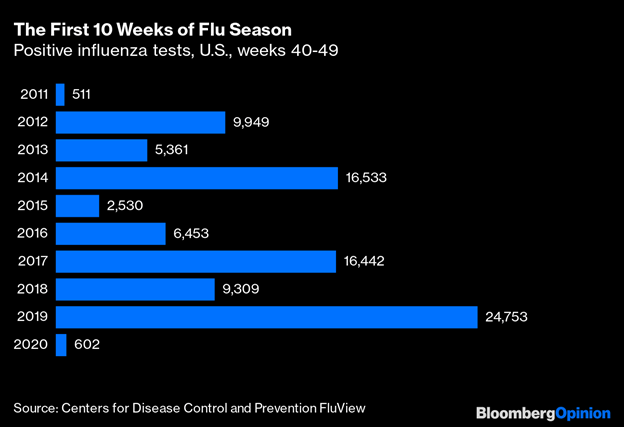
You wouldn’t think there would be many good things that come out of a pandemic like the one we are living through right now. You, of course, would be right. But there is one bright spot that we can be happy about: the mildest flu season in about a decade, so far.

It seems that all of the preventative measures that we have been taking to slow the spread of covid, such as washing hands, wearing masks, distancing from each other, etc., has worked to minimize the spread of other diseases, like the flu. Check out this chart that shows how many positive flu cases that we have had so far this flu season.

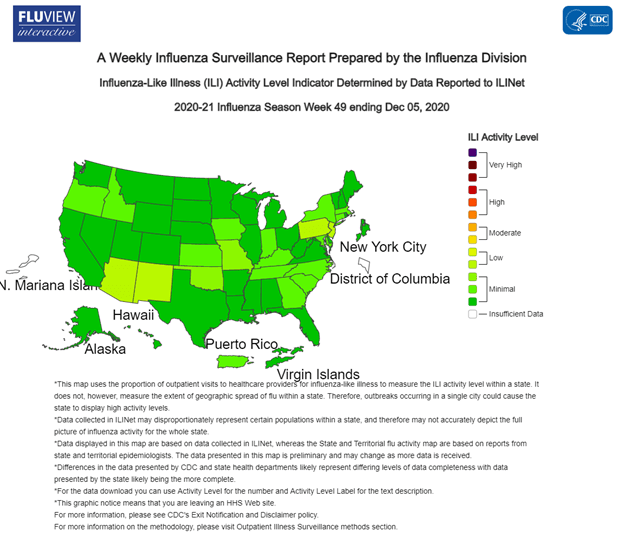
The next image depicts the amount of hospital and urgent care visits that are occurring during this flu season so far. As you can see, visits are in the minimal range, which is good.

Hopefully, we can keep our flu cases to a minimum as we continue to fight the spread of covid. This is incredibly helpful to our healthcare workers spearheading our battle with this pandemic. The big question is if these good-hygiene habits will continue in the future even with the covid vaccine readily available. That is a big IF.

Please let me know if you have any questions.

Joe Baker, CFP®

Baker Asset Management, LLC

joebaker@bakerassetmanagement.com
The Price of Power

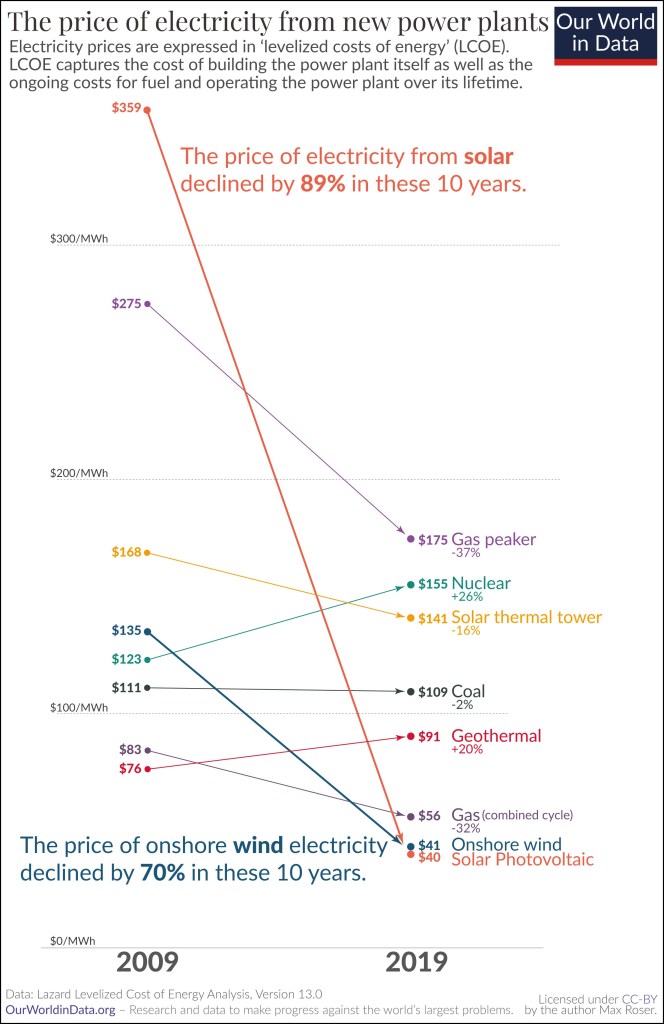
I came across the following chart (that looks like an overhead shot of the game, Ker Plunk!) very confusing) recently and wanted to share it because it is very telling regarding the tectonic shift that is taking place in the power generation industry.

The chart highlights the massive drop in the cost to produce electricity from solar – 89% in the last 10 years! The cost went from $359 to $40. Wind dropped quite a bit as well, from $135 to $41, a not too shabby decrease of 70%.

These two power sources are now so much cheaper than fossil fuels and nuclear to produce electricity. The cheapest fossil fuel, coal, is $109. That is over 270% more expensive than wind or solar. Just 10 years ago, the opposite was true. That is amazing progress.

We still have to improve our energy storage ability for times when there is no wind or sun, but these renewables are cost-effective now and will be providing a much bigger portion of our electricity needs going forward.

Please let me know if you have any questions.

Joe Baker, CFP®

Baker Asset Management, LLC

joebaker@bakerassetmanagement.com

Still Time For Retirement Plan Withdrawals Under CARES Act

There is only 3 weeks remaining in 2020 and that is all the time you have left to take advantage of the special rules enacted by the Coronavirus Aid, Relief, and Economic Security (CARES) Act regarding retirement plan withdrawals/loans.

In a nutshell the CARES Act allows IRA owners to withdraw up to $100,000 in 2020 and owe no taxes on that distribution for 3 years. Also, if it is put back into an IRA within those 3 years, no taxes will be owed.

This also applies to certain defined contribution plans, such as a 401k or 403b plan. However, it is optional for employers to adopt these new rules since they would have to amend their plans to accommodate these new changes for withdrawals and loans. So, please check with your plan administrator to see if they have adopted these changes.

You have to be a “qualified” individual to use these new withdrawal/loan rules. You are a qualified individual if:

  • You are diagnosed with the virus SARS-CoV-2 or with coronavirus disease 2019 (COVID-19) by a test approved by the Centers for Disease Control and Prevention;
  • Your spouse or dependent is diagnosed with SARS-CoV-2 or with COVID-19 by a test approved by the Centers for Disease Control and Prevention;
  • You experience adverse financial consequences as a result of being quarantined, being furloughed or laid off, or having work hours reduced due to SARS-CoV-2 or COVID-19;
  • You experience adverse financial consequences as a result of being unable to work due to lack of childcare due to SARS-CoV-2 or COVID-19; or
  • You experience adverse financial consequences as a result of closing or reducing hours of a business that you own or operate due to SARS-CoV-2 or COVID-19.

Also, if you are under the age of 59 ½, the 10% early withdrawal penalty is waived in 2020.

There will be a new IRS form, Form 8915-E, that will be used to report 2020 CARES Act plan distributions and repayments. Remember, you can spread the distribution over 3 years: 2020, 2021, and 2022. You can also do the same for the repayments if you choose to put the distributions back in to your retirement plan or IRA. If you do repay, you will not be subject to taxes on those distributions.

Please let me know if you have any questions.

Joe Baker, CFP®

Baker Asset Management, LLC

joebaker@bakerassetmanagement.com