

Calendar Notes
- Sunday, June 16th, Father’s Day
- Wednesday, June 19th, Juneteenth National Independence Day. The stock market is closed.
Stocks headed higher in May after a brief April pause. It seems that we are getting comfortable with interest rates where they are right now, and rates have been the main mover of stock prices over the last year or so. The economy certainly isn’t being bothered by high rates as evidence of a strong economy continues to show up in the data.
For the month, the S&P 500 was higher by about 4.80%. For 2024, it is up nearly 11%.
Most Q1 earnings have been reported which means the only known catalysts out there to move stocks are inflation data and the actions of the Federal Reserve.
In recent history, June has been pretty good for stocks. In fact, over the last ten years, the S&P 500 has averaged about a 1% positive return on investment. We’ll see in a month if the market can at least hit the average.
Take a look at the Outlook section below to see what events could move the markets over the short term.
Bond prices reversed course once again and moved higher in May as inflation data showed stronger signs of cooling down at a faster pace. It would be nice to string together a couple of months of this data to convince the Federal Reserve that it’s time to start cutting interest rates. Hopefully, this is the start. We will get a better read from them when they meet later this month.
The 10-year US Treasury note yield fell in May, finishing the month at 4.51%, lower than the 4.69% that it was at the beginning of the month. The 30-year bond yield closed out the month at 4.65%, lower than the 4.79% that it was a month ago.
Bond investors still need to be cautious even if the data points to rates trending lower in the near future. Therefore, bond buyers should continue to focus on bonds with short-term maturities. I would keep maturities under 18 months and just plan on holding these bonds to maturity. That way, you won’t have to worry about selling at a discount if interest rates head higher.
Savings rates fluctuated very little this past month, keeping rates at their highest levels since 2007. For many homeowners with a mortgage, it is nice when your savings account is paying more interest to you than you are paying to your mortgage lender. CDs and MMAs continue to be a great place to park your cash and your emergency fund. These rates continue to be a legitimate alternative to stocks and bonds, especially for risk-averse investors, and will keep pressure on those markets until we see this trend reverse, which looks like it will be happening much later in the year than expected.
Now, take a lookat the top rates for CDs and money market accounts (MMA):
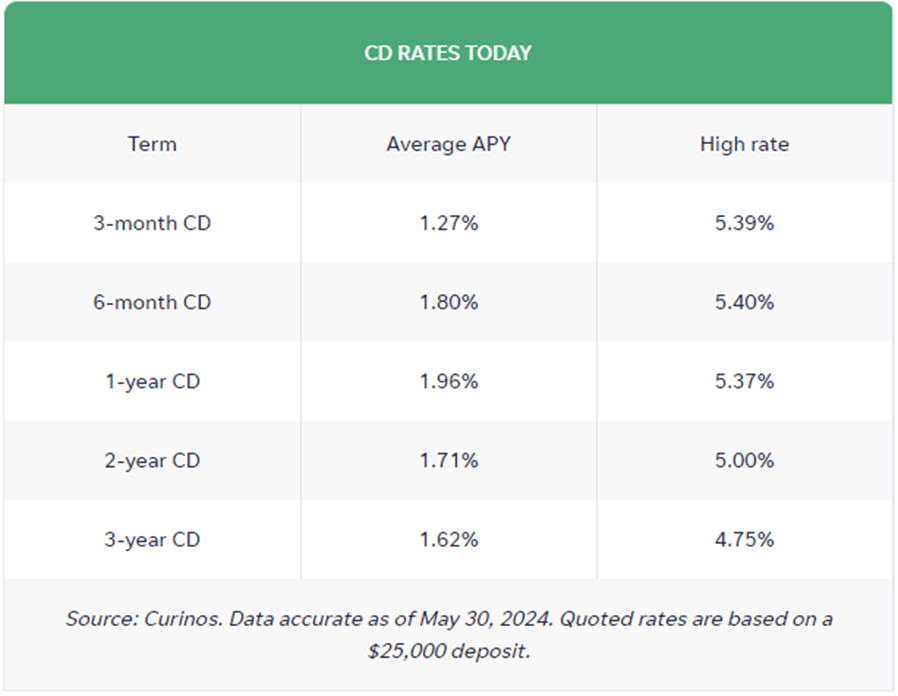
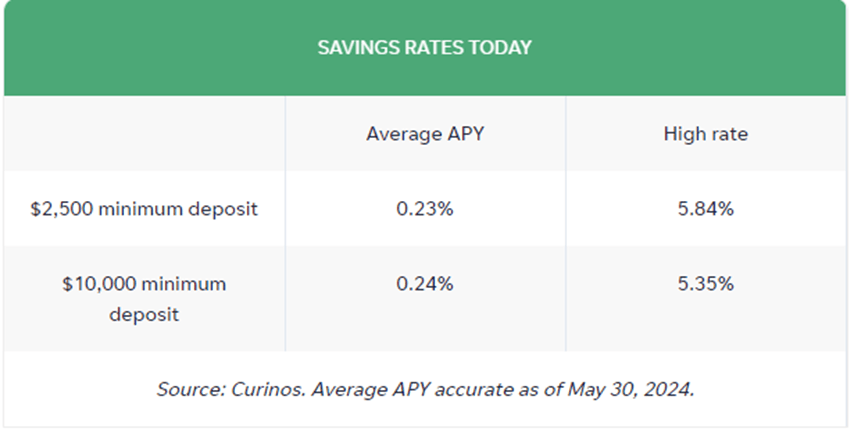
The best 1-year CD interest rate is currently at 5.37%. The best 5-year CD rate right now is around 5.40%. We finally saw the 5-year CD rate surpass the 1-year rate, albeit just barely. This is a good sign that yield curves are normalizing. Let’s hope it continues this trend.
Eventually, savings rates will normalize but not until inflation comes down enough for the Fed to feel comfortable lowering interest rates. That said, I would still put my savings or emergency spending money into short-term CDs, 1 year or less, and reevaluate when they mature. If you would rather have more liquidity, look intoan MMA (some yielding close to 6% currently). Keep the total under $250,000 per person at any one bank to ensure you are fully covered by the FDIC. CDs and MMAs have become nice alternatives for risk-averse investors and have drawn money away from stocks because of their relatively high rates that carry virtually no risk.
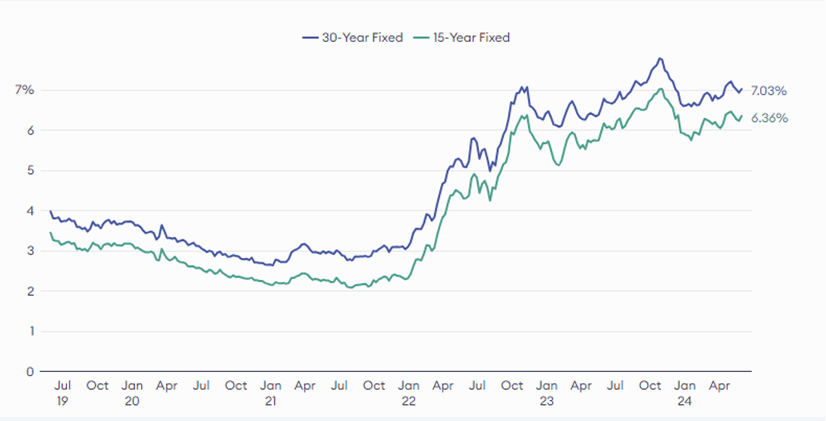
Mortgage rates dipped slightly in May as buyers and sellers vie for any advantage in the midst of the spring buying season. Currently, the 30-year rate sits at 7.03%, lower than a month ago, at 7.31%. The housing market continues to be in an unusual situation (high rates, low home inventory, strong demand) and that is making mortgage rates very volatile. Most homeowners either own their home outright or have a mortgage below 3.5%. There is very little incentive to sell a home with rates where they are right now. That will not change until mortgage rates fall. For now, the industry continues to bank on the Federal Reserve to get it squared away.
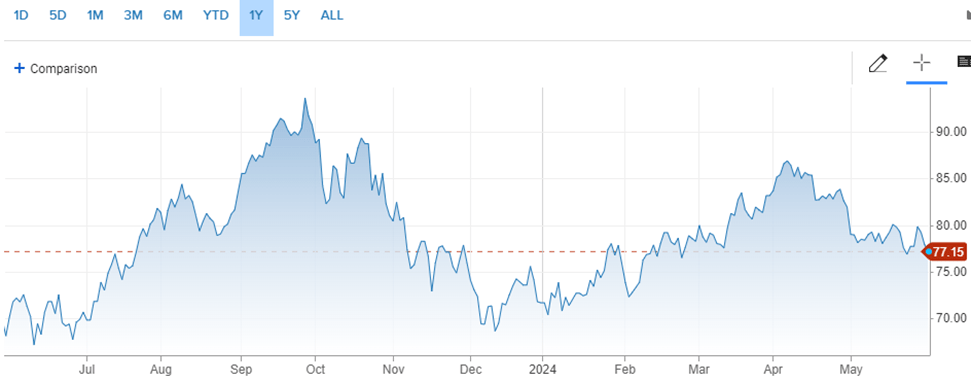
Oil prices continued lower for a second month in a row as demand wanes worldwide. It also should be noted that the dollar has weakened a bit over the last month as well, which may have contributed to some of the price drop.
For the month, the price for a barrel of oil settled at $77.21, down from $81.61 at the beginning of May. For the year, it is up about 7.6%. Although oil prices fell again this month, they are still high and are a big cause of the stubborn inflation that we are seeing in consumer prices, especially in the food and travel/leisure industries. It could be tough to get prices lower with economies worldwide continuing to chug along at a strong pace. It is a quandary that might be resolved only through demand destruction, or put another way, the cure for high oil prices is high oil prices.
Here’s a look at the one-year chart for U.S. oil:
Gasoline prices headed lower in May as gasoline demand softened despite the summer driving season ramping up. Regular unleaded gasoline is now averaging $3.56 per gallon, down from $3.66 last month. Mississippi has the cheapest gas currently, checking in at $3.03 a gallon. California has the most expensive gasoline at $5.08 per gallon. FYI, a year ago, we were paying $3.58.
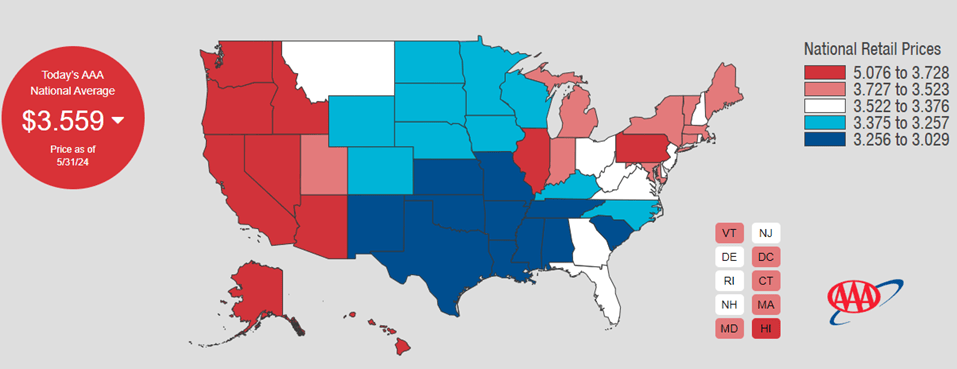
Check out the prices at the pump in your area: AAA Gas Prices.
Outlook
Events on the horizon that could move the markets in the near term:
- Fed & Inflation: Members of the Federal Reserve have been making the speaking rounds since their last meeting at the beginning of May. They meet again on June 12th and although there is little chance of a rate cut being announced at that meeting, the financial world will be listening for any hints of when a cut might happen.
I can’t see them cutting rates, through at least the summer, because the economy is just too strong right now. Consumers are still willing to spend, especially on travel, leisure, and services. Plus, the high rates aren’t having their typical effect on consumers because many households have no mortgage or one with a very low rate. Now, with elections coming up in November, the Fed will probably push out any rate cuts until after that, so as not to influence any election outcomes. So, the next few meetings can be market movers but only from what they say, since they won’t be taking any action.
Joe Baker, CFP®
Baker Asset Management, LLC
joebaker@bakerassetmanagement.com

