

Fun Facts about May
- Birthstone: Emerald
- Flower: Lily of the Valley
- Zodiac signs: Taurus and Gemini
- The month of May was named for the Greek goddess Maia. She was the goddess of fertility.
- It is the third and last full month of the season of spring.
- May in the Northern Hemisphere is similar to November in the Southern Hemisphere.
- The Kentucky Derby, the world’s most famous horse race, is held on the first Saturday of May. This year it is on May 6th.
- The Indianapolis 500 car race is on Sunday, May 28th this year.
- Memorial Day is on Monday, May 29th. All stock and bond markets in the U.S. are closed.
Stocks headed higher once again in a choppy market for the month of April. The banking crisis seems to have been quarantined to just a few banks, which is great news (except for their shareholders). Economic data is showing solid signs that inflation is dying down and that the Fed should be more worried about pushing the U.S. into a recession. Notwithstanding, earnings for Q1 are coming in pretty strong, especially for the big technology companies.
The S&P 500 rose 1.6% during the month of April and is now up 8.8% for the year with one-third of 2023 already in the books.
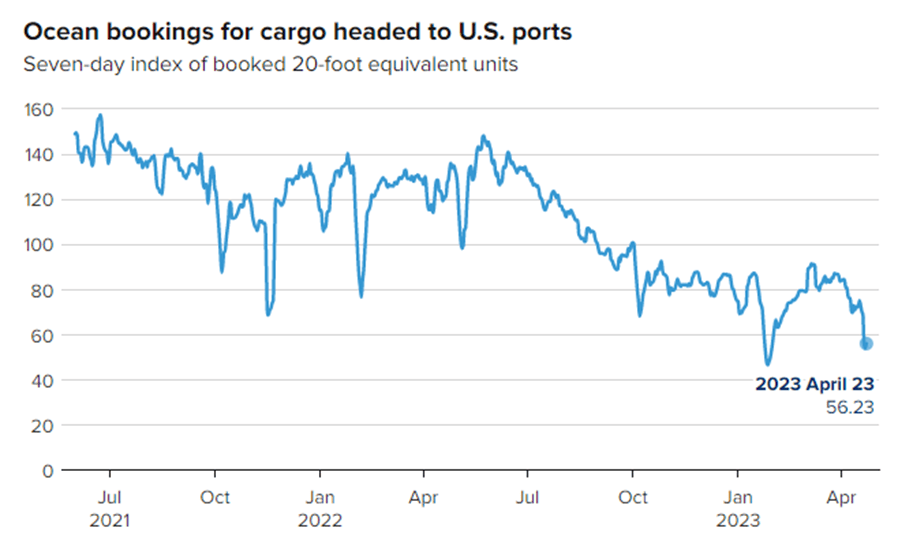
There are still a bunch of earnings coming out over the next few weeks that could shift market sentiment either way. Also, data from the freight industry are showing signs of an economic slowdown here in the states. For instance, the following chart shows the amount of freight scheduled to be shipped to the U.S. After peaking in July 2021, it has trended downward over the past two years. That said, it looks like it may be bottoming out and should head back up as companies prep for the holiday season.
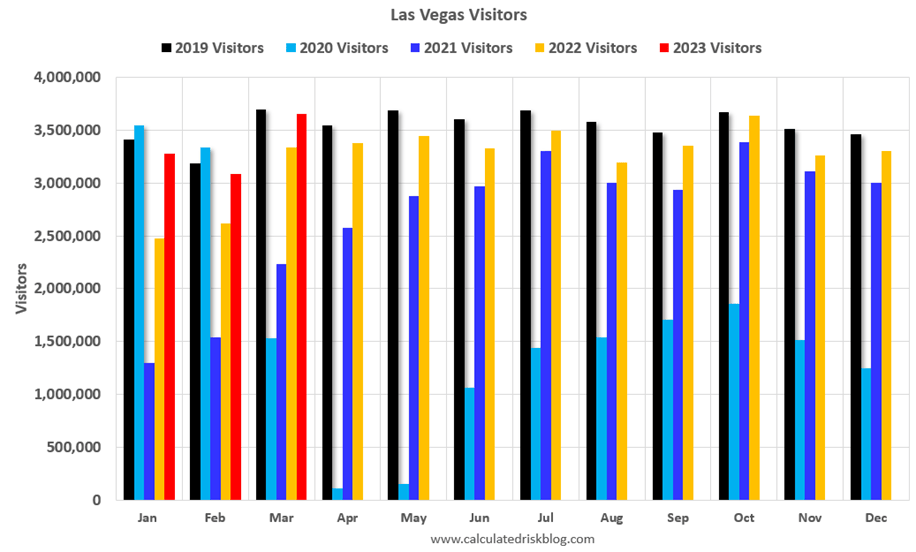
That is not the case in the travel/leisure and restaurant industries. People may not be buying stuff, but they are buying experiences. One of the best proxies to monitor these industries is to check out how many people are visiting Las Vegas. Looking at the following chart shows that we are almost back up to the pre-pandemic visitor levels.
Finally, the Federal Reserve will be meeting this week after a one-month hiatus, which should make for a very interesting week for the markets.
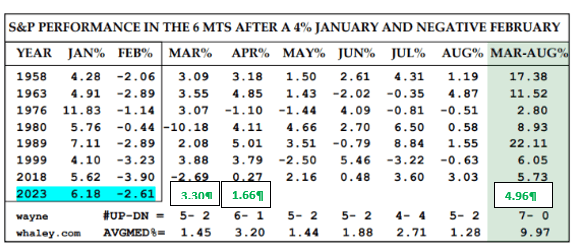
I’m leaving this table in the update through August to see if history repeats itself. There have been seven instances where a January with a 4% or higher return was followed by a negative February. 2023 is now the eighth. For each one of these years, the following six months had an average gain of almost 10%. Will 2023 keep this undefeated streak going?
Take a look at the Outlook section below to see what events could move the markets over the short term.
Bond prices moved up modestly in April, making it two months in a row of higher prices and lower yields. There is still a lot of uncertainty in the bond markets but most of that is due to the upcoming Federal Reserve meeting this week. The data is indicating that there is an economic slowdown ahead for the U.S. The Fed is seeing that and should put the brakes on any more rate increases after an expected 25 bps bump at their meeting this week. Also, another bank failure is close to happening (First Republic Bank) which always sends jitters through the bond markets, but this should be it for those.
The 10-year US Treasury note yield headed lower once again in April, closing the month at 3.43%. The 30-year bond yield moved just a touch higher, closing the month at 3.68%. These yields are still well below the short-term treasuries. For example, the 6-month T-bill is currently yielding 5.03%, confirming a strong inversion of the yield curve and one of the best indicators of an impending recession.
Bond buyers should continue to focus on bonds with short-term maturities. I would keep maturities under two years and just plan on holding these bonds to maturity. That way, you won’t have to worry about selling at a discount if interest rates head higher. By the way, this is what happened to the banks that recently failed: owned too many bonds with long-term maturities that they had to sell at a loss to cover withdrawals.
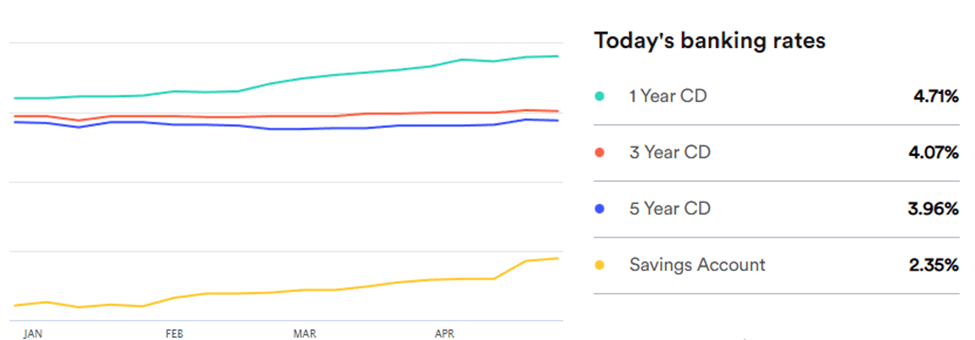
Savings rates moved higher once again in April. These rates have been getting more competitive as savers are moving their money to institutions with better interest rates. Traditional bank accounts are also having to sweeten their rates for depositors because many are moving their savings to brokerage money market accounts in the wake of the recent bank failures. Good stuff for risk averse investors and for our emergency reserves accounts.
Currently, the average savings account is paying 2.35%, up from 2.10% last month. There are some banks that are paying well over 4% right now and are worth taking the time to research.
The 1-year CD interest rate is now averaging 4.71%, up from 4.59% last month. The 5-year CD rate is currently at 3.96%, up from 3.90% last month. These rates are still inverted, just like the yield curve, meaning they are paying a higher rate to borrow your money for a shorter time period, which isn’t normal. These inversions typically do not last longer than six months. That said, if you’re looking for a place to park your savings or emergency spending money, just buy short-term CDs, 1 year or less, and reevaluate when they mature. Keep the total under $250,000 per person at any one bank to ensure you are fully covered by the FDIC. CDs are becoming a nice alternative for risk-averse investors and have drawn money away from stocks because of these relatively high rates that carry virtually no risk. I wouldn’t mind if these rates stayed this high but do not want to see them heading up much further.
Mortgage rates remained relatively flat throughout April as we await the first Federal Reserve meeting since March (see chart below). Currently, the 30-year rate sits at 6.87%, down from 6.88% a month ago. It is an unusual environment, currently. There is very little inventory out there of both new homes and of existing homes for sale. This reduces mortgage demand. But, as soon as rates drop a little, you have an uptick in demand and multiple offers on all homes for sale. Still seems like a buyers’ market in most locations, especially the southern U.S.
These rates are still the highest they have been in about fifteen years but that might not last too much longer. The fixed income markets are predicting a recession based on the inverted yield curve. If it comes to fruition, a recession would force interest rates down, including mortgage rates.
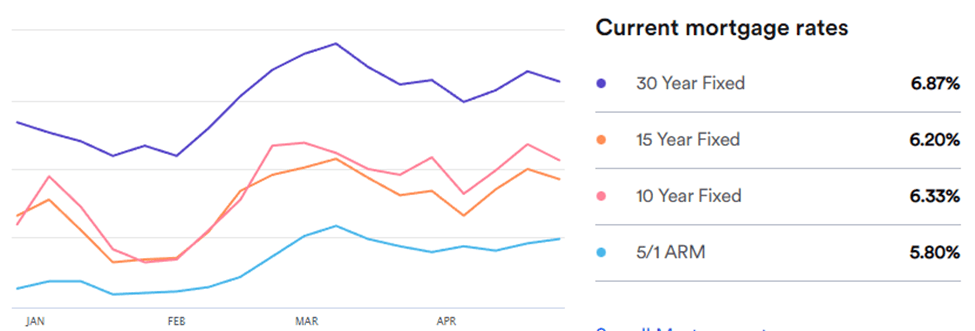
I have had to field some questions recently on the possibility of another major housing collapse like we had during the Great Financial Crisis in 2008-2009. I don’t expect anything like that in the foreseeable future. For perspective, check out the chart below:
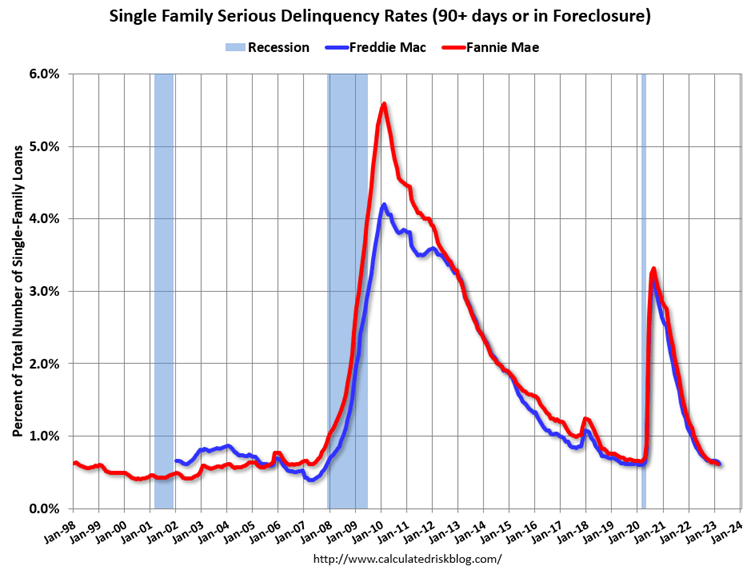
Homeowners have the most equity in their homes since they started tracking it. Currently, the delinquency rate for mortgages is at 0.62%. As you can see in the chart, the rate was much higher during the GFC and during the pandemic. The current delinquency rate will most likely worsen if layoffs continue and those with variable rate mortgages see their rates rise significantly. However, the housing market will be fine.
Oil prices crept up in April as demand has started to pick up, coupled with lower production worldwide. dropped once again in March as lighter demand continued across the globe. For the month, the price for a barrel of oil settled at $76.63, about $1.09 higher than it was at the beginning of March.
The year-to-date chart for the price of oil looks like a fun roller coaster ride!
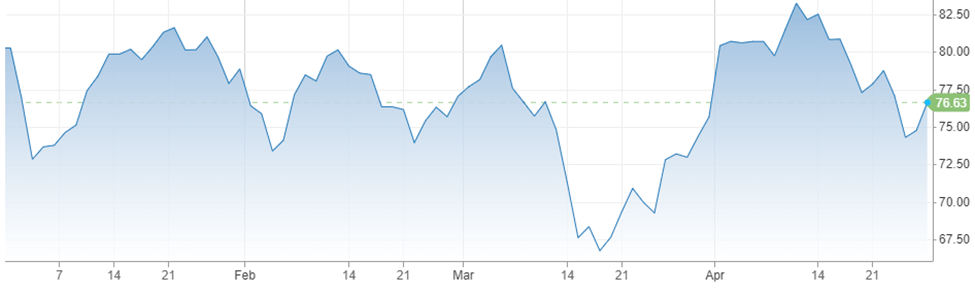
Still hoping to see prices drop into the $55 to $70 range. We may get there if the economy continues to slow.
Gasoline prices moved higher in April once again as better weather sparked an uptick in recreational driving. Regular unleaded gasoline is now averaging $3.62 per gallon, up $0.12 from last month. Mississippi has the cheapest gas for the second month in a row, at $3.10 a gallon. California has the most expensive gasoline at $4.87 per gallon. FYI, a year ago, we were paying $4.16.
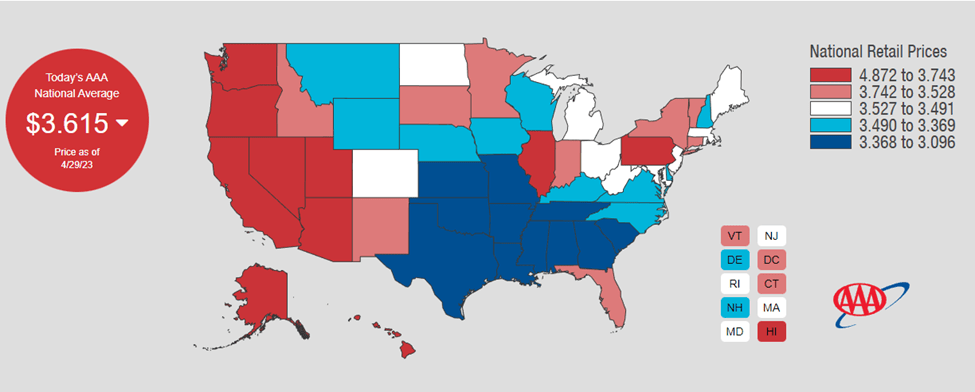
Check out the prices at the pump in your area: AAA Gas Prices.
Outlook
Events on the horizon that could move the markets in the near term:
- Fed & Inflation: It seems like every Federal Reserve meeting is the most important meeting in recent history. Well, we have one in a few days, and it probably meets this criteria once again. The consensus is that they will raise rates another 25 basis points and then pause to evaluate the data as these rate increases work themselves into the economy. As stated throughout this update, they are having their desired effect. Any deviation from the consensus outlook and we could see some big moves in the stock and bond markets.
Joe Baker, CFP®
Baker Asset Management, LLC
joebaker@bakerassetmanagement.com

