

Fun Facts about October
- Birthstone: Opal and pink tourmaline
- Flower: Calendula
- Zodiac signs: Libra and Scorpio
- October’s name comes from the Latin word octo, meaning “eight.” This month had originally been the eighth month of the early Roman calendar.
- October is the first full month of the autumn season in the Northern Hemisphere. Its Southern Hemisphere equivalent is April.
- October 4th marks the start of Yom Kippur, at sundown.
- October 10th is Columbus Day, a federal holiday, and is observed on the second Monday in October. It was on October 12, 1492, that Christopher Columbus landed on a small island in the Bahamas, convinced that he had reached Asia.
- October 10th is also Indigenous Peoples’ Day —a holiday that celebrates the history and cultures of indigenous peoples native to the United States.
- October 31 is Halloween (All Hallows’ Eve)!
Stocks had a brutal September, not to mention bonds, commodities, crypto, and real estate. The fear of a recession due to the Federal Reserve hiking interest rates too much made investors just throw in the towel and hit the sell button. When it was all said and done, the S&P 500 dropped nearly 10% in September. For the year, it is down nearly 25% and all hopes for a year-end rally now hinge on the Fed.
Stocks all of a sudden have some worthy competition that they haven’t had since 2007: bonds. Yields of risk-free U.S. government bonds that mature in two years or less are at or near 4.2% currently. That’s a huge increase from just a year ago when they were yielding about 0.75%. This is enticing investors to sell stocks and buy bonds. Add that to the fears of a Fed-induced recession and you have a gloomy scenario in place for the stock market.
Wages seem to be the biggest concern for the Fed. Unemployment is down to pre-pandemic levels (that’s a good thing, right?) so it’s an employee’s market. Employers have to raise wages to recruit/retain employees right now. More wages mean more people are willing to pay higher prices for groceries, cars, etc. Fortunately, we are seeing lower input costs for consumer goods, especially regarding transport costs (fuel, shipping rates, etc.). I’m cautiously optimistic that the Federal Reserve will take a step back at the end of the year and reassess their rate-hiking strategy to make sure that they don’t overshoot and drive us into a full-blown recession.
Q3 earnings will start coming out in a few weeks and it will be interesting to hear companies’ opinions on how the rate hikes have affected and will affect their businesses.
Take a look at the Outlook section below to see what events could move the markets over the short term.
Bond prices continued to sink as interest rates rose worldwide in September amid inflation fears. Even owners of government bonds that mature in a few years want out and are selling, indicating that there’s no safe haven in these markets.
The 10-year US Treasury note continued to ride the inflation wave up, almost touching 4% at one point, but eventually ending September at 3.80%. The 30-year bond almost yields the same as the 10-year, at 3.78%, ending the month higher as well.
If you are buying individual bonds, especially high-yield, or junk bonds, make sure you do your research before buying. Companies issuing bonds paying higher interest rates could be subject to default more easily if they are not managed well and are having a hard time making money in this economic environment. I would try to stick to government-issued bonds or bonds issued from high quality companies with strong cash flow and balance sheets, even though you will be getting a smaller interest payment than from junk bonds. I would avoid bond mutual funds or ETFs with no maturity date in this interest rate environment.
Savings rates continue to climb (11 months in a row!) as interest rates rise across the board. We’re finally getting paid something to put our money in money market and savings accounts.
Currently, the average savings account is paying 1.02%, up from 0.86% last month. Not great, but better than the 0.10% the banks were paying us just about a year ago.
The 1-year CD interest rate is now averaging 2.80%, up from 2.34% last month. The 5-year CD rate is currently at 2.97%, up from 2.70% last month. They are getting to a pretty decent rate for risk-free returns, at least the one-year CD anyway. I would like to see the 5-year at 4.25% to be worthwhile, in my opinion.
Mortgage rates continued their march higher, in step with other lending rates. They reached their highest levels of the year in September, even as demand wanes for new home loans and refinanced mortgages. Currently, the 30-year rate sits at 6.83%, up from 5.93% a month ago. Home prices continue to fall across the country as buyers shun the larger mortgage payments for both new and existing homes. I would think mortgage rates have to be leveling off due to weak demand, but I said the same thing last month and they are still heading higher. Over the last 50 years, rates are still lower than average, but they are the highest they’ve been since 2008. Rates might peak pretty soon if demand for mortgages continues to drop.
Oil prices continue to step down as global inflation curbs spending and traveling. No hurricane activity near rigs or refineries is helping to keep prices low, particularly in the U.S. In September, the price for a barrel of oil settled at $79.67, $10 less than it was at the beginning of the month. For the year, oil is now only up about 3.5%.
The drop in oil prices should continue as demand slows down from the effects of inflation. Fuel is a big component of the input costs for most consumer products so this drop in oil prices is good news for those looking for signs that inflation is easing. I’m sure the Fed is monitoring this as they consider more rate hikes (please, no more).
Gasoline prices dropped significantly once again in September. Regular unleaded gasoline is now averaging $3.78 per gallon, down $0.05 from last month. Mississippi now has the cheapest gas, at $3.07 a gallon. California recaptured the crown from Hawaii (that was short lived) for the most expensive gasoline at $6.29 per gallon. FYI, a year ago, we were paying $3.19.
Check out the prices at the pump in your area: AAA Gas Prices.
Outlook
Events on the horizon that could move the markets in the near term:
- Russia Invasion of Ukraine: The world seems to be settling into this conflict with no end in sight. I feel for the Ukrainians as well as the Russians trying to flee their own country as Putin slips ever so farther into madness. This war is still affecting energy prices, especially for Europe. However, the one factor that could wreak havoc on the world is if Putin goes full Dr. Evil and uses nukes. I’m hopeful that there are people surrounding him that are aware of the consequences of such actions and will prevent it from happening. This is really the one thing that is not priced into the markets yet. Hopefully, it won’t have to be.
- Supply Chain Status: Shipping costs continue to retreat as fuel prices decline and port congestion eases up on the west coast. NY/NJ ports have now become the biggest importer by container volume as shippers divert more cargo to the east coast to avoid possible port labor strikes on the west coast. In fact, this August was the busiest August in the history of the Port of New York and New Jersey and the fourth busiest month ever. The port’s five busiest months have all occurred in 2022. The graphic below gives you a big-picture view of the U.S. supply chain, shipping specifically.
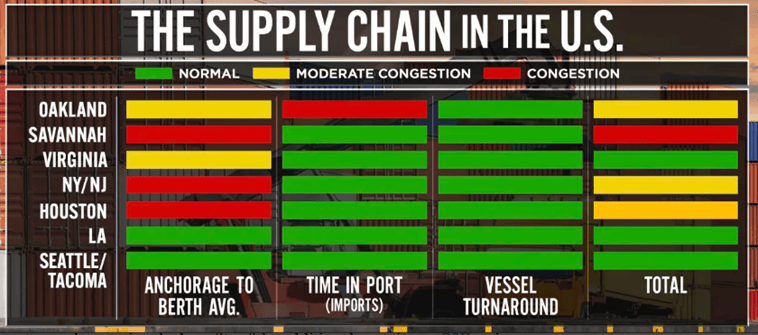
Green is good and this bodes well for retailers wanting to stock their shelves for the holiday shopping season. Hopefully, prices will have fallen enough for us to buy some of this stuff!
- Fed & Inflation: The Fed raised short term lending rates 75 basis points once again to help cool down inflation. They’ve indicated that they will continue to raise rates for the foreseeable future until they get inflation down to 2%. They are trying to do this without raising rates too far too fast, which will throw us into a recession. I think they should pause and monitor the data before raising rates anymore. Prices have come down across the board for almost every consumable. Home and auto prices have dropped as well. The Fed sees this but is also worried about wages getting too elevated. That should be the least of their worries, in my humble opinion. At this point, I believe more damage will be done by raising rates than by taking a pause. Any pause or change in the Fed’s strategy would be a positive catalyst for stocks and bonds.
Joe Baker, CFP®
Baker Asset Management, LLC
joebaker@bakerassetmanagement.com

