
There was an interesting research piece in The Guardian by Damina Carrington recently on how much of the world’s fossil fuel reserves need to stay in the ground to have a meaningful impact on rising global temperatures. I thought this would be of particular interest to those investors looking at, or already invested, in the energy sector.
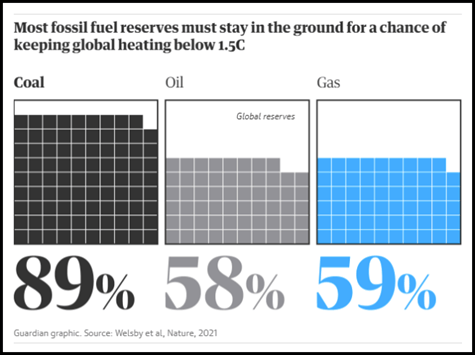
Basically, the analysis found that the vast majority of fossil fuel reserves owned today by countries and companies must remain in the ground if the climate crisis is to be ended.
Here are some fascinating numbers from this article:
- The research found 90% of coal and 60% of oil and gas reserves could not be extracted if there was to be even a 50% chance of keeping global heating below 1.5°C (34.7°F), the temperature beyond which the worst climate impacts hit.
To keep below this temperature increase, here’s some of the things that need to happen:
- The US, Russia and the former Soviet states have half of global coal reserves but will need to keep 97% in the ground, while the figure for Australia is 95%. China and India have about a quarter of global coal reserves and will need to keep 76% in the ground.
- Middle Eastern states have more than half the world oil reserves but will need to keep almost two-thirds in the ground, while 83% of Canada’s oil from tar sands must not be extracted.
- Virtually all unconventional oil or gas, such as from fracking, must remain in the ground and no fossil fuels at all can be extracted from the Arctic.
These objectives are going to be daunting tasks to say the least, based on our current fossil fuel usage. For example, this chart shows how we produce our electrical energy in America:
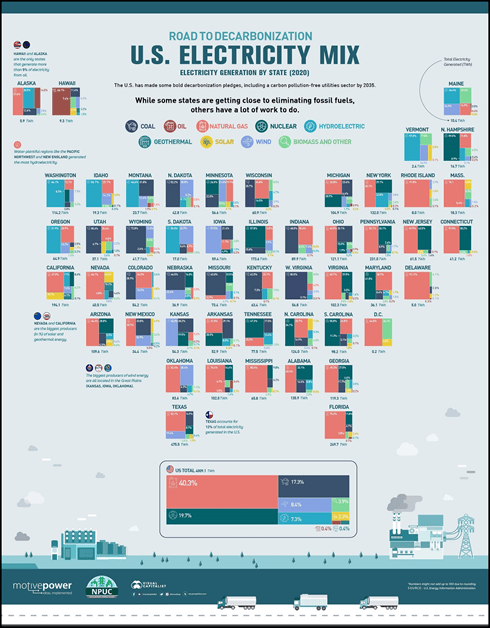
This shows that 60% of our electrical usage is powered by fossil fuels (natural gas and coal).
The other major headwind to completely shutting down fossil fuel extraction would be the fact that the value of these assets would become virtually worthless, which would bankrupt companies and countries alike. This is especially worrisome for major oil-producing countries in the Middle East.
I don’t know if there are any easy solutions other than more rapid adaptation of nuclear and renewable energy sources. I just can’t see this happening any time soon because right now there is such a huge disconnect between the climate change community and the rest of the world.
Please let me know if you have any questions.
Joe Baker, CFP®
Baker Asset Management, LLC
joebaker@bakerassetmanagement.com


A political view that created its own justification
Climate models projecting rising temperature due to their relationship to with fossil fuel use are omitting so many affecting factors they end up with minimal credence. Climatologists admit their own future models are at best with
“ low confidence”
LikeLike