BAM Blog

How Stocks Perform When Interest Rates Rise

Now that the Fed has finished its first meeting of 2022 yesterday, we all know they are planning to raise interest rates, the federal funds rate to be exact. This has caused a lot of angst among investors who are fearful that higher interest rates will wreak havoc on the stock market.

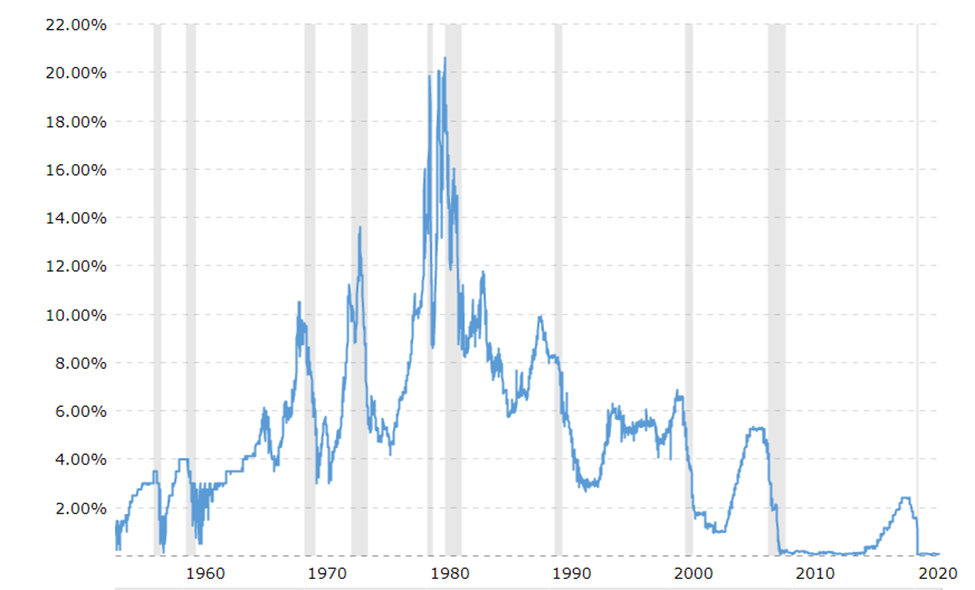
Before we look at how stocks have fared in a rising interest rate environment, let’s look at the fed funds rates over the last 68 years or so:

Fed Funds Rate from 1954 thru January 2022

As you can see, the fed funds rate is at an all time low. The Fed typically raises this rate when the economy is doing well: low unemployment, higher wages, higher consumer prices. This is all happening right now. In fact, GDP numbers just came out and showed that the economy grew 5.7% in 2021, its best showing since 1984.

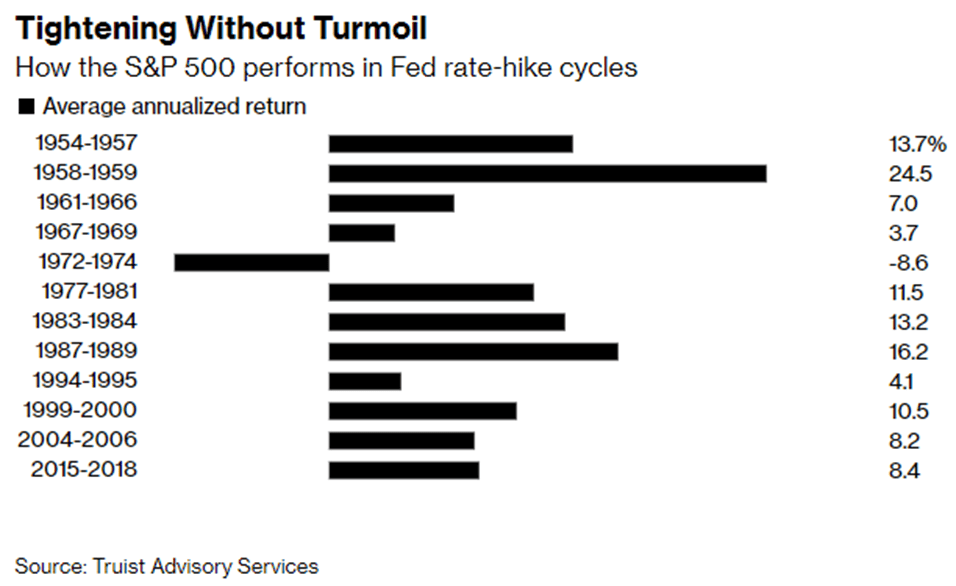
Now, let’s look at how stocks have performed when interest rates start going up:

The chart above shows that stocks have risen at an average annualized rate of 9% during the 12 Fed rate hike cycles since the 1950s and delivered positive returns in 11 of those instances. The one exception was during the 1972-1974 period, which coincided with the 1973-1975 recession.

Having said all that, there is no way of knowing how this market will react to the Fed’s actions, but it’s good to know that we have history on our side.

Please let me know if you have any questions.

Joe Baker, CFP®

Baker Asset Management, LLC

joebaker@bakerassetmanagement.com

5 Things You Should Know About Your IRA

Here’s some useful facts that you should know about your IRA. These change quite frequently so it’s always a good idea to take a look at these every year or so.

  1. How much can I put in?

$6,000 for 2022; $7,000 if you’re over age 50.

  1. Are my contributions tax deductible?

If you don’t have a retirement plan at work:

Yes, regardless of your income.

If you do have a retirement plan at work:

Yes, if your modified adjusted gross income in 2022 is less than $68,000 (single) or $109,000 (married).

  1. When can I contribute?

Pretty much whenever you want, but if you want it to count for 2022, you have to make the contribution before you file your taxes for the year 2022, which is usually April 15, 2023.

  1. Can I have an IRA if I don’t work?

Typically, no. But, if your spouse works, you can open a spousal IRA and contribute to it. Same contribution limits apply.

  1. When can I take money out of my IRA?

After age 59.5, if you want to avoid a 10% penalty. Also, you’ll have to pay taxes on the withdrawals, regardless of age. You have to start taking required minimum distributions (RMDs) at age 72.

Keep in mind, there are many caveats, exceptions, and loopholes to these general rules, as is anything that involves our tax code, so please talk to your tax adviser, or just shoot me an email.

Joe Baker, CFP®

Baker Asset Management, LLC

joebaker@bakerassetmanagement.com

What You Need To Know About Living Trusts

This is always a great time of the year to review your financial picture.

One of the items that you might be considering, or have considered before, is whether or not to establish a revocable living trust to hold your assets.

A revocable living trust is a legal document created by you (the grantor) while you are alive and of sound mind and body.  Just like a will, a living trust spells out exactly what your desires are with regard to your assets, your dependents, and your heirs.  But a won’t go into effect until after you die, whereas a living trust is already in effect.

There is little difference to owning your assets in your name or in your living trust’s name while you are alive and well.  The benefits occur after you die or if you become incapable of handling your own affairs.

Here is a list of some of the benefits of having a living trust:

  • Avoids probate – This is probably the biggest reason people have a living trust.  The trust bypasses the costly and time-consuming process of probate, which is conducted by the state courts of your residence when you die and has the authority to decide how to divvy up your assets.
  • Provides privacy – a living trust is not made public, so upon your death, your estate will be distributed in private.  A will, on the other hand, is public record and so all transactions will be public as well.
  • Maintains control – If you become incapacitated in a way that you can no longer manage your assets, your handpicked successor trustee can manage your affairs without court intervention, and since the trust is revocable, if you dispute your incapacity, you can retain control yourself.

There are disadvantages as well:

  • Cost – A living trust can cost anywhere between $1,000 – $3,000, depending on the complexity.  This is the price that you pay for the money saved by avoiding probate, which can typically run around 4% of your total estate value.
  • Bookkeeping – In order for your living trust to be of use, you have to transfer your assets into it.  That means opening new accounts with the trust as owner for your bank and investment accounts.  Also, transferring deeds and title for property into the trust name, which can be time consuming.

In summary, if you have a large family and/or a large number of assets, you may want to consider establishing a revocable living trust.  It could save you and your family not just a lot of money, but also a ton of undue stress and strain on you and your family during difficult times.

If you have questions or want to know if you should establish a living trust, just shoot me an email.

Joe Baker, CFP®

Baker Asset Management, LLC

joebaker@bakerassetmanagement.com

Monthly Update – January 2022

Fun Facts about January

  • Birthstone: Garnet
  • Flower: Carnation
  • Zodiac signs: Capricorn and Aquarius
  • January was named after the Roman god Janus. Janus is also the Roman word for door. The god, Janus, had two faces which allowed him to look forwards into the coming year and backwards into the past year.
  • On average, it is the coldest month of the year in the Northern Hemisphere.
  • In the Southern Hemisphere January is a summer month the equivalent of July.
  • Martin Luther King Jr. Day is always on the 3rd Monday in January (January 17th this year).

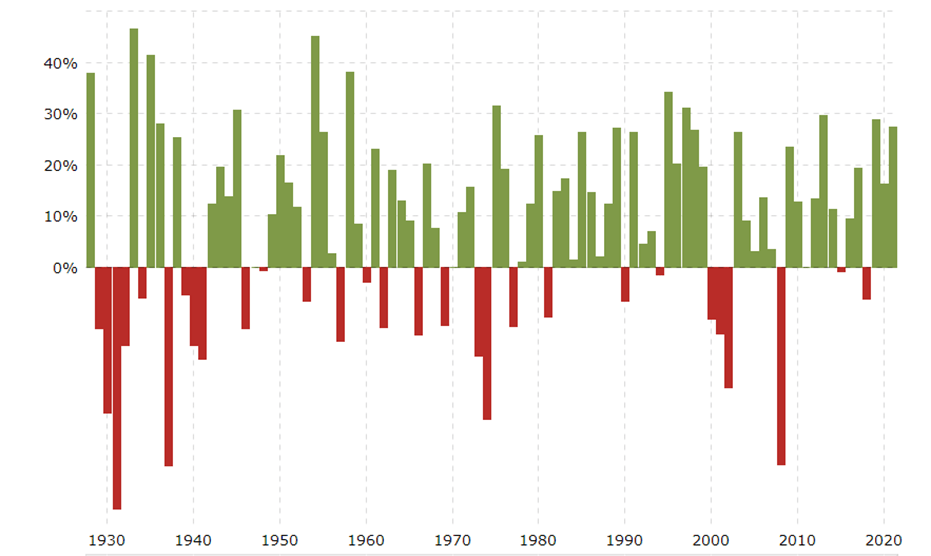
Stocks returned to their positive ways in December with most stock indices approaching or surpassing their respective all-time highs. For the month, the S&P 500 gained about 5%. December made it the tenth positive month for the year 2021. Only January and November had negative returns. For the year, the index finished up an impressive 27%.

I wanted to see how this year’s return compared historically. Check out this chart of the S&P 500 historical annual return since 1928:

Fyi, the best annual return was +46.59% in 1933 and the worst was -47.07% in 1931.

Earnings reports from companies for Q4 and for the entire year of 2021 will start to show up in early January, which could move the markets, as always. But the main thing that you want to listen to is a company’s outlook for 2022: if they believe Covid will become more of a flu-like problem versus a pandemic; if supply chains will return to normal; and how disruptive industries like blockchain, electric vehicles, and the metaverse will affect their earnings going forward.

Supply chains continue to normalize but the people on the front lines say it could take all of 2022 to get back to pre-covid efficiency.

Inflation will probably be the most influential item for the financial markets in 2022. The Fed has mapped out their plan to combat it so now we watch and wait.

Seasonally, we are smack dab in the middle of the time of year where stocks have consistently performed well. The November through April timeframe has historically been the best time of the year to be invested in the stock market.

Take a look at the Outlook section below to see what events could move the markets over the short term.

Bond prices were mixed in December, pretty much the exact opposite of how bonds fared in November. High yield, or junk bond prices moved higher while higher quality corporate and government bonds saw their prices drop. This is normal price action since junk bond prices tend to move more in sync with stock prices than with other bond prices. This bond price movement should be the more common direction going forward as the Fed begins to taper its bond purchases and prepares to raise interest rates. If you expect this to happen, then please be cognizant of this when buying bonds with a maturity date greater than 1-2 years. In this type of interest rate environment, you can expect to lose principal unless you hold the bonds to maturity.

The 10-year US Treasury note is now yielding about 1.52% and the 30-year bond is almost at 1.91%, both slightly higher than last month. The path of least resistance for these rates is up, so expect these yields to continue to rise and their respective bond prices to drop as the fed pumps the brakes on buying so many of these bonds every month.

Interest rates bumped up slightly for the second month in a row. CD, money market, and savings account rates all went up by small percentages once again but are still incredibly low. These rates should continue to move higher into next year, but the savings rates will most likely still be too low to keep up with inflation. Now that we know what the Fed is going to do (raise rates), changes in these rates won’t come as too much of a surprise.

Currently, the average savings account is paying 0.28%, about the same as last month. Although safe from market fluctuations, putting all your eggs in a savings account is not the best bet, especially if you need to grow your account value. Plus, you have to pay taxes on that interest. I do expect these rates to continue to inch up over the next year.

The 1-year CD interest rate is now averaging 0.49%, down from 0.52% last month. The 5-year CD rate stayed the same, at 0.81%. You’re certainly not getting rich owning these. Hopefully, these rates will start to move higher in a meaningful way over the next year or so. That way, we can at least make some money on our emergency reserves.

Mortgage rates remained relatively flat for the month of December now that the uncertainty of what the Fed will be doing over the course of the next year has been removed from the markets. Currently, the 30-year rate sits at 3.19%, up from 3.18% a month ago. There is still high demand for mortgages, although it has come down a bit from its peak back in the fall. It will be interesting to see how housing demand is influenced by the expected rise in mortgage rates in 2022.

Oil prices resumed their upward trek in December after a big dip in November. The scare of the omicron variant seems to have subsided rather quickly as evidenced by the surging numbers at the TSA gates, the increase in cruisers, and the uptick in road trips during the holiday season.

The price for a barrel of oil went up about 15% to settle near $75.30 at the end of the month. Year-to-date, the price is up 58%. I’m still seeing a ton of out-of-state plates here in Charleston right now, which is more like the summertime than now. If this is the case across the U.S., there is going to be continued strong demand for gasoline and for charging stations, for those who already made the switch to electric.

Gasoline prices are lagging oil prices by at least a week because the rise in oil prices is not yet reflected in gas prices at the pump. Regular unleaded gasoline is now averaging $3.28 per gallon, down $0.11 from last month. If the lag is accurate, we should see gasoline prices rise into the end of the year. Oklahoma has the cheapest gas right now, at $2.87. California has the most expensive at $4.66 per gallon. FYI, a year ago, we were paying $2.25.

Check out the prices at the pump in your area: Gas Buddy.

Outlook

Events on the horizon that could move the markets in the near term:

  • Coronavirus: It’s pretty bad out there. The very contagious omicron variant has made cases, hospitalizations, and deaths jump up from a month ago. The U.S. is now averaging about 1,500 daily deaths, up from 1,000 a month ago. The good news is that this mutation is not as severe as previous ones. This could actually help us get closer to herd immunity if those that are unvaxxed or whose vaccinations have waned get infected, hopefully asymptomatic. Currently, we are at 73% of our citizens vaccinated with at least one dose, up from 70% a month ago. I think we are close to accepting that this disease will be with us for the foreseeable future, and we will start to learn how to live with it, similar to how we deal with the flu. This acceptance should bode well for stocks in 2022.
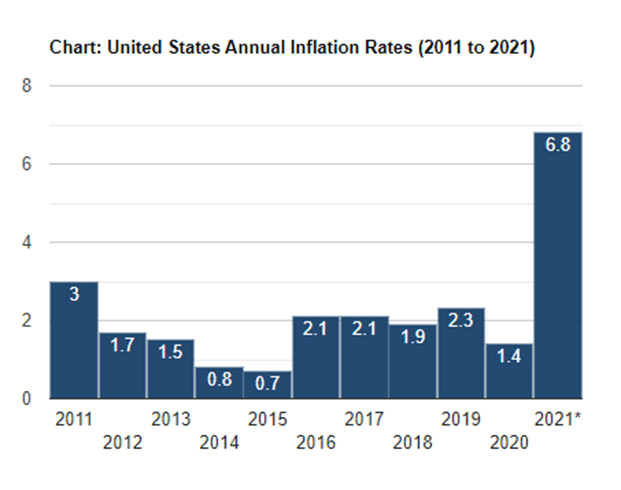
  • Fed & Inflation: The Fed is expected to raise interest rates 3 times in 2022 at a clip of 0.25% each time to combat the rise in inflation. So now, the uncertainty of rate increases is removed from the markets, which is a good thing, since markets hate uncertainty. Historically, stocks have performed well when the Fed begins to raise rates. The same does not hold true for bonds, whose prices drop when rates rise. Also, since rates are still incredibly low, bond investors may shift some of their money to stocks to improve their portfolios’ performance. Monitoring these rate increases will be front and center for investors in 2022. For reference, here is a chart of annual inflation rates in the U.S over the past decade:

Joe Baker, CFP®

Baker Asset Management, LLC

joebaker@bakerassetmanagement.com

How To Get Paid To Save For Retirement

Do you want to get paid for contributing to your IRA or other retirement plans? Well, you can because the IRS will pay you to save for retirement.

There is a little-known tax rule that has been around since 2002 called the Retirement Savings Contributions Credit (Saver’s Credit). This tax credit essentially pays you to put money into your IRA, Roth IRA, 401k, TSA, and most other retirement plans. Here’s a quick summary of how it works:

Eligibility

You’re eligible for the credit if you’re:

  • Age 18 or older,
  • Not claimed as a dependent on another person’s return, and
  • Not a student.

Credit Amount

As with most tax credits, the amount is based on your adjusted gross income (AGI) in the year that you contribute. The maximum amount of the credit is 50% of the amount that you contribute to your retirement plan. The maximum contribution amount that can qualify for the credit is $2,000, making the maximum credit $1,000. Here is an example from the IRS website:

Jill, who works at a retail store, is married and earned $41,000 in 2021. Jill’s spouse was unemployed in 2021 and didn’t have any earnings. Jill contributed $2,000 to her IRA for 2021. After deducting her IRA contribution, the adjusted gross income shown on her joint return is $39,000. Jill may claim a 50% credit of $1,000 for her $2,000 IRA contribution on her 2021 tax return.

The following tables show how much of a credit that you are eligible for:

2022 Saver’s Credit

Credit RateMarried Filing JointlyHead of HouseholdAll Other Filers*
50% of your contributionAGI not more than $41,000AGI not more than $30,750AGI not more than $20,500
20% of your contribution$41,001- $44,000$30,751 – $33,000$20,501 – $22,000
10% of your contribution$44,001 – $68,000$33,001 – $51,000$22,001 – $34,000
0% of your contributionmore than $68,000more than $51,000more than $34,000

*Single, married filing separately, or qualifying widow(er)

2021 Saver’s Credit

Credit RateMarried Filing JointlyHead of HouseholdAll Other Filers*
50% of your contributionAGI not more than $39,500AGI not more than $29,625AGI not more than $19,750
20% of your contribution$39,501 – $43,000$29,626 – $32,250$19,751 – $21,500
10% of your contribution$43,001 – $66,000$32,251 – $49,500$21,501 – $33,000
0% of your contributionmore than $66,000more than $49,500more than $33,000

*Single, married filing separately, or qualifying widow(er)

For those that are eligible, it is like getting a match from the government on your contribution. Every little bit helps.

Let me know if you have any questions and Happy Holidays!

Joe Baker, CFP®

Baker Asset Management, LLC

joebaker@bakerassetmanagement.com

A Quick Way To Check If Your ETFs Overlap

ETFs (Exchange-Traded Funds) have become ubiquitous in the retail investing landscape. We see them in almost half of all U.S. household’s investment portfolios. In fact, ETFs have become so popular that they have recorded global net inflows of over $1 trillion year-to-date through November 2021, the first time ETFs have reached that milestone, according to investment research firm Morningstar Inc.

One of the reasons for their popularity is that they show what they own on a daily basis. You just simply go to their website and click on Holdings or Portfolio to see what companies they are invested in. Having said that, I can make a pretty safe bet that 95% of people that own ETFs have no idea what the 5 biggest stocks are inside those investments. But it is something that you should be looking at periodically, especially if you own more than one ETF. This is to ensure that you are not too concentrated in any one company, which could cause large swings in your portfolio’s value if there is a big change in that company’s stock price.

The good news is that there are websites that allow you to compare ETFs to see what’s inside each of them. Most brokerages have this feature in the Research section on their websites. You can also find some dedicated websites for ETFs that may require a subscription. Here is one that I found that allows you to compare two ETFs without having to sign up for anything:

https://www.etfrc.com/funds/overlap.php

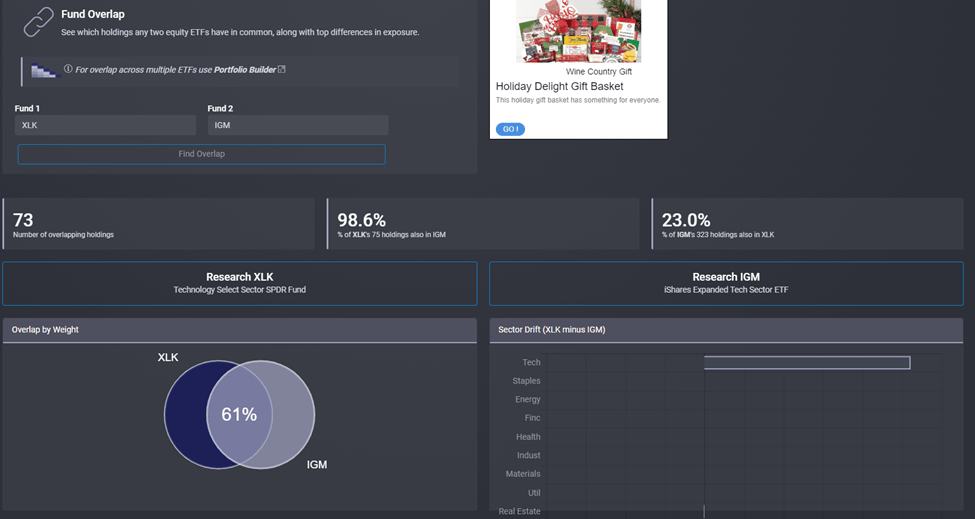
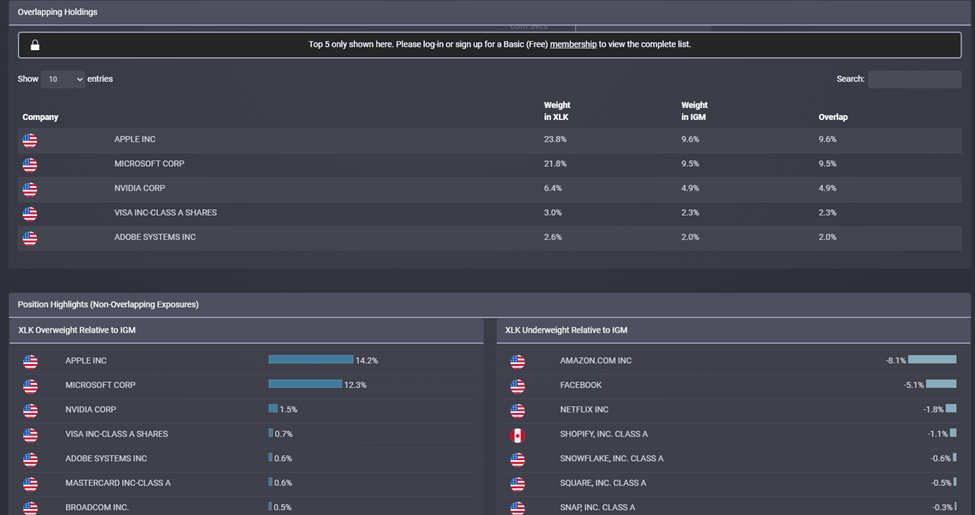
Here is an example from this site, comparing the Technology Select Sector SPDR Fund (XLK) and the iShares Expanded Tech Sector ETF (IGM):

As you can see in the first screen shot, there is a 61% overlap between these two ETFs. That means if you looked at the combined holdings of these funds, you would find that 61% of the companies would be found under both ETFs. That’s a pretty big overlap and the reason I chose these particular ETFs. I wanted to illustrate the importance of knowing what you own so you can ensure you are matching your desired portfolio allocation.

Whatever tools you use, I suggest definitely taking a peek at your holdings about twice a year, just to make sure you don’t get too heavily concentrated in any one sector or stock.

Let me know if you have any questions.

Joe Baker, CFP®

Baker Asset Management, LLC

joebaker@bakerassetmanagement.com

Update On Container Ships Off The Coast of LA

I don’t know why I am so fascinated by the container ship logjam off the coast of Los Angeles but I am so I’m blogging about it.
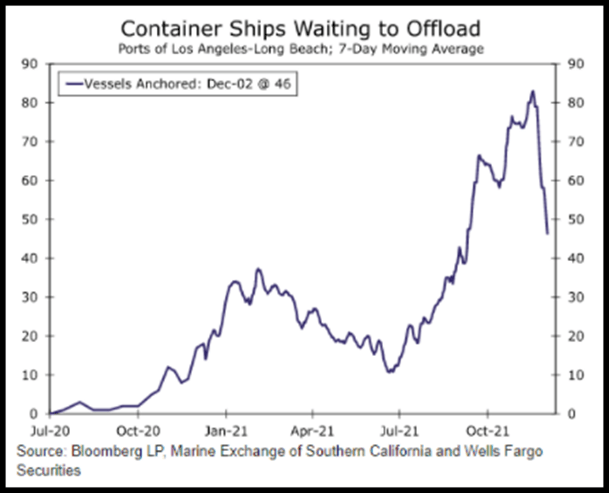
Other than getting into a boat and counting ships, you are definitely going to have to do some digging online to find out the real story. For instance, I just read an article that shows a drop off of 46% (from 86 ships down to 46 ships) in the number of ships at anchor off the coast of LA:

Another source indicates a 30% drop. To be included in these ship counts, they typically have to be within 40 miles of the ports. However, starting in mid-November, ships were allowed to start lining up outside the 40-mile perimeter, in fact, 150 miles away. The main reason for this change was to reduce pollution along the coastal regions of southern California.

So, if you include all of the ships out there with a place in line, there are 96 ships waiting to dock. That’s not counting the 31 ships already docked and in the process of being unloaded. That’s a lot of containers!!

Based on this information, the logjam of ships hasn’t eased at all. Then, I think of each one of those ships carrying 3,000 containers (I’m being conservative) and a truck is needed to haul each one of those containers. Boy, do we need a lot of truck drivers to get this stuff moving. This is certainly going to take awhile to clean this backlog up.

All of this is creating higher costs for importing companies, which will be passed on to their customers, me and you. If it gets to the point where the prices to import become so high, then it will make sense to build stuff here instead of importing and that will be a nice boom for an already booming economy.

Please let me know if you have any questions.

.Joe Baker, CFP®

Baker Asset Management, LLC

joebaker@bakerassetmanagement.com

Monthly Update – December 2021

Fun Facts about December

  • Birthstone: Turquoise or Zircon
  • Flower: Narcissus or Holly
  • Zodiac signs: Sagittarius and Capricorn
  • In the original Roman calendar, December was the tenth month of the year. It got its name from the Latin word “decem” which means ten. However, it became the twelfth month when the Romans added in January and February to the start of the year.
  • December’s equivalent in the Southern Hemisphere is June.
  • Hanukkah 2021 began in the evening of Sunday, November 28 and ends in the evening of Monday, December 6.
  • December 7 is National Pearl Harbor Remembrance Day.
  • December 21 is the Winter Solstice—the astronomical first day of winter in the Northern Hemisphere and first day of summer in the Southern Hemisphere.
  • December 25 is Christmas Day.
  • December 26 is Boxing Day (Canada, UK).

Stocks would have made it two months in a row of positive gains if it wasn’t for a big dip on the last day of the month in November. For the month, the S&P 500 dropped a bit under 1%, 0.825% to be exact. For the year, the index is now up 21.6%.

With Q3 earnings out of the way, the biggest influencers on the market in December will be covid and the Fed. In fact, as I was writing this update, the Fed simply mentioned that they were going to discuss increasing their tapering pace at their next meeting. A nearly 2% drop in the major market indices ensued. This is another great example of how quickly and violently the markets react to the unexpected.

On other fronts, supply chains are starting to mend themselves, although it is probably too late to help the holiday shopping season. Covid is back on the front page again as the omicron variant is spreading rapidly across the globe. The good news is that initial reports show that symptoms are mild, even though it is highly contagious. The bad news is that many countries are locking down again to try and minimize the spread. This has been putting a damper on the markets over the last week or so and could be a problem going forward in the short term.

Seasonally, we are in that time of year where stocks have consistently performed well. The November through April timeframe has historically been the best time of the year to be invested in the stock market. So far, it’s not looking so good, but we still have a chance for a Santa Claus rally to finish up the end of the year.

Take a look at the Outlook section below to see what events could move the markets over the short term.

Bond prices were mixed in November. Higher quality corporate bonds and government bonds saw their prices rise while high yield, or junk, bond prices dropped. This is not unusual, especially when stock prices drop. Junk bond prices tend to follow stock prices more so than government bonds. As the Fed begins to taper its bond purchases, we should see blue chip and government bond prices start to drop along with high yield bonds. It looks like the plan is for the Fed to reduce their asset buying through mid-2022 before they start to raise short-term interest rates. If they accelerate that schedule at all, look for a stock market correction, which is overdue, in my opinion. This action by the Fed will cause bond prices to drop and their yields to rise. So, please be cognizant of this when buying bonds with a maturity date greater than 1-2 years. In this type of interest rate environment, you can expect to lose principal unless you hold the bonds to maturity.

The 10-year US Treasury note is now yielding about 1.5% and the 30-year bond is almost at 1.8%, both lower from last month. The path of least resistance for these rates is up, so expect these yields to rise and their respective bond prices to drop as the fed pumps the brakes on buying so many of these bonds every month.

Interest rates saw a slight rise in November. CD, money market, and savings account rates all went up by small percentages but are still incredibly low. Hey, we’ll take it when we can get it, right? These rates should continue to move higher through the end of the year, but the savings rates will most likely still be too low to keep up with inflation. They certainly won’t rise as much as debt service rates, such as credit card interest rates. The only thing stopping the rise is if the Fed stops talking about raising short term interest rates, which is possible given the new omicron variant of covid popping up recently.

Currently, the average savings account is paying 0.29%, just a touch higher than last month’s 0.28% average. Although safe from market fluctuations, putting all your eggs in a savings account is not the best bet, especially if you need to grow your account value. Plus, you have to pay taxes on that interest. I do expect these rates to continue to inch up over the next year.

The 1-year CD interest rate is now averaging 0.52%, up from 0.46% last month. The 5-year CD rate moved up as well, from 0.73% to 0.81%. You’re certainly not getting rich owning these. Hopefully, these rates will continue to head higher over the next few months as well.

Mortgage rates rose again slightly in November in anticipation of the Fed raising short term rates. Currently, the 30-year rate sits at 3.18%, up from 3.14% a month ago. This rise is not surprising considering most other interest rates are on the upswing as well. Still, historically speaking, mortgage rates are near all-time lows. This will continue to help the housing industry, which is on track to have one of their best years ever.

Oil prices took a well-deserved breather and dropped 20% in the month of November as renewed worries about covid scared owners of the commodity. Some of the drop might have been due to a coordinated effort across the globe to release strategic petroleum reserves this past month. In reality, the release was not that much, in relation to daily usage amounts. In the U.S., we released 50 million barrels of oil. This equates to just 2.5 days of normal usage.

The price for a barrel of oil went up by about 20% to settle near $67 at the end of the month. Year-to-date, the price is up 38%. I’m not sure how long this scare by the omicron variant will last, but if countries continue to lockdown further, we should see prices continue to drop.

The drop in oil prices hasn’t made it to the pump yet, as gasoline prices remain elevated. Regular unleaded gasoline is now averaging $3.39 per gallon, only down a penny from last month. We should see this price come down in December to reflect the added supply of oil. Oklahoma has the cheapest gas right now, at $2.96. California has the most expensive at $4.71 per gallon. FYI, a year ago, we were paying $2.13.

Check out the prices at the pump in your area: Gas Buddy.

Outlook

Events on the horizon that could move the markets in the near term:

  • Infrastructure Bill: Is now officially known as The Infrastructure Investment and Jobs Act (IIJA) since Biden signed it this past month. This act includes a ton of funding for upgrading our country’s roads, bridges , and ports. It will replace lead pipes that provide drinking water. There will be big spending to improve our freight and passenger rail systems, our airports, our broadband internet infrastructure, and infrastructure for electric vehicles(charging stations). It took a while, but they got something done in DC. Overall, this is good for the country and will help form the next leg up for stocks.
  • Coronavirus: It’s back on the front page again with the discovery of a new mutation, code name Omicron. Experts are hopeful that this isn’t as severe as the original or its delta variant. Only time will tell. Overall, the covid numbers in the U.S. are trending down nicely, now averaging just under 1,000 daily deaths (still 365,000 annual average!). The vaccination rate picked up a bit as young children started getting vaccinated. We are now at 70% of citizens with at least one dose. We’re getting there slowly but the numbers are looking good.
  • Fed & Inflation: It appears that we are making some headway in getting the supply chain out of the weeds. CEOs are reporting that raw materials are becoming more available and that they are getting their finished products out the door to end users quicker. In October, we saw the highest inflation rate in 3 decades (6.2%). November and December numbers should be lower. This will definitely cause the Fed to rethink raising rates. Should be interesting to hear what they say at their next meeting coming up in a few weeks.

Joe Baker, CFP®

Baker Asset Management, LLC

joebaker@bakerassetmanagement.com

Important End-of-Year Deadlines You Should Know About

Here are a couple of deadlines you should be aware of that occur at year-end which can affect your taxable income:

Required Minimum Distributions (RMD)

If you are over age 72, RMDs are required annually by the IRS to be made from qualified retirement accounts and are most associated with IRAs (except Roth IRAs).

The RMD for each account is determined by the IRS based on the balance of the account as of Dec. 31st of the prior year and your age, among other factors. If you have an adviser who assists you with your financial planning, you can task them with ensuring that your RMDs are made, but if you manage your accounts yourself, this is a withdrawal you must remember to make every year. If you don’t, you’ll be hit with a 50% penalty on the amount not withdrawn.

Max out employer-sponsored retirement plan contributions

For all employer-sponsored retirement plans, there are annual contribution and salary deferral limits. These caps vary from account to account, and in some cases, depending on the age of the employee, but for many people planning for retirement, maximizing their contributions for the year is an important part of the plan. The deadline for your annual contributions is Dec. 31, but since these contributions are generally made as a percentage of your gross income withheld, to make any year-end adjustments, you’ll need to coordinate with your HR department and leave enough time for your change to be implemented and make an impact.

Tax loss harvesting

Tax-loss harvesting is a strategy where an investor sells a position for a loss to generate a tax deduction and offset other realized capital gains. Also, if your losses exceed your gains, you can use up to $3,000 of leftover losses to offset other income.  Anymore than that can be carried over to the next year.

Roth IRA conversions

If you want to convert your traditional IRA to a Roth IRA, it must be completed by the end of the year.  All contributions to the traditional IRA for which you received an income tax deduction and all associated growth will be taxed as ordinary income in the year you convert to a Roth IRA.  If you have a large sum of money in your IRA that you want to convert to a Roth IRA, you may wish to spread out the conversion over a number of years to minimize the tax consequences.

Charitable donations

If you itemize your taxes, you can still reduce your taxable income through charitable contributions. But you should keep in mind that it takes the charitable organization time to process the donation. So, don’t wait until the last minute, especially if you’re contributing stocks or bonds, which take longer to process than cash.

529 contributions

These accounts are treated like a Roth IRA as far as taxes go, as long as you use the distributions for qualified expenses.  Also, some states even allow a state tax deduction on contributions.  Contributions to a 529 college savings account need to be completed by the end of the year to count for that tax year.

.Joe Baker, CFP®

Baker Asset Management, LLC

joebaker@bakerassetmanagement.com
Important Tax Changes For 2022

Before you flip the calendar to 2022, there are some important changes to the tax code that you should be aware of to help with your tax and retirement planning for next year.

First, here are the new federal income tax brackets for 2022:

RateFor Unmarried IndividualsFor Married Individuals Filing Joint ReturnsFor Heads of Households
10%$0 to $10,275$0 to $20,550$0 to $14,650
12%$10,275 to $41,775$20,550 to $83,550$14,650 to $55,900
22%$41,775 to $89,075$83,550 to $178,150$55,900 to $89,050
24%$89,075 to $170,050$178,150 to $340,100$89,050 to $170,050
32%$170,050 to $215,950$340,100 to $431,900$170,050 to $215,950
35%$215,950 to $539,900$431,900 to $647,850$215,950 to $539,900
37%$539,900 or more$647,850 or more$539,900 or more

The standard deduction has increased a little bit for 2022:

Filing StatusDeduction Amount
Single$12,950
Married Filing Jointly$25,900
Head of Household$19,400

The standard deduction is useful to know at the beginning of the year because if you think your itemized deductions will be less than the standard deduction amount, then you don’t have to worry about retaining receipts, charitable contribution details, etc.

The long-term capital gains tax rates for 2022 are:

 For Unmarried Individuals, Taxable Income OverFor Married Individuals Filing Joint Returns, Taxable Income OverFor Heads of Households, Taxable Income Over
0%$0$0$0
15%$41,675$83,350$55,800
20%$459,750$517,200$488,500

These are the rates that you apply to any realized gains on assets that you sold that were held for over one year. For assets sold that were held less than one year, the gains are taxed at your normal income tax rate.

For example, if you’re married and have $100,000 in taxable income, your long-term capital gains tax rate would be 15%. For comparison, your short-term capital gains tax rate would be 22%.

Contribution limits for retirement plans have changed as well for 2022. Here are the maximum employee contributions in 2022 for the most common retirement plans:

 401k403bSIMPLE IRA
 Max Contribution$20,500$20,500$14,000
    
Catch up amount if over age 50 in 2022$6,500$6,500$3,000

Please let me know if you have any questions.

Joe Baker, CFP®

Baker Asset Management, LLC

joebaker@bakerassetmanagement.com