
BAM Blog

Monthly Update – May 2022

Fun Facts about May

  • Birthstone: Emerald
  • Flower: Lily of the Valley
  • Zodiac signs: Taurus and Gemini
  • The month of May was named for the Greek goddess Maia. She was the goddess of fertility.
  • It is the third and last full month of the season of spring.
  • May in the Northern Hemisphere is similar to November in the Southern Hemisphere.
  • The Kentucky Derby, the world’s most famous horse race, is held on the first Saturday of May. This year it is on May 7th.
  • The Indianapolis 500 car race is on May 29th this year.

Stocks had a brutal month in April. There was no place to hide as selling accelerated due to uncertainty caused by the Russian/Ukraine conflict, Federal Reserve, and supply chain damage due to covid lockdowns in China.

For the month of April, the S&P 500 lost nearly 9%, its worst monthly performance since March 2020. For the year, it is down over 13%.

Earnings reports for Q1 have been coming in fast and furious and will continue to do so for the next few weeks. Companies will have a hard time beating last year’s Q1 numbers due to those issues that I mentioned earlier, namely the Russian-Ukraine war, high inflation/Federal Reserve, and more supply chain woes caused by China’s covid lockdowns.

Also, the Fed may surprise and only raise rates by 25 basis points after seeing how badly the stock and bond markets tanked.

Take a look at the Outlook section below to see what events could move the markets over the short term.

Bond prices slowed their descent downward but still ended the month of April in the red. Like equity investors, bond investors are worried about the Fed raising rates too much too fast. The threat of both bond and stock prices dropping at the same time leaves few safe havens for investors to put their money. Additionally, if inflation is peaking as some experts are saying, metals and other commodities might not be the best place to park cash either. This makes for a very tricky investing environment.

The Fed is intently watching inflation, wages, as well as the stock and bond markets in advance of their meeting next week. I think a 50-basis point hike is already baked into the cake for the markets. A different announcement could cause significant volatility with bond prices.

The 10-year US Treasury note is now yielding about 2.89% and the 30-year bond is at 2.95%, both about 0.50% higher than last month. The path of least resistance for these rates is still up, although we could see a pause after the runup that we had so far this year.

Savings rates continued to move higher for a sixth consecutive month. The last time that has happened was most likely in 2006/2007. CD, money market, and savings account rates all went up by small percentages once again but are still quite low. They certainly aren’t keeping up with inflation or the rate increases on credit card debt and other loans. The good news is that these rates should continue to move higher throughout 2022, but they will most likely still be too low to keep up with inflation. Now that we know what the Fed is going to do (raise rates), changes in these rates won’t come as too much of a surprise.

Currently, the average savings account is paying 0.33%, little changed from last month. Although safe from market fluctuations, putting all your eggs in a savings account right now is not the best bet, especially if you need to grow your account value. Plus, you have to pay taxes on that interest. I certainly expect these rates to continue to inch up over the next year.

The 1-year CD interest rate is now averaging 0.85%, up from 0.74% last month. The 5-year CD rate had a nice gain and is now at 1.41%, up from 1.09% last month. Even with that big jump in the 5-year CD, nobody is getting rich putting their money in them. Hopefully, these rates will continue to move higher in a meaningful way over the next year or so. That way, we can at least make some money on our emergency reserves.

Mortgage rates went vertical in April, marking the fourth straight month of higher rates. Currently, the 30-year rate sits at 5.42%, way up from 4.53% a month ago. Mortgage applications are down again in April as rates continue to climb. It is still tough for builders to finish new homes because of the supply chain constraints. This is causing home prices to climb ever higher with inventory still very low for homebuyers. This problem should resolve itself over the course of the summer as supply chains get squared away.

Oil prices crept higher for the fifth straight month in April but have come down from their peaks in early March. The price for a barrel of oil settled up just above $104, $4 more than it was at the beginning of April. For the year, oil is now up over 38% and this upward trend in prices looks like it will continue.

Global oil production has increased about 5 million barrels per day in 2022 versus in 2021. Surprisingly, oil exports from Russia have not decreased at all despite the war and sanctions. This increase in supply should help slow the rise in oil prices. The problem is the energy traders: they are trading about 13 times the amount of physical oil supply, which increases price volatility significantly. For example, the day before Russia invaded Ukraine, oil was at $90. Since then, despite no change in oil production, the price shot up to $124, then down to $95, and now sits close to $104. It seems like regulators are nowhere to be found.

Gasoline prices have come down from the clouds a little bit. Regular unleaded gasoline is now averaging $4.16 per gallon, down $0.07 from last month. Georgia now has the cheapest gas, at $3.71 a gallon. California has the most expensive at $5.71 per gallon. We’re heading into driving season so don’t expect prices to drop down too much. Also, gas prices are heavily influenced by energy traders as well (see Oil prices section above). FYI, a year ago, we were paying $2.89.

Check out the prices at the pump in your area: AAA Gas Prices.

Outlook

Events on the horizon that could move the markets in the near term:

  • Russia Invasion of Ukraine: Russia’s plan for the invasion of Ukraine has not gone as expected, to say the least. They are only making small gains in territory at great expense to their soldiers, equipment, and reputation. Putin is certainly embarrassed about his once mighty military, but his stubbornness will probably string this out for a while. The only thing that worries me is that he is being humiliated, which could make him do something radical (WMDs?) to save face. Having said that, I do think the world is adjusting to not having Russia as an integral part of the world economy so when this conflict ends, there may not be any major change to the markets.
  • Coronavirus: I was hoping to take this off the board this month but after Apple’s announcement that they could take an $8 billion hit due to the covid lockdowns in China, it definitely is still a major factor in stock market direction. It also reinforces the necessity to have more technology production in the U.S. I know labor costs are much higher here but could be worth it when companies take hits like Apple is this quarter. The good news is that this is more than likely a short-term event and should be resolved by mid-summer.
  • Fed & Inflation: As I mentioned earlier, the Fed is expected to hike rates another 50 basis points when they meet this week. Any move different than this could have a big influence on market direction in the short term. Regarding inflation, there are encouraging signs that inflation may have peaked. If this is the case, we could get a nice stock rally in May.

Joe Baker, CFP®

Baker Asset Management, LLC

joebaker@bakerassetmanagement.com
Traditional IRA v Roth IRA – Know The Difference

I field this question a few times a month and I always start my answer with this question – When do you want to pay the taxes?

The main difference between a Traditional IRA and a Roth IRA is when you pay taxes on the contributions and earnings. With a traditional, you defer paying taxes on contributions and earnings until you take withdrawals. If you have a Roth, you pay taxes on the contributions before they go into the account, but your withdrawals are tax-free, including any earnings.

If you think that you’ll be in a lower tax bracket when you start taking withdrawals from your account, then you should use a Traditional IRA when making contributions. For younger savers just starting out in the workforce, I usually recommend using a Roth since their income is typically low which puts them in a very low tax bracket. Once their income starts to ramp up, they may save more on taxes by switching to a Traditional IRA.

Here is a nice summary of the features of each type of IRA:

FeatureTraditional IRARoth IRA
Tax benefitsTax-deductible contributions and tax-deferred growthTax-free growth potential and qualified withdrawals are tax-free
Age requirementsContributions are allowed at any age.Contributions are allowed at any age.
Income requirementsAnyone with any amount of earned income can contribute. However, income limits may decrease or eliminate the amount that is tax-deductible.A single taxpayer with a modified adjusted gross income of $144,000 or more is not allowed to contribute. The limit is $214,000 for married taxpayers who file jointly. Single taxpayers earning between $129,000 and $144,000 can make only partial contributions. The same is true for married taxpayers who file jointly earning between $204,000 and $214,000.
Contribution limits*For 2022, the total contribution limit for all IRAs is $6,000, or $7,000 for individuals 50 and older.The same IRA contribution limits apply. You cannot contribute more than your taxable compensation for the year.
Taxes upon withdrawalWithdrawals are taxed for pre-tax contributions and earnings.Earnings can be withdrawn tax-free as long as you are over 59½ years old. Your contributions can be withdrawn any time without penalties or taxes.
Early withdrawal penaltiesIf you withdraw funds before age 59½, you may be subject to tax on your contributions and earnings plus a 10% additional tax.Withdrawal of earnings before age 59½ may incur a 10% tax penalty in addition to taxes on your earnings.
Required minimum distributionsA required minimum distribution (RMD) must be taken during the year you turn 72.There are no required distributions during your lifetime.

*Please note that deductible IRA contributions are subject to certain income limits if you or your spouse have an existing retirement plan at work.

In summary, you’re going to get taxed either way, but if you plan accordingly, you can use both of these IRA options to maximize your retirement savings.

Please let me know if you have any questions.

Joe Baker, CFP®

Baker Asset Management, LLC

joebaker@bakerassetmanagement.com
Monthly Update – April 2022

Fun Facts about April

  • Birthstone: Diamond
  • Flower: Daisy and the sweet pea
  • Zodiac signs: Aries and Taurus
  • April 1 is All Fools’ Day—otherwise known as “April Fools’ Day.”
  • In the Southern Hemisphere, April is the same as October in the Northern Hemisphere.
  • The Boston Marathon is held during April.
  • In Ancient Rome the month of April was sacred to the goddess Venus.
  • The stock market is closed on Good Friday, April 15th, which is also the start of Passover.
  • April 15th is also Emancipation Day and so the deadline for filing your federal taxes this year is April 18th.
  • Easter Sunday is on April 17th.

Stocks continued their February freefall in the beginning of March but good news out of Ukraine and the Federal Reserve kickstarted a reversal that saw the S&P 500 rise 9 out of the last 13 trading days of the month. Investors are still very concerned about runaway inflation and any surprises from Putin. Additionally, rising interest rates will force investors to decide whether stocks are still worth the risk or if it is better to buy bonds now that yields have risen significantly.

For the month of March, the S&P 500 gained about 3.5%, making it the first positive month for stocks in 2022. For the year, it is still down almost 5%. Stocks during the month of March have swung in unison with the fortunes of Ukraine. When word comes that they have held their ground against Russia or peace talks are in progress, stocks have been gaining ground. Conversely, when Russia advances further into Ukraine or peace talks break down, stocks take a dive. This was more prevalent at the beginning of March but the conflict’s influence on the markets has waned a little bit since then.

As the final earnings reports came in for 2021, the macro numbers showed that annual corporate profits were the highest since 1950. This is good news but now companies have a high bar to meet when they start reporting earnings for 2022. Investors will have to do their homework to find those companies that can continue the success of last year.

Take a look at the Outlook section below to see what events could move the markets over the short term.

Bond prices headed lower this past month as the Fed cemented its strategy of raising short term rates to help control inflation. Investors are still wary of possible surprises in Ukraine if Russia does something unexpected, but the more probable outcomes have been digested and priced into the bond market already. The main mover of bond prices for the foreseeable future are the actions of the Federal Reserve and that’s what investors are reacting to, particularly this past month. As stated in the past few updates, I expect the overall downward trend in bond prices to continue through 2022 as the Fed raises short term rates and the economic recovery continues from the dwindling pandemic. If this interest rate environment holds true, bond buyers better be wary when purchasing any bonds with a maturity longer than 12-18 months. In this scenario, you can expect to lose principal unless you hold the bonds to maturity.

The 10-year US Treasury note is now yielding about 2.36% and the 30-year bond is at 2.48%, both much higher than last month once again. In fact, the 10-year hasn’t yielded this much since May 2019. The path of least resistance for these rates is still up, so expect these yields to continue to rise and their respective bond prices to drop as the fed pumps the brakes on its bond buying program and raises short-term rates.

Savings rates crept up a little higher in March, continuing their streak of rising rates for a fifth consecutive month. CD, money market, and savings account rates all went up by small percentages once again but are still incredibly low. They certainly aren’t keeping up with the rate increases on credit card debt or loans. However, these rates should continue to move higher throughout 2022, but they will most likely still be too low to keep up with inflation. Now that we know what the Fed is going to do (raise rates), changes in these rates won’t come as too much of a surprise.

Currently, the average savings account is paying 0.30%, little changed from last month. Although safe from market fluctuations, putting all your eggs in a savings account right now is not the best bet, especially if you need to grow your account value. Plus, you have to pay taxes on that interest. I certainly expect these rates to continue to inch up over the next year.

The 1-year CD interest rate is now averaging 0.74%, up from 0.61% last month. The 5-year CD rate finally broke the 1% ceiling and is now at 1.09%, up from 0.95% last month. You’re certainly not getting rich owning these. Hopefully, these rates will continue to move higher in a meaningful way over the next year or so. That way, we can at least make some money on our emergency reserves.

Mortgage rates moved higher for the third month in a row as the Fed confirmed their commitment to raising interest rates this past month. Currently, the 30-year rate sits at 4.53%, up from 4.25% a month ago. Mortgage applications declined in March to the lowest level since December 2019. What a huge turnaround from just a few months ago. Housing inventories are starting to climb a little, which is good for homebuyers.

Oil prices continued to climb higher in March, making it the fourth straight month of rising prices. Besides the Ukraine invasion wreaking havoc, we also have the normal shenanigans going on in the Middle East. Plus, we are inching closer to the summer driving season which will put even more upward pressure on fuel prices.

The price for a barrel of oil settled up just above $100, $4 more than it was at the beginning of March. For the year, oil is now up 30% and that upward trend will probably continue. Fortunately, the best cure for high oil prices is high oil prices. The world will be producing more, demand will come down and that will at least bring a halt to the rapid rise in prices. Also, Biden plans on releasing about a million barrels of oil a day from the Strategic Petroleum Reserve over the next six months to try and cool down the fossil fuels market. This will help a little perception-wise but will do little to keep prices down for long.

Gasoline prices are riding oil’s coattails, as expected. Regular unleaded gasoline is now averaging $4.23 per gallon, up a huge $0.63 from last month. Missouri now has the cheapest gas, at $3.77 a gallon. California has the most expensive at $5.90 per gallon. We are all going to be doing a lot more traveling this year so expect to see prices stay elevated until we get our refiners running at full capacity. Although, prices this high may deter people from getting behind the wheel for a long trip. FYI, a year ago, we were paying $2.87.

Check out the prices at the pump in your area: Gas Buddy.

Outlook

Events on the horizon that could move the markets in the near term:

  • Russia Invasion of Ukraine: It appears that Russia’s advance into Ukraine has bogged down. This last month has exposed the poor leadership and readiness of Russia’s military. The longer this sort of stalemate lasts, the better chances of Russia agreeing to a truce. Of course, Putin could go even more off the rails and start using nukes or some other weapons of mass destruction which could force NATO’s hand and get everyone involved in this mess. Right now, though, investors are cautiously optimistic that peace will prevail, and the markets will reflect that if it holds true.
  • Coronavirus: It’s been 2 years since the pandemic really broke out across the U.S. We were all locked down back then and had no idea how disruptive and deadly it would be for humanity. With so many casualties and deaths, it is amazing to me how quickly we were able to recover. We are nearly back to normal with most aspects of our daily lives. Having said that, new cases continue to plummet across the country: 21,000 per day versus 57,000 last month, which is just great. As expected, daily deaths have been dropping as well. Currently, we are averaging about 512 deaths per day (down from 2,675 per day last month). At this rate, Covid-19 should have little impact on the markets going forward.
  • Fed & Inflation: Earlier this past month, the Fed raised short term rates 25 basis points. Based on their meeting notes, they plan to stay on this path of bumping rates up over the next few years in order to keep inflation under control. Some fear that they are behind the curve already. Unfortunately, nobody knows for certain until the rate increases filter through the economy, which usually take at least six months. I think if the supply chain interruptions can be corrected soon, prices will drop and then they can continue on this path of small, periodic raises. This is a positive for the markets because it is expected. If they deviate from this strategy, especially if they are more aggressive, it could spook the markets and we could see a pullback.

Joe Baker, CFP®

Baker Asset Management, LLC

joebaker@bakerassetmanagement.com

Something Quite Rare Happened Last Week In The Stock Market

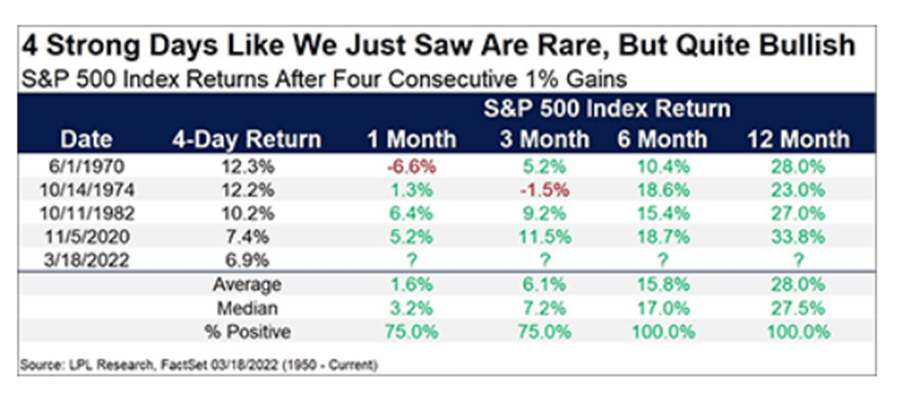
I am staying on the same theme as my last blog post, The First 48, because of what happened last week in the stock market: The S&P 500 gained at least 1% for four consecutive days. This is so rare that it has only occurred 5 times in history! The best news is that it is a great sign that stocks will be up a significant amount one year later.

Take a look at this table:

As you can see, the S&P 500 gained 6.9% last week. Looking at the most recent occurrence for comparison (2020), the index gained 7.4%. The subsequent return one year later was 33.8%. That’s a nice bounce. In fact, all of the one year returns after this event happened were greater than 20%. That’s a pretty good track record.

Of course, past performance does not indicate future returns, but this does put history on your side if you plan on staying in the market and/or adding to your current investments.

Let me know if you have any questions.

Joe Baker, CFP®

Baker Asset Management, LLC

joebaker@bakerassetmanagement.com
The First 48

This is a quick post that I wanted to get out since there is currently a ton of fear going through the markets, and rightfully so. We have the Russian invasion of Ukraine, high inflation, and the Federal Reserve Board on the cusp of starting to raise interest rates.

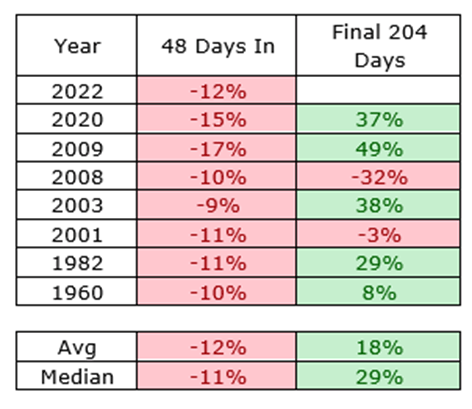
With all that going on, it’s no surprise that the stock market has dropped about 12% since the start of the year. Some investors may even be thinking about getting out of the market completely and waiting until all of this blows over. For those that are worried, I give you this simple table that might help get rid of some of that investor angst.

This illustration shows all the years back to 1960 when the S&P 500 was down 8% or more after the first 48 trading days of the year.

{BofA Securities}

As you can see, stocks performed quite well after such a bad start with the exception of just two times. In 2001, we had 9/11 towards the end of the year which was the main catalyst for the drop that year. In 2008, the start of the Great Recession began in the fall of that year. Based on this data, 2022 should end up being a decent year for stocks, barring an unexpected event towards the end of the year.

I know this is a glass-half-full way of looking at the recent market drop but from an historic viewpoint, the odds for a nice recovery are on our side.

Let me know if you have any questions.

Joe Baker, CFP®

Baker Asset Management, LLC

joebaker@bakerassetmanagement.com

The Facts About US Energy Independence

I read a couple of interesting articles recently about how dependent the U.S. is on other countries with regards to our consumption of fossil fuels. This is as good a time as any to investigate this topic as oil and gas prices are rapidly rising across the globe.

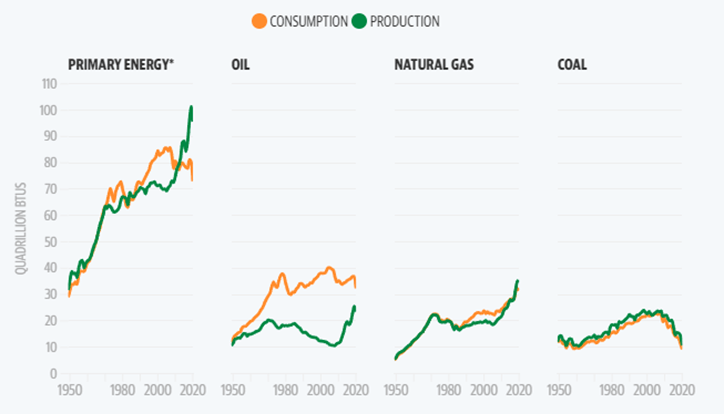
First, let’s talk about the definition of energy independence. For some, it means that we do not need to import any fuel sources from other countries to meet our energy needs. For others, it simply means that our total energy production is greater than our total energy consumption. Regarding the latter definition, we can say that the U.S. has been energy independent since about 2017/2018. Since then, our total energy production from all sources: fossil fuels, renewables, nuclear, etc. has exceeded our energy consumption. However, if you break it down by fuel source, it’s a different story. Take a look at the chart below:

This shows consumption vs. production of all energy sources (Primary Energy) and also for our major fossil fuels: oil, natural gas, and coal. We are producing more natural gas and coal than we are consuming but we still have to import oil to meet our energy needs. In fact, we use 38% more oil than we produce. The good news is that the gap for oil is closing at a nice clip. In 2008, we used 140% more!

In reality, we will probably never achieve true energy independence because our oil producers operate independently in open markets and are not controlled by our government like many other oil-producing countries are. Our oil companies want to maximize their profit so they may find selling to other countries makes more financial sense than to keep it here. When you look at it, most of our oil comes from five states: Texas, North Dakota, New Mexico, Oklahoma, and Alaska. Surprisingly, it can be cheaper to export oil to other continents than to ship it across the country. So, unless our government takes over our oil production, it might be a while until we hit energy independence for oil.

The energy markets are very complex. You have government-run producers and, like us, privately-owned producers. You have both hostile and friendly countries that have what we need. You have rules and regulations that restrict how, where, and when you can move these fuel sources. All of this factors in to the challenges of making the U.S. truly energy independent. I feel that as we continue to grow our renewable energy resources, we will be able to meet our oil demand with domestic production and will not have to rely on foreign imports for our energy needs.

Let me know if you have any questions.

Joe Baker, CFP®

Baker Asset Management, LLC

joebaker@bakerassetmanagement.com
Monthly Update – March 2022

Fun Facts about March

  • Birthstone: aquamarine and bloodstone
  • Flower: daffodil
  • Zodiac signs: Pisces and Aries
  • The name March comes from the Roman god of war, Mars. For many years, March, being the start of spring, was also the start of the New Year.
  • March 1st is Mardi Gras, aka Fat Tuesday.
  • March 2nd is Ash Wednesday which signifies the start of Lent for most Christian religions.
  • March 13th is the start of Daylight-Saving Time, which begins at 2:00 A.M. that Sunday. If your area observes it, don’t forget to “spring forward” and set the clocks one hour ahead, or you may find yourself an hour late to everything!
  • March 17th is St. Patrick’s Day. According to folklore, folks wear a shamrock on St. Patrick’s Day because the saint used its three leaves to explain the Trinity.
  • March 20th brings about the Spring Equinox—also called the vernal equinox in the Northern Hemisphere—marking the beginning of spring. In the Southern Hemisphere, this date marks the Autumnal Equinox and the beginning of fall. On this day, the Sun stands directly over Earth’s equator.

Stocks went on a wild roller coaster ride towards the end of the month after drifting lower for most of February. The main catalyst for the volatility was the Russian invasion of Ukraine. There is a lot of uncertainty on how far this invasion will go and how it will affect the world economy as it continues to recover from the pandemic. This coupled with rising interest rates has put downward pressure on stock prices.

For the month of February, the S&P 500 lost about 2.8%, marking the second consecutive month in the red. For the year, it is down 8%. The conflict in Ukraine is giving some pause by the Fed to aggressively raise interest rates, which could provide some support for stock prices. Looking at it from a strictly economic standpoint, Russia is not a very big player in the world economy, other than being Europe’s fuel pump. So, I feel the market drop may be overdone, as is the case with most geopolitical events.

Earnings reports for 2021 were mostly stellar, confirming a strong U.S. economy. CEOs are reporting that supply chains are being repaired and could normalize by year end for many industries. This, along with higher employment and wage growth are positive signs that we are putting the pandemic behind us. Now, we just have to manage inflation so we don’t overheat and drive us into a recession.

Take a look at the Outlook section below to see what events could move the markets over the short term.

Bond prices continued to drop in February, although they did get a slight bump towards the end of the month as investors flocked to the relative safety of bonds when Russia began its invasion of Ukraine. I expect the overall downward trend in bond prices to continue through 2022 as the Fed raises short term rates and the economic recovery continues from the dwindling pandemic. If this interest rate environment holds true, bond buyers better be wary when purchasing any bonds with a maturity longer than 12-18 months. In this scenario, you can expect to lose principal unless you hold the bonds to maturity.

The 10-year US Treasury note is now yielding about 1.88% and the 30-year bond is at 2.22%, both higher than last month once again. The path of least resistance for these rates is up, so expect these yields to continue to rise and their respective bond prices to drop as the fed pumps the brakes on its bond buying program.

Interest rates continue to rise, up now for a fourth month in a row. CD, money market, and savings account rates all went up by small percentages once again but are still incredibly low. These rates should continue to move higher throughout 2022, but the savings rates will most likely still be too low to keep up with inflation. Now that we know what the Fed is going to do (raise rates), changes in these rates won’t come as too much of a surprise.

Currently, the average savings account is paying 0.30%, little changed from last month. Although safe from market fluctuations, putting all your eggs in a savings account right now is not the best bet, especially if you need to grow your account value. Plus, you have to pay taxes on that interest. I certainly expect these rates to continue to inch up over the next year.

The 1-year CD interest rate is now averaging 0.61%, up from 0.51% last month. The 5-year CD rate is up as well, currently at 0.95% from 0.85% last month. You’re certainly not getting rich owning these. Hopefully, these rates will continue to move higher in a meaningful way over the next year or so. That way, we can at least make some money on our emergency reserves.

Mortgage rates continued their march higher for a second month in a row as the Fed gets ready to raise interest rates to help combat inflation. Currently, the 30-year rate sits at 4.25%, up significantly from 3.74% a month ago. There is still high demand for mortgages as buyers try to lock in these low rates. However, mortgage applications are dropping because of the low inventory of houses for sale.

Oil prices rocketed higher in February to make it three months in a row of higher fuel prices. The main reason for the big price uptick this time is the Russian invasion of Ukraine.

The price for a barrel of oil went up over 9% to settle near $96 at the end of February. For the year, black gold is now up 28% and that upward trend may be tough to stop. Besides the invasion, we have a world that continues to reopen from the pandemic that will continue to boost demand for oil. The good news is that this also means that every oil driller that shut down during the pandemic is going to be restarting their drilling operations. This should help level off prices somewhat.

Gasoline prices are shooting up big time as well. Regular unleaded gasoline is now averaging $3.61 per gallon, up a big $0.24 from last month. Arkansas now has the cheapest gas, at $3.23 a gallon. California has the most expensive at $4.83 per gallon. We are all going to be doing a lot more traveling this year so expect to see prices stay elevated until we get our refiners running at full capacity. FYI, a year ago, we were paying $2.72.

Check out the prices at the pump in your area: Gas Buddy.

Outlook

Events on the horizon that could move the markets in the near term:

  • Ukraine Invasion by Russia: This event caused some incredible swings in the stock and bond markets at the end of February. What Putin is doing is horrible and is being categorically condemned across the globe. Talks between the two countries held near the Belarus/Ukraine border did not prove fruitful so the fighting continues. Hopefully, cooler heads will prevail soon and put an end to this assault because Russia is basically killing its own people, both in Russia, mainly due to the sanctions, and in Ukraine. Obviously, a stop to this will remove an uncertainty that the market currently fears and would be viewed as a positive for stocks and slightly negative for government bonds. Regardless, this event will be a temporary problem for the markets, unless Putin goes full crazy and invades another country.
  • Coronavirus: New cases have dropped off a cliff: 57,000 per day versus 500,000 last month, which is great news. That means daily deaths should soon follow that trend. Currently, we are averaging about 2,675 deaths per day (down from 3,300 per day last month) which to me, is still an incredibly high number. Notwithstanding, these numbers have prompted the CDC to remove mask recommendations for most of the country (Yay!). Also, we are at 76.3% of our citizens vaccinated with at least one dose, up from 75% a month ago. We are probably close to our peak vaccination percentage here in the states. Going forward, it looks like a semi-annual or annual shot will be needed to minimize future covid outbreaks, similar to how we deal with the flu. I think most of us are ready to say goodbye to the pandemic, so this is welcoming news all around.
  • Fed & Inflation: The Ukraine invasion has factored into the Fed’s interest rate decisions, according to economists, analysts, and other Fed watchers. On one hand, the invasion is causing even higher prices, making inflation more of a concern to the Fed than before. This would make the Fed want to raise interest rates more aggressively. On the other hand, it has caused a drop in economic activity across the world. This would steer the Fed to being less aggressive on raising interest rates. Right now, the overall consensus is that the Fed will still be raising rates but not as fast of a clip as previously expected prior to the invasion. This is definitely the event that has the biggest influence on stock markets currently so monitoring these rate increases will be front and center for investors in 2022.

Joe Baker, CFP®

Baker Asset Management, LLC

joebaker@bakerassetmanagement.com

You Can Still Reduce Your 2021 Taxes

2021 is in the rearview mirror but there is still time to reduce your taxable income for last year:

Make a tax-deductible contribution to your IRA.

If you qualify, an IRA contribution can be a great way to reduce your 2021 taxes.  You are allowed to contribute up to $6,000, or even more if you are an old-timer like me: $7,000 for people age 50 and over. You basically just have to be still working (have earned income) to qualify to make an IRA contribution.

Plus, if you are married, you can double up the amount with a spousal IRA.

If you are not covered by a retirement plan at work, you can deduct the full amount of your contribution, regardless of how much money you make.

If you do have a retirement plan at work, there are restrictions and limitations to qualify for the full deduction.  Here’s a table that summarizes these rules. They are confusing so feel free to shoot me an email with any questions.

2021 Traditional IRA deduction limits

Filing StatusModified adjusted gross income (MAGI)Deduction Limit
Single individuals≤ $66,000Full deduction up to the amount of your contribution limit
> $66,000 but < $76,000Partial deduction
≥ $76,000No deduction
Married (filing joint returns)≤ $105,000Full deduction up to the amount of your contribution limit
> $105,000 but < $125,000Partial deduction
≥ $125,000No deduction
Married (filing separately)< $10,000Partial deduction
≥ $10,000No deduction

If you’re self-employed, you can sock away a lot more by opening up a Simplified Employee Pension (SEP) plan before filing your taxes.  For 2021, you can contribute up to $58,000, depending on your income.

Let me know if you have any questions!

Joe Baker, CFP®

Baker Asset Management, LLC

joebaker@bakerassetmanagement.com
From Hot Tub Time Machine To Reality

{I first talked about this back in 2016 so I thought it would be interesting to revisit this almost 6 years later to see how much has actually come true.}

First, full disclosure, Hot Tub Time Machine Part 2 is in my top 5 funniest movies of all time.

Having said that, I’m referring to it because I read a very interesting article about how our lives will change with self-driving cars (the movie has a very funny self-driving car in it).  And I’m not talking about decades from now.  It’s starting now.  If you want to read the original article, written by Venky Ganesan, managing director of Menlo Ventures, a venture capitalist firm, click here: http://www.cnbc.com/2016/08/29/heres-what-the-future-looks-like-in-a-world-of-self-driving-cars-commentary.html

The writer cites a bunch of areas that will be affected immensely by this paradigm shift in how we will be using cars in the near future.  Here’s a quick look at 3 sectors of our society that will be affected greatly:

Health and safety: Every year in the U.S., over 37,000 people die and 2.35 million more are disabled in auto accidents.  Besides the body count, these accidents cost $230 billion annually.  Self-driving cars will substantially reduce these numbers because they are much, much safer than human drivers.  This will hurt health care companies and auto insurance companies no doubt, but lives saved, and injuries avoided would be incredible.

Auto industry: Did you know that the average car is used only 5 percent of the time (95 percent of the time it’s parked). Self-driving cars will change why people buy cars. When self-driving cars become commonplace, will people need their second vehicle? Or will they need a vehicle at all?  This would turn the auto industry on its head.  Actually, many car manufacturers are already preparing for this monster shift.  Not so far off, huh?

Real estate: This is great insight by the writer.  As mentioned before, since cars are parked 95 percent of the time, we spend a substantial amount of our real estate acreage on parking. Whether it’s garages at homes (estimated to be 15 percent of your total square footage) or parking lots at offices and cities, there is significant economics tied to the notion that you need space for parking. In a world of self-driving cars, office parks need not set aside a meaningful portion of their real estate for parking. City zoning laws will be changed to not require parking slots and houses can reclaim their garage space and reuse it for living space.

Other areas, such as the auto loan industry, auto insurance, gas stations, etc. will see huge changes as well and it’s going to happen fast.  In fact, the writer believes that over 5% of all vehicles in our major cities will be self-driving by 2020! 

Now, go pull up HTTM2 to watch how it’s going to work and have some great laughs at the same time.

{Well, we aren’t quite there yet as far as self-driving vehicles swarming the roads go, but I think by the end of this decade we could see a significant percentage of driverless cars in major cities taxiing us around to our favorite places.}

Joe Baker, CFP®

Baker Asset Management, LLC

joebaker@bakerassetmanagement.com

Monthly Update – February 2022

Fun Facts about February

  • Birthstone: Amethyst
  • Flower: Primrose and Violet
  • Zodiac signs: Aquarius and Pisces
  • February was added to the Roman calendar in 713 BC. The length of the month changed over time and, at one time, it had as few as 23 days. When Julius Caesar remade the Roman calendar, the month was assigned 28 days during normal years and 29 days during leap years which occur every four years. 2020 was our last leap year.
  • In the Southern Hemisphere, February is a summer month the equivalent to August.
  • The month is named for the Latin word, februum, which means purification.
  • February is Black History month.
  • Notable days in February include Groundhog (2nd), Valentine’s (14th), and President’s (21st).

Stocks took a hit to start off the new year as investors came to terms with the fact that interest rates are going to go up in 2022. For the month, the S&P 500 lost about 5.2. This was the worst month for the stock market since March 2020, when the pandemic began. Historically, a down January usually doesn’t bode well for stocks for the rest of the year. But, if you remember in 2021, January was also negative for stocks, but they ended up turning in a pretty good performance for the rest of the year.

For the last 13 years, incredibly low interest rates have put in a nice floor for stock prices. That means when stocks take a downturn, it is not too deep and doesn’t last too long. The reason being that investors can’t make any money in bonds, CDs, or savings accounts because rates are so low. They have to get back into the stock market if they want capital appreciation, i.e., make money. Now, everyone expects rates to go up this year as the economy continues to grow and recover from the pandemic. So, it would be prudent to watch rates because if they rise too fast, it could spell trouble for stocks and bonds.

Earnings reports for Q4 and the entire 2021 year are starting to come out in a flurry and certainly could move stock prices in the near term. So far, companies that actually have earnings are doing well. Those with only hopes of positive earnings, not so much.

Take a look at the Outlook section below to see what events could move the markets over the short term.

Bond prices took the dive with stocks in January as the Fed confirmed that they plan on raising the Fed Funds rate soon. This price action is expected since bond prices act inversely to their yields. So, as yields, or interest rates, rise, the respective bond prices drop. This trend should hold going forward based on the Fed’s current strategy that they have spelled out in recent meetings. Bond buyers be wary in a rising interest rate environment. If you expect rates to go up, then please be cognizant of this when buying bonds with a maturity date greater than 1-2 years. In this type of interest rate environment, you can expect to lose principal unless you hold the bonds to maturity.

The 10-year US Treasury note is now yielding about 1.78% and the 30-year bond is at 2.10%, both higher than last month. The path of least resistance for these rates is up, so expect these yields to continue to rise and their respective bond prices to drop as the fed pumps the brakes on buying so many of these bonds every month.

Interest rates bumped up slightly for the third month in a row for all the same reasons that were mentioned above regarding bonds. CD, money market, and savings account rates all went up by small percentages once again but are still incredibly low. These rates should continue to move higher throughout 2022, but the savings rates will most likely still be too low to keep up with inflation. Now that we know what the Fed is going to do (raise rates), changes in these rates won’t come as too much of a surprise.

Currently, the average savings account is paying 0.30%, up slightly from last month. Although safe from market fluctuations, putting all your eggs in a savings account right now is not the best bet, especially if you need to grow your account value. Plus, you have to pay taxes on that interest. I certainly expect these rates to continue to inch up over the next year.

The 1-year CD interest rate is now averaging 0.51%, up from 0.49% last month. The 5-year CD rate is up as well, currently at 0.85% from 0.81% last month. You’re certainly not getting rich owning these. Hopefully, these rates will continue to move higher in a meaningful way over the next year or so. That way, we can at least make some money on our emergency reserves.

Mortgage rates had a big uptick in January as the Fed laid the groundwork for rising interest rates. Currently, the 30-year rate sits at 3.74%, up significantly from 3.19% a month ago. There is still high demand for mortgages as buyers try to lock in these low rates. Rates are still super low from a historical perspective.

Oil prices continued higher for the second month in a row. Fears of the omicron variant shutting down the world again were over blown, and demand is once again picking up as the economy continues to grow. The flights that I was on this past month were all booked solid, confirming signs of the recovery from the pandemic.

The price for a barrel of oil went up over 14% to settle near $88.15 at the end of the month. That’s a big rise, coupled with the 15% increase this past December. Inflation, a strong dollar, and high demand are all contributing to this price increase.

Gasoline prices are catching up to the rise in oil prices as reflected in recent gas prices at the pump. Regular unleaded gasoline is now averaging $3.37 per gallon, up $0.09 from last month. Mississippi now has the cheapest gas, at $3.00 a gallon. California has the most expensive at $4.64 per gallon. FYI, a year ago, we were paying $2.42.

Check out the prices at the pump in your area: Gas Buddy.

Outlook

Events on the horizon that could move the markets in the near term:

  • Coronavirus: We are continuing to see some pretty awful numbers here in the states. Although new cases have been dropping, we’re still averaging about 500,000 per day and the fatal cases are getting worse, since these typically lag the new cases by at least a few weeks. We’re now averaging over 3,300 deaths per day. The overwhelming majority of these deaths are people who are not vaccinated. We should see the death rate peak some time in February. Currently, we are at 75% of our citizens vaccinated with at least one dose, up from 73% a month ago. At this point, I think we are close to accepting that this disease will be with us for the foreseeable future, and we will start to learn how to live with it, similar to how we deal with the flu. This acceptance should bode well for stocks in 2022.
  • Fed & Inflation: Economists are now expecting the Fed to raise interest rates 5 times in 2022 at a clip of 0.25% each time to combat the rise in inflation. This prediction is up from an expected 3 rate increases from a month ago. I think the markets have accepted that some interest rates bumps are inevitable. That’s an uncertainty that is now removed from the markets. This is always a good thing for stocks when markets know what to expect. Of course, if the Fed does something different, than we could see some wild swings in stock and bond prices. Historically, stocks have performed well when the Fed begins to raise rates. The same does not hold true for bonds, whose prices drop when rates rise. Also, since rates are still incredibly low, bond investors may shift some of their money to stocks to improve their portfolios’ performance. Monitoring these rate increases will be front and center for investors in 2022.

Joe Baker, CFP®

Baker Asset Management, LLC

joebaker@bakerassetmanagement.com