
I read a couple of interesting articles recently about how dependent the U.S. is on other countries with regards to our consumption of fossil fuels. This is as good a time as any to investigate this topic as oil and gas prices are rapidly rising across the globe.
First, let’s talk about the definition of energy independence. For some, it means that we do not need to import any fuel sources from other countries to meet our energy needs. For others, it simply means that our total energy production is greater than our total energy consumption. Regarding the latter definition, we can say that the U.S. has been energy independent since about 2017/2018. Since then, our total energy production from all sources: fossil fuels, renewables, nuclear, etc. has exceeded our energy consumption. However, if you break it down by fuel source, it’s a different story. Take a look at the chart below:
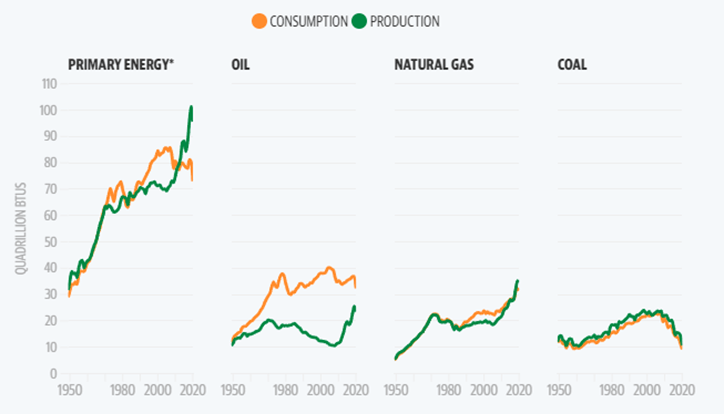
This shows consumption vs. production of all energy sources (Primary Energy) and also for our major fossil fuels: oil, natural gas, and coal. We are producing more natural gas and coal than we are consuming but we still have to import oil to meet our energy needs. In fact, we use 38% more oil than we produce. The good news is that the gap for oil is closing at a nice clip. In 2008, we used 140% more!
In reality, we will probably never achieve true energy independence because our oil producers operate independently in open markets and are not controlled by our government like many other oil-producing countries are. Our oil companies want to maximize their profit so they may find selling to other countries makes more financial sense than to keep it here. When you look at it, most of our oil comes from five states: Texas, North Dakota, New Mexico, Oklahoma, and Alaska. Surprisingly, it can be cheaper to export oil to other continents than to ship it across the country. So, unless our government takes over our oil production, it might be a while until we hit energy independence for oil.
The energy markets are very complex. You have government-run producers and, like us, privately-owned producers. You have both hostile and friendly countries that have what we need. You have rules and regulations that restrict how, where, and when you can move these fuel sources. All of this factors in to the challenges of making the U.S. truly energy independent. I feel that as we continue to grow our renewable energy resources, we will be able to meet our oil demand with domestic production and will not have to rely on foreign imports for our energy needs.
Let me know if you have any questions.
Joe Baker, CFP®
Baker Asset Management, LLC
joebaker@bakerassetmanagement.com

