

Fun Facts about January
- Birthstone: Garnet
- Flower: Carnation
- Zodiac signs: Capricorn and Aquarius
- January was named after the Roman god Janus. Janus is also the Roman word for door. The god, Janus, had two faces which allowed him to look forwards into the coming year and backwards into the past year.
- On average, it is the coldest month of the year in the Northern Hemisphere.
- In the Southern Hemisphere January is a summer month the equivalent of July.
- Martin Luther King Jr. Day is always on the 3rd Monday in January (January 17th this year).
Stocks returned to their positive ways in December with most stock indices approaching or surpassing their respective all-time highs. For the month, the S&P 500 gained about 5%. December made it the tenth positive month for the year 2021. Only January and November had negative returns. For the year, the index finished up an impressive 27%.
I wanted to see how this year’s return compared historically. Check out this chart of the S&P 500 historical annual return since 1928:
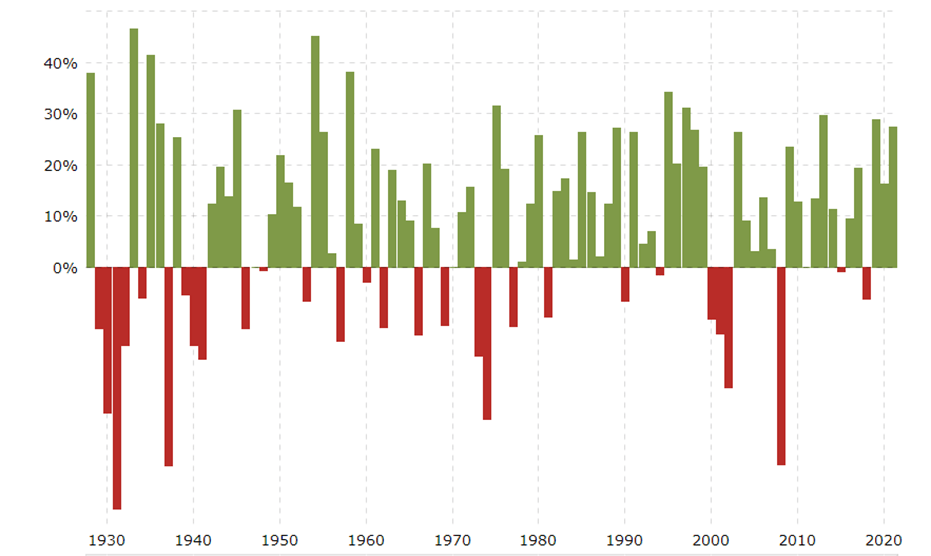
Fyi, the best annual return was +46.59% in 1933 and the worst was -47.07% in 1931.
Earnings reports from companies for Q4 and for the entire year of 2021 will start to show up in early January, which could move the markets, as always. But the main thing that you want to listen to is a company’s outlook for 2022: if they believe Covid will become more of a flu-like problem versus a pandemic; if supply chains will return to normal; and how disruptive industries like blockchain, electric vehicles, and the metaverse will affect their earnings going forward.
Supply chains continue to normalize but the people on the front lines say it could take all of 2022 to get back to pre-covid efficiency.
Inflation will probably be the most influential item for the financial markets in 2022. The Fed has mapped out their plan to combat it so now we watch and wait.
Seasonally, we are smack dab in the middle of the time of year where stocks have consistently performed well. The November through April timeframe has historically been the best time of the year to be invested in the stock market.
Take a look at the Outlook section below to see what events could move the markets over the short term.
Bond prices were mixed in December, pretty much the exact opposite of how bonds fared in November. High yield, or junk bond prices moved higher while higher quality corporate and government bonds saw their prices drop. This is normal price action since junk bond prices tend to move more in sync with stock prices than with other bond prices. This bond price movement should be the more common direction going forward as the Fed begins to taper its bond purchases and prepares to raise interest rates. If you expect this to happen, then please be cognizant of this when buying bonds with a maturity date greater than 1-2 years. In this type of interest rate environment, you can expect to lose principal unless you hold the bonds to maturity.
The 10-year US Treasury note is now yielding about 1.52% and the 30-year bond is almost at 1.91%, both slightly higher than last month. The path of least resistance for these rates is up, so expect these yields to continue to rise and their respective bond prices to drop as the fed pumps the brakes on buying so many of these bonds every month.
Interest rates bumped up slightly for the second month in a row. CD, money market, and savings account rates all went up by small percentages once again but are still incredibly low. These rates should continue to move higher into next year, but the savings rates will most likely still be too low to keep up with inflation. Now that we know what the Fed is going to do (raise rates), changes in these rates won’t come as too much of a surprise.
Currently, the average savings account is paying 0.28%, about the same as last month. Although safe from market fluctuations, putting all your eggs in a savings account is not the best bet, especially if you need to grow your account value. Plus, you have to pay taxes on that interest. I do expect these rates to continue to inch up over the next year.
The 1-year CD interest rate is now averaging 0.49%, down from 0.52% last month. The 5-year CD rate stayed the same, at 0.81%. You’re certainly not getting rich owning these. Hopefully, these rates will start to move higher in a meaningful way over the next year or so. That way, we can at least make some money on our emergency reserves.
Mortgage rates remained relatively flat for the month of December now that the uncertainty of what the Fed will be doing over the course of the next year has been removed from the markets. Currently, the 30-year rate sits at 3.19%, up from 3.18% a month ago. There is still high demand for mortgages, although it has come down a bit from its peak back in the fall. It will be interesting to see how housing demand is influenced by the expected rise in mortgage rates in 2022.
Oil prices resumed their upward trek in December after a big dip in November. The scare of the omicron variant seems to have subsided rather quickly as evidenced by the surging numbers at the TSA gates, the increase in cruisers, and the uptick in road trips during the holiday season.
The price for a barrel of oil went up about 15% to settle near $75.30 at the end of the month. Year-to-date, the price is up 58%. I’m still seeing a ton of out-of-state plates here in Charleston right now, which is more like the summertime than now. If this is the case across the U.S., there is going to be continued strong demand for gasoline and for charging stations, for those who already made the switch to electric.
Gasoline prices are lagging oil prices by at least a week because the rise in oil prices is not yet reflected in gas prices at the pump. Regular unleaded gasoline is now averaging $3.28 per gallon, down $0.11 from last month. If the lag is accurate, we should see gasoline prices rise into the end of the year. Oklahoma has the cheapest gas right now, at $2.87. California has the most expensive at $4.66 per gallon. FYI, a year ago, we were paying $2.25.
Check out the prices at the pump in your area: Gas Buddy.
Outlook
Events on the horizon that could move the markets in the near term:
- Coronavirus: It’s pretty bad out there. The very contagious omicron variant has made cases, hospitalizations, and deaths jump up from a month ago. The U.S. is now averaging about 1,500 daily deaths, up from 1,000 a month ago. The good news is that this mutation is not as severe as previous ones. This could actually help us get closer to herd immunity if those that are unvaxxed or whose vaccinations have waned get infected, hopefully asymptomatic. Currently, we are at 73% of our citizens vaccinated with at least one dose, up from 70% a month ago. I think we are close to accepting that this disease will be with us for the foreseeable future, and we will start to learn how to live with it, similar to how we deal with the flu. This acceptance should bode well for stocks in 2022.
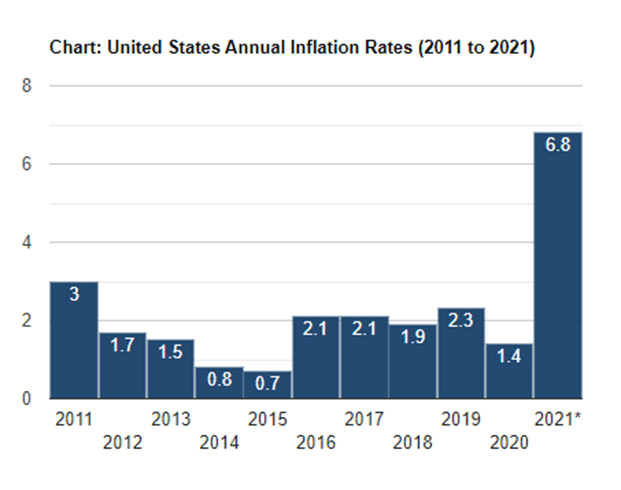
- Fed & Inflation: The Fed is expected to raise interest rates 3 times in 2022 at a clip of 0.25% each time to combat the rise in inflation. So now, the uncertainty of rate increases is removed from the markets, which is a good thing, since markets hate uncertainty. Historically, stocks have performed well when the Fed begins to raise rates. The same does not hold true for bonds, whose prices drop when rates rise. Also, since rates are still incredibly low, bond investors may shift some of their money to stocks to improve their portfolios’ performance. Monitoring these rate increases will be front and center for investors in 2022. For reference, here is a chart of annual inflation rates in the U.S over the past decade:
Joe Baker, CFP®
Baker Asset Management, LLC
joebaker@bakerassetmanagement.com

