
ETFs (Exchange-Traded Funds) have become ubiquitous in the retail investing landscape. We see them in almost half of all U.S. household’s investment portfolios. In fact, ETFs have become so popular that they have recorded global net inflows of over $1 trillion year-to-date through November 2021, the first time ETFs have reached that milestone, according to investment research firm Morningstar Inc.
One of the reasons for their popularity is that they show what they own on a daily basis. You just simply go to their website and click on Holdings or Portfolio to see what companies they are invested in. Having said that, I can make a pretty safe bet that 95% of people that own ETFs have no idea what the 5 biggest stocks are inside those investments. But it is something that you should be looking at periodically, especially if you own more than one ETF. This is to ensure that you are not too concentrated in any one company, which could cause large swings in your portfolio’s value if there is a big change in that company’s stock price.
The good news is that there are websites that allow you to compare ETFs to see what’s inside each of them. Most brokerages have this feature in the Research section on their websites. You can also find some dedicated websites for ETFs that may require a subscription. Here is one that I found that allows you to compare two ETFs without having to sign up for anything:
https://www.etfrc.com/funds/overlap.php
Here is an example from this site, comparing the Technology Select Sector SPDR Fund (XLK) and the iShares Expanded Tech Sector ETF (IGM):
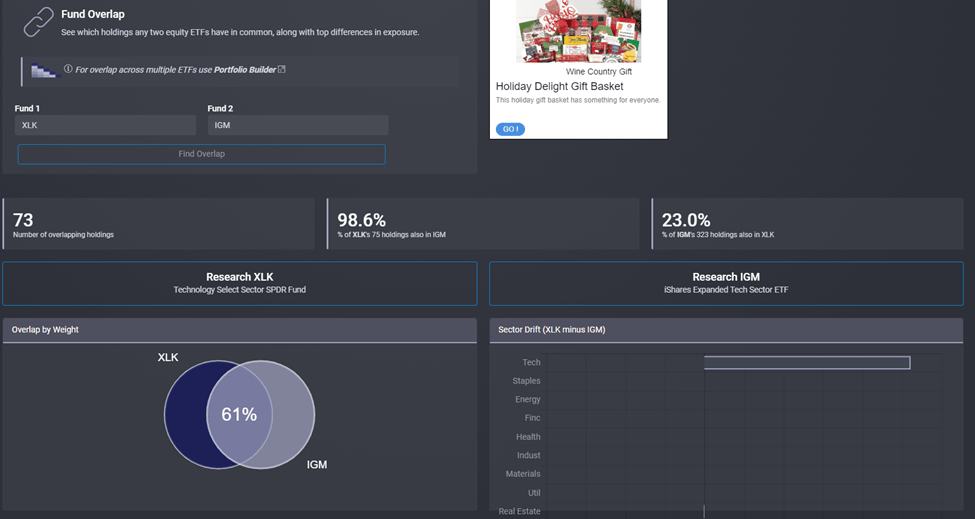
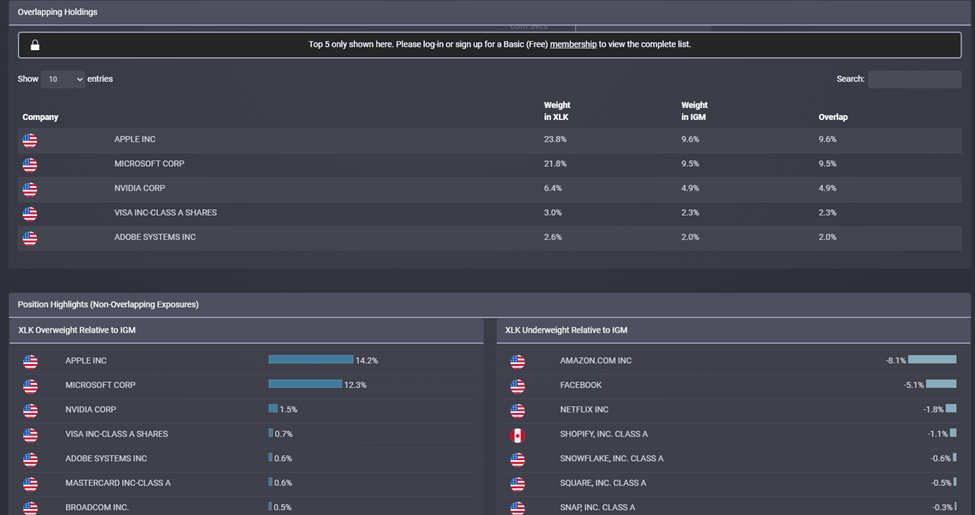
As you can see in the first screen shot, there is a 61% overlap between these two ETFs. That means if you looked at the combined holdings of these funds, you would find that 61% of the companies would be found under both ETFs. That’s a pretty big overlap and the reason I chose these particular ETFs. I wanted to illustrate the importance of knowing what you own so you can ensure you are matching your desired portfolio allocation.
Whatever tools you use, I suggest definitely taking a peek at your holdings about twice a year, just to make sure you don’t get too heavily concentrated in any one sector or stock.
Let me know if you have any questions.
Joe Baker, CFP®
Baker Asset Management, LLC
joebaker@bakerassetmanagement.com

