Retail Is A Wreck

retail-bankruptcy

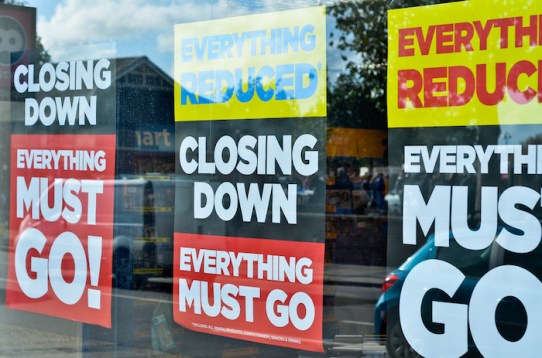
Brick and mortar retailers have been going through a death-by-a-thousand-papercuts for at least the last 5 years and 2020 is no exception. Besides the competition of online retailers, especially from the Amazon death star, these companies now must deal with a never-ending pandemic, stifling their shoppers but still having to pay rent, employees, and vendors.

Who knew, but online-only retailers were made for pandemics. So, this should come as no surprise that there have been at least 21 major retailers that have filed for bankruptcy protection this year. By the way, last year there were a total of 19 that filed. That is a lot, but we could see almost twice that many by the end of 2020.

Here is a current list of major retailers that filed for bankruptcy in 2020:

Select a retailer to learn more about their bankruptcy.

RTW Retailwinds (July 13)

Muji USA (July 10)

Sur La Table (July 8)

Brooks Brothers (July 8)

G-Star Raw (July 3)

Lucky Brand (July 3)

GNC (June 23)

Tuesday Morning (May 27)

Centric Brands (May 18)

J.C. Penney (May 15)

Stage Stores (May 11)


Aldo (May 7)

Neiman Marcus (May 7)

J. Crew (May 4)

Roots USA (April 29)

True Religion (April 13)

Modell’s Sporting Goods (March 11)

Art Van Furniture (March 9)

Bluestem Brands (March 9)

Pier 1 (Feb. 17)

SFP Franchise Corp (Jan. 23)


There is a website that keeps a running list of retail bankruptcies if you want to learn more about them:

https://www.retaildive.com/news/the-running-list-of-2020-retail-bankruptcies/571159/

The takeaway from an investing point of view is to steer clear of brick and mortar retail companies until there is some kind of light at the end of the Covid tunnel.

Please let me know if you have any questions.

Joe Baker, CFP®

Baker Asset Management, LLC

joebaker@bakerassetmanagement.com

How The VIX Can Help With Your Investment Strategy

Market-Volatility-Visualized


One of the metrics that I like to look at when assessing market risk is the CBOE Volatility Index, more commonly known as the VIX. The VIX measures the level of fear, anxiety, and/or uncertainty in the stock market. Technically, it looks at the options pricing of the S&P 500 index into the near future (about a month). When investors buy a lot of call options, meaning they expect the stock market to go up, the VIX drops. Conversely, when a lot of put options are bought, meaning people expect the stock market to drop, the VIX rises.

Of course, like everything else on Wall Street, there is a saying for the VIX: “When the VIX is high, it’s time to buy. When the VIX is low, look out below!” You’re probably thinking that this doesn’t make sense. A high VIX means there are a lot of pessimistic investors and so it would be bad for stocks. This is true but it is also true that the herd is usually wrong, so the VIX is normally interpreted as a contrarian indicator. This means when everyone is fearful, a high VIX, it’s probably not a bad time to buy stocks and vice versa.

Right now, we have a VIX of about 29, higher than what most investors consider a neutral VIX of 20. This makes sense because there is still a lot of fear and uncertainty in the market due to the pandemic and the upcoming elections in November.

Using the VIX as part of your big picture view of the market’s risk is a useful data point to help with your investment decision making. Please let me know if you have any questions.

Joe Baker, CFP®

Baker Asset Management, LLC

joebaker@bakerassetmanagement.com

Monthly Update – July 2020

july

Stocks pumped the brakes on their recovery rally in June. The S&P 500 was essentially flat for the month. It remains down about 4% for the year. All things considered, the performance is amazing, but I can’t shake the feeling that we are whistling past the graveyard.

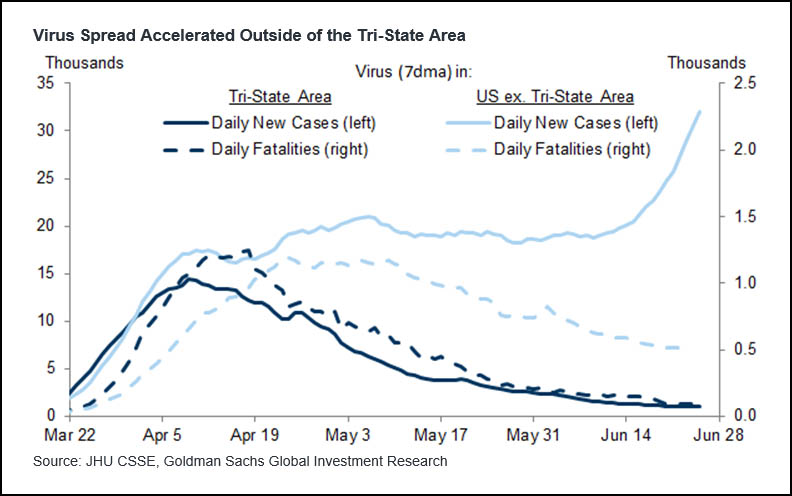
The markets are on shaky ground, at best right now, with Covid being the biggest influence. Positive cases are spiking in pretty much the entire country except for the northeast. The good news is that fatalities continue to drop. This is due to the fact that the average age of those testing positive has fallen dramatically, and we have learned how to better treat those that have to be hospitalized. This chart is a good illustration of that (Tri-State Area being NY, NJ, CT):
2_VirusSpread

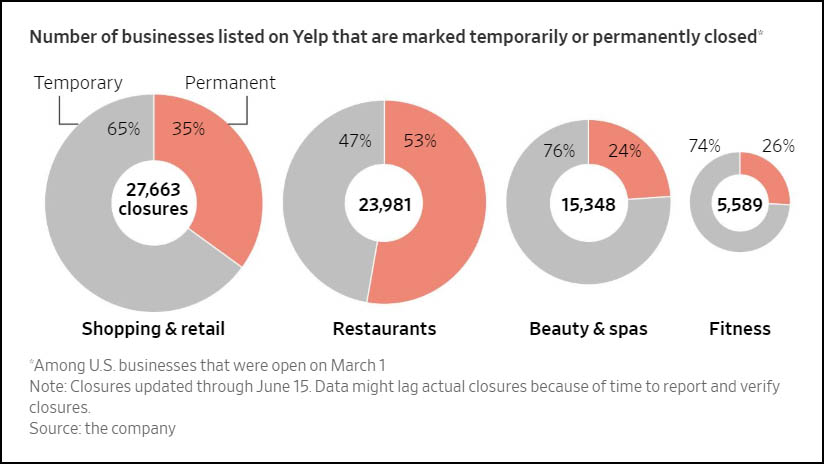
Unfortunately, the pandemic is still wreaking havoc on our small businesses. Here’s a glimpse of the devastation:
4_Businesses

The Fed is still in the markets’ corner, helping out in many ways. We’ll still need some more fiscal support from Congress if this second wave of Covid cases continues to halt the country from reopening.

Take a look at the Outlook section below to see what events could move the markets over the short term.

Bond prices were a mixed bag in June. Lower quality bonds, i.e., junk bonds, saw their prices drop slightly while higher quality corporate and government bonds moved higher. Right now, bonds have the world’s biggest buyer, the United States, scooping them up so many investors are trying to front-run the Fed, hence the rise in prices on the high-quality side.

The 10-year US Treasury note is yielding 0.63% and the 30 year is at 1.38%, both slightly lower than last month. These low yields continue to force more money into the stock market because they are just too low to tie up money for such long periods of time.

Interest rates continued to trend lower in June. The word is out that the economy is not going to spring back as fast as it dropped. The uncertainty of the pandemic and all the shuttered or semi-open businesses is ensuring rates stay low.

On the savings side, short-term rates, like savings and money market accounts, as well as longer-term rates, like CDs, have continued their slow drip downward.

Currently, the average savings account is paying 0.53%, slightly lower from a month ago, 0.60%.  Nobody is making money in cash, but at least it is safe.

The 1-year CD interest rate is now averaging 0.90%, less than the 1.01% it was yielding a month ago.  The 5-year CD rate is tracking lower as well, now at 0.99% from 1.22%. With people saving their income at an unprecedented high rate, these rates will continue to stay historically low. The good news for stock investors is that all this cash is going to have to go somewhere and this usually is a precursor to higher stock prices.

Mortgage rates headed lower yet again in June. Currently, the 30-year rate is at 3.29% down from 3.52% a month ago. The Fed flooding the market with liquidity is helping to keep these rates extremely low, particularly for the variable rate mortgage loans. With rates this low, it’s no surprise that pending home sales rose over 44% in May, the biggest monthly jump since 2001.

Oil prices continued their bounce back after the drop into the abyss in April. The price for a barrel of crude rose about 10% to $39.31. If you are trading oil this year, you better have a crash cart close by. The price swings are insane. Rising oil prices are reflecting the promise of more demand worldwide as countries begin to open to a more normal operating mode. These prices are good news for all those employed in the fossil fuels industries. I can’t see demand getting back to where it was 6 months ago so maybe oil prices in the $30 to $40 range will be the new normal. There is so much oil stored already and sitting in ships that it would be tough for prices to continue this uptrend unless there are significant production cuts by the U.S. and OPEC.

Gasoline prices bounced up along with the price of oil. Prices at the pump are averaging about $2.18 per gallon, 20 cents higher than a month ago.  Mississippi has the cheapest fuel, at $1.82.  FYI, a year ago, we were paying $2.72.

Check out the prices at the pump in your area: Gas Buddy.

 Outlook

Events on the horizon that could move the markets in the near term:

  • Coronavirus: Depending on what part of the country that you are in really determines how you feel which way we’re heading with this disease. The northeast has seen a steady decrease in the number of new cases while pretty much everywhere else is seeing cases spike. It will be interesting to see if there is a resurgence in cases in the northeast as that area opens back up. Many other areas are putting restrictions back on to try and slow the rise in new covid cases. Basically, it’s going to be a mess until there’s a vaccine. The markets will rise and fall as news of vaccine rumors swirl around but when the real deal is announced, we will get a huge boost for stocks across the board.
  • Interest Rates: {repeat from last month} Rates are at historical lows and will be for the foreseeable future. The savings rate for Americans is at 33%, the highest since we started tracking it in in the ‘50’s. How long will we leave our money in something that doesn’t earn any interest and loses value over time due to inflation? I see a lot of home improvement going on so I know that money is starting to be spent.
  • Election: I didn’t want to put this on here for at least another month, but I felt compelled to after fielding a bunch of calls on how the election will affect portfolios. Both republicans and democrats are fearful of the other side winning. Someone is going to win, and the country and the markets will adjust accordingly, as they always do. Regardless, there are going to be some wild swings over the next few months heading into the elections. Plus, the way this year is unfolding, anything can happen!
  • Trade Wars/Tariffs: I don’t expect any progress on these issues until after the election. It is all about Covid right now.


Joe Baker, CFP®

Baker Asset Management, LLC

joebaker@bakerassetmanagement.com

7 Interesting Factoids From The Pandemic

I wanted to put together some fascinating stats, datapoints, and predictions resulting from this pandemic that I have seen over the last week. Check these out:

  • Hotel downsizing: As many as 25,000 rooms, or 20% of New York’s total hotel room capacity, might not reopen, analysts and hotel owners say. That is equivalent to the entire size of hotel markets in Louisville, Ky., or Jacksonville, Fla.
  • In Beantown, it’ll be harder to get some chowdah: The coronavirus pandemic could wipe out roughly one quarter of Massachusetts’ restaurants, according to the Massachusetts Restaurant Association. The group predicts that about 3,600 of the state’s 16,000 restaurants will not survive the pandemic, based on reports from the state’s two major food suppliers. Bob Luz, the president and chief executive of the restaurant group, has said this number could climb higher as the pandemic continues to take a toll on the food industry.
  • Consumers may not be staying in hotels or dining out, but they are still spending: The Sherwin-Williams Company (NYSE: SHW) today increased its net sales guidance for the second quarter of 2020. Net sales in the Consumer Brands Group are expected to be significantly above the high end of the previous guidance.
  • Another beneficiary of the pandemic: Once limited to workouts and errands, athleisure becomes a workwear staple. Athleisure — clothes that are fit for workouts but are way nicer than your ratty old gym shorts — has been on the rise for years now. The market is projected to leap by $80.7B between 2020 and 2024. The pandemic has been a boon to many athleisure companies.
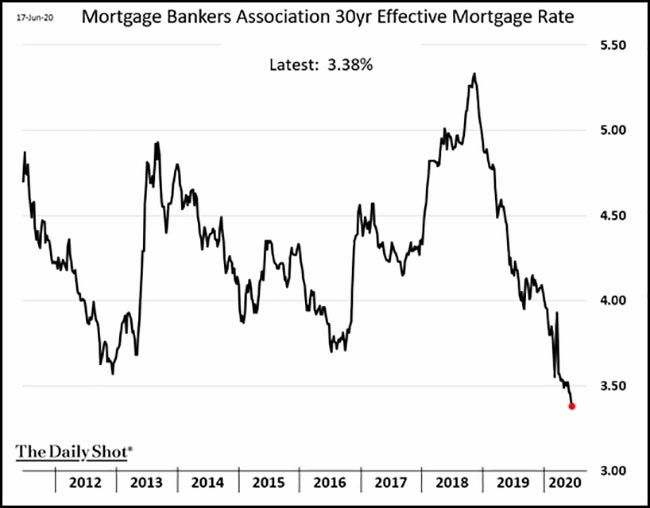
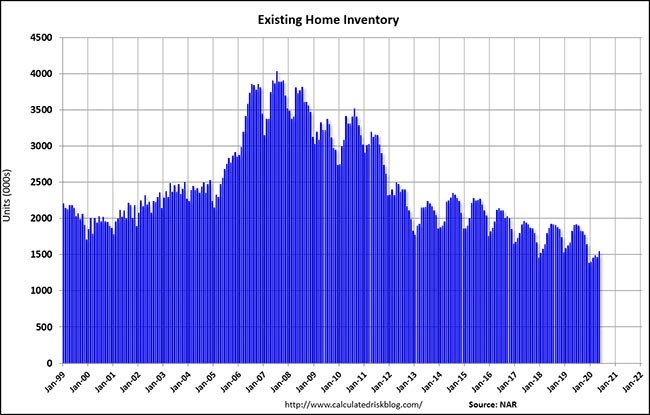
  • Mortgage rates are at all-time lows while houses for sale are as well. This is not normal but is nice for borrowers:


  • This was certainly not unexpected:
  • Finally, if you read about this product pre-covid, you would have laughed, shook your head, and forgot about it. Now, you might give it a second look:

This portable urinal company is flush with demand. If you’ve ever peed in a water jug in the back seat of a car and thought, “I’m OK with this, but I would love something a little more bourgeois,” boy do we have the product for you.

The Travel John is your perfect on-the-go bladder. For $17, you get a six-pack of bags, stuffed with crystals that absorb your urine and its smells. If you want one, you might have to hurry: The company behind the Travel John says it’s seeing a “drastic increase” in demand right now. It brings the lavatory right to your door. Listen: We get it. In loo of flying, Americans are taking tons of road trips this summer. And road trips are long, and maybe you’re nervous about using rest stops, and… suddenly, that portable urinal sounds pretty damn convenient. More good news: The ladies won’t be left in the cold. The Travel John’s feminine compatriot is the pink Travel Jane.

Joe Baker, CFP®
Baker Asset Management, LLC
joebaker@bakerassetmanagement.com
Current Market Forces At Play

As a money manager, one of the things that I like to do at least monthly is make a list of the forces that are moving the stock and bond markets. This helps in my decision-making processes, such as when to buy, sell, take some profit, or cut losses. I have been doing this exercise a bit more frequently over the last few months, as the world basically turned upside down and now is trying to right itself.

Here’s a brief list of market forces that I think are having the most influence on stock and bond prices right now:

Low Interest Rates – I talk about this one a lot. Low interest rates are usually an indicator that the economy is not doing well. I see low rates as sort of a sheep dog herding investors towards stocks and high yield bonds since they can’t make any money in government bonds or CD’s. One data point I watch frequently is the US Treasury 10-year note. Right now, it is yielding 0.70%. As an investor, I’d rather buy stock of a quality company that’s paying a 3% dividend and has the chance to appreciate in price as well. If the 10-year note yield starts to get near 3.5%, then I like to reduce my stock holdings.

Personal Savings Rate – This is the percent of money that people save from their income each month. Over the last 5 years, this rate has fluctuated between 6% and 8%. This past April, it was 33%. This big increase in the savings rate makes sense since much of the economy was literally shut down, so there were not many places to spend it. I’m sure the next few readings are going to drop off quite a bit from that high-water mark and that will be good for company’s profits, which will be good for their stock prices.

Economy Opening Back Up – This is a pretty obvious positive sign for investors. However, there are going to be certain parts of the economy that are going to take a awhile to get back to normal or that may have to have a new normal (airlines, rental cars, movie theaters, sports). This is where you have to choose the sectors that can recover the quickest from the pandemic, otherwise, you could be sitting on dead money for some time.

China Trade Tensions – This is still festering in the background. We’re not really hearing anything about it because of the pandemic, protests, and riots topping the news cycle. This will probably come back into play as we approach the November elections and is a net negative overall for US company profits since US companies are the ones paying the tariffs.

Oil Prices – I never thought that I’d see oil prices fall to below $0 per barrel in some areas but they did this year. Just as surprisingly, prices have rebounded smartly from those lows and now are in the mid-$30’s. There’s still going to be a ton of job losses in the fossil fuels industry but these higher prices could save some of the smaller drillers from going bankrupt. This isn’t as big as a factor as it once was on the overall economy in the U.S. since much of economy is consumer drive and service based, versus manufacturing.

To summarize, these forces are mostly positive for stocks and bonds but there is still so much uncertainty out there with regards to how the pandemic will play out. We’re starting to see a spike in cases as most of the country opens back up. If we start to see hospitals getting swamped again and deaths start to mount, it could be another market dive in the months ahead. Stay tuned and stay safe.

Joe Baker, CFP®
Baker Asset Management, LLC
joebaker@bakerassetmanagement.com
Covid-19 Is Changing How We Live

I was doing some light reading about how the pandemic is changing our daily lives and I came across this great article by a frequent flyer that gives a nice description of what to expect if you are going to start flying again. He took plenty of pictures which really helps visualizing what he is describing.

I haven’t boarded a plane since March 9th so this was very helpful for me as I prepare to get back in the air.

The airline industry is just one of the sectors of our economy and our way of life that will be permanently changed by Covid-19.

Here’s the link:

https://www.yahoo.com/news/flew-americas-2-largest-airlines-123600145.html

Joe Baker, CFP®
Baker Asset Management, LLC
joebaker@bakerassetmanagement.com

Monthly Update – June 2020

Stocks continued their recovery rally from the pandemic shutdown. The S&P 500 finished May with a 4.8% gain and is now down only about 6% for the year.  This rise is just as impressive to me as the drop that happened back in March, which seems so long ago.

Earlier in May, I talked about why stocks are going up while the economy is spiraling downward. You can read what I said here: https://bakerassetmanagement.wordpress.com/2020/05/09/892/. The markets are basically saying that the worst is behind us. But there is still so much uncertainty about Covid-19 that it is hard for me to agree with that. We have seen a recent spike in new cases as well as deaths in many states, as the country slowly reopens. However, I like that the percentage of people infected is going down as we increase testing. Also, the hospitalization rate is .07%, which is very low. I think by the end of June we will have enough data since the time that we started to reopen to assess if we can open all the way up. Let’s keep our new and improved sanitary measures and habits in place, regardless.

The Fed is still doing its part to maintain stable financial markets and that is vital because Congress is no longer playing nice again. So, don’t bet on any help from the fiscal side of things while partisan politics ramps up as we move towards the November elections.

Take a look at the Outlook section below to see what events could move the markets over the short term.

Bond prices moved higher across the board. Government bonds had the smallest increase and just like last month, corporate bond prices moved solidly higher as the Fed continues to buy corporate bonds and bond exchange-traded funds.

The 10-year US Treasury note is yielding 0.65% and the 30 year is at 1.40%, both slightly higher than last month but still ridiculously low. These low yields force more money into the stock market because they are just too low to tie up money for such long periods of time.

Interest rates are trending lower again after a slight rise in April. Besides the poor economy, another reason for this trend is that more of us are saving our money since we can’t spend it as freely due to the shutdown. This past month showed that Americans are saving about 33% of our income, the highest rate ever recorded since the government started tracking it back in the 1950’s. For comparison, this rate is usually around 5% to 9%.

On the savings side, short-term rates, like savings and money market accounts, as well as longer-term rates, like CDs, have resumed their slide downward.

Currently, the average savings account is paying 0.60%, slightly lower from a month ago, 0.66%.  Nobody is making money in cash, but at least it is safe.

The 1-year CD interest rate is now averaging 1.01%, less than the 1.19% it was yielding a month ago.  The 5-year CD rate is tracking lower as well, now at 1.22% from 1.36%. With people saving their income at an unprecedented high rate, these rates will continue to stay historically low. The good news for stock investors is that all this cash is going to have to go somewhere and this usually is a precursor to higher stock prices.

Mortgage rates headed lower again in May, with the exception of the 30-year fixed rate, which was little changed.  Currently, the 30-year rate is at 3.52%, no change from last month (3.53%). The Fed flooding the market with liquidity is helping to keep these rates extremely low, particularly for the variable rate mortgage loans.

Oil prices rose an incredible 135% in May after going negative just a month ago! Rising oil prices are reflecting the promise of more demand worldwide as countries begin to open to a more normal operating mode. These prices are good news for all those employed in the fossil fuels industries. I can’t see demand getting back to where it was 6 months ago so maybe oil prices in the $30 to $40 range will be the new normal. There is so much oil stored already and sitting in ships that it would be tough for prices to continue this uptrend unless there are significant production cuts by the U.S. and OPEC.

Gasoline prices bounced up along with the price of oil. Prices at the pump are averaging about $1.98 per gallon, 21 cents higher than a month ago.  Mississippi has the cheapest fuel, at $1.59.  FYI, a year ago, we were paying $2.83.

Check out the prices at the pump in your area: Gas Buddy.

Outlook

Events on the horizon that could move the markets in the near term:

  • Coronavirus: There are promising signs that the worst is behind us: more testing, less infections, less daily deaths. Hope jumps and fades every day as news of promising vaccines are reported. The markets have been rising and falling in response to this news cycle as well. We will have a vaccine and it could be like the one we have for the flu, where we have to take it every year. We just have to wait to find out, but the world is going to continue to open back up as the research continues.
  • Interest Rates: Rates are at historical lows and will be for the foreseeable future. The savings rate for Americans is at 33%, the highest since we started tracking it in in the ‘50’s.  How long will we leave our money in something that doesn’t earn any interest and loses value over time due to inflation? Once we start spending and/or investing this cash, it will give the markets a nice boost.
  • Unemployment Rate: So far, there have been over 40 million Americans that have filed for unemployment since the Covid crisis began. This equates to an unemployment rate of about 15%, although many sources claim that the actual rate is closer to 20%. This is devastating. I have to believe this rate will drop over the next few months as we get back to work. But there could be no jobs to go back to for many (retail and tourism industries to name a few), which will be a long-term problem for our economy and country.
  • Trade Wars/Tariffs:  Tensions continue to ramp up between us and the rest of the world, especially China. As I’ve said before, now is not the time to be feuding with our biggest trading partner. There will be plenty of time for squabbling after we get back on our feet. This will continue to put a drag on our economy and the markets.

Joe Baker, CFP®

Baker Asset Management, LLC

joebaker@bakerassetmanagement.com
When a 401k Loan Makes Sense

In an ideal world, it never makes sense to borrow from your 401k account.  However, in the real world, there are times when it is necessary (especially in Covid pandemic times). Surprisingly, it can be a relatively cheap way to borrow money.

If you’re considering a 401k loan, the first thing you have to do is make sure they are available in your plan.  Most offer loans but it is not required.

Recent legislation, known as the CARES Act, has changed some of the rules when borrowing from your 401k. These changes have made 401k loans even more appealing, compared to other sources when cash is needed. The following incorporates those updates:

If your plan allows loans, here are the basics:

  • You can borrow up to 100% of your account value, with a maximum dollar value of $100,000.
  • You can wait up to 1 year to start paying back the loan.
  • You have up to 5 years to pay back the loan. Actually 6 years, if you defer payments 1 year.
  • Loan payments are deducted directly out of your paycheck.
  • The interest rate is typically the prime rate at the time the loan is taken out.  Currently, the prime rate is 3.25%.
  • Your spouse has to sign off on the loan as well.
  • If you quit or lose your job, the loan has to be repaid in full or it will be considered a distribution, which is subject to taxes and penalties.

When you take a 401k loan, you are borrowing from yourself.  Essentially, you are trading stock market returns for a fixed interest rate (the loan rate).  If the market tanks while you have a loan out, you’ll look like an investment genius.  Usually though, there is an opportunity cost on that loan amount.  For example, if you didn’t take a 401k loan, that money would be invested in the stock market.  The opportunity cost is the difference between what your stock market fund in your 401k returns and what the loan interest rate is.

I think there are certain situations where taking a loan out on your 401k makes sense.  If you have high interest debt, say credit card debt with an interest rate of 20%, taking a 401k loan with a rate around 5% to pay off that credit card debt is a sound financial move.

Having said that, this isn’t a one-size-fits-all solution. Your financial situation and your 401k plan are unique to you, so crunch the numbers to make sure it makes sense before pulling the trigger.

Let me know if you have any questions.

Joe Baker, CFP®
Baker Asset Management, LLC
joebaker@bakerassetmanagement.com
Lock Down or Open Up….Who’s Right?

lock down open up

We are halfway through May smack dab in the middle of a pandemic and right now, are at a crossroads of sorts: Stay in lockdown or Open up. There are valid arguments on both sides but the biggest issue is the unknowns. There are so many when talking about Covid-19. Here is an incomplete list that I frequently think of:

  • How contagious is it
  • How long is it alive on surfaces inside, outside, exposed to sun, no sun, etc.
  • How far does it travel in the air
  • Once infected and recovered, can you get it again
  • Will the antibodies stay effective like with chicken pox, or will we need a vaccine shot every year like the flu
  • If we continue with measures to flatten the curve, will we extend our economic turmoil to a point where it is not worth it

There are answers to some of these but most are educated guesses, which is really all we can do at this point. Obviously, the more data that we gather, the closer we can get to answering these questions with confidence.

The one amazing data point that really fascinates me is that at least 80% of people infected by Covid are asymptomatic, meaning they pretty much don’t know they have it. If that’s the case, then we’ll never be able to stop the spread unless we can test our entire population at least weekly.

So, knowing all of this, do you stay shut down or do you open back up? Each state is making the choice right now. Some have already opened all the way up, including reopening schools. Others have continued their lockdown and plan on keeping it like that through June. Here in South Carolina, the beaches are packed and restaurants are open, albeit with social distancing restrictions.

It is a tough decision for governors and mayors because nobody knows which way is the right way. For those states that have opened up, I guess we’ll find out in a few weeks by looking at any upticks in hospitalizations and death tolls. Obviously, I’m hoping there is not a big increase anywhere and that will help states that are still in lockdown to decide to start opening back up.


Joe Baker, CFP®

Baker Asset Management, LLC

joebaker@bakerassetmanagement.com
With All The Bad News, Why Is The Stock Market Going Up?

stock-rise

The stock market continues to surge in the positive direction. Just this past week, the S&P 500 gained 3.5%.  Incredibly, it is only down 10% for the year!

I say incredible because stocks are rising during a period of horrific economic damage being done throughout the world. Here in the U.S., the unemployment rate is at 15%, which equates to about 34 million people who lost their jobs due to the pandemic. Logically, you would think stocks would go down with such bad news out there. Here’s my thoughts on why they are doing the opposite:

  • The stock market is a forward-looking mechanism. This simply means that the market is more interested in what is going to happen in the future than what has happened or what is happening. In this instance, the market believes that the worst is behind us and that we will start to recover from the pandemic over the next few months.
  • The economic shutdown was self-imposed, and restarting should occur more quickly than, say after the 2008 financial crisis. Back then, banks and the financial markets were on the brink of freezing up. Today, most banks are well-funded and are helping to stabilize the financial markets.
  • The Federal Reserve has taken extraordinary steps to keep money flowing through the economy. Knowing the Fed won’t let markets fail is a huge positive for stocks and bonds.
  • News of vaccines being available within a year has sparked optimism that things will go back to normal.

Any resurgence in new covid cases and deaths could throw a big wrench into this comeback. So, those numbers over the next month or so will be very telling. You also have the questions of whether this thing is seasonal and how long the antibodies stay effective in our systems. But for now, the market is a glass-half-full kind of person, so let’s enjoy it while it lasts.


Joe Baker, CFP®

Baker Asset Management, LLC

joebaker@bakerassetmanagement.com