
Calendar Notes
- March 8th, Sunday – Daylight Saving Time: Clocks jump ahead 1 hour.
- March 17th, Tuesday – St. Patrick’s Day.
- March 20th, Friday – First day of spring.
Stocks could not continue their positive vibe from the beginning of the year as February finished in the red for most indices.
For the month of February, the S&P 500 finished at a loss of almost 1.00%, below its historical average over the last thirty years of +0.37%. Sticky inflation data and the fear of several industries being viewed as highly vulnerable to disruption by AI were enough to offset positive earnings reports and decent job numbers. For the year, the index is now up about 0.60%
Looking ahead, potential catalysts to move stocks this March include the February jobs report due out on Friday, March 6th. Also, the FOMC meeting on March 19th could stir up the markets. The Fed is expected to continue their pause on cutting rates so any change will certainly create some volatility.
Historically, the S&P 500 index has performed quite well in March, often referred to as the starting gun for the “Spring Rally”. Over the last thirty years, it has had an impressive +1.80% return on average.
Take a look at the Outlook section below to see what events could move the markets over the short term.
Bond prices, with the exception of junk bonds, had a nice run up in the month of February. The best performing bonds were those with longer dated maturities. In fact, U.S. Treasury bonds with 10 year or longer maturities had their best month in over two years. The main reason was the SCOTUS tariff ruling, which struck down broad universal reciprocal tariffs and was viewed by bond traders as a massive disinflationary event. By invalidating tariffs that were viewed as a “tax” on consumers, the ruling lowered long-term inflation forecasts, causing bond prices to rise.
The 10-year US Treasury note yield finished higher in January, settling at 3.95%, much lower than the 4.24% yield that it was at the beginning of the month. The 30-year bond yield closed out the month at 4.62%, 26 basis points lower than a month ago.
Bond investors will be looking ahead to the FOMC meeting in mid-March to get some clarity on how many rate cuts they are considering this year. Consensus shows that they won’t cut rates again until June at the earliest.
I still like bonds with at least a 12-month maturity but plan on holding them until they mature.
Savings rates came down rather significantly, particularly the longer-term CD rates, as inflation expectations eased following the tariff ruling by SCOTUS. For savers and risk-averse investors, the rates still haven’t dropped enough to look elsewhere to park their money. However, some investors may look to shift some of their money market assets to high-yield bonds and/or dividend-paying blue-chip stocks as an alternative.
| Account Type | Average Rate | Highest Rate |
| Money Market Account | 0.39% | 4.25% |
| High-Yield Savings Account | 0.56% | 5.05% |
| CD Term | Average Rate | Highest Rate | |
| 1-Year | 1.88% | 4.10% | |
| 3-Year | 1.63% | 3.95% | |
| 5-Year | 1.68% | 4.15% |
For now, CDs and MMAs are still a great place to put your cash and your emergency funds. Knowing this, it makes sense in most situations to put cash that you don’t immediately need into CDs with up to 2-year maturities. For emergency cash, stick to high yielding money market and savings accounts, of which the best are yielding about 5.0%. As always, keep the total under $250,000 per person at any one bank to ensure you are fully covered by the FDIC.
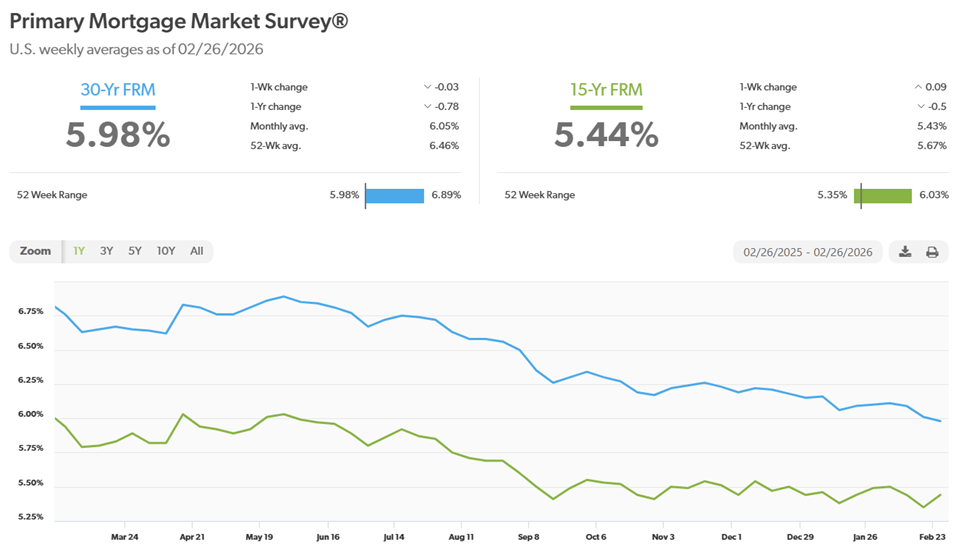
Mortgage rates continued their march lower in February for a third month in a row. Also, for the first time in nearly three and a half years, the average 30-year fixed rate dipped below 6%. This downward trend has begun to crack the “lock-in effect,” encouraging homeowners to list their properties and providing a much-needed boost in inventory just in time for the spring buying season.
The 30-year fixed rate finished the month at 5.98%, 12 bps lower than last month and finally below the 6% mark. Looking ahead, rates are most likely to hover in the 6% neighborhood, especially if inflation remains sticky, which will keep the Fed from cutting rates any further in the short term.
Here is a look at the one-year chart of the 15- and 30-year mortgage rates from Freddie Mac.
Oil prices continued their move higher in February as geopolitical tensions (U.S./Israel v Iran) put upward pressure on global prices. As I write this, U.S. and Israel have commenced air strikes on Iran and they have countered. Expect a temporary spike in prices this week.
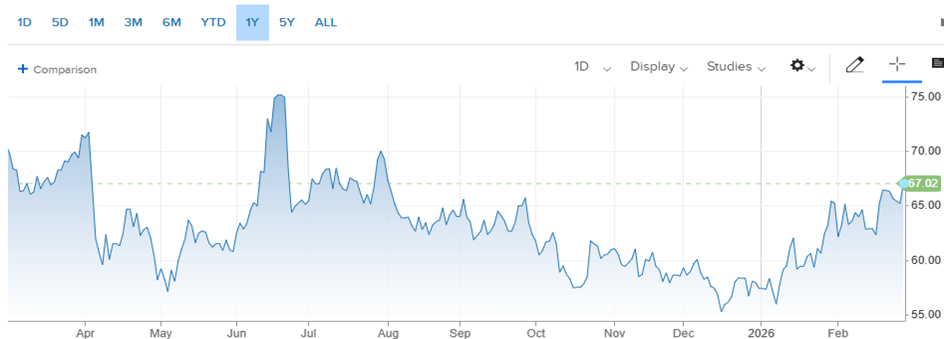
For the month of February, the price for a barrel of West Texas Intermediate (WTI) oil started at $65.74 and ended at $67.29, up $1.55 for the month. For the year, it is now up $9.87 a barrel, almost 10%.
Looking ahead, if this Iran conflict lingers on, we could see prices rise into the upper $70s but hopefully cooler heads will prevail to find some resolution.
Here’s a look at the one-year chart for U.S. oil:
Gasoline prices followed oil higher in February for the second month in a row. Low seasonal demand at this time of year won’t be enough to offset the Iran conflict in the near term but a quick resolution should put some downward pressure on prices before we start thawing out in the spring. Oklahoma has the cheapest gas currently, checking in at $2.47 a gallon. California has the most expensive gasoline at $4.64 per gallon. FYI, a year ago, we were paying $3.11.
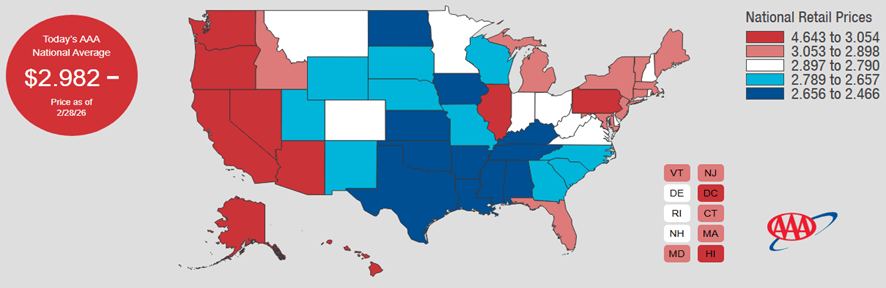
Check out the prices at the pump in your area: AAA Gas Prices.
Outlook
Events on the horizon that could move the markets in the near term:
- Fed, Rates, & Inflation: The Federal Open Market Committee (FOMC) did not meet this past month, and it looks like they are going to continue to keep interest rates steady in the short term. They meet again in the middle of March, but recent economic data still shows inflation holding steady, meaning a rate cut is not likely in the near future.
Regarding jobs and wage growth, the recent Supreme Court ruling striking down broad tariffs could provide a “confidence boost” to companies, as businesses regain the capital previously tied up in duty payments to hire more workers and/or increase wages.
- Trump Administration Policies: SCOTUS finally released their decision on the legality of most of the tariffs imposed by the Trump administration in 2025. The Court ruled that the president does not have the authority to impose broad, open-ended tariffs under the International Emergency Economic Powers Act (IEEPA) of 1977. Now, the process of refunding those tariffs to the U.S. companies that paid them begins. The result is good news for U.S. companies and consumers, but it was largely priced into both stocks and bonds already so it will not be a major market mover.
Aggressive immigration enforcement and restrictive visa policies continue to have a detrimental effect on the economy in the form of significant labor shortages and decreased revenue across several U.S. sectors. Some of the sectors that have been hit the hardest are agriculture, tourism/hospitality, and construction. This continues to put upward pressure on inflation, particularly in housing, groceries, and the food and beverage industry.
- Iran Conflict: As far as catalysts go for the stock and bond markets, this came off the back burner this weekend in a hurry, emerging as the single most critical factor determining market performance. If this conflict intensifies, we could see a flight to safety (sell stocks, buy treasuries) driven by fears of a sustained energy price spike that could derail anticipated interest rate cuts and reignite inflationary pressures. For long-term stock investors, it could be a buying opportunity if your holding period is more than two years.
Joe Baker, CFP®
Baker Asset Management, LLC
joebaker@bakerassetmanagement.com

