

Calendar Notes
- February 8th, Sunday – Super Bowl LX.
- February 16th, Monday – President’s Day. Stock market is closed.
Stocks posted a healthy, positive performance to get the year off to a good start. This was even more impressive when you consider the chaos coming out of DC, causing uncertainty as well as a convergence of sovereign and civil unrest.
For the month of January, the S&P 500 had a nice gain of 1.37%, well above its average of 0.28% over the last thirty years. The other good news is that historically, when the S&P 500 has a positive return in January, the rest of the year has performed exceptionally well, with an average annual return of approximately 16.9% and a positive full year return 89% of the time, based on data since 1950. If this holds true, that will make it four consecutive years of positive returns for the index. Undoubtedly, the ongoing AI revolution could make this a reality. We will see in eleven months.
Looking ahead, potential catalysts to move stocks this February include the possible SCOTUS decision on the legality of many of the tariffs implemented in 2025. Also, there are still some large tech companies, Amazon, Alphabet, and Nvidia specifically, that will report Q4 earnings over the next few weeks that could have influence over the entire stock market. Finally, the weak dollar is creating artificial inflation within the economy, causing input materials, such as metals, crops, and fossil fuels valued in dollars to increase in price significantly.
Historically, February is often cited as one of the worst months for the S&P 500 index. Over the last thirty years, it has had a meager 0.37% return on average.
Take a look at the Outlook section below to see what events could move the markets over the short term.
Bond prices were mixed this past January, with shorter maturities heading higher and bonds with ten plus years to maturity dropping slightly. FOMC keeping rates steady had little affect on bonds since this decision was already factored into bond prices.
The 10-year US Treasury note yield finished higher in January, settling at 4.24%, higher than the 4.16% yield that it was at the beginning of the month. The 30-year bond yield closed out the month at 4.88%, 4 basis points higher than a month ago.
A major influence on bond prices currently is the weakening dollar. A sustained dollar weakness has the potential to erode foreign demand for US Treasuries, about a third of which are held outside the US. A weak dollar also makes imports more expensive, creating currency-driven inflation. This will steer the Federal Reserve towards maintaining or raising interest rates to tame inflation from both the weak dollar as well as from the tariffs. A stronger dollar can offset some of the inflation caused by the tariffs currently being imposed by the Trump administration.
Even though there is no FOMC meeting in February, bond investors will still be active as a deluge of fresh economic data comes out this week, including the monthly jobs report, manufacturing PMI, and consumer sentiment.
I still like bonds with at least a 12-month maturity but plan on holding them until they mature.
Savings rates were slightly higher for CDs with longer maturities but everything else was about the same as last month. I suspect they will stay put now that the Fed has paused their rate cuts, at least for the next few months. For savers and risk-averse investors, the rates still haven’t dropped enough to look elsewhere to park their money.
| Account Type | Average Rate | Highest Rate |
| Money Market Account | 0.56% | 4.10% |
| High-Yield Savings Account | 0.39% | 5.00% |
| CD Term | Average Rate | Highest Rate |
| 1-Year | 1.77% | 5.11% |
| 3-Year | 1.53% | 4.30% |
| 5-Year | 1.56% | 4.50% |
For now, CDs and MMAs are still a great place to put your cash and your emergency funds. Knowing this, it makes sense in most situations to put cash that you don’t immediately need into CDs with up to 2-year maturities. For emergency cash, stick to high yielding money market and savings accounts, of which the best are yielding about 5.0%. As always, keep the total under $250,000 per person at any one bank to ensure you are fully covered by the FDIC.
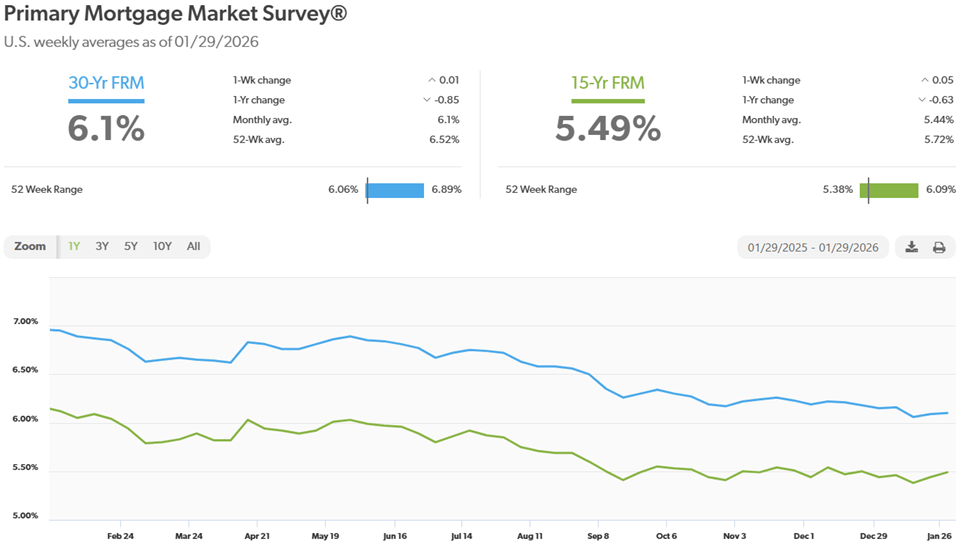
Mortgage rates continued to drift lower in January for a second month in a row. With the Fed holding bank lending rates steady after their meeting this past week, mortgage rates are expected to flatten out in the 6% neighborhood over the next few months as expectations for additional Fed rate cuts this year diminish. Regarding the housing market, it continues to shift to a strong buyer’s market, with the gap between sellers and buyers widening to about 42%, the largest gap on record. Even so, with housing prices near all-time highs, affordability is preventing many buyers from owning a home.
The 30-year fixed rate finished the month at 6.10%, 8 bps lower than last month and ever so close to breaching the 6% mark.
Here is a look at the one-year chart of the 15- and 30-year mortgage rates from Freddie Mac.
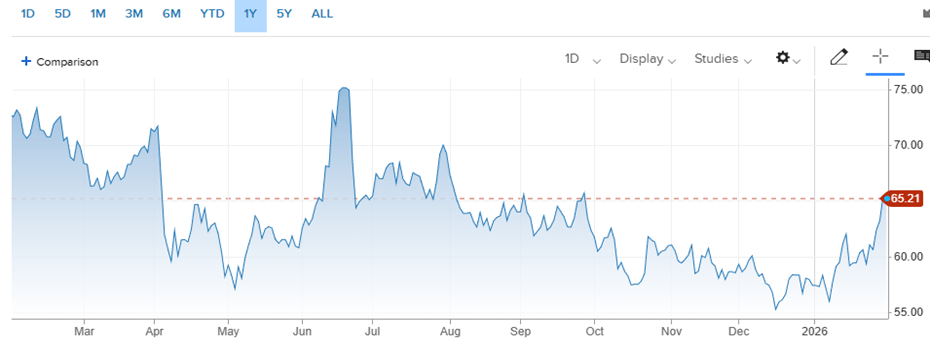
Oil prices had a major reversal in January and moved higher as a combination of geopolitical tensions (U.S. discussing plans about striking Iran) and a weaker dollar put upward pressure on the price of black gold.
For the month of January, the price for a barrel of West Texas Intermediate (WTI) oil started at $57.42 and ended at $65.74, up $8.32 for the month.
Looking ahead, if we don’t attack Iran and the dollar halts its drop, I still see prices hovering around the $60 area for the next few months. That said, if prices continue higher, we’ll see wells that shut in due to low prices open back up to capture some profits.
Here’s a look at the one-year chart for U.S. oil:
Gasoline prices creeped back up in late January following oil’s big reversal. A gallon of regular unleaded ended the month at $2.87, $0.03 higher than last month. Seasonal demand at this time of year should keep some downward pressure on prices before we start thawing out in the spring. Oklahoma had the cheapest gas this past month, checking in at $2.40 a gallon. Hawaii has the most expensive gasoline at $4.41 per gallon. FYI, a year ago, we were paying $3.11.
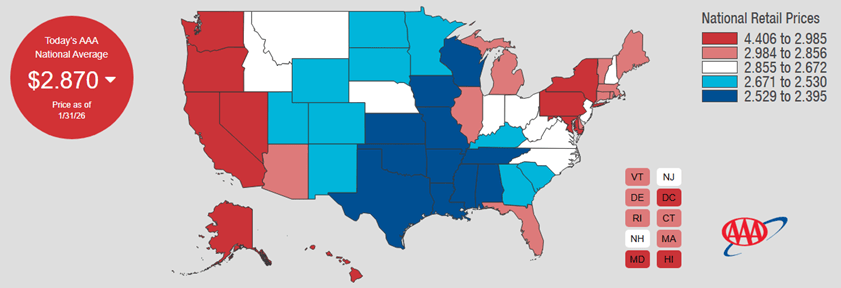
Check out the prices at the pump in your area: AAA Gas Prices.
Outlook
Events on the horizon that could move the markets in the near term:
- Fed, Rates, & Inflation: The Federal Open Market Committee (FOMC) decided to hold the federal funds rate steady in the target range of 3.5% to 3.75% at its meeting this past Wednesday. This marks a pause after three consecutive rate cuts in late 2025. They noted improving economic activity and a more stabilized labor market as the main reasons for the rate cut pause.
Inflation is still prevalent but has levelled off somewhat at 2.7%. This means that prices are still rising but the rate of increase, aka inflation, is getting closer to the Fed’s goal of 2.0%. Regarding the labor market, there have been quite a few layoff announcements included in Q4 earnings reports by some of the largest U.S. companies. This could sway the FOMC to restart rate cuts later in the year. Investors are expecting a few more cuts this year so stock and bond prices might already reflect these rate adjustments. Big picture, rates should head lower over the course of the year as there are more catalysts putting downside pressure on them.
- Trump Administration Policies: Still no decision from SCOTUS regarding the legality of many of the tariffs implemented in 2025 and now that they are in recess again, we probably won’t get a ruling until later this month at the earliest. Many companies offset most of the tariff costs by reducing staff and raising prices, hence the sticky inflation and layoff announcements. I also believe AI has accelerated some of the layoffs that we are hearing about.
Aggressive immigration enforcement and restrictive visa policies policies have led to significant labor shortages and decreased revenue across several U.S. sectors. Over 1.2 million immigrants left the workforce between January and July 2025 alone, causing a sharp contraction in labor-intensive industries. Some of the sectors that have been hit particularly hard are agriculture, tourism/hospitality, and construction. This is also exacerbating inflation, particularly in housing, groceries, and the food and beverage industry.
Without any significant changes to our current trade and immigration policies, they will continue to put downward pressure on job creation and the economy in general.
Joe Baker, CFP®
Baker Asset Management, LLC
joebaker@bakerassetmanagement.com

