
Calendar Notes
- December 24th, Wednesday, – Christmas Eve. Stock market will close early at 1:00 p.m.
- December 25th, Thursday, – Christmas. Stock market is closed.
- December 31st, Wednesday, – New Year’s Eve.
Stocks squeaked out a small gain this past November following a strong five-day rally at the end of the month. This helped the index to extend its streak of positive monthly returns to seven. However, the big tech stocks that have been powering the index higher this year took a breather as investors hit the sell button due to concerns over valuations and the massive amounts that they are spending on AI implementation.
For the month of November, the S&P 500 rose a mere 0.13%, well below its average over the last thirty years of 2.60%. For the year, the index is up about 16.45%. Still hoping for that Santa Claus rally to finish out the year even stronger.
Looking ahead, potential catalysts to move stocks this December include the Federal Open Market Committee (FOMC) meeting on December 10th and the potential SCOTUS decision on the legality of many of the tariffs implemented this year. Investors are expecting another 25 basis points cut from the Fed, but the crystal ball is murky on what they do next, especially because there hasn’t been much economic data coming out due to the recent government shutdown which thankfully ended this past month. Regarding the SCOTUS decision, a ruling against the tariffs would certainly help the bottom line of our companies and also help reduce inflation, which would be great for the bottom lines of households, especially those in the lower tiers of the income scale.
Historically, December is one of the best months of the year for the S&P 500 index, averaging about +1.5% over the last thirty years. December also falls within a period of historically strong performance, with the S&P 500 delivering an average return of approximately 7% from November to April since 1945, which is significantly higher than the average return in the other six months of the year. Come on, Santa!
Take a look at the Outlook section below to see what events could move the markets over the short term.
Bond prices were relatively flat but fluctuated quite a bit during November. One of the reasons was the lack of economic data while the government was shut down. Another was conflicting messages coming out of the Federal Reserve on whether or not they were going to cut rates during their December meeting, their final meeting of 2025. The picture cleared up by the end of last month indicating that the Fed will almost certainly cut rates by another 25 basis points before the end of the year.
Bond investors will be anxiously awaiting the results of the FOMC meeting that concludes on December 10th. As I previously stated, a 25-bps cut is pretty much baked into the cake. Any insights on inflation and employment numbers by the Fed will also be very much anticipated at that meeting. Another potential mover of bond prices will be the SCOTUS ruling on the legality of several tariff policies, which may be announced this month. If they deem the tariffs illegal, the Fed will almost certainly start cutting rates more aggressively since a big catalyst of the current rise in inflation will be removed.
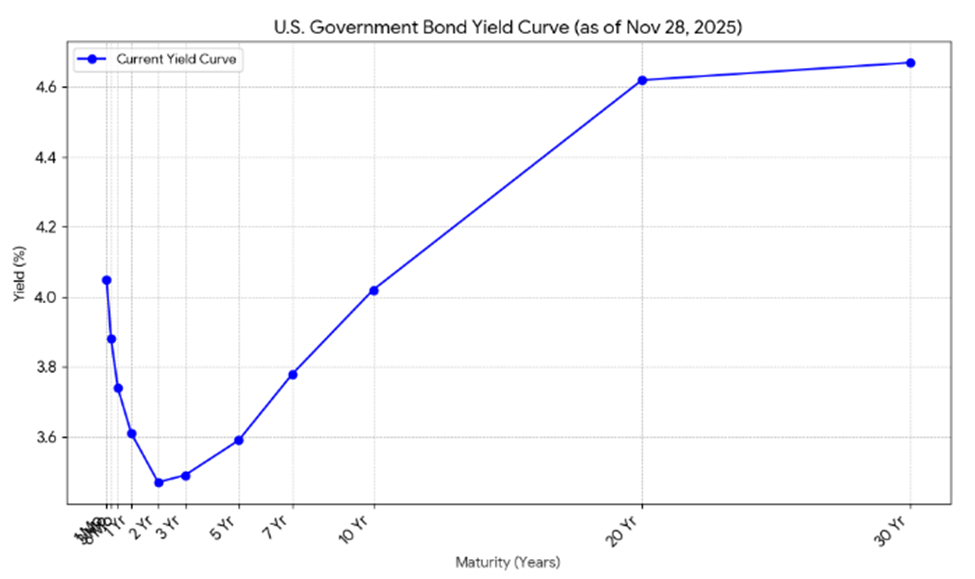
The 10-year US Treasury note yield finished lower in October, settling at 4.02%, lower than the 4.08% yield that it was at the beginning of the month. The 30-year bond yield closed out the month at 4.67%, just 1 basis point higher than a month ago. For the most part, the yield curve has normalized, with the exception of the very short maturity periods, less than two years. Check it out:
There is still plenty of uncertainty in the bond market, so it is prudent to invest in bonds that mature sooner rather than later. I like bonds with a 9-to-12-month maturity and plan on holding onto them until they mature.
Savings rates continue to creep lower as employment data continues to deteriorate and the expectation that the Fed will cut rates for the third time this year in December. Money market rates and savings accounts are averaging only about 0.5% but the best rates can be found at credit unions and online banks. It is worth some of your time looking for the place with the best rates to park your cash.
| Account Type | Average Rate | Highest Rate |
| Money Market Account | 0.54% | 4.50% |
| High-Yield Savings Account | 0.51% | 5.00% |
| CD Term | Average Rate | Highest Rate | |
| 1-Year | 1.80% | 4.30% | |
| 3-Year | 1.50% | 4.15% | |
| 5-Year | 1.51% | 4.30% |
There are literally tons of cash in savings accounts despite falling interest rates. Currently, there is approximately $11 trillion held in insured deposits in FDIC-insured institutions, which includes savings and CD accounts. Separately, the total assets held in money market funds is about $7.57 trillion. If interest rates for these accounts continue to drop, we could start to see some of this cash flow to corporate bonds with higher yields as well as dividend-paying stocks. This is a trend to look for over the next several months.
For now, CDs and MMAs are still a great place to put your cash and your emergency funds. Knowing this, it makes sense in most situations to put cash that you don’t immediately need into CDs with up to 2-year maturities. For emergency cash, stick to high yielding money market and savings accounts, of which the best are yielding about 5.0%. As always, keep the total under $250,000 per person at any one bank to ensure you are fully covered by the FDIC.
Mortgage rates halted their descent and headed higher in November as demand picked up slightly. Despite this rise, we are still near the 12-month lows. Rates should revert to their previous trend of heading lower as expectations for a Fed rate cut are locked in. Also, continued weakness in the labor market will put downward pressure on rates as well.
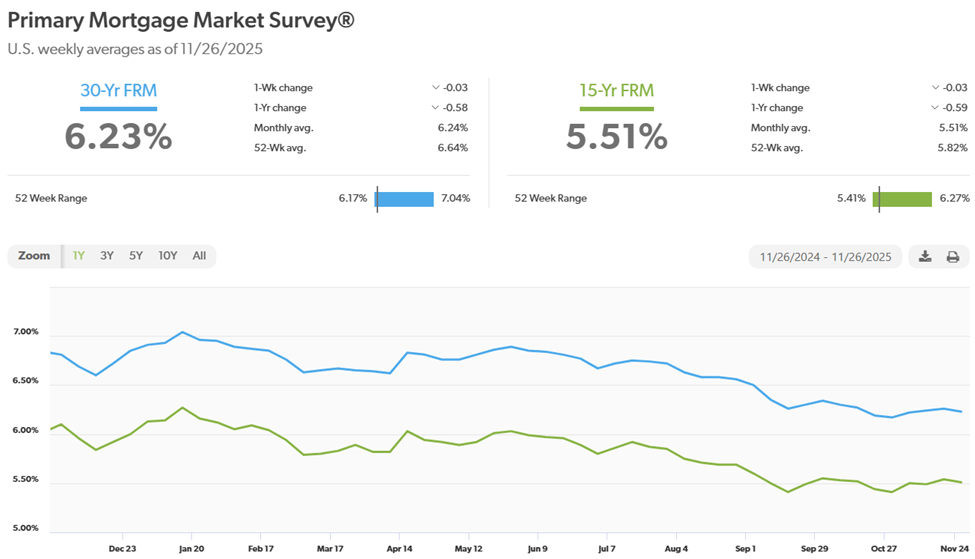
The 30-year fixed rate finished the month at 6.23%, just 6 bps higher than last month. It remains firmly below the narrow range of 6.5% and 7% that it had been at for most of the previous year.
Here is a look at the one-year chart of the 15- and 30-year mortgage rates from Freddie Mac.
Oil prices continued to drop in November as a combination of increased global supplies, slowing demand, and Ukraine-Russia peace talks continuing to move forward.
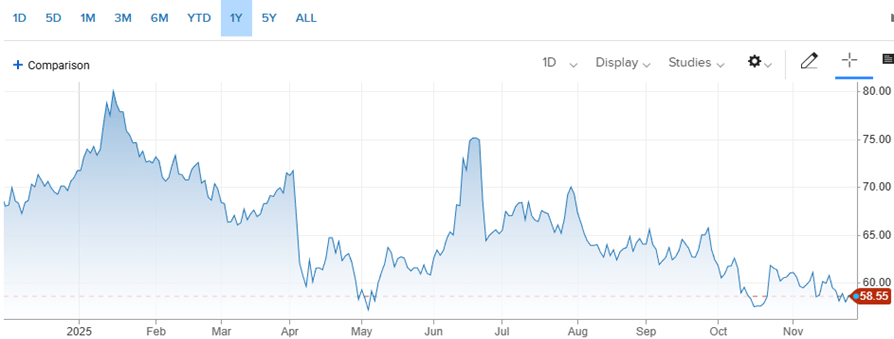
For the month, the price for a barrel of oil closed at $58.48, down about $2.30 from the beginning of November. For the year, it’s down about 18.50%.
Looking ahead, I see prices hovering around the $60 area for the near future because there just aren’t any drivers that can move prices higher, other than a major war or suppliers simply turning the spigots off. Also, with prices now down in the $50s per barrel, we will start to see some drillers stop pumping because it is no longer profitable, particularly for the shale drillers.
Here’s a look at the one-year chart for U.S. oil:
Gasoline prices drifted slightly lower in November, down just 3 cents from the previous month, as they followed oil prices lower. We should continue to see prices moving lower, mostly due to increased oil supply as well as slowing demand (seasonal but also economic). Oklahoma had the cheapest gas this past month, checking in at $2.43 a gallon. California still has the most expensive gasoline at $4.57 per gallon. FYI, a year ago, we were paying $3.06.
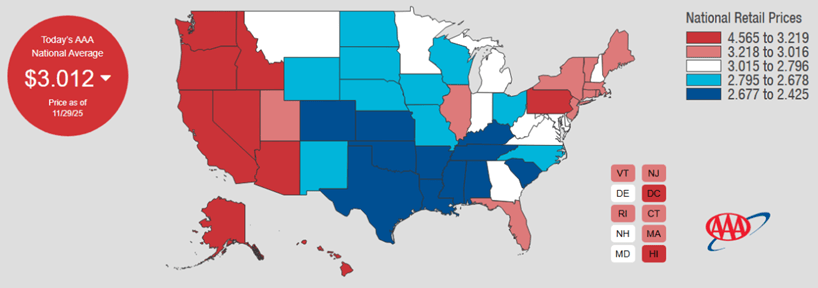
Check out the prices at the pump in your area: AAA Gas Prices.
Outlook
Events on the horizon that could move the markets in the near term:
- Fed & Inflation: With no FOMC meeting in November and the government shut down for all of October and almost half of November, there was even more uncertainty in the markets, and it showed. There was much more volatility in both the bond and stock markets this past month and that may not end until we get some more recent economic data. Regardless, they’ll be cutting rates by 25 bps at their next meeting in about a week.
Despite the lack of official economic data recently, I feel that there is enough data from payroll providers, job seeker sites, and layoff announcements to confirm that the health of the jobs market is weakening enough to justify another rate cut. Inflation is still increasing but under control and could get some help if the Supreme Court rules in favor of the small businesses that sued that the tariffs are illegal. So, the momentum is with lower interest rates, which bode well for both stocks and bonds.
- Trump Administration Policies: The tariff whipsaw continues with tariffs being implemented as well as exemptions for specific countries or materials. SCOTUS is expected to rule on the legality of many of the tariffs put in place this year, hopefully by the end of the year. If they are deemed illegal and tariffs refunded, it will be a big win for small businesses and may even provide a boost for the markets.
- Artificial Intelligence: I talked last week about the growth path of AI and how disruptive that it will be over the next decades. I feel that it is advancing so quickly that many of the companies announcing layoffs this year may never have to staff those positions again. This is great for company profitability after the initial costs of implementing AI, but not so good for the overall job market. This is a problem that needs to be reckoned with sooner than later, in my opinion. That said, AI is a transformative force that is influencing all sectors of the global economy as we speak and will be the major market mover for years to come, in my opinion. As an investor, this is the major theme that you want to consider when selecting investments over the next few decades.
Joe Baker, CFP®
Baker Asset Management, LLC
joebaker@bakerassetmanagement.com

