
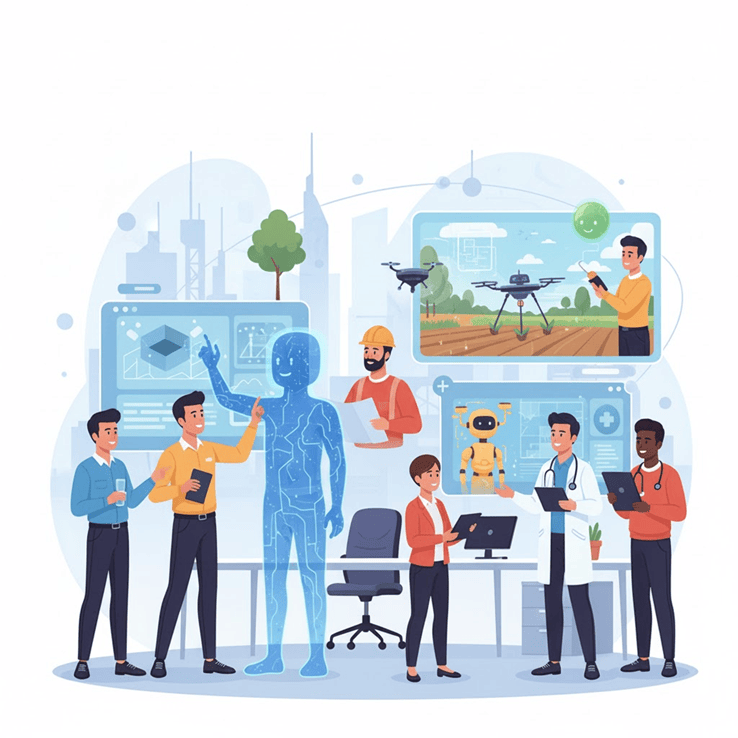
Artificial Intelligence (AI) is reshaping the U.S. economy with major challenges and opportunities. While AI promises long-term gains like productivity growth and higher national income, it also brings short-term risks of job loss and market disruption.
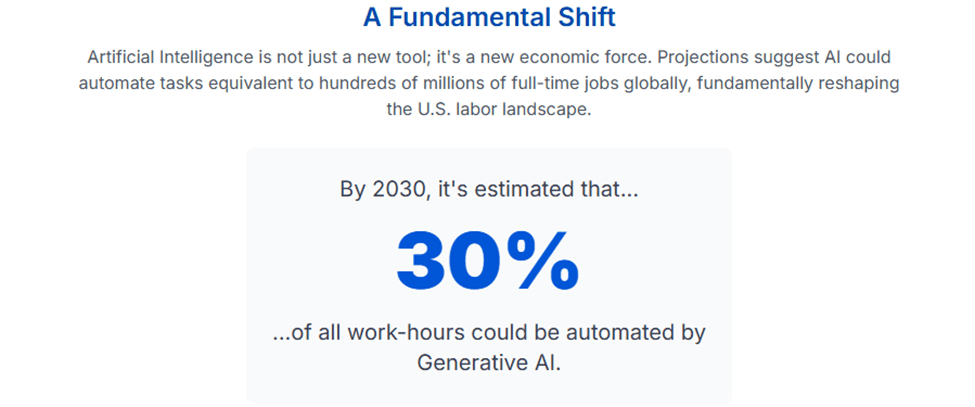
That percentage almost seems unbelievable, especially since it is less than 5 years away. Here’s where we are going to see it the most:
The following table, based on the percentage of tasks susceptible to automation, identifies the highest-risk occupation groups in the U.S. economy:
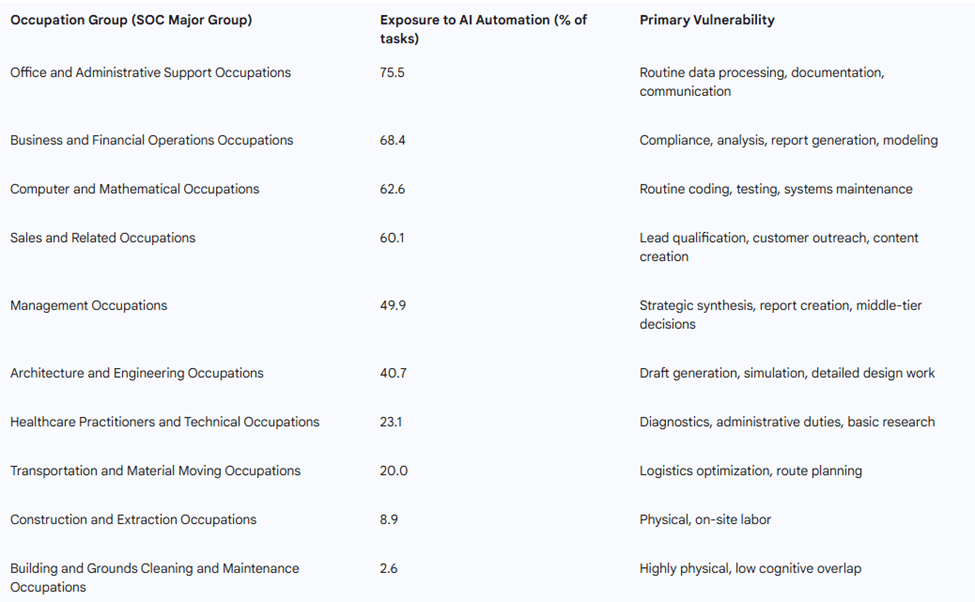
Some jobs can’t be easily replaced by machines (yet) because they need special skills, physical effort, or involve important moral choices. These jobs are called “Fortress Occupations”:
- Jobs that need a lot of skill and unpredictable physical work, like surgery or trades (plumbers, electricians, masons, etc.), are hard for robots to do. Even simple physical jobs, like cleaning, aren’t fully automated because it’s too expensive.
- Jobs that rely on emotion and trust, like caring for others, therapy, or teaching, still need real people because technology can’t replace human empathy or ethical decision-making.
So, as AI handles most routine cognitive tasks, skills like critical thinking, decision-making, and emotional intelligence become more valuable. Success will depend on managing AI tools with strong human judgment and problem-solving.
The Long-Term Challenge: AI and Income Polarization
AI isn’t just changing how many jobs there are, it’s also making the gap between rich and poor even wider. In the past, technology like computers took over a lot of middle-paying jobs, splitting the workforce into mostly high-paying and low-paying positions. Now, AI is going after higher-skilled, well-paid jobs (like analysts and programmers). When these workers lose their jobs, they could end up competing for lower-wage service roles that still need humans, such as hospital aides or nannies. This shift pushes down wages for those jobs and means most of the new wealth created by AI goes to the people who own and develop the technology. As a result, the middle class shrinks, leaving a small group of highly paid experts and a much larger group of low-paid workers. Solutions to this problem could include universal basic income and universal healthcare.
In summary, as AI accelerates both economic growth and inequality, the future will depend on how society navigates these challenges and harnesses technology to benefit everyone.
{Btw, AI did the bulk of the research for this blog post as well as the first few drafts!}
Please comment or send an email if you have any questions.
Joe Baker, CFP®
Baker Asset Management, LLC
joebaker@bakerassetmanagement.com

