

Calendar Notes
- October 13th, Monday – Columbus Day
- October 31st, Friday – Halloween
Stocks shrugged off tariffs, geopolitical tensions, and even history, in the month of September to continue its momentum higher. A strong performance this past month made it five months in a row of positive returns for the S&P 500 index. Once again, much of the gains can be attributed to big tech and big financial stocks as they appear to be the most resilient to the current economic headwinds.
For the month of September, the S&P 500 rose an impressive 3.52%, well above its average of negative 1.2%. For the year, the index is now up about 14.5%.
The start of Q4 today means that Q3 earnings will start to come out shortly. Investors will be listening to what companies are saying about tariffs, how they will affect their bottom lines, and what they will do to mitigate the damage.
Speaking of tariffs, as they continue to cut into corporate profits, companies are faced with continuing to eat the cost of the tariffs or pass them on to their customers. So far, many companies have only been passing on some of the tariff costs. If they want to maintain their profit margins, they will have to pass more of the costs to us, the consumer, and/or reduce costs in other ways, like laying off workers. Q3 earnings calls should be very interesting.
Historically, October has been a positive month for stocks over the past thirty years. The S&P 500 index has returned about +0.8%.
The major market catalysts (that we know about) for October will be interest rates, Q3 earnings, and jobs numbers. Right now, with the economy remaining strong and a possible interest rate cut this month, we could see another positive month for stocks.
Take a look at the Outlook section below to see what events could move the markets over the short term.
Bond prices were flat to slightly down last month across the debt spectrum despite the Federal Reserve cutting short-term rates by 25 bps. The stronger-than-anticipated economic data that came in at the end of September (e.g., upward revision of Q2 GDP and strong jobs reports) led investors to reassess expectations for more Federal Reserve rate cuts. This pushed Treasury yields higher, particularly in the short-to-intermediate end of the curve, which kept a lid on all bond prices.
Bond investors will be watching the Fed, as always, but also the Supreme Court to see if they deem the tariffs illegal. If they do, the Fed will almost certainly start cutting rates more aggressively since a big catalyst of the current rise in inflation will be removed.
The 10-year US Treasury note yield finished lower in September, settling at 4.16%, lower than the 4.23% yield that it was at the beginning of the month. The 30-year bond yield closed out the month at 4.74%, 19 basis points lower than a month ago.
There is still plenty of uncertainty in the bond market, so it is prudent to invest in bonds that mature sooner rather than later. I like bonds with a 9-to-18-month maturity and plan on holding onto them until they mature.
Savings rates barely moved, even after the Fed rate cut this past September. There is usually a lag between when the Fed cuts rates and when those cuts are reflected in savings rates. Money market rates and savings accounts are averaging only about 0.5% but the best rates can be found at credit unions and online banks. It is worth some of your time looking for the place with the best rates to park your cash.
| Account Type | Average Rate | Highest Rate |
| Money Market Account | 0.52% | 4.80% |
| High-Yield Savings Account | 0.51% | 5.00% |
| CD Term | Average Rate | Highest Rate |
| 1-Year | 1.70% | 4.50% |
| 3-Year | 1.33% | 4.15% |
| 5-Year | 1.34% | 4.25% |
With money market and bank savings deposits still at record highs and the potential for savings rates to head lower, we could start to see cash flowing from savings and CDs to corporate bonds with higher yields as well as dividend-paying stocks. This is a trend to look for over the next several months.
For now, CDs and MMAs are still a great place to put your cash and your emergency funds. Knowing this, it makes sense in most situations to put cash that you don’t immediately need into CDs with up to 2-year maturities. For emergency cash, stick to high yielding money market and savings accounts, of which the best are yielding about 5.0%. As always, keep the total under $250,000 per person at any one bank to ensure you are fully covered by the FDIC.
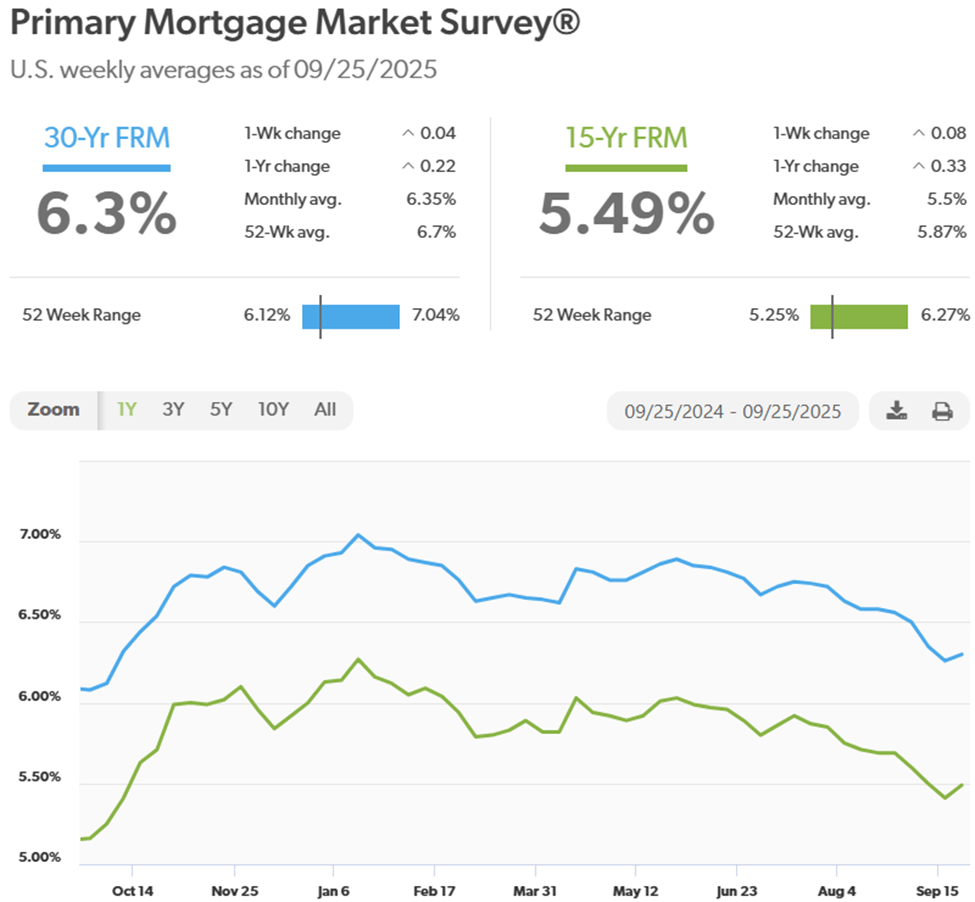
Mortgage rates continued to drift lower in September as hopes of additional interest rate cuts by the Federal Reserve increased. Rates are now at 12-month lows. The decline has been largely attributed to weaker-than-expected economic data, particularly in the labor market, which has increased the chances of another interest rate cut by the Federal Reserve, although recent data has curbed some of those expectations.
The 30-year fixed rate finished the month at 6.30%, about 25 bps lower than last month and now just below the narrow range of 6.5% and 7% that it has been in since October of last year.
Here is a look at the one-year chart of the 15- and 30-year mortgage rates from Freddie Mac.
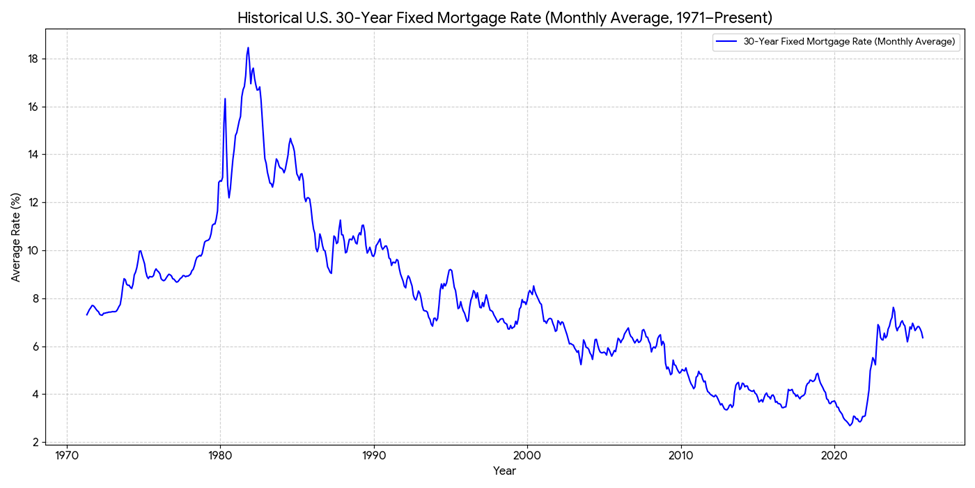
Just for reference, here’s a simple chart of the 30-year mortgage rate over the past 54 years. The average rate for that period is about 7.70%.
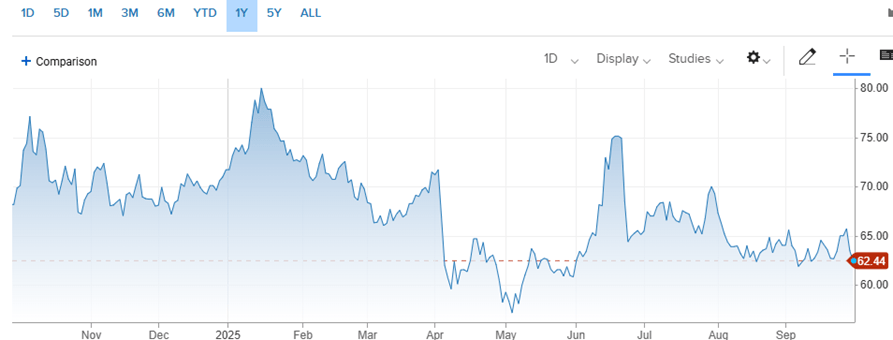
Oil prices fluctuated quite a bit in September with geopolitical tensions rising around the globe, especially between Europe and Russia as well as the middle east. Eventually, oil continued its downtrend mainly due to the weakening dollar and a global supply glut.
For the month, the price for a barrel of oil closed at $62.44, down about $1.50 from the beginning of September. For the year, it’s down about 13.00%. Looking ahead, there are still more catalysts that could move prices lower than higher, such as increased production across the globe, but that can change quickly. For now, prices going lower is good thing, in my opinion, but obviously not good for companies and their workers in the oil industry.
Here’s a look at the one-year chart for U.S. oil:
Gasoline prices had a small drop in September as they started to catch up to the front-running decline in oil prices. Regular unleaded gasoline is now averaging $3.15 per gallon, down 4 cents from last month. We should see prices moving lower, especially now that the summer driving season has ended. Oklahoma took the lead for the cheapest gas, checking in at $2.63 a gallon. California still has the most expensive gasoline at $4.65 per gallon. FYI, a year ago, we were paying $3.22.
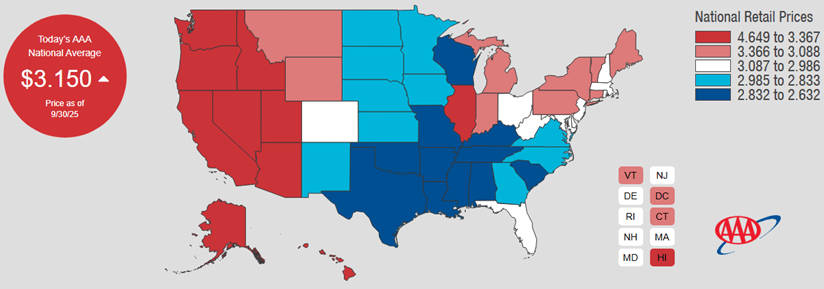
Check out the prices at the pump in your area: AAA Gas Prices.
Outlook
Events on the horizon that could move the markets in the near term:
- Fed & Inflation: As expected, the Federal Open Market Committee (FOMC) delivered its first interest rate cut of the year in September 2025, lowering the benchmark federal funds rate by 0.25 percentage points to a new target range of 4% to 4.25%. They made this move to provide support to the labor market. Of course, they are also monitoring inflation and aim to keep that number from increasing more than it already has this year.
The economy continues to defy the odds as the data shows that consumer spending is still strong despite prices increasing. This may cause the Fed to put rate cuts on the back burner for the rest of the year. The employment numbers coming up at the end of this week should give the Fed a clearer picture of which way to go with rates. Any cuts to interest rates could give stocks and bonds the fuel needed for another leg up going into the end of the year.
- Trump Administration Policies: New tariffs were piled onto the already historic number of tariffs put in place so far this year. Some of the latest ones include 100% tariffs on pharmaceutical products, 50% on kitchen cabinets and bathroom vanities, and 30% on upholstered furniture. If you want to dig down into the details, here is a good place to start: Trump’s trade war timeline 2.0: An up-to-date guide. As I have said many times before, carpet-bombing our economy with tariffs will only hurt our economy, since we, US companies and its citizens, are paying these import taxes.
I believe that the administration has implemented certain trade and immigration policies to accomplish the following: reduce immigration, bring back manufacturing to the U.S., and reduce inflation. The problem is that achieving all three of these goals simultaneously is nearly impossible, especially with their haphazard way of implementing and removing policies almost daily. It is a strategy caught in a tug-of-war. For instance, Immigration policy is hurting manufacturing and tariffs are raising prices, not lowering them. Tariffs are also hurting the labor market. If we continue down this path, these policies will continue to create uncertainty, erode trust among businesses, and make the U.S. a less attractive place to invest.
That said, many of these tariffs can be ruled illegal by the courts as early as November of this year, so stock market volatility will be on edge for the next few months at least.
Joe Baker, CFP®
Baker Asset Management, LLC
joebaker@bakerassetmanagement.com


I really enjoyed reading your newsletter. I particularly enjoyed seeing the mortgage rates over time. Good thoughts on what’s to come. Thanks so much!
LikeLike