

Calendar Notes
- Tuesday, March 4th – Mardi Gras
- Monday, March 17th – St. Patrick’s Day
Stocks faltered in February, as cracks began to form in the strong economy and labor markets. The S&P 500 tracked with its average February this century, which has been negative. Although earnings reports for Q4 were pretty good for most of the large cap companies here in the states, their outlook for the rest of this year was filled with uncertainty. There are a lot of policy changes coming out of DC right now that have to be analyzed before making estimates on future revenue and earnings.
For the month, the S&P 500 lost about 1.43%. So far this year, it is up 1.24%.
Looking ahead, investors will have to factor in a whole bunch of catalysts before making any investment decisions. Here are the big ones: tariffs, immigration policy, layoffs, and, as always, interest rates. There definitely is less confidence in the stock market and hopes of a soft landing for the economy have faded quite a bit. To wit, companies are planning to tighten their belts going forward this year due to the uncertainty of several trade and fiscal policies that may or may not go into effect, based on CEO surveys.
Historically, March has seen average gains of about 1.1%. That would be a nice rebound from this past month.
Take a look at the Outlook section below to see what events could move the markets over the short term.
Bond prices made a strong move upward as investors flocked to safety. The economic outlook has become quite murky and so money has been heading to the relative safety of the bond universe. Both corporate and government bond prices rose once again in February, marking one of the best yearly starts ever for bonds.
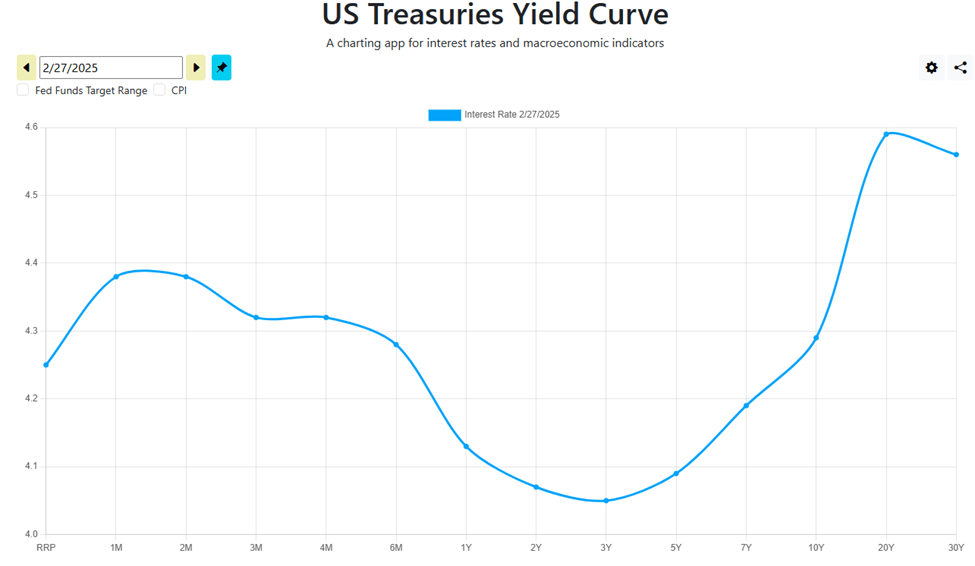
The 10-year US Treasury note yield finished lower in February, settling at about 4.22%, below the 4.54% that it was at the beginning of the month. The 30-year bond yield closed out the month at 4.51%, about 28 basis points lower than a month ago.
Bond investors have done well so far this year but will have to stay on top of the news as the Trump administration continues to roll out several new policy initiatives. Price and yield volatility will certainly continue as these new policies get implemented.
Here’s a look at the current yield curve. As you can see, there is some inversion between the 1 month and 10-year rates, which is indicative of a possible recession.
Savings rates continue to sit where they have been for the past few months. However, with the Federal reserve meeting this month for the first time since January, we could get a clearer picture on where savings rates are headed. Regardless, rates are still very attractive, and I think more money is going to be heading back into the safe havens of money markets and CDs as the stock market shows signs of more volatility. Currently, you can get around 4.5% return on your money. So, CDs and MMAs continue to be a great place to put your cash and your emergency fund, for now. Knowing this, it makes sense in most situations to put cash that you don’t immediately need into CDs with up to 2-year maturities. For emergency cash, stick to high yielding money market and savings accounts, of which the best are yielding around 4.5%. As always, keep the total under $250,000 per person at any one bank to ensure you are fully covered by the FDIC.
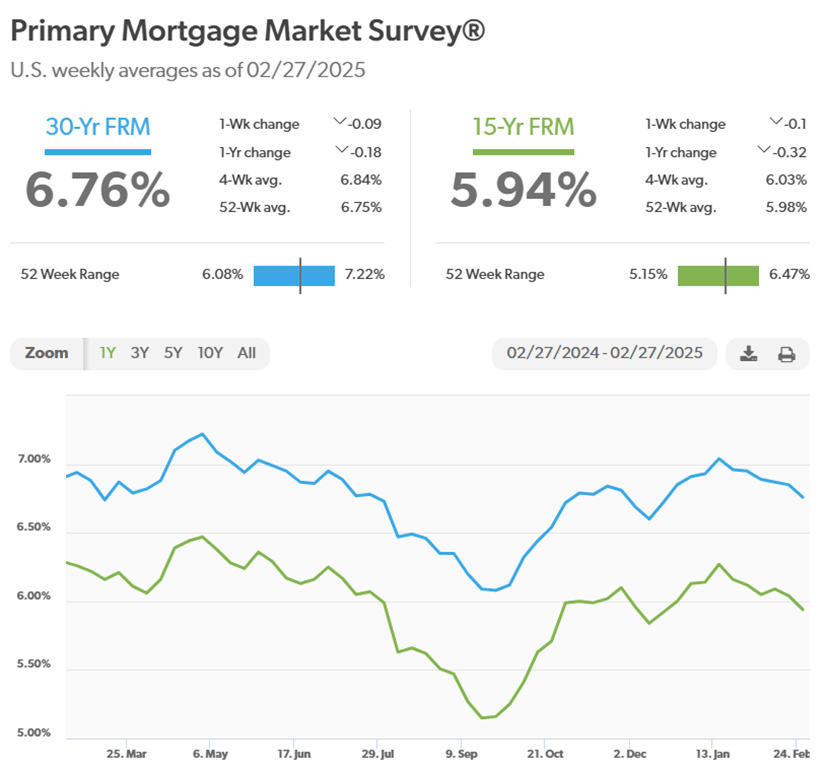
Mortgage rates reversed course and headed lower in February, keeping the 30-year loan below the 7% mark. Currently, the 30-year rate sits at 6.76%, lower than a month ago, at 6.95%. Also, in December 2024, nearly 73,000 homes were delisted, a 64% increase from the previous year. This surge in delistings could indicate a broader cooling of the real estate market and one of the reasons for lower mortgage rates. The real test will be over the next few months during peak buying season.
Here is a look at the one-year chart of the 15- and 30-year mortgage rates from Freddie Mac.
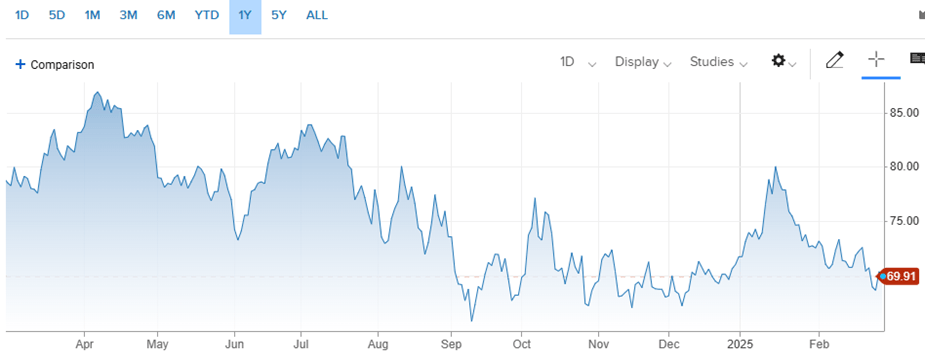
Oil prices rolled over and headed lower in February, dropping below the $70 level despite the threat of tariffs from the U.S. Also, some of the economic data that is coming in now is showing signs of a slowdown which would push prices lower.
For the month, the price for a barrel of oil closed at $69.91, down from $72.46 at the beginning of February. If this drop in oil prices could be sustained for a while, it could help offset some of the price increases that are expected from the tariffs that are expected to be implemented. Regardless, oil prices below $70 are a good thing for the country as a whole.
Here’s a look at the one-year chart for U.S. oil:
Gasoline prices stayed about the same from January through February. Regular unleaded gasoline is now averaging $3.11 per gallon, same as last month. Hopefully, the recent drop in oil prices will be reflected at the pump next month. Mississippi has the cheapest gas currently, checking in at $2.67 a gallon. California has the most expensive gasoline at $4.80 per gallon. FYI, a year ago, we were paying $3.29.
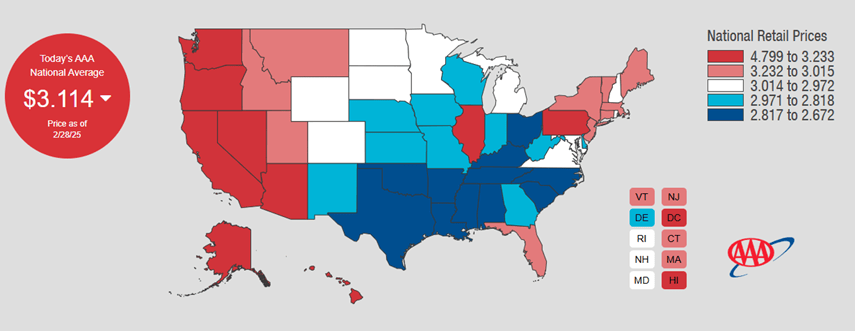
Check out the prices at the pump in your area: AAA Gas Prices.
Outlook
Events on the horizon that could move the markets in the near term:
- Fed & Inflation: Inflation continues to slowly creep back up in certain sectors, such as fuels and groceries (eggs!). The Federal Reserve has a wait and see approach regarding what to do with interest rates. They are definitely in no hurry to resume cutting rates when there is so much uncertainty out there and price inflation remaining sticky. Tariffs, deportations, mass layoffs in the federal government, and major proposed changes in fiscal policy (government spending and taxes) are some of the main forces the Fed has to consider when determining what to do with interest rates. As I said last month, I don’t mind where rates are right now. Investors can swap out of riskier investments and still get a decent rate of return in money markets and CDs.
- DOGE Action: The Department of Government Efficiency has made some major moves in the short time that it’s been in existence. I like the fact that they are looking to reduce government spending and improve its efficiency, but their strategy of ready, fire, aim is causing a lot of angst across the financial markets, not to mention the country as a whole. We all want a less bloated and a more streamlined functioning government, but DOGE seems to be prioritizing action over planning, meaning a willingness to take immediate action without a plan for what comes next. The biggest factor affecting markets from DOGE’s efforts is the job losses in both the government sector and the private sector (government contractors). This could help push the economy towards a recession versus the expected soft landing, resulting in a negative catalyst for the markets.
- Trump Administration Policies: There are a lot of policy changes happening almost every day, from trade to immigration to taxes. Some of these changes could help boost the economy while others could do damage. But the real problem that is causing the most volatility in the markets is the uncertainty of it all. Nobody knows for certain what will be implemented or what will be tossed aside. We do know that they want to shrink the government and apply tariffs to our imports. That means unemployment will almost certainly increase as the government layoffs accelerate. Also, consumer prices are going to rise as retailers pass on the tariff costs to us. Investors definitely need to be on their toes investing in this environment.
Joe Baker, CFP®
Baker Asset Management, LLC
joebaker@bakerassetmanagement.com

