

Calendar Notes
- Friday, February 14th – Valentine’s Day
- Monday, February 17th – Presidents’ Day – Stock market is closed.
Stocks kicked off 2025 with a solid performance in January. The economy continues to exceed expectations with low unemployment and solid wage growth. The tech giants that have led the markets higher over the past two years have allowed other industries to get in on the fun this past month, such as financials.
For the month, the S&P 500 gained about 2.67%.
Looking ahead, we still have a big chunk of 2024 Q4 earnings for companies to report but a major headwind for stocks could be inflation, which is starting to creep back up. Even more influential is how the Federal Reserve will try to counter it.
The Trump administration didn’t waste any time getting settled in and is already influencing the markets with several executive orders being implemented. It is still too early to tell how they will affect the economy.
Historically, when January is positive for stocks, full year returns have been positive 77% of the time. However, the S&P 500 has averaged a negative return in February since 2000.
Take a look at the Outlook section below to see what events could move the markets over the short term.
Bond prices are staying on the roller coaster for some more fun, once again reflecting the uncertainty in the current interest rate environment. Both corporate and government bond prices rose during the month of January as the threat of tariffs subsided momentarily. As I am writing this, Trump has declared that the U.S. will hit both Mexico and Canada with a 25% tariff and tack on a 10% duty for all imports coming from China. We should know more details over the weekend. If these tariffs are enacted, you can be sure that bond prices will be staying on the roller coaster.
The 10-year US Treasury note yield finished slightly lower in January, settling at about 4.54%, just below the 4.57% that it was at the beginning of the month. The 30-year bond yield closed out the month at 4.79%, the same as it was a month ago.
Bond investors will have to stay on top of the news as the new administration acts on their new policy initiatives. Price and yield volatility will certainly be picking up as these new policies get implemented.
Savings rates pretty much flatlined in January, most likely waiting on any major moves by the Federal Reserve, of which there were none. The Fed is waiting on policy changes from the new administration to make any decisions, so expect rates to stay where they are in the short term. That said, these rates are pretty good for savers and risk-averse investors. You can get above 4.5% return on your money currently. So, CDs and MMAs continue to be a great place to put your cash and your emergency fund, for now.
Savings rates should continue to stay in a holding pattern until we get a clearer picture on where interest rates are heading. This isn’t a bad thing, especially for risk-averse investors and savers. Knowing this, it makes sense in most situations to put cash that you don’t immediately need into CDs with up to 2-year maturities. For emergency cash, stick to high yielding money market and savings accounts, of which the best are yielding around 4.75%. As always, keep the total under $250,000 per person at any one bank to ensure you are fully covered by the FDIC.
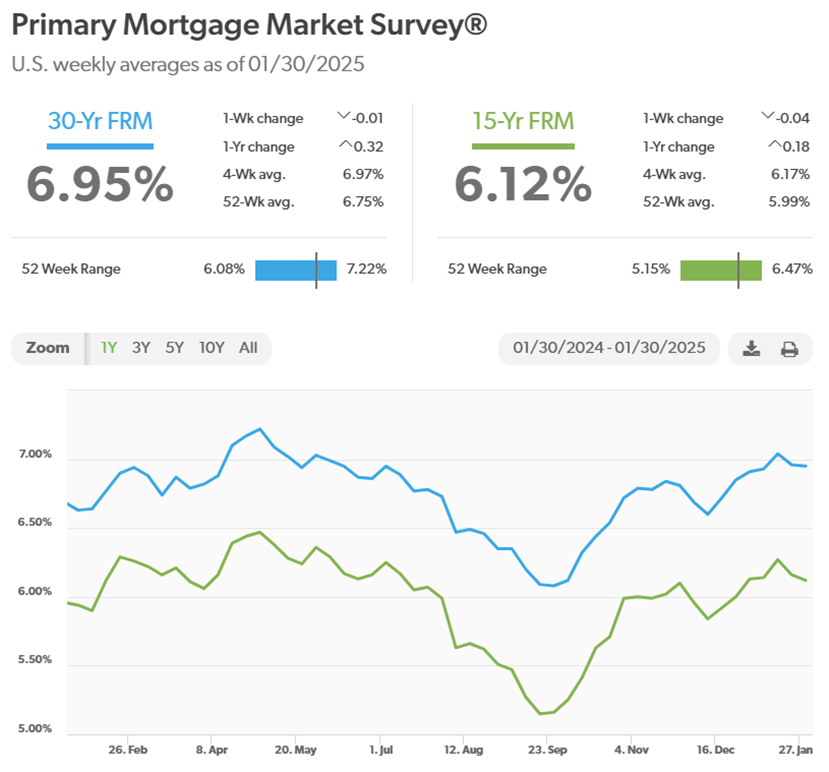
Mortgage rates moved slightly higher in January, pushing the 30-year loan even closer to the 7% mark. Currently, the 30-year rate sits at 6.95%, slightly higher than a month ago, at 6.85%. There is still low inventory, especially for existing homes, so any drop in rates continues to be met with a quick surge in demand. Demand is also being helped by improving consumer confidence and a strong economy.
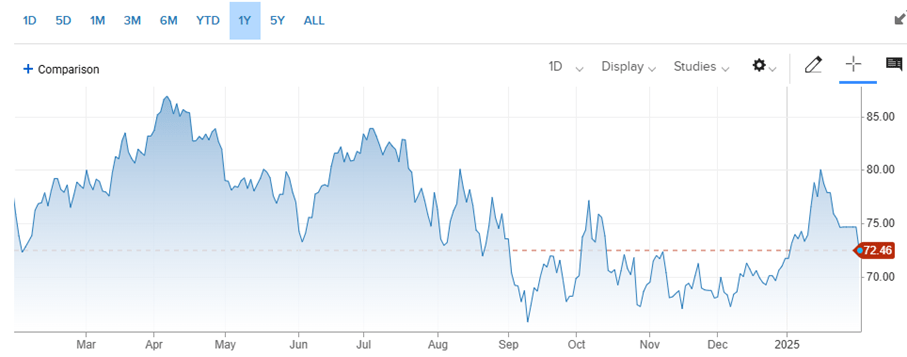
Oil prices inched up higher once again and it was no coincidence that it occurred right about when oil prices dropped below the $70 level. There seems to be ample supply to meet the world’s demand and no major catastrophes and/or wars to disrupt it.
For the month, the price for a barrel of oil closed at $72.46, up from $71.72 at the beginning of January. We were below $70 a barrel for a little bit at the end of 2024 but that did not last long. Producers love the price above $70 so they tightened the spigots just a touch.
Here’s a look at the one-year chart for U.S. oil:
Gasoline prices crept up slightly in January. Regular unleaded gasoline is now averaging $3.11 per gallon, up from $3.04 last month. Mississippi has the cheapest gas currently, checking in at $2.68 a gallon. Hawaii has the most expensive gasoline at $4.55 per gallon. FYI, a year ago, we were paying $3.14.
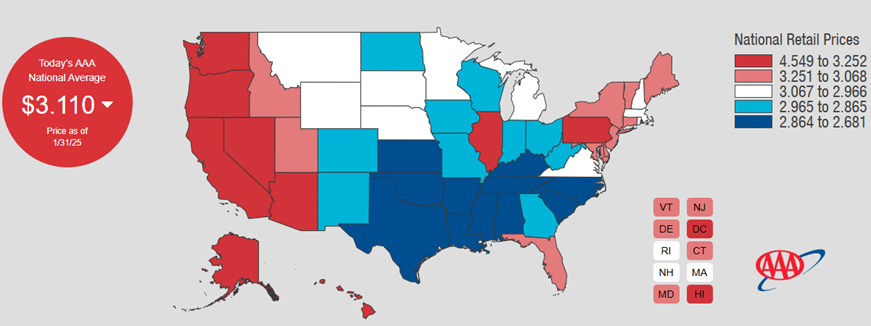
Check out the prices at the pump in your area: AAA Gas Prices.
Outlook
Events on the horizon that could move the markets in the near term:
- Fed & Inflation: The Federal Reserve held interest rates steady at their last meeting a few days ago. They won’t be meeting again until March so we will have a longer than normal time period before they make a decision on interest rates. Of course, they could change rates at any time but that would jolt the markets more than they would want. They did state that they will be holding rates steady and are in no rush to change them anytime soon. They understand that there are a lot of catalysts coming up this year that will steer their decision-making (see next bullet item). I don’t mind where they are now. This is more of the normal range for the 10-year treasury note and the 30-year mortgage. Plus, risk averse investors can get a decent interest rate in the fixed income market now versus the last 15 years.
- New Administration Policies: Besides inflation and interest rates, there are plenty of other things that can move the markets over the next several months. The effects of tariffs (higher consumer prices and/or lower earnings for U.S. companies), immigration (potentially lower unemployment, possibly higher food/construction prices), fiscal policy (lower personal and business taxes), and regulatory policy (less restrictions on businesses) could play a bigger than normal role in moving stock and bond prices. Investors definitely need to keep up with everything that is coming out of D.C. but they need to analyze how it will affect their investments before making any major portfolio changes.
Joe Baker, CFP®
Baker Asset Management, LLC
joebaker@bakerassetmanagement.com

