
Calendar Notes
- Saturday, December 7th – National Pearl Harbor Remembrance Day
- Tuesday, December 24th – Christmas Eve: Stock market closes early at 1 p.m.
- Wednesday, December 25th – Christmas Day: Stock market is closed.
- Tuesday, December 31st – New Year’s Eve
Stocks closed out their strongest month of the year in November with major help from the Trump victory and the continued strength in the economy. Stocks experienced a big reversal following a negative October and finished November with the best monthly return of 2024.
For the month, the S&P 500 racked up a positive return of 5.7%. For 2024, it is up over 27%.
Now that the election is over, all attention is on how the new administration’s policies are going to affect the markets. Tariffs and deportations could heavily influence the path of stock prices over the next year or even longer. They also could change the trajectory of inflation, and subsequently, the Federal Reserve’s game plan regarding interest rates. These next few months will be very interesting for not only the investment world, but almost all sectors of the economy.
Historically, December is the third best month for stocks, returning about 1.3% on average. I expect history to repeat itself this coming month as the economy continues to grow and the country prepares for the changing of the guard in DC.
Take a look at the Outlook section below to see what events could move the markets over the short term.
Bond prices did another one eighty and this time headed higher in November mainly due to the Federal Reserve cutting rates another 25 bps at their November meeting. Bonds across the spectrum dropped in yield as investors felt more confident that the Fed would continue on their path of reducing short-term interest rates.
The 10-year US Treasury note yield finished lower in November, settling at about 4.18%, below the 4.28% that it was at the beginning of the month. The 30-year bond yield closed out the month at 4.37%, lower than the 4.47% that it was a month ago.
Bond investors are looking to Washington, D.C., for any hints about trade and immigration policy changes that may come from the new administration set to take office in late January. Higher tariffs and mass deportations, if implemented, could cause a spike in inflation and interest rates, which will cause bond prices to drop.
Savings rates continue to come down at a very slow pace. The direction of where these rates are heading has become a bit murky as of late due to inflation slowing down its descent. I think we have to wait for the Trump administration to get settled in order to get a clearer picture. Still, these rates are pretty good for savers and risk-averse investors. You can get close to 5% return on your money currently. So, CDs and MMAs continue to be a great place to put your cash and your emergency fund, for now.
Now, take a look at the top rates for CDs and money market accounts (MMA):
CD Rates
| Term | National Average | High Rate |
| 1-year | 1.84% | 4.35% |
| 3-year | 1.35% | 3.90% |
| 5-year | 1.35% | 4.00% |
MMA Rates
| National Average | High Rate |
| 0.57% | 5.01% |
The best 1-year CD interest rate is currently at 4.35%, lower than last month. The best 5-year CD rate right now is around 4.00%, a 30-basis point drop from last month. MMA and traditional bank savings account rates changed very little from last month.
Savings rates are going to be coming down over the next year or so as long as inflation remains tame. If this holds true, it would be okay to put cash that you don’t need immediately into CDs with up to 2-year maturities. For emergency cash, stick to high yielding money market and savings accounts, which are still yielding around 5%. As always, keep the total under $250,000 per person at any one bank to ensure you are fully covered by the FDIC.
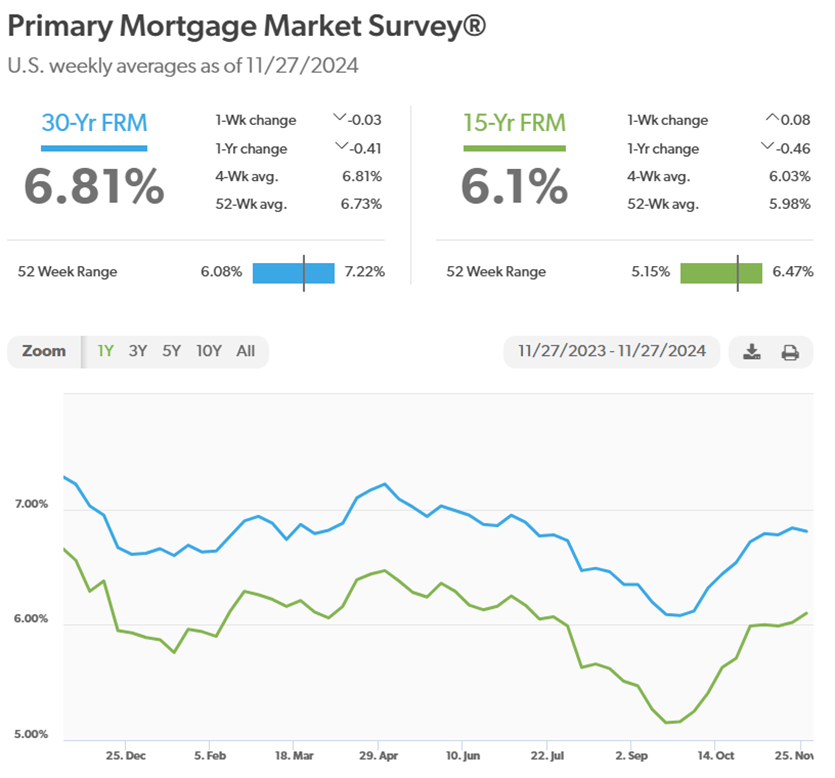
Mortgage rates continued higher once again in November, with the 30-year loan approaching the dreaded 7% level. Currently, the 30-year rate sits at 6.81%, higher than a month ago, at 6.72%. There is still low inventory, especially for existing homes, so any drop in rates has been met with a quick jump in demand. On a side note, I saw an interesting stat about the current crop of homebuyers in the U.S.: the average age of buyers is 56 in 2024, up from 49 in 2023. It is definitely taking longer for people to have the savings and income needed to be able to purchase a home nowadays.
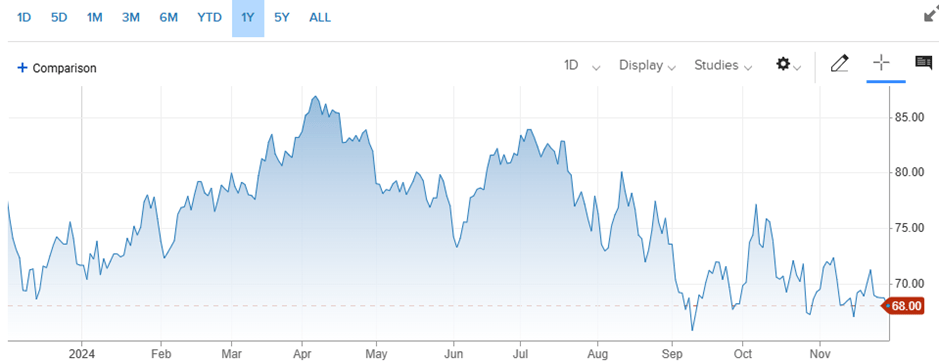
Oil prices fell modestly in November, helped by the “drill, baby, drill” mantra of Trump after winning the election and by the ceasefire in the Middle East.
For the month, the price for a barrel of oil settled at $68.15, down from $70.60 at the beginning of November. For the year, prices are still negative, currently down almost 5%. I would love to see oil prices stay below $70 for a sustained period. As a raw material for almost everything, lower oil prices mean lower manufacturing costs and hopefully companies will pass those savings onto us, the consumers.
Here’s a look at the one-year chart for U.S. oil:
Gasoline prices followed oil prices and fell once again in November. Regular unleaded gasoline is now averaging $3.06 per gallon, down from $3.13 last month. Oklahoma has the cheapest gas currently, checking in at $2.48 a gallon. Hawaii has the most expensive gasoline at $4.57 per gallon. FYI, a year ago, we were paying $3.48.
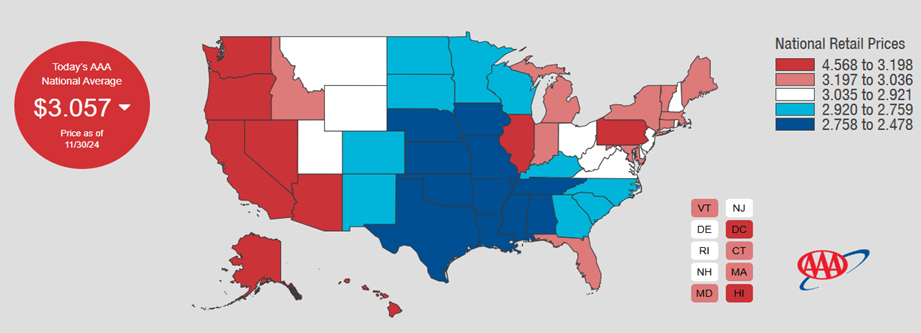
Check out the prices at the pump in your area: AAA Gas Prices.
Outlook
Events on the horizon that could move the markets in the near term:
- Fed & Inflation: Inflation continues to drop but looks more like it is bottoming out. Even so, the Fed is expected to cut rates by 25 bps at their last meeting of the year in a few weeks. Currently, the inflation rate is almost at the Federal Reserve’s target of 2.0%. However, there are some potential catalysts in the near future that might cause prices to reverse course and head higher. The two main ones to watch out for are tariffs and deportations. Investors will be giving the new administration their undivided attention regarding these issues over the next few months.
- Potential Asset Shift: Investors and savers may keep their money in CDs and MMAs if tariffs are implemented across the board and if mass deportations significantly cut into our workforce. These actions will accelerate inflation, forcing the Fed to keep interest rates elevated. These are two major issues that everyone will be watching as the new administration gets settled in early next year.
- Change in DC: In a few months, the Republicans will take over DC, with Trump moving back into the White House and his party taking control of both chambers of Congress. Historically, when one party controls both the presidency and Congress (single-party control), stocks have an annual return of about 8%. They do much better with a divided Congress, as you can see in the illustration below:
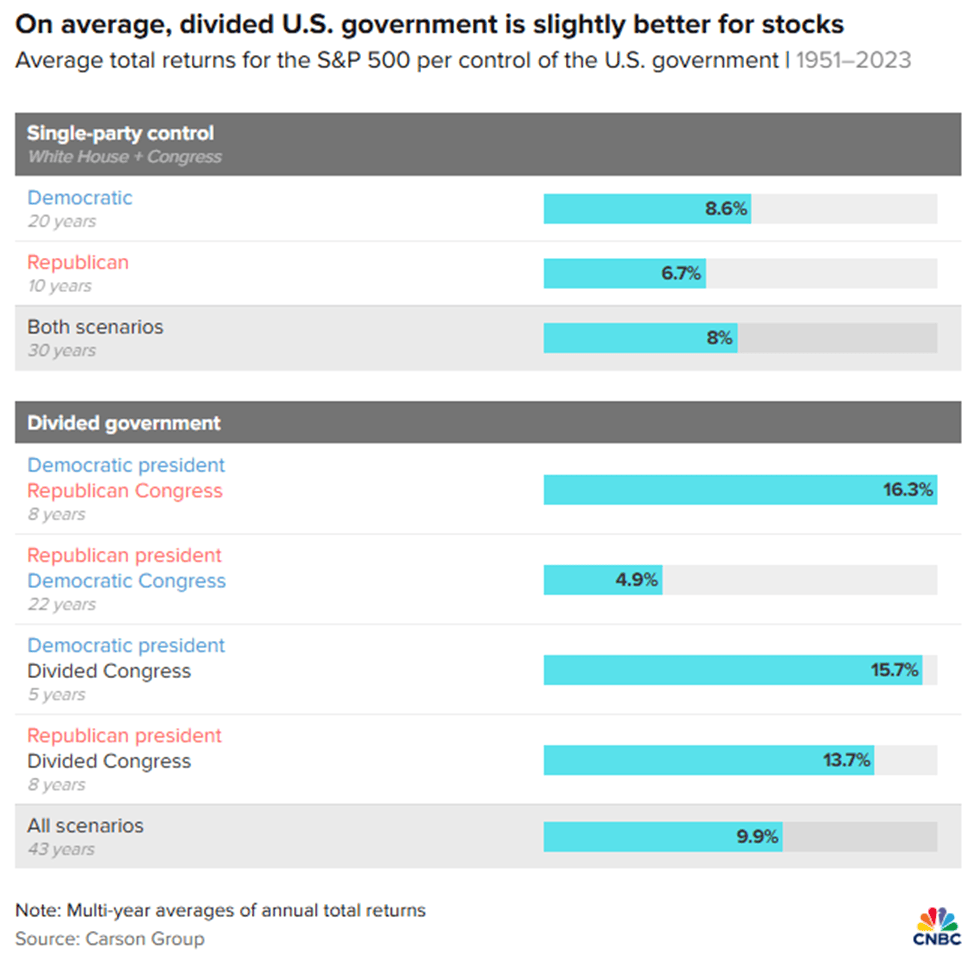
According to these stats, stocks look good regardless of who is in control. But it will be interesting to see if history repeats itself when we check the performance of the stock market at the mid-term elections two years from now.
Joe Baker, CFP®
Baker Asset Management, LLC
joebaker@bakerassetmanagement.com

