

Calendar Notes
- Monday, October 14th – Columbus Day
- Thursday, October 31st – Halloween
Stocks bucked the historical data and stayed positive to end the month of September. The Federal Reserve cutting interest rates 50 basis points in the middle of the month certainly helped. Economic data continue to come in supporting a soft landing for the economy, meaning no recession on the horizon.
For the month, the S&P 500 was higher for the fifth month in a row, this time by 2.02%. For 2024, it is up 20.81%.
Interest rates are still the main driver for stocks in the short term. Based on the Fed and the most recent economic data, rates should trend lower over the next year or so. This is bullish for stocks as investors look for a place to get a better rate of return for their money than in money markets, CDs, and bonds.
Historically, October has been a very volatile month. Some of the worst market drops in history happened in October: 1929, Black Monday in 1987, and multiple plunges in 2008 during the financial crisis. Also, since 1950, election-year Octobers have been the worst month for the Dow, S&P 500, and NASDAQ. However, more recently, October has been one of the best performing months for stocks, averaging about a 1.1% gain over the past two decades. It will be interesting to see how this October ends up.
Take a look at the Outlook section below to see what events could move the markets over the short term.
Bond prices moved higher once again, making it five months in a row of higher prices. Government, corporate, and high yield bonds all moved higher as inflation continues to drop and the Federal Reserve sets the table for more rate cuts in the near future.
The 10-year US Treasury note yield fell in September, finishing the month at 3.79%, lower than the 3.91% that it was at the beginning of the month. The 30-year bond yield closed out the month at 4.12%, lower than the 4.20% that it was a month ago.
Bond investors can now feel more confident buying bonds with longer maturities since they can be fairly certain that interest rates will be trending lower over the next year or so. Therefore, bond buyers holding to maturity could extend their maturity range out to two to three years. If rates drop faster than expected, you can sell those bonds before they mature with some nice capital gains.
Savings rates are showing signs of weakness and should start dropping more convincingly as the Federal Reserve continues to cut the short-term lending rates between banks. That said, rates are still pretty juicy and because of that, there is still a ton of money parked in cash (CDs, MMA, Savings). You can still get over 5% return on your money, risk free. So, CDs and MMAs continue to be a great place to put your cash and your emergency fund, for now.
Now, take a look atthe top rates for CDs and money market accounts (MMA):
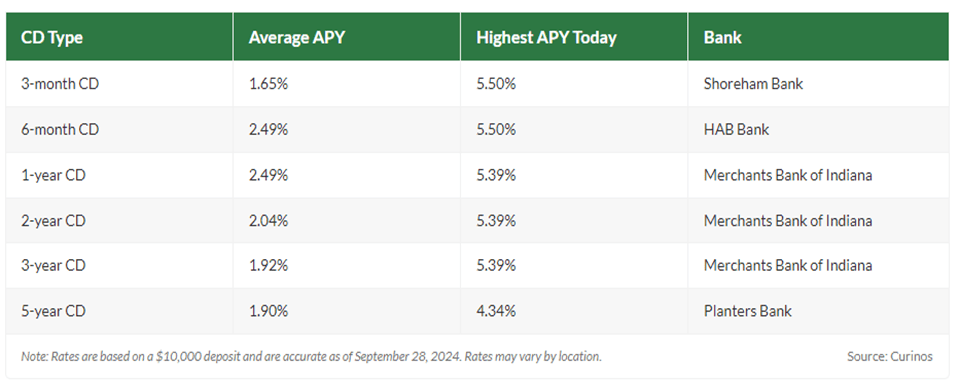
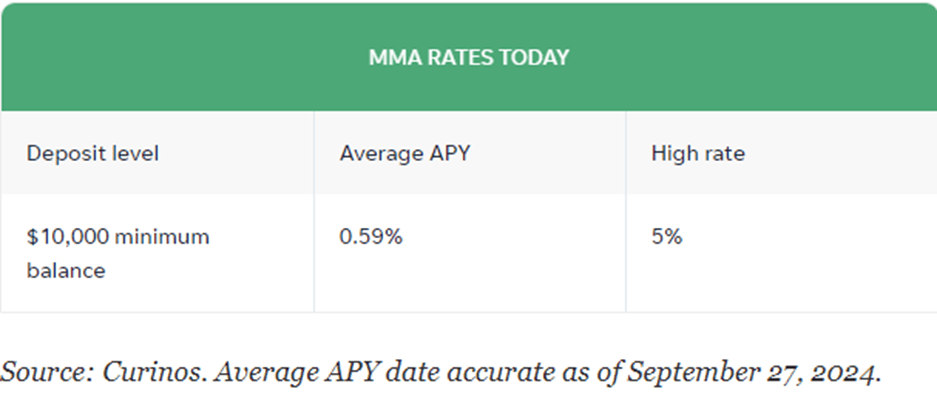
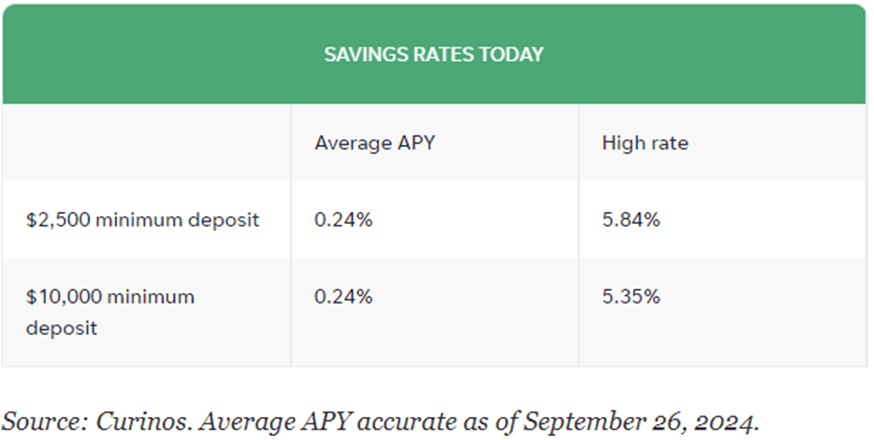
The best 1-year CD interest rate is currently at 5.39%, about the same as last month. The best 5-year CD rate right now is around 4.34%, a 16-basis point drop from last month. All the other rates pretty much stayed the same.
Savings rates are going to be coming down over the next year or so as long as inflation remains tame. If this holds true, it would be okay to put cash that you don’t need immediately in CDs with up to 2-year maturities. For emergency cash, stick to high yielding money market and savings accounts, which are still yielding well over 5%. As always, keep the total under $250,000 per person at any one bank to ensure you are fully covered by the FDIC.
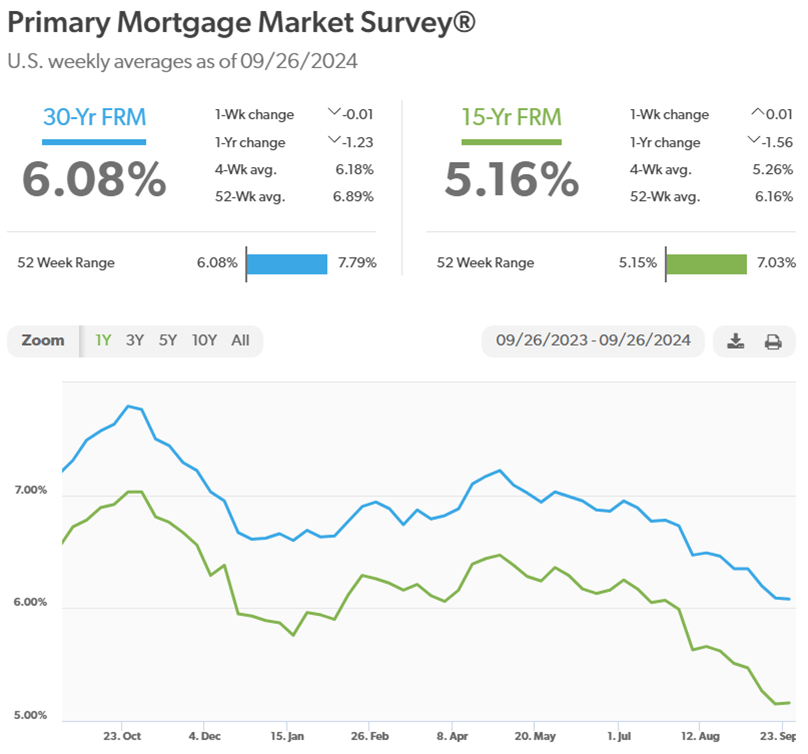
Mortgage rates continued to head lower in September, with the 30-year loan close to breaking 6%. Currently, the 30-year rate sits at 6.08%, lower than a month ago, at 6.35%. It’s still a seller’s market in the housing sector but with rates expecting to drop more over the next year, we should see homes become more affordable to first-time buyers and those owners who want to downsize but can’t let go of that 3% mortgage that they currently have.
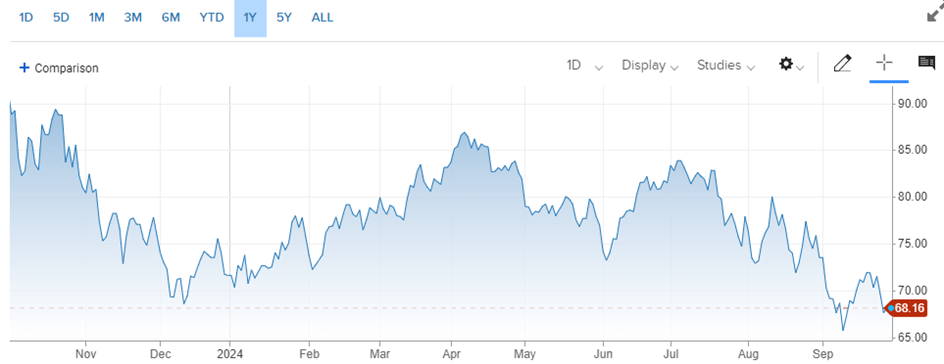
Oil prices took another dip in September, despite chaos in the Middle East. Saudi Arabia’s plans to increase production and the slow economy in China are some of the reasons for the drop.
For the month, the price for a barrel of oil settled at $68.16, down from $73.43 at the beginning of September. For the year, the price difference is now negative, down about 5.0%. If China’s economy starts to rebound, we might not see oil dropping much lower than it is now. Oil, diesel, and gasoline prices are input costs for almost every product or service consumers use. So, watching the price trends of fossil fuels is a great leading indicator as to where consumer prices should be heading, which has been lower.
Here’s a look at the one-year chart for U.S. oil:
Gasoline prices continued to drop in September. Regular unleaded gasoline is now averaging $3.22 per gallon, down from $3.35 last month. Mississippi has the cheapest gas currently, checking in at $2.70 a gallon. California is back on top with the most expensive gasoline at $4.70 per gallon. FYI, a year ago, we were paying $3.84.
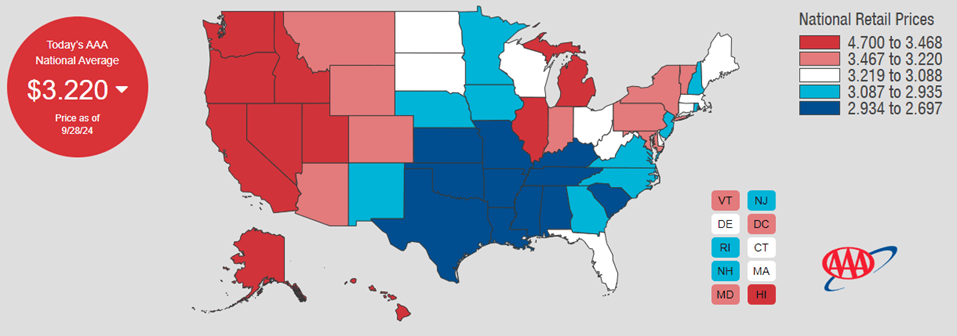
Check out the prices at the pump in your area: AAA Gas Prices.
Outlook
Events on the horizon that could move the markets in the near term:
- Fed & Inflation: Everyone knew it was coming so it wasn’t a surprise when the Federal Reserve cut interest rates this past month. Stocks and bonds got a little bump, but it was pretty much factored into prices already. Data keeps coming in indicating that inflation continues to drop and also showing that the economy will most likely avoid a recession. If this comes to fruition along with more expected rate cuts by the Fed, this is a goldilocks scenario and could kickstart another leg higher for stocks.
- Potential Asset Shift: Interest rates are coming down the other side of the mountain now. As money market and CD rates fall, some of that cash will start looking for a better rate of return and it could find its way into stocks, particularly high-quality stocks that pay a good dividend. It hasn’t really happened yet (there is still a record $6.3 trillion in money markets/CD/savings accounts) and there may be a few reasons. The first is that rates are still high compared to the past fifteen years so there’s no reason to move cash yet. The second reason could be that some investors may want to wait until after the election is over in November. Regardless, some portion of that cash will be coming over to the stock market and should provide some dry powder as rates drop and a floor for stock prices if there are any down swings in the stock market.
- East Coast Port Strike: Longshoremen unions operating the east coast and gulf coast ports are set to strike this week which could disrupt the U.S. economy in a big way. Almost half of all containers coming into the country arrive on the east coast and every day the strike goes on, it will take a week to get the supply chain back to normal. This could cause a spike in inflation as demand outstrips supply during the strike and will shake up both the bond and stock markets until the strike is resolved.
- Election: This year’s elections in early November will probably cause some volatility in the markets but shouldn’t last too long unless one party controls both houses of congress along with the executive branch, i.e., the president.
Joe Baker, CFP®
Baker Asset Management, LLC
joebaker@bakerassetmanagement.com

