

Calendar Notes
- August 24th – College football kicks off!
Stocks eked out a monthly gain after a huge day yesterday mainly due to the Federal Reserve meeting and what they said once it ended. The big technology stocks, however, took a beating this past month, which means the markets were helped by other sectors of the economy. This is good to see that the gains are more broad-based, which is a sign of a healthy stock market.
For the month, the S&P 500 was higher by 1.13%. For 2024, it is up 15.8%.
The Federal Reserve kept interest rates unchanged after their meeting ended yesterday but greased the skids for a rate cut when they meet next in September. Q2 earnings are coming out in droves right now and are moving stocks along with the Fed in an otherwise quiet time in the markets.
Historically, August has been the worst month for stocks over the last forty years. This is not surprising since most of the financial world is on vacation, Europe is on holiday, and Congress is out of session until September. Nothing is getting done in August.
Besides history, another potential market catalyst is interest rate cuts, which appear to be imminent, so let’s go to the charts. The only thing I want you to take away from the following chart is the blue line, which is how the S&P 500 index has performed one year before and one year after the Federal Reserve does their first rate cut:
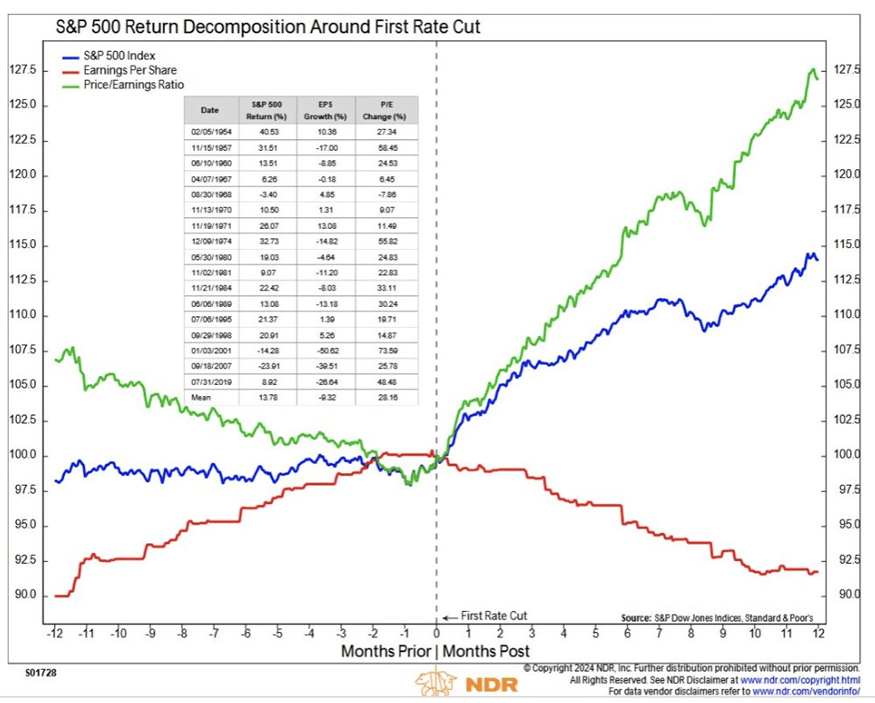
As you can see, stocks are relatively flat the year prior to starting rate cuts and perform pretty good in the year following the first rate cut by the Fed. In the current scenario, stocks have done extremely well in the past twelve months, assuming a rate cut is coming in September. So, can we expect stocks to follow this blue line after a rate cut? Personally, I feel rate cuts have been telegraphed for so long that the first few might already be baked into stock prices, but we will have to wait and see.
Take a look at the Outlook section below to see what events could move the markets over the short term.
Bond prices marched higher for the third consecutive month as inflation continues to cool. Although the Federal Reserve held rates steady again yesterday, their comments laid the groundwork for a rate cut in September. As of right now, if they don’t cut rates in September, that would be a surprise.
The 10-year US Treasury note yield fell in July, finishing the month at 4.07%, lower than the 4.39% that it was at the beginning of the month. The 30-year bond yield closed out the month at 4.35%, lower than the 4.55% that it was a month ago.
Bond investors still need to be cautious even if the data points to rates trending lower in the near future. Therefore, bond buyers should continue to focus on bonds with short-term maturities. I would keep maturities under 18 months and just plan on holding these bonds to maturity. That way, you won’t have to worry about selling at a discount if interest rates head higher.
Savings rates are starting to roll over as we get closer to a rate cut by the Federal Reserve. You can definitely see the drop in rates the farther that you go out on the CD maturity timeline. Still, if you shop around, you can park money in savings and get almost double the interest that you are paying on a mortgage that was refinanced back in 2020/2021. That is fantastic for those homeowners. High interest rates aren’t always bad. CDs and MMAs continue to be a great place to park your cash and your emergency fund. These rates keep savings accounts in the running as a legitimate alternative to stocks and bonds, especially for risk-averse investors, and will keep pressure on those markets until we see this trend reverse, which looks like it will be happening most likely in Q4 of this year.
Now, take a look at the top rates for CDs and money market accounts (MMA):
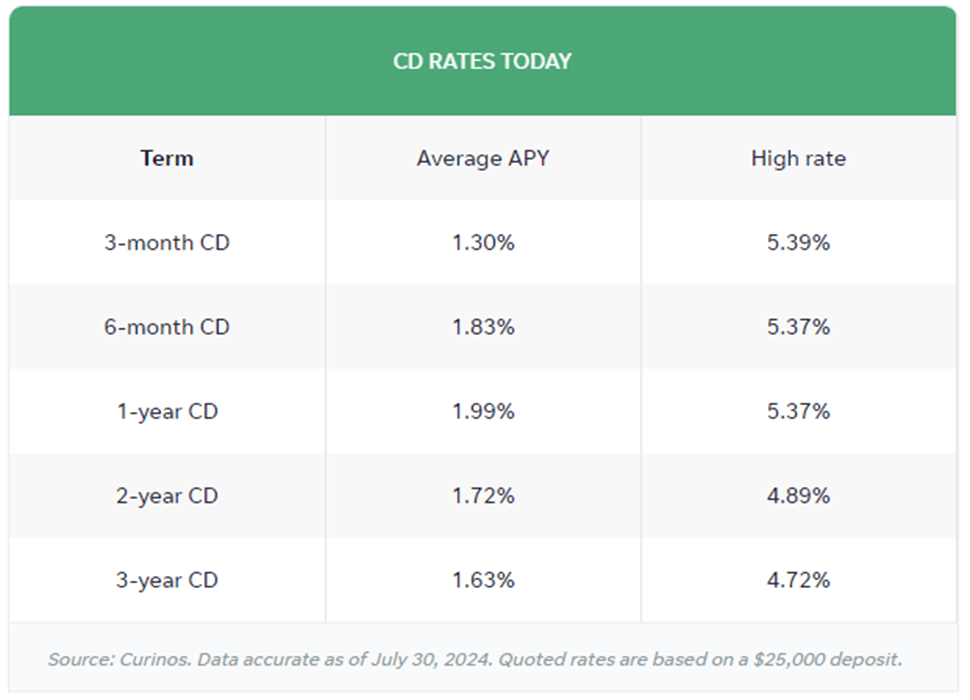
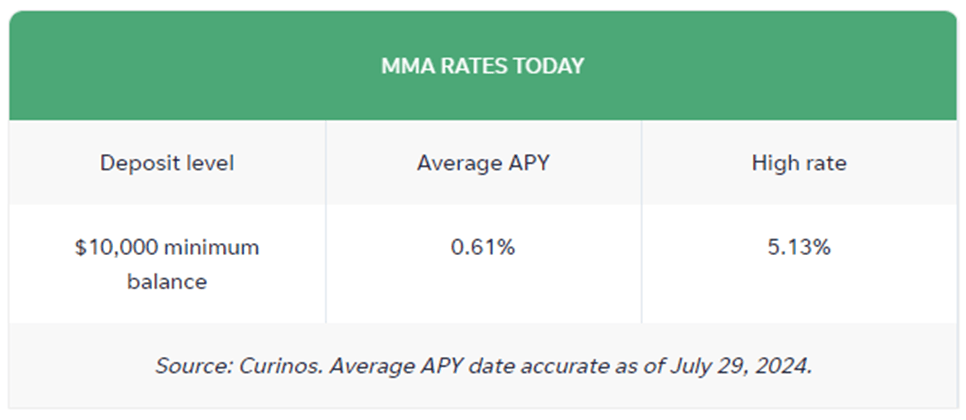
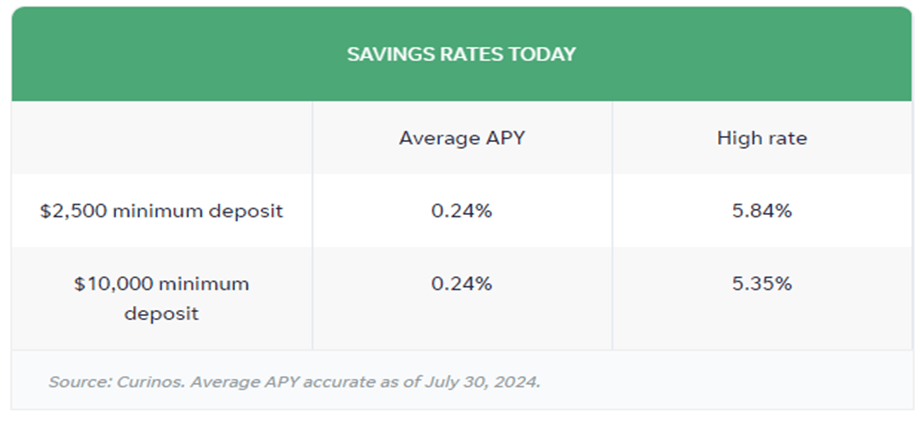
The best 1-year CD interest rate is currently at 5.37%. The best 5-year CD rate right now is around 4.75%. Rates became inverted again after only a short time with the 5-year yielding more than the 1-year.
Eventually, savings rates will normalize but not until inflation comes down enough for the Fed to feel comfortable lowering interest rates. That said, I would still put my savings or emergency spending money into short-term CDs, 1 year or less, and reevaluate when they mature. If you would rather have more liquidity, look into an MMA (some yielding close to 5.5% currently). Keep the total under $250,000 per person at any one bank to ensure you are fully covered by the FDIC. CDs and MMAs have become nice alternatives for risk-averse investors and have drawn money away from stocks because of their relatively high rates that carry virtually no risk.
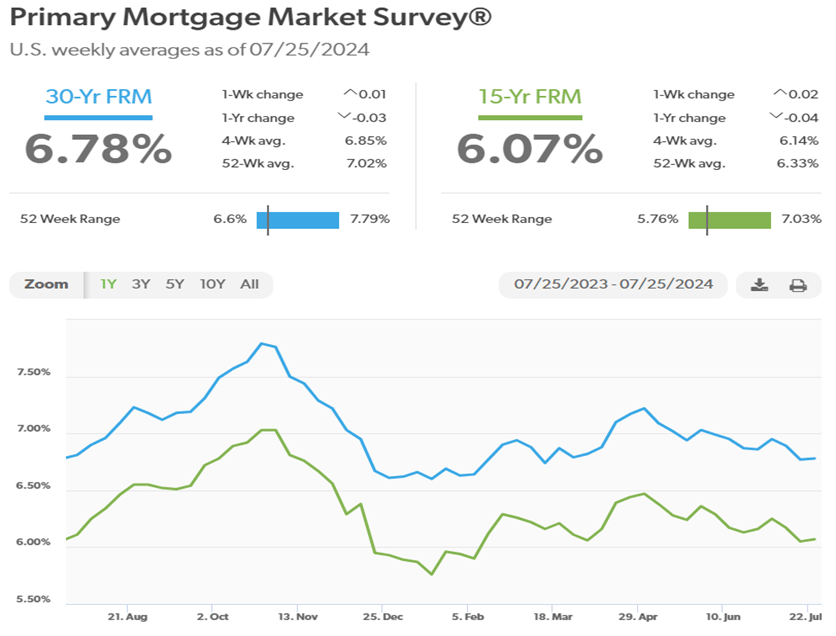
Mortgage rates dropped once again in July, remaining below the 7% mark once again for the 30-year rate. If this downward trend continues, this could be the last we see of 7% mortgages for a while. Currently, the 30-year rate sits at 6.78%, lower than a month ago, at 6.87%. Housing inventory continues to build. In fact, it is at its highest level since June 2020, but it is still far below pre-pandemic levels. This should keep a floor under home prices for now.
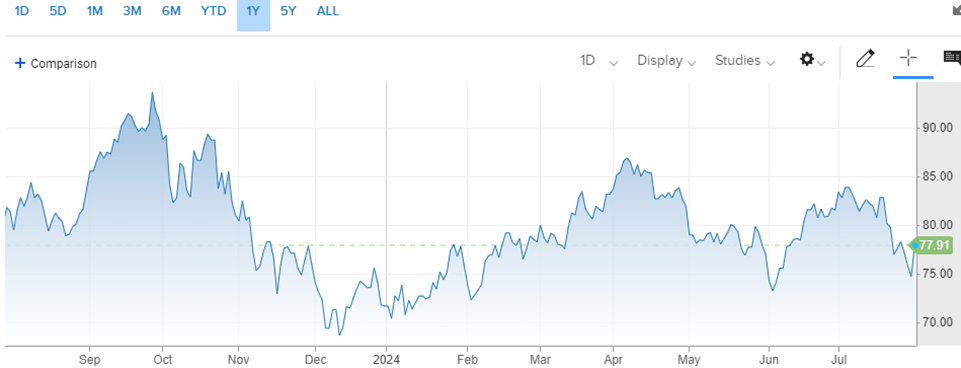
Oil prices took a welcomed dip in July as the U.S. continues to increase production, now the largest oil producer on the planet. The drop would have been even bigger if it weren’t for the charlie foxtrot going on in the Middle East between Israel and Hamas.
For the month, the price for a barrel of oil settled at $77.91, down from $81.46 at the beginning of July. For the year, it is up about 9%. Oil, diesel, and gasoline prices are input costs for almost every product or service consumers use. So, watching the price trends of fossil fuels is a great leading indicator as to where consumer prices should be heading.
Here’s a look at the one-year chart for U.S. oil:
Gasoline prices dropped slightly in July even as hurricane season ramped up along with summer driving. Hopefully, the big drop in oil prices will be reflected in gas prices this month. Regular unleaded gasoline is now averaging $3.49 per gallon, down from $3.50 last month. Mississippi has the cheapest gas currently, checking in at $2.97 a gallon. Hawaii has the most expensive gasoline at $4.68 per gallon. FYI, a year ago, we were paying $3.76.
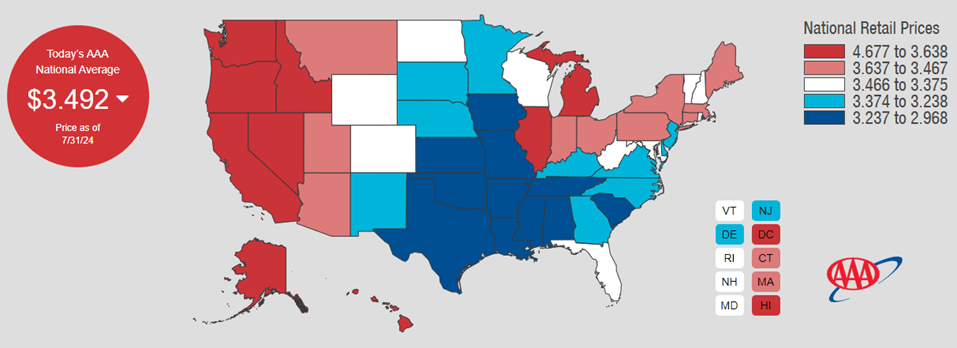
Check out the prices at the pump in your area: AAA Gas Prices.
Outlook
Events on the horizon that could move the markets in the near term:
- Fed & Inflation: The Federal Reserve Open Market Committee (FOMC) held short-term interest rates steady once again, following the conclusion of their meeting yesterday. Inflation data continues to trend lower and now we are also seeing wage growth slowing. This isn’t great news, but it is better than mass layoffs. Also, there are still almost 8.2 million job openings out there, which is a positive. Also, consumers will be more discerning about where to spend their money – read tightening our belts. Like I said earlier, it feels like a 25-bps rate cut is already priced into the stock market but if it leads to a few more cuts, we could get a nice boost for both stock and bond prices.
- Potential Asset Shift: Interest rates appear to have peaked and are rolling downward as inflation cools and in anticipation of rate cuts by the Fed. If we have peaked and rates continue to drop, we could see money flow from savings accounts, money market accounts and CDs to stocks, especially high-quality dividend paying stocks. This is the potential source for the fuel to send the stock market higher after its impressive run in the past 18 months. Just looking at money market assets, there is currently about $6.1 trillion sitting in MMA. That’s a lot of fuel.
Joe Baker, CFP®
Baker Asset Management, LLC
joebaker@bakerassetmanagement.com

