

Calendar Notes
- Thursday, July 4th, Independence Day. The stock market is closed. Also, markets will close early at 1:00 pm on Wednesday, July 3rd.
Stocks delivered positive returns again in June as investors continue to bank on the Federal Reserve cutting rates sooner rather than later. It appears that a rising stock market and above average interest rates can coexist, just like they did forever until the financial crisis of 2008.
For the month, the S&P 500 was higher by almost 3.50%. For 2024, it is up 14.5%.
Economic data continue to show inflation cooling down. Regarding food prices, I have seen actual proof at Walmart with all of the Rollback price signs out, especially in the grocery section.
Companies are going to start reporting Q2 earnings shortly and that should cause some short-term market volatility.
Historically, July has emerged as the best month of the year, on average, in terms of stock-market performance. Since 1928, the S&P 500 has experienced an average gain of 1.7% in July, according to Dow Jones Market Data. We beat the average gain in June. Now, let’s see if we can do it again in July.
Take a look at the Outlook section below to see what events could move the markets over the short term.
Bond prices continued higher for a second month in a row as inflation data confirmed that prices were rising at a slower pace on a year-over-year basis. This is giving the Federal Reserve more confidence that inflation is cooling down enough for them to cut rates at some point this year. That said, nobody expects them to cut rates at the next FOMC meeting at the end of July, but more and more economists expect a cut in September.
The 10-year US Treasury note yield fell in June, finishing the month at 4.39%, lower than the 4.51% that it was at the beginning of the month. The 30-year bond yield closed out the month at 4.55%, lower than the 4.65% that it was a month ago.
Bond investors still need to be cautious even if the data points to rates trending lower in the near future. Therefore, bond buyers should continue to focus on bonds with short-term maturities. I would keep maturities under 18 months and just plan on holding these bonds to maturity. That way, you won’t have to worry about selling at a discount if interest rates head higher.
Savings rates remained pretty much unchanged this past month once again, keeping rates at their highest levels since 2007. For most homeowners with a mortgage that is more than 18 months old, it is nice when your savings account is paying more interest to you than you are paying to your mortgage lender. CDs and MMAs continue to be a great place to park your cash and your emergency fund. These rates keep savings accounts in the running as a legitimate alternative to stocks and bonds, especially for risk-averse investors, and will keep pressure on those markets until we see this trend reverse, which looks like it will be happening much later in the year than expected.
Now, take a look atthe top rates for CDs and money market accounts (MMA):
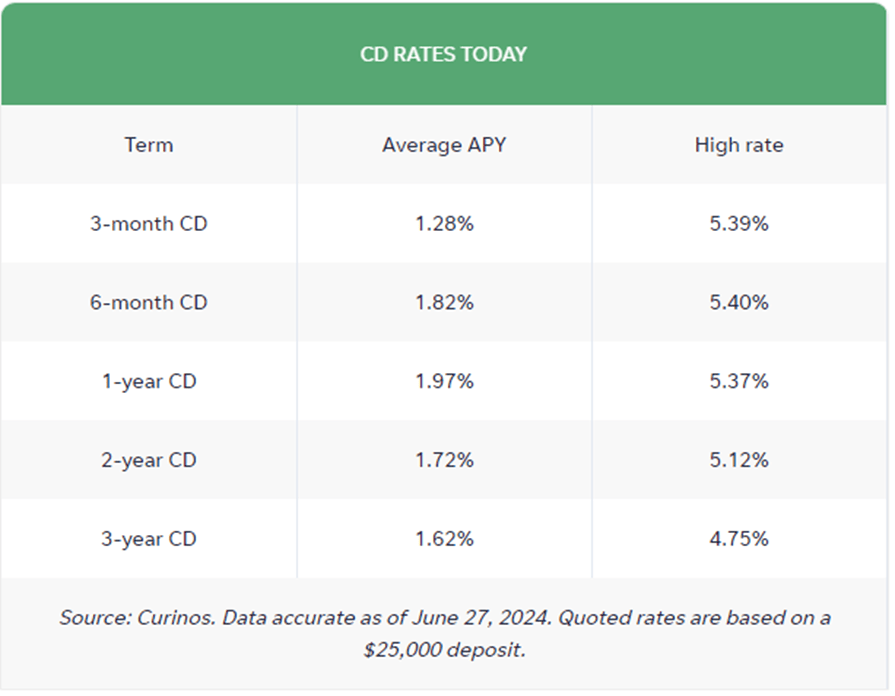
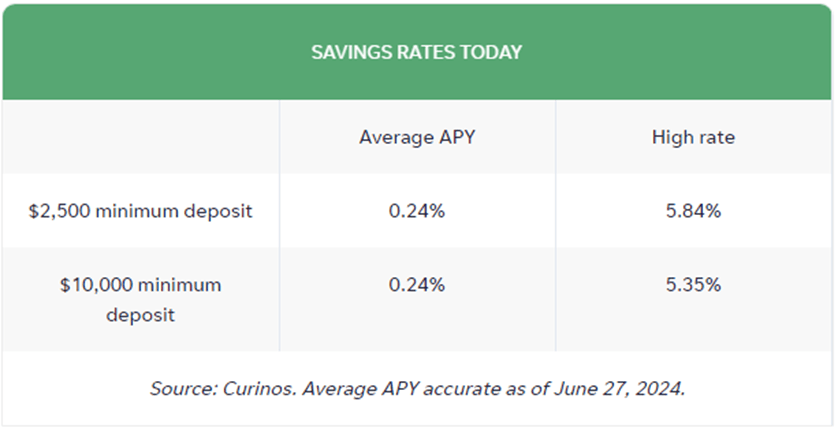
The best 1-year CD interest rate is currently at 5.37%. The best 5-year CD rate right now is around 4.80%. Rates became inverted again after only a short time with the 5-year yielding more than the 1-year.
Eventually, savings rates will normalize but not until inflation comes down enough for the Fed to feel comfortable lowering interest rates. That said, I would still put my savings or emergency spending money into short-term CDs, 1 year or less, and reevaluate when they mature. If you would rather have more liquidity, look into an MMA (some yielding close to 6% currently). Keep the total under $250,000 per person at any one bank to ensure you are fully covered by the FDIC. CDs and MMAs have become nice alternatives for risk-averse investors and have drawn money away from stocks because of their relatively high rates that carry virtually no risk.
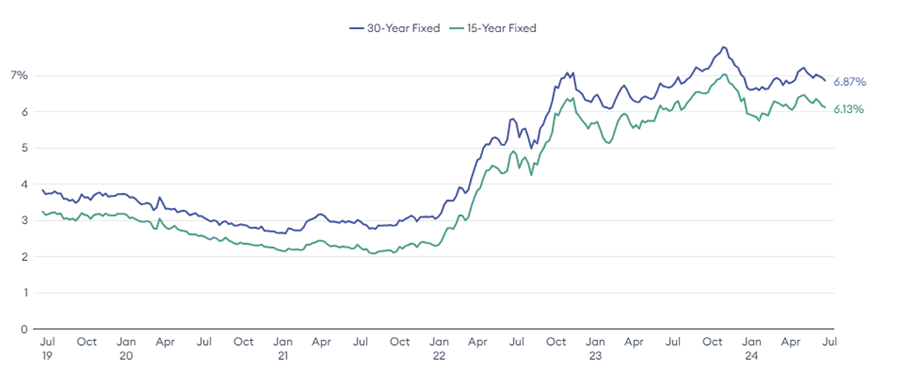
Mortgage rates continued sliding down in June, dropping below the 7% mark once again for the 30-year rate. It seems like 7% is the battleground for mortgage rates as you can see in the chart below. It has been meandering above and below the 7% line since Octoberof last year. Currently, the 30-year rate sits at 6.87%, lower than a month ago, at 7.03%. Home sales have stalled, keeping demand subdued for mortgage loans. Plus, there is very little incentive to buy a home with rates where they are right now. That will not change until mortgage rates fall. For now, the industry continues to bank on the Federal Reserve to get it squared away and that means rate cuts.
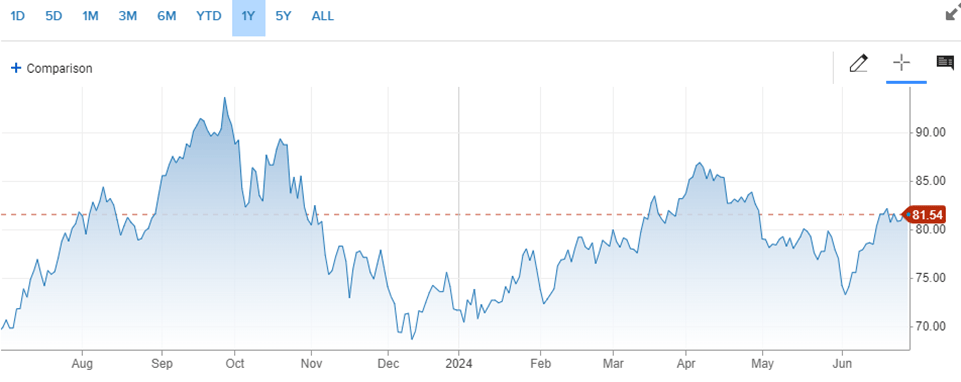
Oil prices recovered in June after a two month drop as tensions in the middle east offset the buildup of inventory in the U.S., which comes as no surprise to anyone. Also, the higher potential of rate cuts here in the states might have contributed to the bump up in oil prices.
For the month, the price for a barrel of oil settled at $81.46, up from $76.99 at the beginning of June. For the year, it is up about 13.7%. Oil, diesel, and gasoline prices are input costs for almost every product or service consumers use. So, watching the price trends of fossil fuels is a great leading indicator as to where consumer prices should be heading.
Here’s a look at the one-year chart for U.S. oil:
Gasoline prices continued to drop in June as gasoline demand remained subdued. Regular unleaded gasoline is now averaging $3.50 per gallon, down from $3.56 last month. Mississippi has the cheapest gas currently, checking in at $2.95 a gallon. California has the most expensive gasoline at $4.80 per gallon. FYI, a year ago, we were paying $3.56.
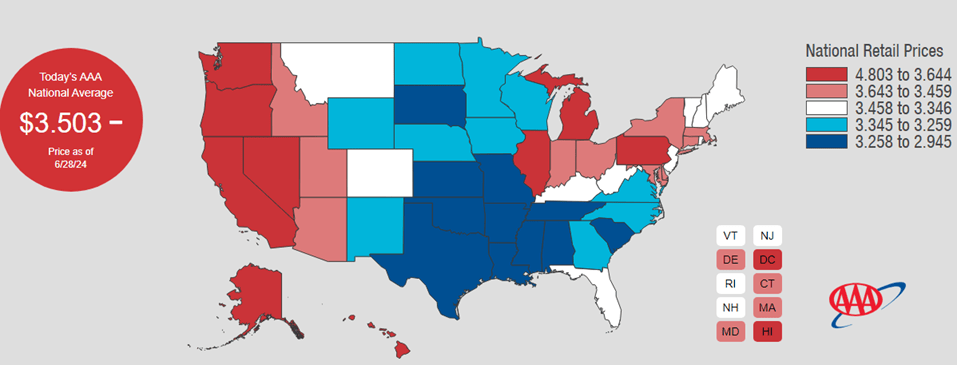
Check out the prices at the pump in your area: AAA Gas Prices.
Outlook
Events on the horizon that could move the markets in the near term:
- Fed & Inflation: The Federal Reserve Open Market Committee (FOMC) is poised to cut interest rates. With the latest consumer pricing data coming in this past Friday confirming that inflation is cooling, it looks like we should see at least one rate cut this year. It feels like a 25 bps rate cut is already priced into the stock market but if it leads to a few more cuts, we could get a nice boost for both stock and bond prices.
- Potential Asset Shift: Interest rates have flatlined at their highs for most of this year. If this is the peak and rates begin to come down, we could see money flow from savings accounts, money market accounts and CDs to stocks, especially high-quality dividend paying stocks. This is the potential source for the fuel to send the stock market higher after its impressive run in the past 18 months. Take a look at how much money is sitting in savings vehicles currently:
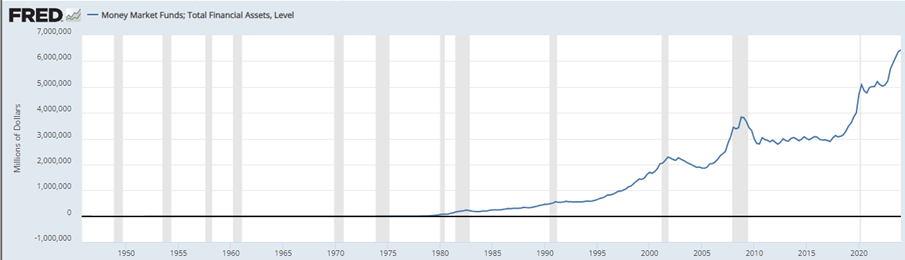
The St. Louis Fed reports almost $6.5 trillion in these accounts as of 2024 Q1. If this money starts shifting to the stock market, it could be the catalyst for a nice leg up.
Joe Baker, CFP®
Baker Asset Management, LLC
joebaker@bakerassetmanagement.com

