

Fun Facts about April
- Birthstone: Diamond
- Flower: Daisy and the sweet pea
- Zodiac signs: Aries and Taurus
- April 1st (this Saturday) is April Fool’s Day. Watch out!
- In the Southern Hemisphere, April’s weather is equivalent to October in the Northern Hemisphere.
- Passover starts on Wednesday, April 5th and lasts through Thursday, April 13th.
- The stock market is closed on Good Friday, April 7th.
- Easter Sunday is April 9th this year.
- Federal tax returns need to be postmarked by Tuesday, April 18th. The unusual filing deadline is due to Emancipation Day being on Sunday, April 16th but will be observed on Monday, April 17th this year. This is a public holiday in Washington D.C.
Stocks held up amazingly well during a tumultuous March that included some mid-size bank failures and an unrelenting Federal Reserve. The S&P 500 rose 3.3% during the month of March and is now up 7% for the year.
Other than the banking sector, most industries fared okay. If you owned big technology companies with solid balance sheets, you did very well, as many investors not only shifted their money from bank stocks but also moved their bank deposits into those tech stocks. This helped the NASDAQ 100 index enjoy its best week since 2010. In what became a bizarro-world moment, the stocks of Microsoft, Apple, Google, and Amazon became safe havens for investors and bank depositors!
Now, with Q1 in the books, earnings season will be moving the markets, at least until the Federal Reserve meets again in the beginning of May.
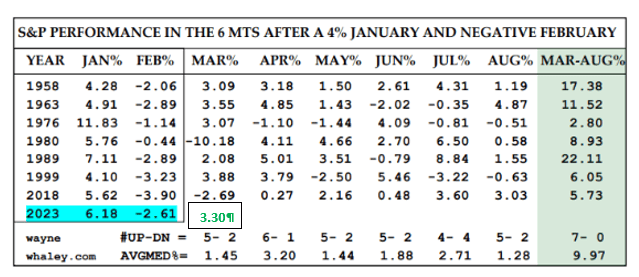
I’m leaving this table in the update through August to see if history repeats itself. There have been seven instances where a January with a 4% or higher return was followed by a negative February. 2023 is now the eighth. For each one of these years, the following six months had an average gain of almost 10%. Will 2023 keep this undefeated streak going?
Take a look at the Outlook section below to see what events could move the markets over the short term.
Bond prices have risen in January, dropped in February, and now have jumped up again in March. This is a clear indication that there is a lot of uncertainty out there in the fixed-income markets. On one hand, the economy continues to prove resilient in many sectors but on the other, there are signs of the economy slowing down (layoffs, tighter money supply, etc.). Plus, there are still fears of more bank failures. When there is a lot of uncertainty, there usually is a flight to safe haven investments, such as treasury bonds. This could explain the rise in bond prices this past month.
The 10-year US Treasury note yield headed lower in March, closing the month at 3.48%. The 30-year bond yield ended lower as well, closing the month at 3.66%. These yields are still well below the short-term treasuries. For example, the 6-month T-bill is currently yielding 4.88%, confirming a strong inversion of the yield curve and one of the best indicators of an impending recession.
Bond buyers should continue to focus on bonds with short-term maturities. I would keep maturities under two years and just plan on holding these bonds to maturity. That way, you won’t have to worry about selling at a discount if interest rates continue to rise. By the way, this is what happened to the banks that recently failed: owned too many bonds with long-term maturities that they had to sell at a loss to cover withdrawals.
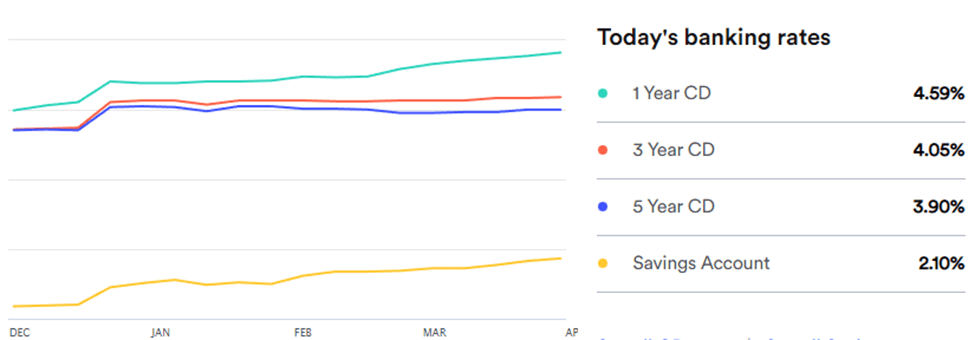
Savings rates moved higher just a touch in March. These rates have been getting more competitive as savers are moving their money to institutions with better interest rates. Traditional bank accounts are also having to sweeten their rates for depositors because many are moving their savings to brokerage money market accounts in the wake of the recent bank failures.
Currently, the average savings account is paying 2.10%, up from 1.95% last month. There are some online savings accounts that are paying much higher rates than these and are worth taking the time to research.
The 1-year CD interest rate is now averaging 4.59%, up from 4.39% last month. The 5-year CD rate is currently at 3.90%, up from 3.86% last month. These rates are still inverted, just like the yield curve, meaning they are paying a higher rate to borrow your money for a shorter time period, which isn’t normal. These inversions typically do not last longer than six months. That said, if you’re looking for a place to park your savings or emergency spending money, just buy short-term CDs, 1 year or less, and reevaluate when they mature. Keep the total under $250,000 at any one bank to ensure you are fully covered by the FDIC. CDs are becoming a nice alternative for risk-averse investors and have drawn money away from stocks because of these relatively high rates that carry virtually no risk. I wouldn’t mind if these rates stayed this high but do not want to see them heading up much further.
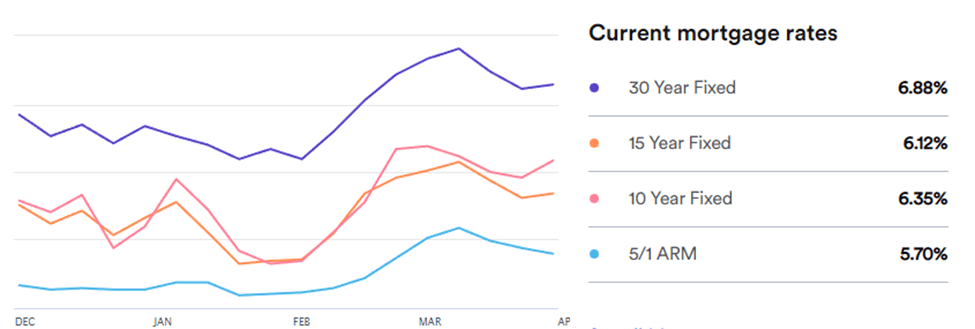
Mortgage rates resumed their downtrend in March after a one month rise in February (see chart below). Currently, the 30-year rate sits at 6.88%, down from 6.95% a month ago. It seems like any meaningful drop in mortgage rates causes demand to quickly heat up and it makes sense. Home buyers have a low inventory to choose from, which keeps home prices high. So, when mortgage rates drop, their potential home becomes more affordable and they want to jump on it while they can.
These rates are still the highest they have been in about fifteen years but that might last too much longer. The fixed income markets are predicting a recession based on the quick drop in short-term treasury bonds, which would force interest rates down, including mortgage rates.
Oil prices dropped once again in March as lighter demand continued across the globe. Also, natural gas prices are down almost 80% from their highs last summer, as its price continues to collapse due to a warm European winter and ample supplies from the U.S. to counter the cuts from Russia.
For the month, the price for a barrel of oil settled at $75.54, about $1.40 less than it was at the beginning of March. This is a nice downtrend that hopefully will continue before the summer driving months and hurricane season begin.
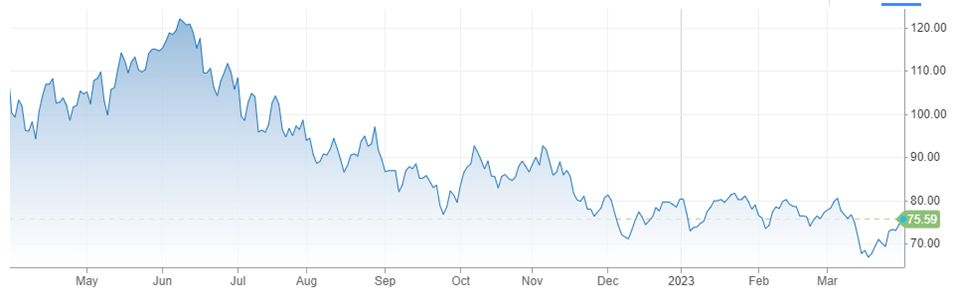
Prices keep creeping lower, approaching a more sustainable price point, between $55 and $70 per barrel, that can keep both producers and consumers happy. This trend lower is also good for cooling down inflation since oil is a major input cost for almost everything that we consume.
Gasoline prices moved higher in March, as better weather sparked an uptick in recreational driving. Regular unleaded gasoline is now averaging $3.50 per gallon, up $0.14 from last month. Mississippi has the cheapest gas, at $3.03 a gallon. California has the most expensive gasoline at $4.83 per gallon. FYI, a year ago, we were paying $4.23.
Check out the prices at the pump in your area: AAA Gas Prices.
Outlook
Events on the horizon that could move the markets in the near term:
- Fed & Inflation: In March, the Fed raised their overnight lending rate by 25 basis points once again. I thought that the multiple bank failures would have forced them to hit the brakes on raising rates, at least until they had a better understanding of how deep the problem was with the banking system. Even after the meeting, they still talked about raising rates even more. However, the markets don’t believe the Fed, at least based on the direction of interest rates recently. Investors feel strongly that the economy is heading for a recession and that the Fed is going to start cutting interest rates at some point this year. The 2 year treasury note, for instance, was yielding as high as 5.1% in the beginning of March but now is yielding only 4%, even after the Fed raised rates. I feel the Fed has done enough and needs to step back and reevaluate before they go too far and cause more damage than expected. By the way, the next Federal Reserve meeting is set for May 2nd-3rd.
- Russia Invasion of Ukraine: I feel like news about this conflict has gone on the back burner and the world has accepted it and is adapting accordingly. Of course, this is just my observation from a continent away. I know close up, war zones are absolute hell on earth. Ukraine continues to hold its own and the only major news gaining traction is that Putin is thinking about placing tactical nukes in Belarus. Whether tactical or strategic, any nuke is a bad thing for everyone. Hopefully, this won’t come to fruition but I do believe Putin is getting desperate to try and end this war before he loses his grip on his own country. Any nuke movement will be bad for markets in the short term.
Joe Baker, CFP®
Baker Asset Management, LLC
joebaker@bakerassetmanagement.com

