

Fun Facts about March
- Birthstone: Aquamarine
- Flower: Daffodil and Jonquil
- Zodiac signs: Pisces and Aries
- March’s equivalent in the Southern Hemisphere is September.
- Sunday, March 12th, Daylight Saving Begins. We turn our clocks forward one hour (losing sleep!).
- Friday, March 17th, is St. Patrick’s Day.
- Monday, March 20th, is the 1st day of Spring, also known as Spring Equinox.
Stocks ran out of steam quickly after that big jump in January. For the month of February, the S&P 500 fell 2.5%. For the year, however, the index is still up 3.2%. The macro reason for the drop this month is, of course, the uncertainty of what the Federal Reserve is going to do when they meet again this month. There are conflicting signs regarding inflation and the potential for a recession. Concerning inflation, wages are still high, but energy and housing prices continue to drop. Concerning a recession, layoffs are muted outside of the tech sector and the economy is doing great in almost all industries. These higher wages by the way, especially in the retail, food and beverage, and travel sectors are probably here to stay. They needed to catch up with the rest of the economy because they were so low for so long. So, now it’s up to the Fed to decide how much higher they need to raise rates. If they raise them much more, it could spell trouble for stocks. There already is some stiff competition for stocks with interest rates as high as they are right now. Risk-free government bonds paying 5% are a solid, able-to-sleep-at-night alternative to stocks.
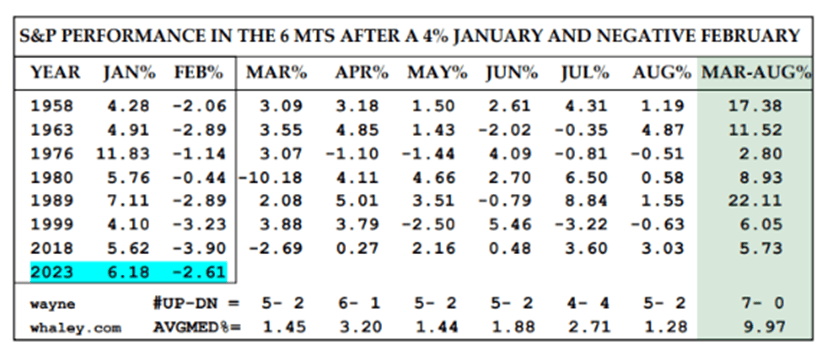
For you stock bulls, this table should give you some confidence that stock prices will rise over the short term. There have been seven instances where a January with a 4% or higher return was followed by a negative February. 2023 is now the eighth. For each one of these years, the following six months had an average gain of almost 10%. Will 2023 keep this undefeated streak going?
Take a look at the Outlook section below to see what events could move the markets over the short term.
Bond prices across the debt spectrum reversed course from January’s rise and dropped throughout February as economic data that pointed to stubborn inflation surprised investors. Yields subsequently went up through the end of the month as they move in the opposite direction of bond prices.
The 10-year US Treasury note yield moved up in February, closing the month at 3.91%. The 30-year bond yield ended higher as well, also closing the month at 3.91%, matching the yield of the 10-year note. These yields are still well below the short-term treasuries. For example, the 6-month T-bill is currently yielding 5.14%, confirming a strong inversion of the yield curve.
Bond buyers should be focusing on bonds with short-term maturities. I would keep it under two years and just plan on holding them to maturity, so you won’t have to worry about selling at a discount if interest rates continue to rise.
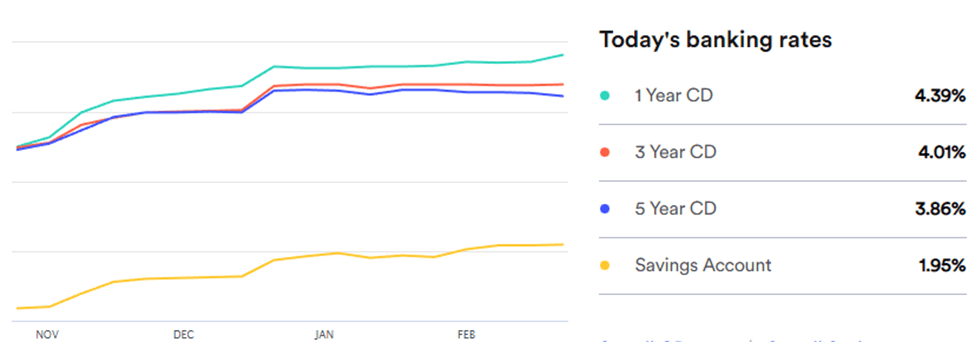
Savings rates remained relatively unchanged throughout February despite the Fed raising rates once again. There is still plenty of chatter that the Fed will continue to push rates higher, which should help boost our savings rates in money markets and CDs. However, it does feel like we are nearing the top on these rates.
Currently, the average savings account is paying 1.95%, up from 1.79% last month. There are some online savings accounts that are paying much higher rates than these and are worth taking the time to research.
The 1-year CD interest rate is now averaging 4.39%, up modestly from 4.25% last month. The 5-year CD rate is currently at 3.86%, down from 3.95% last month. These rates are still inverted, just like the yield curve, meaning they are paying a higher rate to borrow your money for a shorter time period, which isn’t normal. These inversions typically do not last longer than six months. That said, if you’re looking for a place to park your savings or emergency spending money, just buy short-term CDs, 1 year or less, and reevaluate when they mature. CDs are becoming a nice alternative for risk-averse investors and have drawn money away from stocks because of these relatively high rates that carry virtually no risk. I wouldn’t mind if these rates stayed this high but do not want to see them heading up much further.
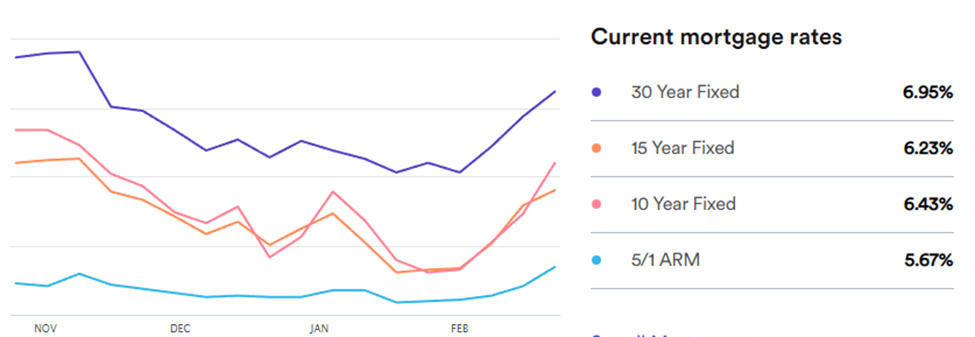
Mortgage rates did a major reversal in February and moved higher after a significant downtrend in the three months prior (see chart below). Currently, the 30-year rate sits at 6.95%, up from 6.43% a month ago. I think the main catalyst for this upswing is the hot inflation numbers that keep posting, which suggest that the Fed is going to keep raising interest rates. Also, demand has picked up since rates have fallen to lows not seen since last fall.
Going forward, that might not be the case, particularly with existing home sales. That’s because many occupied homes holding a mortgage have a fixed mortgage in the 2-3% range from the pandemic days and those owners have little incentive to sell if they have to buy a house with a 7% mortgage.
Oil prices continued to drop in February as demand waned due to an unusually warm winter. By the way, the same can be said for natural gas prices, which were nearly $10 per MMBtu this past summer and now are about $2.65!
For the month, the price for a barrel of oil settled at $76.92, about $2 less than it was at the beginning of February. This is a nice downtrend that hopefully will continue before the summer driving months and hurricane season begin.
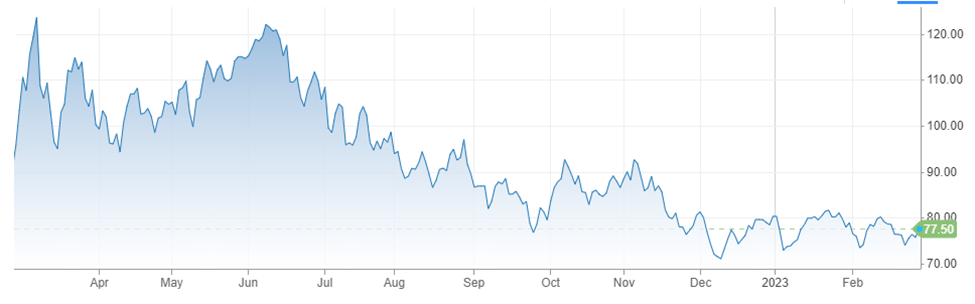
Prices keep creeping lower, approaching a more sustainable price point, between $55 and $70 per barrel, that can keep both producers and consumers happy. This trend lower is also good for cooling down inflation since oil is a major input cost for almost everything that we consume.
Gasoline prices tracked lower with oil prices in February. Regular unleaded gasoline is now averaging $3.36 per gallon, down $0.15 from last month. Texas has the cheapest gas for a second month in a row, at $2.91 a gallon. Hawaii has the most expensive gasoline at $4.88 per gallon. FYI, a year ago, we were paying $3.61.
Check out the prices at the pump in your area: AAA Gas Prices.
Outlook
Events on the horizon that could move the markets in the near term:
- Fed & Inflation: The Fed raised their overnight lending rate by 25 basis points, as expected, in February’s meeting. They also noted that they have solid data indicating that inflation has slowed its rise and may have peaked. Then, some hot inflation data points came in during this past month that spooked investors. Now, nobody is sure what the Fed may do at their next meeting or how much longer they plan on raising rates. This uncertainty has put a damper on the stock market recovery that we saw in the beginning of the year. Expect this volatility in the markets to continue as we approach the date of the next Fed meeting in late March. They’ll most likely raise rates again, but it is what they say about future rate hikes that will steer the direction of the market going forward.
- Russia Invasion of Ukraine: Ukraine is holding on and for them, a stalemate is a win. But, on the ground, war is hell, especially for the Ukraine civilians just trying to survive. The warm winter was a godsend for the country and certainly helped erase the inflated oil and natural gas prices that we saw this past summer. It’s been over a year since the invasion started and the damage is massive for both countries: structurally for Ukraine, but Russia has been devastated economically regardless of the outcome. It will end and when it does, it will be a positive for the markets although not as much anymore since the world has learned to live with this conflict.
Joe Baker, CFP®
Baker Asset Management, LLC
joebaker@bakerassetmanagement.com

