

Fun Facts about February (How is it February already!!)
- Birthstone: Amethyst
- Flower: Violet and Primrose
- Zodiac signs: Aquarius and Pisces
- February’s equivalent in the Southern Hemisphere is August.
- Thursday, February 2nd is Groundhog Day. This is the day we find out whether winter will last six more weeks or call it quits early.
- Tuesday, February 14th is Valentine’s Day.
- Monday, February 20th, is Presidents Day. The stock market, banks, and government offices will be closed that Monday.
- Tuesday, February 21st, is Mardi Gras, aka Fat Tuesday.
Stocks started out 2023 with a nice performance in January. In fact, it was the best January for the S&P 500 since 2019. For the month of January, the S&P 500 had a positive gain of 6.5%. Historically, this is a good sign that stocks will finish positive for the rest of the year, with the average annual gain of about 11.5%. Plus, when the previous year (2022) was negative, the annual return for the ensuing year has been even better, averaging about +14%.
We have companies reporting their Q4 and 2022 numbers right now but the big news that will move the markets will be coming from the Federal Reserve this afternoon. They are expected to raise rates again but by a smaller amount, most likely 25 basis points. But, it’s what they say about their strategy going forward that could send the stock market reeling or give it a nice boost. Canada’s central bank has put a halt to their interest rate hikes last week, which could be a good sign to those of us who would like the Fed to do the same.
Take a look at the Outlook section below to see what events could move the markets over the short term.
Bond prices across the debt spectrum slowly drifted up as more signs of a slowing economy and possible recession popped up throughout this past month. Yields subsequently dropped through the end of the month as they move in the opposite direction of bond prices. This price action, coupled with the inverted yield curve, is sending a strong signal to the Federal Reserve that they should be more worried about sending the economy into a recession, rather than trying to rein in inflation (which they have already done).
The 10-year US Treasury note yield headed lower in January, closing the month at 3.51%. The 30-year bond yield ended lower as well, closing the month at 3.64%, still lingering just above the yield of the 10-year note once again. These yields are still well below the short-term treasuries. For example, the 6-month T-bill is currently yielding 4.83%, confirming a strong inversion of the yield curve.
Investors are going to be tuning in later today when the Fed announces their decision on interest rates and, more importantly, if they decide to adjust their strategy. Today and the rest of the week should be very interesting and will certainly move the bond and stock markets if there are any surprises. That said, bond buyers should stick to purchasing individual bonds with maturities less than 2 years.
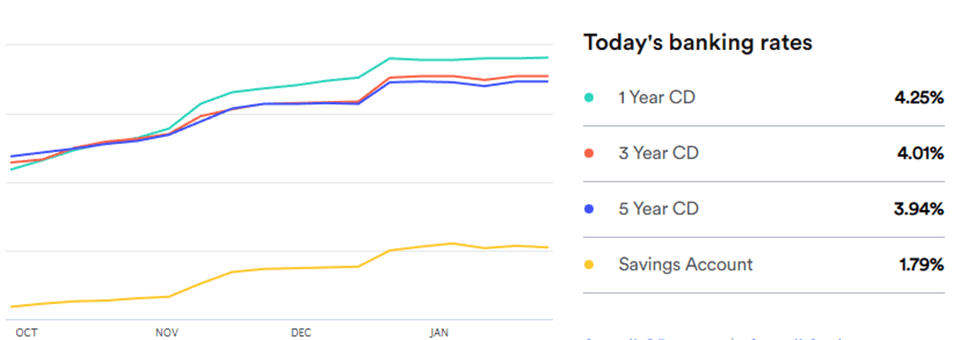
Savings rates finally have levelled off after moving higher for fourteen straight months. Most rates stayed flat throughout January as we wait for the first Federal Reserve meeting of 2023 to end this afternoon with their decision on interest rates. We will see if savings rates continue to climb or if they have peaked. Regardless, it is nice to finally earn some interest in our money market and CD accounts.
Currently, the average savings account is paying 1.79%, about the same as last month.
The 1-year CD interest rate is now averaging 4.25%, up slightly from 4.22% last month. The 5-year CD rate is currently at 3.94%, exactly the same as last month. These rates are still inverted, just like the yield curve, meaning they are paying a higher rate to borrow your money for a shorter time period, which isn’t normal. These inversions typically do not last longer than six months. That said, if you’re looking for a place to park your savings or emergency spending money, just buy short-term CDs, 1 year or less, and reevaluate when they mature. CDs are becoming a nice alternative for risk-averse investors and have drawn money away from stocks because of these relatively high rates that carry virtually no risk. I wouldn’t mind if these rates stayed this high but then that means that inflation is staying high as well, which is no good in the long run.
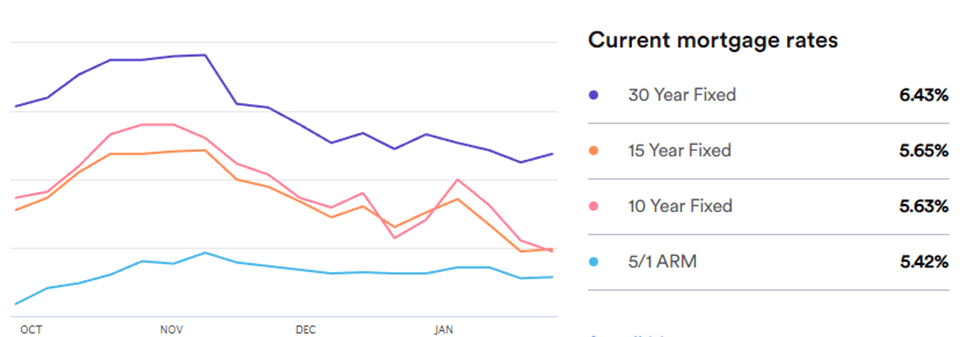
Mortgage rates continue to trend downward after peaking in November (see chart below). Currently, the 30-year rate sits at 6.43%, down from 6.59% a month ago. In most areas of the country, home prices continue to fall as demand wanes due to recession fears. Existing home sales for December came in down over 36% from one year ago. That is a huge drop. Also, the home builders’ confidence report has declined for thirteen months in a row now, nearly matching the lows at the start of the pandemic in 2020. The silver lining here is that the rate of decrease for both of these has slowed significantly.
Another ray of hope for the housing market is a data point known as the homeowner vacancy rate, which shows what share of owner-occupied housing units are vacant and for sale. It is currently just off its all-time low. That means inventory (supply) is still pretty low, which helps to keep prices from falling. I’m pretty sure there’s plenty of homeowners that have paid off their mortgage or have a 2-3% mortgage rate that are not even considering moving, which is certainly helping to keep existing home inventories low.
Oil prices dropped once again in January as fears of slowing demand outweighed China’s reopening from the pandemic. For the month, the price for a barrel of oil settled at $79.00, about $1.50 less than it was at the beginning of January. Another helpful data point confirming inflation has most likely peaked.
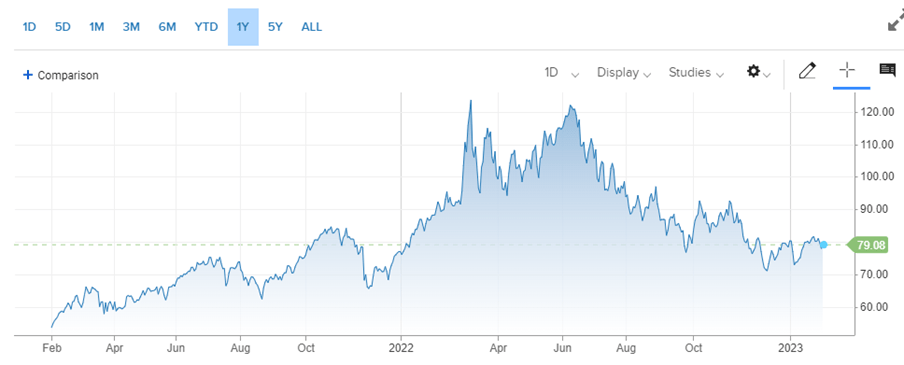
We’re getting back down to what I like to call the sweet spot for oil prices, between $55 and $70 per barrel. This price range is profitable enough for oil companies and tolerable for businesses and consumers when converted to diesel and gasoline. This downtrend in oil prices should be well noted by the Federal Reserve and hopefully they will cease and desist on raising rates further.
Gasoline prices did not follow the drop in oil prices and rose significantly in January. Regular unleaded gasoline is now averaging $3.51 per gallon, up $0.31 from last month. There are no states with gasoline under $3 (there were sixteen last month). Texas has the cheapest gas, at $3.13 a gallon. Hawaii has the most expensive gasoline at $4.94 per gallon. FYI, a year ago, we were paying $3.37.
Check out the prices at the pump in your area: AAA Gas Prices.
Outlook
Events on the horizon that could move the markets in the near term:
- Fed & Inflation: The Federal Reserve Open Market Committee is wrapping up their two-day meeting this afternoon that will end with their decision on how much they plan to raise short term interest rates. Most bets are on a 25 basis points raise and that is already factored into stock and bond prices right now. The big question that needs to be answered is what they expect going forward. Everyone knows inflation peaked last year and has been coming down ever since. Does the Fed still need to raise rates, or have they done enough to tame inflation? If they keep raising rates after this meeting, it could trigger another leg down for stocks and bonds. If they plan to hold steady, we could see a new bull market emerge for stocks.
- Russia Invasion of Ukraine: Really no change from last month. Putin has gone full crazy, and everyone is just hoping someone takes him out from the inside. They’ve been at it for almost a year and you really have to be amazed by the resiliency of the Ukraine people. Hopefully, they can continue to hang in there until Russia gives up and goes home. Because of the war’s unexpected lengthy duration, only a major change in this stalemate, like an end to it, will move the markets significantly.
Joe Baker, CFP®
Baker Asset Management, LLC
joebaker@bakerassetmanagement.com

