

Fun Facts about July
- Birthstone: Red ruby
- Flower: Water Lily and Larkspur
- Zodiac signs: Cancer and Leo
- The 4th of July falls on a Monday this year. Happy birthday USA!
- July is, on average, the warmest month of the year in the northern hemisphere. Its southern hemisphere equivalent is January.
Stocks continued to drop throughout June as negative news continued to grab the headlines. As with most of this year, we still have a bunch of negative catalysts putting downward pressure on stock prices: high inflation, supply chain disruptions, Russian/Ukraine conflict, and the Fed raising interest rates.
For the month of June, the S&P 500 dropped about 8.4%. For the year, it is now down over 21%. That’s a bad six months. In fact, it’s the worst first half of a year since 1970. Will it continue or are we going to turn it around? If you watch or listen to the financial news, you would think the world is going to end next week. There seems to be no positive news out there. This is keeping investors scared and on the sidelines.
I thought this illustration below is an accurate depiction of investor sentiment right now.
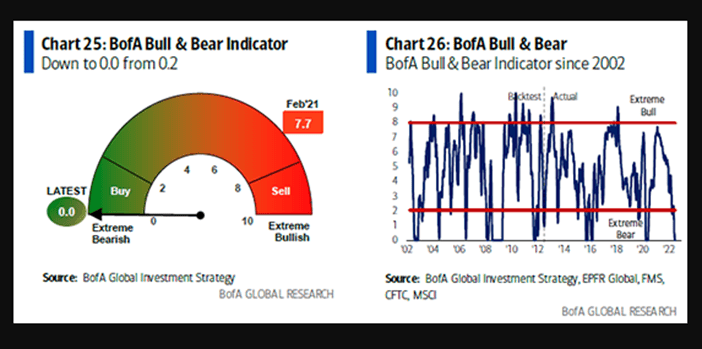
The good news is that investor sentiment is a pretty accurate contrarian indicator for stocks, meaning when investors feel the worst, stock prices usually bottom out and start to rise. If the pattern on Chart 26 holds true, stock market investors should be pretty happy over the next couple of years.
Take a look at the Outlook section below to see what events could move the markets over the short term.
Bond prices reverted back to its downward trend in June after a move higher in May. With bond interest rates going up, they are becoming more attractive and will be bought, which will slow down the rate of increase in these rates.
The 10-year US Treasury note breached the 3% watermark during June but ended the month just below it at 2.98%. The 30-year bond is at 3.12%, ending the month higher as well but off its peak from the middle of the month. We could see these rates roll over and stay flat or even continue to drop as investors give up on stocks and seek the safety of government bonds.
Savings rates moved higher for the eighth consecutive month. This is really good news for savers and risk-averse investors. Of course, these rates are still no match for the current inflation rates but at least we’re seeing some substantial improvement. Hopefully, savings rates will continue to head up and narrow the gap between what banks charge us to borrow and what they pay us to hold our money.
Currently, the average savings account is paying 0.51%, up from 0.38% last month. We’re still not making much interest here, but it’s getting better, and we should see higher rates throughout the rest of this year.
The 1-year CD interest rate is now averaging 1.69%, up from 1.36% last month. The 5-year CD rate is solidly above 2% and now sits at 2.38%, up from 2.04% last month. I would still rather buy some blue-chip stocks that pay 3% or 4% dividends, but at least now, CDs are getting a little more attractive for conservative investors.
Mortgage rates resumed their march higher in June after a pause in May. Currently, the 30-year rate sits at 5.83%, up from 5.28% a month ago. Home sellers are seeing much less competition for their homes. Stats are showing about 1 in 4 homes are dropping their selling price, which indicates that some homes are getting no offers. This should come as no surprise with the large spike in mortgage rates this year. This is becoming more of a normal housing market than the last two years. Also, we will probably see mortgage rates level off here or even drop a bit as demand wanes for new mortgages.
Oil prices dropped in June as businesses and consumers tightened their belts to combat inflation. The price for a barrel of oil settled up just below $106, $9 less than it was at the beginning of June. For the year, oil is still up almost 50%.
The drop in oil prices could continue as demand slows down from the effects of inflation. Any hurricane activity over the next couple of months could negate the demand slowdown so expect prices to continue to be volatile.
Gasoline prices rose again at the pump in June. Regular unleaded gasoline is now averaging $4.81 per gallon, up $0.19 from last month. South Carolina now has the cheapest gas, at $4.32 a gallon. California has the most expensive at $6.24 per gallon. FYI, a year ago, we were paying $3.13.
Check out the prices at the pump in your area: AAA Gas Prices.
Outlook
Events on the horizon that could move the markets in the near term:
- Russia Invasion of Ukraine: Russia defaulted on their debt for the first time since 1918. Their economy is in a freefall. But they are making progress against Ukraine, capturing some territory along the northeast border. Amidst all the death and destruction, both sides are looking to find a way to move one of their biggest export products: wheat. I believe they will get a deal done to allow their wheat exports to go out, since it would be a big humanitarian crisis if it was not able to reach the rest of the world, particularly many of our poorer nations. The quickest way out of this mess is a coup from within Russia to get Putin out of there. That would give us one less uncertainty in the markets.
- Supply Chain Status: It’s been easier to get raw materials and finished products to market over the last month as China unlocks from Covid again and demand drops due to higher prices all around. The reduced demand should also allow the supply chain to take a breath finally and get back on track. Shipping and trucking rates have dropped considerably since earlier in the year. This should help in reducing prices at the consumer level.
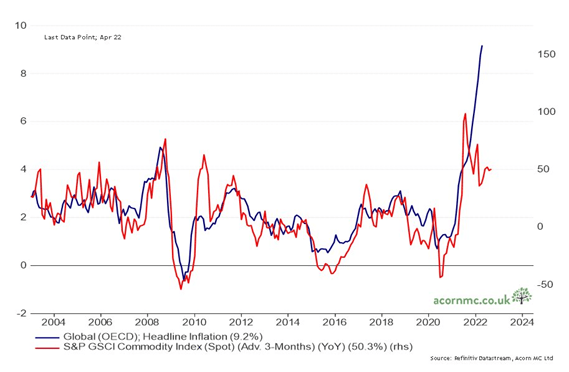
- Fed & Inflation: The Fed raised short-term interest rates another 75 basis points. This pushed the prime rate to 4.75%, which is the basis for many consumer loans (mortgages, credit cards, autos). The Fed has talked about how their actions have already had an effect on prices and consumer spending. This is one of the reasons that stock markets had a nice rebound in the latter part of June. I think if raw material prices continue to drop and mortgage rates stay where they are, the Fed should have a wait and see approach on raising interest rates further. Their previous rate-raising actions have been working and they could sell more of their assets that they have on the books to tighten money supply without having to raise rates again. Money is already pretty tight thanks to the $10 trillion loss in stockholder value. This greatly reduced the collateral available to guarantee loans. The following graph shows where inflation is heading (down):
Joe Baker, CFP®
Baker Asset Management, LLC
joebaker@bakerassetmanagement.com

