
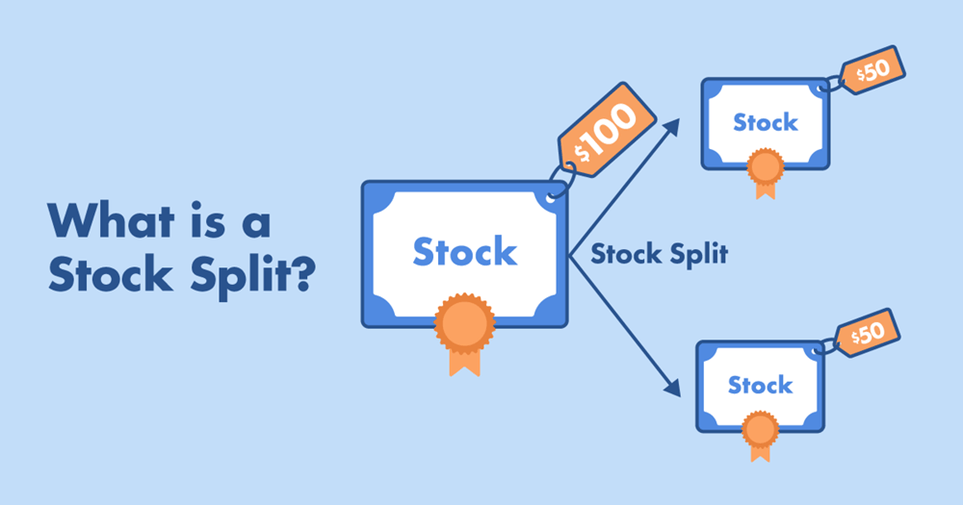
I thought stock splits would be a good topic to talk about since two of the world’s biggest companies are about to do a stock split. Amazon is doing a 20-for-1 stock split that will happen on June 6th. Google will also be doing a 20-for-1 stock split next month, on July 15th. A stock split changes the number of outstanding shares available to investors without changing the market value of the company. This is because the share price changes in proportion to the split ratio.
Here’s an example to illustrate this:
You own 100 shares of ABC stock with a share price of $10, a$1,000 value. If they have a 2-for-1 stock split, you will now have 200 shares at a price of $5 per share, still a $1,000 value.
Companies do stock splits mainly to change its share price to appeal to more investors, particularly individual, or retail, investors. They may also do splits to try and get into a certain stock index or to remain listed on a particular stock exchange.
Because Amazon’s split takes effect this Monday, if you own Amazon stock today, on Monday you will have twenty times as many shares in your account and the price will be 1/20th, or 5% of its closing price at the end of today. So, if today you own 1 share of AMZN, current price of $2,510, on Monday you will own 20 shares of AMZN at a price of $125.50 per share.
I suspect that both Amazon and Google are doing a split to get more retail investors to own their stock. Also, I believe they want to be a part of the Dow Jones Industrial Average Index (DJIA), the most popular index in the world. This index is a price-weighted index so reducing their share prices to be more in line with the prices of other companies in the index will give them a better chance of being included. This usually is a positive for a company’s share price when included in this index since many mutual funds and other institutional investors are obliged to buy it as part of their ownership mandates.
Finally, a quick mention of reverse stock splits. These are typically done to help a company stay listed on an exchange and usually are not a good sign for a company. This is when the stock price goes up and the number of shares go down. For example, if you own a 100 shares of ABC stock at $1 per share, a 1-for-10 reverse stock split means you will now own 10 shares at $10 per share. I usually run from companies that do reverse stock splits.
Please let me know if you have any questions.
Joe Baker, CFP®
Baker Asset Management, LLC
joebaker@bakerassetmanagement.com

