

Part of a sound investment strategy is monitoring your investments to ensure that you are on track to meet your financial goals, such as retirement, college funding, home purchase, etc. But for many investors, monitoring their accounts has become a daily, or even more frequent, task in their typical day.
Studies have found that you should only check your investments about once every three months and there is a psychological explanation for this recommendation. Human beings are vulnerable to a natural tendency to avoid losses over making profits. This is a bias known as loss aversion. Behavioral scientists have found that the pain of a loss is more strongly felt than the pleasure of an equivalent gain. In my twenty-five years in the business, I can confirm that these findings are correct.
Research has also shown that investors are more likely to make investment decisions based on emotions when they check their investments every day. This can have detrimental consequences to their portfolio performance when looking long-term, such as with retirement accounts. This is because stocks, in general, have always moved higher when looking at longer time frames than just one day or month. This illustration is my go-to when trying to explain stock market action:
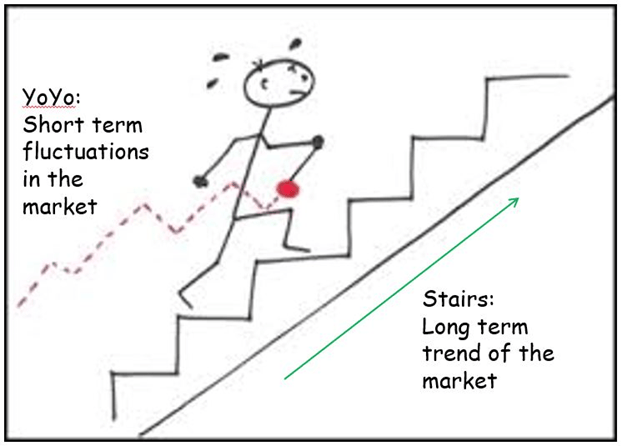
Right now, we are in a pretty decent decline in the stock market. Nobody knows when it will turn around, but it will, and when people least expect it. A recent example of a big market drop that reversed course was in early 2020 at the start of the pandemic. The S&P 500 lost 34% in less than a month as investors sold in a panic. As you know, the market rebounded quickly and hit all-time highs soon after. However, most of the panic sellers missed out on those gains.
I know it is tough not to check your investments, especially when access to this information is readily available 24/7. But, checking them every few months instead of every few days could keep you from making emotional knee-jerk decisions that could hurt your account performance in the long run.
Please let me know if you have any questions.
Joe Baker, CFP®
Baker Asset Management, LLC
joebaker@bakerassetmanagement.com

