
We recently talked about distribution rules for IRAs. Today, I wanted to go over the distribution rules for Roth IRAs, which are a little bit different. Before we do that, let’s look at the main differences between an IRA and a Roth IRA:
| ROTH IRA | TRADITIONAL IRA |
| + Contributions are made with after-tax dollars, meaning no tax benefit for contributing. + Contributions can be withdrawn at any time without taxes or penalties. + Qualified withdrawals in retirement are tax-free. + No required minimum distributions (RMDs). | + Contributions are tax deductible in the year they are made. + Distributions in retirement are taxed as ordinary income. + At age 72, there are required minimum distributions (RMDs). |
From the above, you can see that the biggest difference between a Roth IRA and a traditional IRA is how and when you get a tax break. Contributions to traditional IRAs are tax-deductible, but withdrawals in retirement are taxable. Conversely, contributions to Roth IRAs are not tax-deductible, but the withdrawals in retirement are tax-free.
Keep in mind that there are two types of money in your Roth IRA: contributions and earnings. Contributions are the funds that you put into (contribute) to the Roth IRA. This is money that has already been taxed. Earnings are any gains that you made on the investments within your Roth IRA. Earnings grow tax-deferred and can be withdrawn tax-free if you follow the distribution rules.
It’s important to note that withdrawals always come out of a Roth IRA using the First In, First Out (FIFO) method. This means that contributions will always come out first, before earnings.
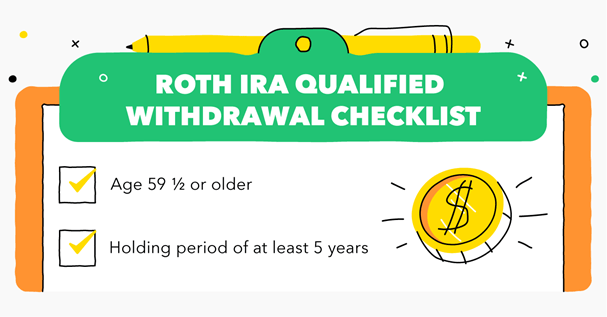
Now, let’s look at when you can withdraw from your Roth IRA tax-free and penalty-free, also known as a qualified distribution:
- you’re older than age 59 1/2.
- This means that you can be younger than 59 ½ and pay no taxes or penalties.
- It’s been at least 5 years since you first contributed to your Roth account and your withdrawal will be used to purchase your first home. There is a $10,000 maximum on this withdrawal.
If you inherit a Roth IRA, the rules depend on if you are the spouse of the account owner or not. If you are a spouse beneficiary, you can simply roll it into your own Roth IRA, which almost always makes the most sense.
For non-spouse beneficiaries, you have to withdraw all of the money in the inherited Roth IRA account within 10 years of the account owner’s death. No taxes or penalties will be due, but the account has to be emptied within 10 years.
The key takeaways from this post are:
- Contributions to your Roth IRA can always be withdrawn at any time without taxes or penalties.
- You can withdraw earnings tax-free and penalty-free if you are over age 59 ½ and the Roth IRA account is at least 5 years old.
Please let me know if you have any questions.
Joe Baker, CFP®
Baker Asset Management, LLC
joebaker@bakerassetmanagement.com

