

Stocks took an absolute shellacking in February as the Coronavirus continued to spread across the globe. The magnitude of the drop was surprising, but the real shocker was how fast it dropped. The S&P 500 dropped almost 13% from its record high in February and it all occurred within the last seven days of the month. It brought the index back down to levels last seen in October of 2019. For the year, the S&P 500 is down almost 9%.
For historical perspective, this was the worst February for stocks since 2009, during the financial crisis. It wasn’t like we weren’t expecting some sort of correction, but we definitely weren’t expecting a correction this big and in such a short time. Financial markets do not like uncertainty and there is so much of it surrounding this virus: how deadly it is, how it will disrupt supply chains, how it will affect our lives in general. Until we can find answers to questions like these, stocks may find a hard time coming back from these lows. The good news is that there is some progress in developing a vaccine. A research institute in Israel is claiming that they will have a vaccine ready to begin the approval process in two weeks (and no, I can’t find a way to invest in them…yet!). It is wait and see mode for traders and investors alike right now.
Selloffs like the one we are experiencing right now are gut wrenching. It may seem hard to stick to your plan and stay the course. Looking at history might provide you with a better perspective on what the best move is for your investments right now. The chart from J.P. Morgan shows how $10,000 invested in the S&P 500, for the 20-year period of 1999 through 2018, would have performed under various scenarios.
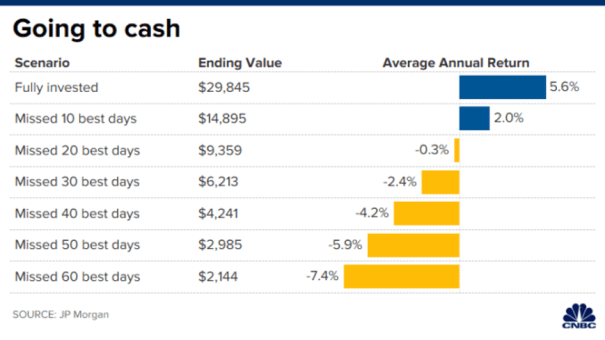
If the $10,000 remained fully invested, it would have grown to $29,845 with an average annual return of 5.6%.
In comparison, missing out on just the best 10 days in that time period would have reduced the growth of the initial investment by more than half: After 20 years, that $10,000 would be just $14,895 with a 2% average yearly return.
And if the best 20 or more days were missed, the returns over that 20-year period are in the red.
Even if you think you’ll just wait it out for a few weeks to see what happens, be aware that six of the S&P’s ten best-performing days during the 20-year period occurred within two weeks of the 10 worst days.
What this data is telling us is that it is time in the market, not timing the market, that creates the portfolio growth that you need to reach your financial goals.
Take a look at the Outlook section below to see what events could move the markets between now and then.
Bonds reacted as expected, with their prices moving sharply higher as investors flocked to the safe haven of US Treasury and high-quality company bonds. Also as expected, high yield, or junk, bond prices dipped a little bit but nothing like their companies’ stock prices.
The yield curve took a dramatic reversal from normalizing, almost completely inverting. Only until you go out to a 20-year maturity bond, can you get a higher interest rate than a 1 month bond. This will make the Fed cut rates sooner as well since they can control the shorter end of the curve much easier than the long end.
This action still hasn’t changed my outlook on bond ownership. I’m sticking to my guns and staying away from bonds that mature more than two years from now. For me, there just seems like too much risk to take on, compared to other investment options, such as high-quality stocks.
Interest rates, which were already heading lower, really fell off a cliff at the end of February. Most US government issued bonds hit all-time lows on yield. The bellwether 10 year note closed February at a yield of 1.16%. That is impressive. This is great for borrowers and bad for savers. This type of interest rate environment forces savers to take on more risk to get the returns that they need to hit their financial goals. The Fed probably has no choice but to cut short term rates now that long-term rates have sunk to all-time lows.
On the savings side, short-term rates, like savings and money market accounts, as well as longer-term rates, like CDs, continued to trend down.
Currently, the average savings account is paying 0.94%, surprisingly up a bit from 0.87%.
The 1-year CD interest rate is now averaging 1.81%, slightly less than the 1.89% it was yielding a month ago and the 5-year CD rate is at 1.87%, down from 1.95%. These rates are brutal for savers.
Mortgage rates continued down in February. Currently, the 30-year rate is at 3.62%, down from 3.64% last month. Refi’s really look good right now, especially if you plan on being in your home for at least 5 more years.
Oil prices plummeted in February, as travel restrictions kicked in and uncertainty about the coronavirus spread. It had dropped about $10 a barrel in January and more bad news this month clipped another $4 off of the price, which now sits at $45.26.
This virus will definitely put a lid on oil prices as commerce and travel continue to get shut down to halt the spread of the disease.
Nationally, gasoline prices are following oil prices lower. Prices at the pump are averaging about $2.45 per gallon, 4 cents lower than a month ago. Mississippi and Texas have the cheapest fuel, at $2.14. FYI, a year ago, we were paying $2.41.
Check out the prices at the pump in your area: Gas Buddy.
Outlook
Events on the horizon that could move the markets in the near term:
- Coronavirus: Last month, I said that this virus wouldn’t have any long-term effects on stock prices and I still believe that, but it sure had some short-term effects! We are going to see continued market volatility as the virus spreads. Until we get answers on the virus’ lethality and vaccine availability, expect stock prices and interest rates to remain low. Any information that removes uncertainty about the disease will cause a move up in stock prices.
- Interest Rates: The Fed is now expected to lower rates to help bolster our economy as the coronavirus takes hold here in the states. This may help stock prices a little in the very short term, but it won’t cure people infected with the virus and it won’t help reconnect supply chains.
- Trade Wars/Tariffs: These policies are still taking a toll on US companies, even more so with the coronavirus disrupting supply chains. Farmers continue to take a beating: The Department of Agriculture has distributed about $19 billion of the $28 billion allocated to help farmers, but most are still having a tough time surviving the trade war. Farm bankruptcies reached an 8-year high in 2019. This is not good for our economy, which is not good for stock prices. In light of the current global economic chaos being caused by the coronavirus, it may be a good time for our government to re-evaluate the effectiveness of tariffs and trade wars and take action.
- Impeachment: The trial finished with the expected verdict: not enough votes to remove the president from office. There was muted reaction from the markets as this was a foregone conclusion.
Joe Baker, CFP®
Baker Asset Management, LLC
joebaker@bakerassetmanagement.com

