
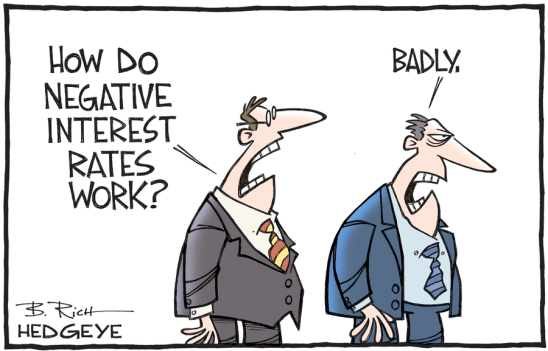
There’s a lot of talk in the financial world right now about bonds having negative interest rates. That sounds like you, as the lender, have to pay the borrower to loan them money. It’s not quite like that. Bond issuers, like governments or corporations, typically offer bonds that pay a fixed interest rate that is greater than, or equal to, 0%. Once they start trading in the secondary market, their effective interest rate changes as the bond price changes. So, as rates have continued to drop over the past year, the prices of bonds that were issued, say last September, have risen quite a bit. So much so that there are some bonds, actually about $15 trillion worth globally, that if you bought today and held to maturity, would guarantee that you lost money, even after all of the interest payments! This is where they come up with negative interest rates because your return on investment would be negative.
This return on investment, sometimes referred to as the yield to maturity, is one of the most important data points bond investors use when deciding to buy a bond or not. I don’t think that I have ever bought a bond with a negative yield to maturity and I always have a hard time understanding why someone would do that, especially when interest rates are so low right now.
Having said all that, there is still a big demand for negative yielding bonds. Just yesterday, Germany issued the first ever bond with a 0% interest rate. Investors are already paying a premium for these bonds, driving the yield to maturity into negative territory and this is for a bond that matures in 30 years. Why would you put your money in something that will not pay you any interest and has a high risk of losing value if interest rates ever go up? Well, those that do buy these bonds aren’t going to hold them to maturity. They are hoping that interest rates will drop further, which will make the price rise, and then they can sell them at a profit. That’s a tough bet for me. I’d rather take my chances on buying a high-quality stock that pays a nice dividend.
Hopefully, this helps a little bit in understanding what negative interest rates really mean. Please contact me if you have any questions.
Joe Baker, CFP®
Baker Asset Management, LLC
joebaker@bakerassetmanagement.com

