What Happens When The Fed Changes Rates

panic-wallpaper-6-743320

The Fed, specifically, the Federal Open Market Committee (FOMC), ends their two-day meeting today with a decision on what they will do with interest rates.  I just wanted to clarify what that means for us and our economy.

When the FOMC changes interest rates, they aren’t changing every rate out there.  They are only changing the Federal Funds Rate (FFR).  This is the rate that banks charge each other for overnight loans.  Modifying this rate is one of the Fed’s tools that they use to maintain a healthy economy.  They lower it if they feel the economy is slowing and raise it if the economy is heating up too quickly.

Although you probably have never heard of the Fed Funds Rate, it does influence many of the interest rates that you are familiar with and interact with every day.  Here’s a table that shows what is expected with various rates and other economic factors when the FOMC changes the Fed Funds rate:

  When FOMC raises the FFR, plan on: When FOMC lowers the FFR, plan on:
Mortgage rates Higher Lower
Car loan rates Higher Lower
CD rates Higher Lower
Money market rates Higher Lower
Credit card rates Higher Lower
Business profits Lower Higher
Stock market Lower Higher
Consumer spending Lower Higher
Home sales Lower Higher

These expected changes don’t happen overnight.  It takes time for the Fed’s actions to trickle down to other rates and markets.  For instance, if the Fed raises the FFR, the stock market might not go down until rates are high enough in other investments, such as bonds or CDs, to justify the shift from stocks to those other investment options.

This should give you a better understanding of what is happening when you hear that the Fed is changing interest rates.

Shoot me an email if you have any questions.


Joe Baker, CFP®

Baker Asset Management, LLC

joebaker@bakerassetmanagement.com


How To Get More FDIC Insurance Coverage

FDIC-WEB-732x384

Have you ever wondered that if you had more than $250,000 in your bank, that it would be insured by the FDIC?  Well, wonder no more, because here’s what you need to know if you have that much cash lying around.

First, FDIC is short for Federal Deposit Insurance Corporation.  It is an independent agency of the United States government that protects you against the loss of your insured deposits if an FDIC-insured bank fails.  FDIC insurance is backed by the full faith and credit of the United States government.  The FDIC insures up to $250,000 per person, per bank, per ownership category.  If you have money in a credit union, don’t fret.  They are insured under the same terms by the National Credit Union Administration (NCUA).

Coverage is automatic whenever you open an account at an FDIC-insured bank.  Not all banks are FDIC insured, so please check your bank by going here:  FDIC’s BankFind tool.

If a bank closes, the FDIC usually pays insurance within two business days, either by providing depositors with a new account at another insured bank or by issuing a check for the insured balance of the account at the failed bank.

Now that you know how FDIC insurance works, here are a couple of easy ways to get the most out of it:

  • Open accounts at different FDIC-insured banks. For example, if you have $400,000, you can have a bank account at two different banks to have your 400k fully insured, even if they have the same account title.
  • If you want to keep all your money at one bank, you can open accounts with different account titles. Say, for instance, that you are married and have $1 million that you want insured at a single bank.  Here’s how you can do it: open a joint account with you and your spouse as the owners and then open an individual account for you and another one for your spouse.  The joint account has $250,000 insurance per each joint owner, for a total of $500,000 coverage.  Each individual account has $250,000 FDIC insurance as well.  This will give you FDIC insurance on your entire $1 million, all at the same bank.  You can also use IRAs, trusts, etc. to insure even more at the same bank.

Shoot me an email if you have any questions.


Joe Baker, CFP®

Baker Asset Management, LLC

joebaker@bakerassetmanagement.com


Monthly Update – September 2019

september

Stocks took a little breather in August.  There was a lot of volatility throughout the month, mostly due to the back and forth between the U.S. and China regarding trade talks.  In the end, however, the S&P 500 finished August with a small loss of about 1.6%.

With Q2 earnings out of the way, there is really only two major forces influencing stock prices right now: the White House and the Federal Reserve.  Check out the Outlook section below to get my take on how these could move markets in the short term.

The swings in the stock and bond markets are beginning to pick up and I believe it is only going to get more volatile over the next year as we approach the presidential election.  This type of uncertain environment creates opportunities to buy into great companies that might get thrown out with everything else as investors with no plan or conviction sell everything.  So, it’s probably not a bad idea to make a list of some investments that you like but want to buy at a cheaper price.

Bonds had a very good month as yields tanked.  This includes government bonds to junk bonds and everything in between.  This price trend could continue as the trade war keeps everyone guessing (even more than usual) where the economy is heading.

As low as our bond yields are right now, they are looking pretty good compared to many European countries and Japan.  Those countries’ bonds have a negative yield and if you look globally, there are about $17 trillion in bonds with negative yields, up from $13 trillion last month.  The holders of these bonds could be in for some severe pain if interest rates reverse course and head higher.

Interest rates plummeted in August as they continued this downward trend since last fall.  The economy still is showing no signs of inflation and the tariffs continue to impact commerce enough to hurt economic expansion across the globe.  If the tariffs do stay in place much longer, we could see inflation as U.S. companies pass along this import tax to their customers.

On the savings side, short-term rates, like savings and money market accounts, as well as longer-term rates, like CDs, have continued to come down.

Currently, the average savings account is paying 1.24%, down slightly from 1.28%.

The 1 year CD interest rate is now averaging 2.28% and the 5 year CD rate is at 2.22%, both down from July.  Notice that the 5 year rate is lower than the 1 year rate.

Mortgage rates continue to decline, with the 30 year still well below the 4% level.  Currently, the 30 year rate is at 3.70%, down from 3.88% last month.  Refi’s are looking great, especially if you plan on being in your home for at least 5 more years.

Oil prices meandered around in the low to mid 50’s range for most of the month of August.  Price for a barrel of crude fell a few bucks to about $55.25.  Prices usually rise during this time of year as more people are travelling on vacation and hurricanes are shutting down offshore rigs.  They may get a bump if Hurricane Dorian hits the Gulf of Mexico this week.  This price range, in the fifties, is a good price point for both consumers and producers.

Nationally, gasoline prices have dropped pretty significantly as we are seeing usage drop year-over-year.  Prices at the pump are averaging about $2.58 per gallon, 14 cents lower than a month ago.  Mississippi and Louisiana have the cheapest fuel for 2 months in a row, at $2.20.  FYI, a year ago, we were paying $2.84.

Check out the prices at the pump in your area: Gas Buddy.

Outlook

Events on the horizon that could move the markets in the near term:

  • Federal Reserve: They now have to counter the White House to keep our economy from stalling and possibly falling into a recession.  Trump keeps berating the chairman, Powell, via Twitter of course, for not doing what he wants.  Powell and the rest of the FOMC are maintaining their independence and watching the data, but they will have to cut interest rates if the tariffs stay in place.  These low rates will continue to force investors to venture into higher risk, such as stocks and junk bonds, if they want to get a decent rate of return on their investments.
  • Trade Wars: I’m saying the same thing as last month: The good news is that there are negotiations still going on between the U.S. and China to try and put an end to this trade war.  The bad news is that little progress has been made, as far as the public knows anyway.  It looks like talks will resume in September in the U.S.  At some point, a deal will be made and when it happens, it will be a nice boost for the markets.
  • Tariffs: First, regardless of what you hear, China is not paying the tariffs. U.S. companies that import from China are, and that means we are ultimately.  Not a good plan.  The new tariffs that are going to take effect today are going to hurt U.S. companies even more.  These are also going to be too much for them to absorb and will have to pass these costs onto us, the consumers, in order to stay afloat.  My biggest worry is for our farmers because it will be tough to get the China market back once they find suppliers elsewhere.  In summary, tariffs will be a damper for most investments until they get rescinded.


Joe Baker, CFP®

Baker Asset Management, LLC

joebaker@bakerassetmanagement.com


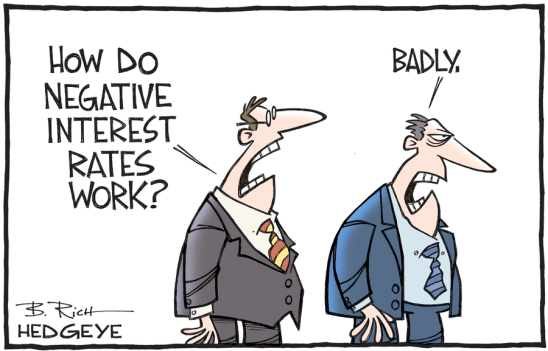
Negative Bond Yields Explained, Sort Of

negative_interest_rates_cartoon_07.12.2016-1

There’s a lot of talk in the financial world right now about bonds having negative interest rates.  That sounds like you, as the lender, have to pay the borrower to loan them money.  It’s not quite like that.  Bond issuers, like governments or corporations, typically offer bonds that pay a fixed interest rate that is greater than, or equal to, 0%.  Once they start trading in the secondary market, their effective interest rate changes as the bond price changes.  So, as rates have continued to drop over the past year, the prices of bonds that were issued, say last September, have risen quite a bit.  So much so that there are some bonds, actually about $15 trillion worth globally, that if you bought today and held to maturity, would guarantee that you lost money, even after all of the interest payments!  This is where they come up with negative interest rates because your return on investment would be negative.

This return on investment, sometimes referred to as the yield to maturity, is one of the most important data points bond investors use when deciding to buy a bond or not.  I don’t think that I have ever bought a bond with a negative yield to maturity and I always have a hard time understanding why someone would do that, especially when interest rates are so low right now.

Having said all that, there is still a big demand for negative yielding bonds.  Just yesterday, Germany issued the first ever bond with a 0% interest rate.  Investors are already paying a premium for these bonds, driving the yield to maturity into negative territory and this is for a bond that matures in 30 years.  Why would you put your money in something that will not pay you any interest and has a high risk of losing value if interest rates ever go up?  Well, those that do buy these bonds aren’t going to hold them to maturity.  They are hoping that interest rates will drop further, which will make the price rise, and then they can sell them at a profit.  That’s a tough bet for me.  I’d rather take my chances on buying a high-quality stock that pays a nice dividend.

Hopefully, this helps a little bit in understanding what negative interest rates really mean.  Please contact me if you have any questions.

Joe Baker, CFP®
Baker Asset Management, LLC
joebaker@bakerassetmanagement.com


Meet Your Doctor Outside the U.S. To Save Some Money

medical-tourism

Americans have been traveling outside the United States for medical procedures for years now.  The main reasons are lower surgical costs and for treatments that aren’t legal here.  The biggest drawback, besides the travel, is the perception that the level of care is not as good as it is here.  One of the ways to improve that stigma is to have medical personnel from the U.S. meet you in another country to perform the procedure that you need.

There’s a company, based in Denver, that is tapping into this trend.  North American Specialty Hospital, or NASH, is basically a travel agent that connects patients and doctors to meet at a high-end private hospital in Cancun, Mexico.  NASH mainly works with companies that self-insure their employees.  They get paid a flat rate by the patient’s employer.  It’s a win-win-win for the patient, the doctor, and the employer.  The patient saves money, and sometimes even gets a check from their employer because they save so much on insurance costs.  The doctor makes more money than if she performed the same procedure here, as much as three times more.  Finally, the employer saves a lot of money because it is so much cheaper for them than if they had their employees receive the same medical treatments in the states.

Here’s the link to the NY Times article that talks about this: https://www.nytimes.com/2019/08/09/business/medical-tourism-mexico.html

Also, here is the link to Nash’s website to learn more about their company: https://northamericanspecialtyhospital.com/

Right now, there is such a small percentage of Americans opting for medical treatment outside the U.S., but with the costs of medical care and health insurance going up exponentially every year and Congress doing nothing about it, this trend might be the only viable option for a lot of people.


Joe Baker, CFP®

Baker Asset Management, LLC

joebaker@bakerassetmanagement.com


What’s Causing The Stock Market Madness

market madness

Stock markets have been taken a beating since August began, so much so, that the huge gains from June and July have almost been wiped.

Here’s what I think is causing this shake up:

  • Tariffs – Tariffs are taking a big bite out of profits for our companies and reducing the spending power of our consumers.  Regardless of what you hear out of DC, the fact is that the tariffs are being paid by US companies that import goods from other countries.  Whether they pass the costs on to the consumers is up to them.  Some are eating the tariff costs and some are passing the costs on to us, or they are doing a little of each.  Either way, China does not pay our tariffs, we do.
  • Trade Wars – Besides China and the EU slapping retaliatory tariffs on U.S. goods that they import, some countries are just halting trade of certain goods with us.  For instance, China says they will stop buying our agricultural products altogether.  This is probably the most devastating action to be taken against our farmers.  They’re already suffering from a late planting season and previous tariffs, but if China shops elsewhere, they might not come back.  That would bankrupt a ton of farmers.
  • Federal Reserve Versus White House – Because the tariffs and trade wars are slowing our economy, the Fed has to counteract the White House by lowering interest rates to help spur the economy.  This is causing uncertainty in the stock and bond markets, which typically causes stocks to fall because stock markets don’t like uncertainty.

China has been taking advantage of us for a long time, so something needs to be done.  But the negotiating method that we are using right now has never worked in the long run.  These bullying tactics will only produce one winner in this trade war and it will be very hard for us to outlast China.  They have a much larger population that live on a lot less than we do.

The good news is that with elections coming up in the fall of 2020, the White House will have to make some trade concessions soon or we’ll be seeing a moving van there next November.

If you want to find out what to do when markets tank like they are right now, take a look at what I wrote back in January of this year, which is very applicable to our current situation: What To Do About This Crazy Market


Joe Baker, CFP®

Baker Asset Management, LLC

joebaker@bakerassetmanagement.com

Monthly Update – August 2019

august

Stocks managed to squeak out a small gain in July, despite being smack dab in the middle of the dog days of summer.  The S&P 500 gained about 1.5% in July, adding on to an already very positive year.

With the Federal Reserve giving the markets what they wanted by cutting interest rates, for the first time since 2008 by the way, you would have thought stocks would see a nice rally.  However, the rate cut was already priced in when the market rallied in June, so market reaction to the upside was muted, to say the least.  There are a couple of possible catalysts that can keep this rally going.  Check out the Outlook section below to see what may move the markets over the next month or so.

On a somewhat related note, did you know that the dog days of summer refer to the dog star, Sirius, and its position in the heavens during this time of the year?  To the Greeks and Romans, the dog days occurred around the day when Sirius appeared to rise just before the sun, in late July and early August.

Bonds had a mixed month of small gains and losses in July.  Short term bonds saw their yields drop while bonds that mature in 10 years or more had a little bump in their yields.  This is good for bringing the yield curve out of inversion, although it is still slightly inverted.  Overall, bond prices were pretty much flat for the month across the spectrum: government, corporate, and junk.

Across the pond, bizarro world is occurring in the bond market.  For instance, Switzerland’s entire government bond market is paying negative interest rates, including their 50 year bond!!  Overall, there is $13 trillion in negative yielding bonds globally.  That’s amazing.

Interest rates continued their drop again in July and it’s not surprising why.  The economy is showing no signs of inflation and the tariffs continue to impact commerce enough to hurt economic expansion across the globe.

On the savings side, short-term rates, like savings and money market accounts, as well as longer-term rates, like CDs, have continued to come down.

Currently, the average savings account is paying 1.28%, down slightly from 1.33%.

The 1 year CD interest rate is now averaging 2.41% and the 5 year CD rate is at 2.39%, both down from June.

Mortgage rates continue to decline, with the 30 year still below the 4% level.  Currently, the 30 year rate is at 3.88%, unchanged from last month.  Refi’s are still looking good, especially if you plan on being in your home for at least 5 more years.

Oil prices went on a little roller coaster ride in July but after all was said and done, they finished a few bucks lower, settling at $57.50 a barrel.  Prices usually rise during this time of year as more people are travelling on vacation and hurricanes shutting down offshore rigs.  This price range, in the fifties, is a good price point for both consumers and producers.

Nationally, gasoline prices have stayed about the same from last month.  Prices at the pump are averaging about $2.72 per gallon, a penny higher than a month ago.  Mississippi and Louisiana have the cheapest fuel, at $2.35.  FYI, a year ago, we were paying $2.87.

Check out the prices at the pump in your area: Gas Buddy.

Outlook

Events on the horizon that could move the markets in the near term:

  • Federal Reserve: They just cut the overnight bank lending rate 0.25%, the first cut since 2008. This should force investors to venture into higher risk, such as stocks and junk bonds, if they want to get a decent rate of return on their investments.
  • Trade Wars: The good news is that there are negotiations still going on between the U.S. and China to try and put an end to this trade war. The bad news is that little progress has been made, as far as the public knows anyway.  It looks like talks will resume in September in the U.S.  At some point, a deal will be made and when it happens, it will be a nice boost for the markets.
  • Tariffs: The tariffs are taking a big toll on our economy as companies paying the tariffs have to make the decision to either keep eating them or pass them on to consumers. Also, if the tariffs stay in place much longer, our farmers are not going to be able to get back China as a customer because they will be buying elsewhere.


Joe Baker, CFP®

Baker Asset Management, LLC

joebaker@bakerassetmanagement.com

How To Make A Quick $125

databreach-580x358

Back in 2017, Equifax, one of our 3 credit monitoring companies, had a huge data breach that affected almost 150 million people.

Recently, the company settled a class action lawsuit relating to this incident.  The settlement allows you to get 4 years of credit monitoring at all three credit bureaus or $125 cash.  It also allows people to file further claims for up to $20,000 to pay for costs associated with fraud or identity theft as a result of the breach.

You can see if you are eligible for the $125 by going to this site:

https://eligibility.equifaxbreachsettlement.com/en/eligibility

You just need to put in your last name and your last 6 digits of your social security number.  The main site that explains the settlement and all the details can be found here:

https://www.ftc.gov/enforcement/cases-proceedings/refunds/equifax-data-breach-settlement

You have until January 22, 2020 to file a claim.  Don’t expect the cash until later next year, at the earliest.

Joe Baker, CFP®

Baker Asset Management, LLC

joebaker@bakerassetmanagement.com
Capital One just Got Hacked. What To Do.

data-breach-computer-security-670x335

Once again, another huge financial company, this time, Capital One, just had its customer data breached.  Here are some things that you can do to check to see if you have been hacked and to minimize the damage:

  • Look over your credit card and banking statements, and report any suspicious activity to the bank as soon as possible.
  • Freeze your credit by going online to one of the three main credit bureaus: Experian, Equifax, and TransUnion.
  • Change your passwords.
  • Enable two factor authorization.  This means that you need a password and another form of verification, such as a code from a text or email.
  • Sign up for a credit monitoring service, like LifeLock.
  • Don’t respond to phone calls or emails from creditors.  Go to their website and contact them using their official channels.

These data breaches are becoming more and more common, so you need to stay vigilant.  You may not be able to completely protect your information from the hackers, but at least you can make it a lot harder for them.

Joe Baker, CFP®
Baker Asset Management, LLC
joebaker@bakerassetmanagement.com
How Much Do You Really Need To Retire?

How-Much-Do-You-Really-Need-to-Retire

As I’ve said in previous posts about retirement planning, there are so many variables that come into play when trying to figure out how much money you’ll need to do what you want to do during your retirement years.

The one that I wanted to focus on today is the withdrawal rate of your retirement accounts.  That is, how much will you need to take out of your IRA, 401k, etc., to live the life that you desire during retirement.

The most common method is to figure out what your expected monthly expenses will be and then determine if you’ll have enough in your accounts to cover those expenses for the rest of your life.  For example, if you expect to need $6,000 per month in retirement over the next 30 years, you’ll need a about $1,300,000 to start with in your retirement savings.  This accounts for everything, including all the fun that you’re going to have: trips, vacations, etc.

What most people, and their advisers, don’t account for is their activity levels throughout retirement.  That’s why I feel this method for calculating your “number” is kind of misleading.

Using the same example, you might only need that $6,000 monthly amount for, say, the first 15 years of retirement.  Then, after all that partying, you might want to take it down a notch.  So, let’s make it $4,000 per month that you’ll need for the remainder of your retirement years.  It turns out in this scenario, that you’ll only need about $1,080,000 to start with, or about $220,000 less than if you just used the same monthly amount for your entire retirement.

Of course, the bigger the number that you can start with, the better.  So, the next time you want to calculate your retirement “number”, consider making the adjustment above.  It might make you realize that you are doing all the right things to prepare for the future and will take some stress out of your life today.

Joe Baker, CFP®
Baker Asset Management, LLC
joebaker@bakerassetmanagement.com