
Monthly Update – December 2019

december-2012-web

Stocks rocked in November, extending their uptrend from the previous two months.  The S&P 500 ended the month up about 3.6% and is looking to have one of its best years since 2013.  It is up over 25% year-to-date.

The stock market has a couple of good things going for it: potentially a heavy spending holiday season and a possible resolution to the trade war with China.  Low interest rates also help by putting a floor under stock prices.

Take a look at the Outlook section below to see my take on what will move the markets over the next few months.

Bonds were again relatively flat through November.  It looks like the Fed is going to sit tight on changing rates anytime soon, based on their last meeting notes.

I took a look at the yield curve and it is flat up to the 7 year note maturity and then rates start to climb.  This is telling me that rates are trying to normalize: the longer that you lend out your money, the more interest that you should be paid.

Global bond yields are still in bizarro world.  Germany, France, Japan, and Switzerland have negative bond yields.  Even Switzerland’s 50-year bond has a negative yield.  Yikes!  This is a bubble that could burst big time if interest rates reverse course and head higher.  Stay away from any bonds that mature more than 3 years out.

Interest rates reversed course and headed lower in November as more investors became skittish and looked for safe havens for their money.  Looking at the big picture though, rates are still extremely low based on historical averages.  They will most likely remain in this low range until we start to see signs of inflation, which, so far, are non existent.

On the savings side, short-term rates, like savings and money market accounts, as well as longer-term rates, like CDs, trended lower in the same direction as general interest rates in November.

Currently, the average savings account is paying 1.04%, down from 1.15%.

The 1-year CD interest rate is now averaging 1.98%, less than the 2.10% it was yielding a month ago and the 5-year CD rate is at 2.07%, up slightly from 2.05% last month.  Notice that the 5-year rate has finally risen above the 1-year rate.  That’s how it’s supposed to be.

Mortgage rates continue to stay flat, with the 30 year still well below the 4% level.  Currently, the 30-year rate is at 3.73%, down a bit from 3.77% last month.  Refi’s are still looking great, especially if you plan on being in your home for at least 5 more years.

Oil prices had a couple of wild swings in November but ended up about $1.27 from where it started at the beginning of the month.  Price for a barrel settled at $55.42.

Now that the U.S. is one of the world’s biggest oil producers, we like where prices currently are because our oil drillers and refiners can be profitable without making any major cuts to the costs of running their companies.  As consumers, it’s a little high but very tolerable since we have a glut of oil floating around that will keep a lid on prices.

Nationally, gasoline prices went the opposite way of oil prices in November.  Prices at the pump are averaging about $2.59 per gallon, 2 cents lower than a month ago.  Louisiana has the cheapest fuel, at $2.22.  California was able to get its prices back down below $4 per gallon.  FYI, a year ago, we were paying $2.49.

Check out the prices at the pump in your area: Gas Buddy.

Outlook

Events on the horizon that could move the markets in the near term:

  • Trade Wars: Still on again, off again.  But the worst part is that it looks like we’re just trying to make a deal that gets us back to where we were before the trade war.  That’s not very good negotiating.  My biggest worry is for our farmers because they can’t withstand another growing season like we just had, coupled with losing their biggest buyer.  Fingers are crossed for a deal to be made soon, which should give stocks a boost.
  • Tariffs: So far, importers/retailers have not passed on their tariff costs to us, the consumers.  Earnings dipped because of them but still held up well.  The big companies are absorbing the tariffs but small businesses are having a tough time hanging in there.  The tariffs go hand-in-hand with the trade war, so any deal would include a reduction or removal of tariffs, which would be good for U.S. companies and their stock prices.
  • Impeachment:  A lot of information damning to Trump came out in the public hearings in November.  Now, it goes to the House Judiciary Committee where it looks like they will have arguments for and against whether to impeach the president and what articles of impeachment will be submitted.  Then, it’s on to the Senate for the trial.  As of now, it doesn’t look likely that there is enough votes in the Senate to remove Trump.  This will almost certainly spill over into 2020 and I assume if the outcome is as expected, it would be positive for the markets.


Joe Baker, CFP®

Baker Asset Management, LLC

joebaker@bakerassetmanagement.com

 

Updated Retirement Plan Contribution Limits For 2020

2020 cont limits

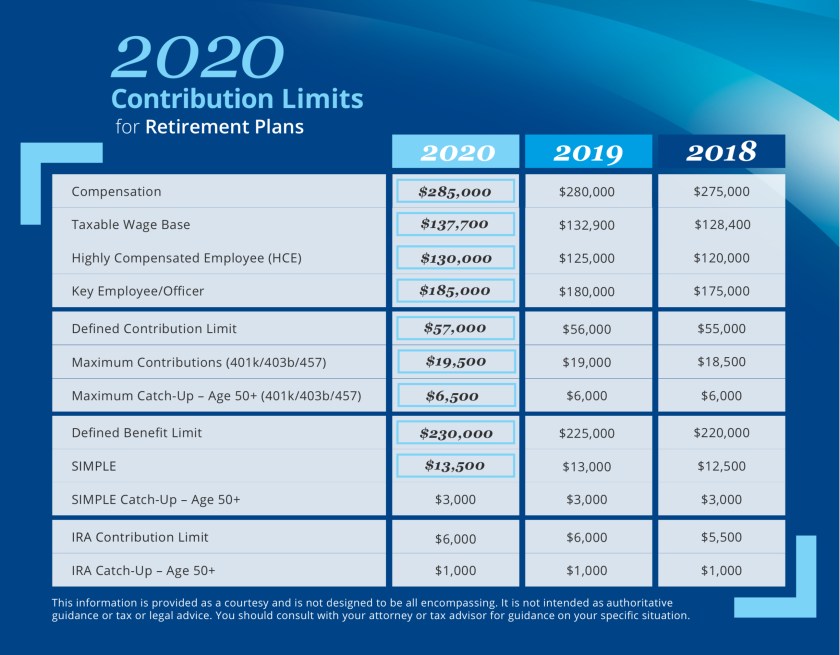
The Internal Revenue Service has recently updated the contribution limits for retirement plans for 2020.

The table below gives a nice summary and comparison to past years’ limits.  It also shows you what how much of your pay is used for calculating certain contributions.  For instance, the taxable wage base of $137,700 is the max pay that will be subject to social security tax.

Something else that I wanted to point out is Catch-Up feature.  This allows you to contribute money to your plan if you are age 50 or older.  You don’t have to wait until you turn 50, either.  You just have to urn 50 at some point in the year.  So, if you turn 50 on December 4, 2020, you can start doing the Catch-Up contributions right at the beginning of 2020

Take a look at these numbers and let me know if you have any questions.  Have a great Thanksgiving!

AA390A23-1224-4A96-ABA6-2EF890AA3DE5.jpeg


Joe Baker, CFP®
Baker Asset Management, LLC
joebaker@bakerassetmanagement.com


End of Year Tax Tips – 2019

year end tax planning.jpg

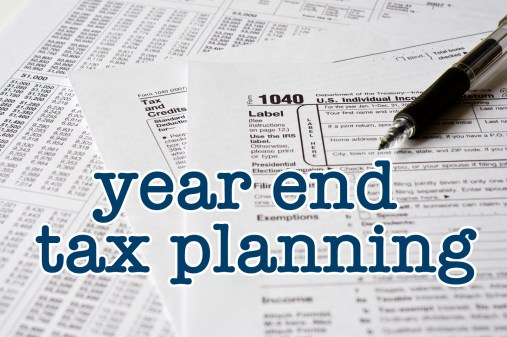
Thinking about year-end tax planning is about as much fun as waiting in line at the DMV, but it’s something that could save you some money so it’s always a good thing to take a look at your financials before the end of the year.

Below are some items that may help you lower your 2019 taxes:

1.   Spend any leftover cash that is in your flexible spending accounts.

If you have a Flexible Spending Account and have money left, get caught up on your doctor’s visits! While the old “use it or lose it” rule may not still apply, you may only be able to carry over $500 worth of unused money left in your 2019 FSA account at the end of the year. Your plan may also limit the amount of time you’re able to use your funds to 2 1/2 months after the end of the plan year.

2.  Max out your retirement plan contributions to lower your taxable income.

Lowering your taxable income means paying less tax and it could also reduce the amount of Social Security subject to tax or any net investment income tax.

Contributing to a pre-tax retirement plan lowers both your adjustable gross income (front of the 1040 form) and your taxable income (back of the 1040 form). These plans include 401(k)s, 403(b)s, deductible IRAs, SIMPLE IRAs and SEPs.  You have until Dec. 31st to make contributions to 401(k)s and 403(b)s for 2019.  But for most other plans and IRAs, you can wait until when you file your taxes to make the contribution.

3.  Sell your investment losers.

If you have realized capital gains this year, you might want to sell some of your losers in your stock, bond, or real estate portfolio to realize a loss before year end. This strategy, called “tax loss harvesting”, can reduce the amount of capital gains subject to tax.  If your losses exceed your gains, you can apply $3,000 of that against your regular income.  Any extra will then be passed to the next tax year.  However, don’t sell just for the tax benefit.  Make sure it makes sense based on your overall investment strategy.

4.  Update paycheck withholding.

Tax reform and paycheck withholding changes almost always upset the balance that you want between the size of your tax refund and the size of your paycheck.  Whenever there are changes to the tax code that affect your take home pay, you need need to update your W-4 with your employer so you can continue to get the balance you want.  For this year, it’s too late in the year to meaningfully impact your 2019 return, but updating your W-4 now means you can start off 2020 just how you want.


Joe Baker, CFP®
Baker Asset Management, LLC
joebaker@bakerassetmanagement.com
 

Is Our Income Inequality That Bad?

income-inequality

I recently read an interesting article about income inequality.  I’m glad I did because it does make me feel a little better about this topic.  Here’s a summary of what I found out.

Recent headlines have been saying that U.S. income inequality has reached a 50-year high, based on the Census Bureau’s latest report on Income and Poverty in the US.  It makes sense when you look at CEO’s pay compared to the average worker:  they make, on average, 287 times what the average worker makes.  Some make much higher.  For example, Gap’s CEO makes 3,566 times what their average salary is over there in the mall.

At first blush, this sounds absolutely horrible.  But, when you dig a little bit deeper into how they come up with these numbers, the disparity isn’t as bad as you think.

The headline numbers that you are reading are published by the Census Bureau.  The BIG problem with these numbers is that they don’t account for benefits, such as Medicare/Medicaid, food stamps, subsidized housing, etc.  There are 95 of these federal programs, along with dozens of state and local programs that need to be included in the calculations to have a true comparison.  The other major omission in their calculations is that they don’t account for taxes.  That’s nuts.  Especially when the top 20% of earners pay 75% of all the taxes in the US.

To summarize, the low earners receive almost all of the benefits of federal and state programs and the high earners pay almost all of the taxes.  This adds to the low earners’ net income and reduces the high earners’ net income.

So, it is obvious that they are way overstating this differential. In fact, by including benefits and taxes, the actual income equality between the top 20% and the bottom 20% goes from 60 to 1 all the way down to 3.8 to 1.

Don’t get me wrong, we still have a huge gap between the top tier and bottom tier earners when you look at straight, gross earnings.  But it is disingenuous to publish these numbers without factoring in taxes and benefits in order to have a beneficial discussion.

Joe Baker, CFP®

Baker Asset Management, LLC

joebaker@bakerassetmanagement.com

 

Monthly Update – November 2019

November16

Stocks continued their upward trend in October, picking up where they left off in September.  The S&P 500 ended the month up about 1.5%, despite some very serious headwinds.

The stock market is truly climbing a wall of worry right now.  Some of the issues that are worrying investors include: economic slowdown, tariffs, trade wars, and impeachment.  The two things that I think are helping stocks move higher are very low interest rates and the impressive spending by the American consumer.  History is also on the side of positive stock returns during this time of the year as we are in the best 6 months to invest (November through April) according to historical performance.

Take a look at the Outlook section below to see my take on what will move the markets over the next few months.

Bonds were pretty much flat through October as yields climbed up from crazy low to just ridiculously low.  It’s a good bet that rates are going to stay in this range for the remainder of the year, especially since the Fed just lowered rates by 25 basis points a few days ago at their last meeting.

I took a peek at global bond yields and they are still way out of whack.  Germany, France, Japan, Switzerland, and even Italy have negative bond yields.  Even Switzerland’s 50-year bond has a negative yield.  Yikes!  This is a bubble that could burst big time if interest rates reverse course and head higher.  Stay away from any bonds that mature more than 3 years out.

Interest rates inched up again in October as they try to climb out of the August abyss.  The economy still is showing no signs of inflation and the tariffs continue to impact commerce enough to hurt economic expansion across the globe.  If the tariffs do stay in place much longer, we could see inflation as U.S. companies pass along this import tax to their customers.  Hopefully, we’ll get a deal worked out with China and Europe so rates could normalize.

On the savings side, short-term rates, like savings and money market accounts, as well as longer-term rates, like CDs, have bottomed out and hopefully will start to move back up.

Currently, the average savings account is paying 1.15%, up from 1.03%.

The 1-year CD interest rate is now averaging 2.10% and the 5-year CD rate is at 2.05%, both slightly down from the previous month.  Notice that the 5-year rate is still lower than the 1-year rate.

Mortgage rates flattened out, with the 30 year still well below the 4% level.  Currently, the 30-year rate is at 3.77%, up a smidge from 3.73% last month.  Refi’s are still looking great, especially if you plan on being in your home for at least 5 more years.

Oil prices calmed down in October after the wild swings in September following the attack on Saudi oil fields.  Price for a barrel stayed relatively flat, settling $54.15, down slightly from last month’s price of $55.45.

As producers, we like this price range because we can be profitable without making any major cuts to the costs of running the company.  As consumers, it’s high but very tolerable since we have a glut of oil floating around that will keep a lid on prices.

Nationally, gasoline prices followed oil prices lower in October.  Prices at the pump are averaging about $2.61 per gallon, 4 cents lower than a month ago.  Louisiana has the cheapest fuel, at $2.23.  By the way, California is still above the $4 mark, $4.06 to be exact.  FYI, a year ago, we were paying $2.80.

Check out the prices at the pump in your area: Gas Buddy.

Outlook

Events on the horizon that could move the markets in the near term:

  • Trade Wars: Okay, this is getting ridiculous.  The meeting we were supposed to have with China is now canceled again. This on again, off again has become so frequent that when a meeting is announced, the markets barely move anymore.  Trump just tweeted that another meeting is scheduled but who is going to believe it after all of the false starts already?  All we can do is wait until a deal is signed, sealed, and delivered.
  • Tariffs: Q3 earnings started to show the detrimental effects of the tariffs to our companies’ earnings, but it wasn’t as bad as I feared.  I know small businesses are being hurt pretty bad, but our large corporations seem to be holding their own with these added costs.  The tariffs go hand-in-hand with the trade war, so any deal would include a reduction or removal of tariffs, which would be good for U.S. companies and their stock prices.
  • Impeachment: This is really heating up now.  The HOR just voted to approve a formal impeachment inquiry.  I guess now there will be public testimony from witnesses and a lot of grandstanding from representatives on both sides of the aisle.  After this, they will vote on articles of impeachment and then it will go to trial in the Senate.  This will almost certainly spill over into 2020 and how it will affect the markets is still anyone’s guess.


Joe Baker, CFP®

Baker Asset Management, LLC

joebaker@bakerassetmanagement.com



Why You Should Care About Medicare

medicare

This is a good time of the year to share some good information about Medicare, since the Open Enrollment period just started (October 15th) and runs through December 7th.

You can google Medicare and get more information that you can handle on the subject.  But, sometimes too much information and too many options can be overwhelming.  So, I put this 4 page document on the BAM website with the link here: Medicare White Paper

It gives a nice summary of how Medicare works.  Take a look at let me know if you have any questions.

Joe Baker, CFP®

Baker Asset Management, LLC

joebaker@bakerassetmanagement.com


What’s Weighing On The Stock Market Right Now

Scales on white background. Isolated 3D image

There seems to be an unusual number of events weighing on the stock market, both positive and negative, so I thought that I would try and list the most influential ones.

As an investment adviser, I always like to have a good grasp of what I believe is influencing the investments that I manage for clients.  I know in the long term that it is a company’s fundamentals that drives its stock price, but understanding the external factors influencing that company’s business help me in determining entry and exit points in an investment to, hopefully, maximize profit.

So, here is what I think is driving the markets right now, in no particular order:


Positives Negatives
·         Low interest rates ·         Trade War/Tariffs
·         Low unemployment ·         Impeachment
·         Cheap oil and natural gas ·         Global economic slowdown
·         Fed in easing mode  


These observations are big picture, macro economic views.  I look at these to get a feel for where our economy, and subsequently stock prices, are heading over the next 6 months.

Also, looking at the recent financial headlines, you would think the markets would be doing poorly, but stocks are having a very good year, with the S&P 500 up nearly 20% for 2019.  There is, of course, a Wall Street saying for this:  Stocks climb a wall of worry.  Plus, historically, speaking, we are entering the best 6 months to be invested in stocks, November thru April.

Personally, out of all the factors listed above, low interest rates have the biggest influence on stock prices.  This is because, investors can’t get a decent rate of return in bonds or savings accounts, so they have to look to stocks to get a decent bang for their buck.

Stepping back from all the noise and doing this assessment of market influencers can help you make the right investment decisions.

Joe Baker, CFP®

Baker Asset Management, LLC

joebaker@bakerassetmanagement.com

 

Life Insurance You Can Use Before You Die

LTC Coverage.jpg

Life insurance is not a topic most people want to talk about, including me.  Either is long-term care insurance, but they do warrant consideration when looking at your comprehensive financial plan.  So, let’s kill two birds with one stone and take a look at a product that combines both of these insurances into one: Hybrid Life Insurance/Long-Term Care Policy, or Hybrid LTC Policy.

First, do you even need it? According to recent studies, nearly 70% of Americans turning 65 today will need long-term care at some point.  With those odds, you need to at least look at your options.

Here is an excerpt from an article that I recently read on this subject.  The link to the complete article is here: https://seniorslifeinsurancefinder.com/hybrid-long-term-care-policy/

What is Hybrid LTC Policy?

They are policies that bundle life insurance policies with long term care coverage.  They are asset-based products that can be categorized into two: accelerated death benefit riders and linked benefit products. The linked benefits offer long term benefits while the accelerated death benefit riders may be used to meet long term expenses. Both of them are treated as LTC insurance policies.

Thus, the hybrid long term care policies connect insurance benefits and long term care benefits. Such hybrid linked benefits may be funded by a single upfront payment of say $100,000 or $50,000. Even though, the policyholder may decide to make installment payment for 10-15 years.

Generally, most of the hybrid policies will give you a chance to choose the long term care benefit. It could be monthly, periodically or inflation protection. The period one may need to wait could be fixed by the insurer but it is mostly 90 days.

Note that the hybrid LTC policies guarantee the holder to receive back their premium if they decide that they no longer need the long term care. They also have another advantage in that the premiums never increase.

The policy will:

  • Meet the cost of care should you need one.
  • Provide an estate tax-free cover should you decide that you don’t need the care.
  • Give your money back if you change your mind.

But for people who have liquid assets and who may not need retirement income, the hybrid insurance policy may not be of value to them. Notice that the policies do not offer LTC partnership protection.

The Best Hybrid Long Term Care Life Insurance Policy

How it Works

It combines long term care insurance and life insurance features. It then forms a single hybrid policy. In some cases, it pairs long term care cover with an annuity. So, it may just need a single upfront premium payment to guarantee benefits that are associated with annuity or life policy base.

The long term care coverage borrows from traditional coverage. It offers leveraged pay-outs to meet LTC expenses. It thus puts aside some money that can be utilized in providing care for a lifetime or a specified period.

In some cases, the policies may come with accelerated death benefit rider. It is intended to provide LTC services. So if the insured needs long term care service, the amount to cover for these expenses must be recovered from the value of the death benefit. In such a case, the accelerated death proceeds will be treated as free riders.

Insurance policies may require that you have standalone LTC rider. In such a case, you will need to pay more money to purchase the cover. But the policy is only available to people who already own a universal life, indexed universal life policies and whole life covers. It will not be available to the Term Life Policyholder.

Advantages of Hybrid Life Insurance with LTC

  • The hybrid product guarantees that the premiums paid will be paid back as either death or LTC benefits.
  • Medical underwriting is easy.
  • The premiums paid are predetermined and fixed.
  • When you repurpose the existing life insurance policy to finance LTC, it attracts preferential tax treatment.

Disadvantages

  • It requires a single lump-sum payment of the premiums which may be too expensive for some people. Also, where installments are allowed, there are normally structured annual payments. It may be too costly to most people.
  • The payouts made will reduce the death benefits or the cash value of the policy. It means that the dependents may not get anything upon your death.


These policies are relatively complex and need to be reviewed thoroughly to ensure that it is the best policy to suit your needs.  Let me know if you have any questions.


Joe Baker, CFP®

Baker Asset Management, LLC

joebaker@bakerassetmanagement.com



Monthly Update – October 2019

October400

Stocks returned to their positive ways and finished up for the month of September.  That’s pretty impressive, considering that there are quite a few negative forces weighing on the economy right now.  By the way, September has been, historically, the worst month for stock market performance.  Nonetheless, the S&P 500 finished September with a small increase of about 1.4%.

With Q3 earnings flooding the financial news airwaves throughout the next month, coupled with trade wars, tariffs and impeachment, there will be no shortage of events to influence the markets in October.  I would expect some pretty good volatility for the stock market in general, but I think the US consumer is still strong and will be spending this holiday season, which always bodes well for the markets.

My biggest concern is if we can’t get a resolution on the trade war and tariffs.  These are already causing prices to rise for just about everything for us.  If it continues, I’m afraid that we will start to see companies tightening their belts, unemployment start to rise, and the economy stall out.  The good news is that there is an election in about a year and the White House will try to get deals done so they have positive momentum going into the elections.

Bonds dipped in price slightly in September as economic news was a little bit better than expected.  If Q3 earnings come in weak, I suspect that rates will continue to remain low for at least the rest of the year.

As low as our bond yields are right now, they are looking pretty good compared to many European countries and Japan.  Those countries’ bonds have a negative yield and if you look globally, there are about $17 trillion in bonds with negative yields.  That’s a lot of cabbage.  The holders of these bonds could be in for some severe pain if interest rates reverse course and head higher.

Interest rates inched up in September after falling to near record lows in August.  The economy still is showing no signs of inflation and the tariffs continue to impact commerce enough to hurt economic expansion across the globe.  If the tariffs do stay in place much longer, we could see inflation as U.S. companies pass along this import tax to their customers.  Hopefully, we’ll get a deal worked out with China and Europe so rates could normalize.

On the savings side, short-term rates, like savings and money market accounts, as well as longer-term rates, like CDs, have continued to come down.

Currently, the average savings account is paying 1.03%, down from 1.24%.

The 1 year CD interest rate is now averaging 2.16% and the 5 year CD rate is at 2.08%, both down from the previous month.  Notice that the 5 year rate is still lower than the 1 year rate.

Mortgage rates continue to decline, with the 30 year still well below the 4% level.  Currently, the 30 year rate is at 3.73%, up a smidge from 3.70% last month.  Refi’s are still looking great, especially if you plan on being in your home for at least 5 more years.

Oil prices had a wild month in September.  Following the attack on Saudi oil assets in the middle of the month, prices jumped almost 15%.  Fortunately, they have come back down to almost pre-attack levels once they realized the attack wasn’t as damaging as feared.  Price for a barrel of crude ended September close to where it was at the beginning of the month, $55.45.  It was good to see that this attack didn’t affect prices for any significant length of time.  This made sense, since there is a lot of excess oil in the market and there are more big producers to handle any shortfalls if one producer has problems.

Nationally, gasoline prices rose as a result of the attack on Saudi oil facilities.  Prices at the pump are averaging about $2.65 per gallon, 7 cents higher than a month ago.  Mississippi and Louisiana have the cheapest fuel for 3 months in a row, at $2.31.  I also saw that California broke through the $4 mark, $4.03 to be exact.  FYI, a year ago, we were paying $2.88.

Check out the prices at the pump in your area: Gas Buddy.

Outlook

Events on the horizon that could move the markets in the near term:

  • Federal Reserve: The Fed cut rates again in September by 25 basis points.  It looks like they are worried that the tariffs and trade war will slow our economy down too much to keep rates where they are currently.  I see this as a positive for stocks because lower rates make bonds less attractive to investors, so they’ll tend to keep their money in stocks.
  • Trade Wars: It looks like we’re set to meet with China in October to hopefully hash out a deal with them.  Let’s keep our fingers crossed that we make some progress.  If we can get any kind of deal put together, I believe the markets will get a nice boost to finish the year.
  • Tariffs: With Q3 earnings coming out over the next month and a half or so, it will be interesting to see how detrimental the tariffs were to companies’ profitability.  The tariffs go hand-in-hand with the trade war, so any deal would include a reduction or removal of tariffs, which would be good for U.S. companies and their stock prices.
  • Impeachment: This is a wild card and could be in the headlines for a while.  There has never been a president removed from office via this process and it looks like it will end up that way this time.  I recently wrote about how this might affect the markets in my blog recently.  Click here to check it out.


Joe Baker, CFP®

Baker Asset Management, LLC

joebaker@bakerassetmanagement.com



How Impeachment Could Affect The Stock Market

impeach graph

The House of Representatives finally pulled the trigger and started a formal impeachment inquiry.  This means that the HOR will determine if there is enough evidence to file articles of impeachment.  If there is, they then will vote to determine if the president will go to trial for those charges.  If approved, the trial is held by the Senate and is overseen by the Chief Justice, John Roberts.  For the president to be found guilty and removed from office, there needs to be a two-thirds majority vote in the Senate on any one of the impeachment articles.  Fyi, no president has ever been removed from office by the impeachment process.

So, how will this whole process affect your investments? For some insight, let’s take a look at the last time this happened.  On October 8, 1998, the HOR began the impeachment of Bill Clinton.  The impeachment was approved by the HOR and Clinton went to trial before the Senate.  He was acquitted of all charges at the end of the trial on February 12, 1999.  The entire process took about 4 months.

During those 4 months, the S&P 500 rose about 25%.  This is a huge rise in that short amount of time but remember, we were in the midst of the dot com revolution.  If Trump’s impeachment goes forward, we will be in a similar time frame as Clinton’s.  For what it’s worth, these months are historically some of the best to be invested in stocks.

My take on it is this: stock and bond markets will make some wild swings as information comes out during this process.  If Trump is found guilty, the markets might like Pence in there because of less uncertainty and chaos.  However, in reality, the odds of the Senate finding Trump guilty is slim to none.  Regardless of the outcome, the good news is that stock prices always revert back to a company’s fundamentals.  So, if you’re invested in high quality companies, it doesn’t really matter who is living in the White House.

Let me know if you have any questions.


Joe Baker, CFP®

Baker Asset Management, LLC

joebaker@bakerassetmanagement.com