
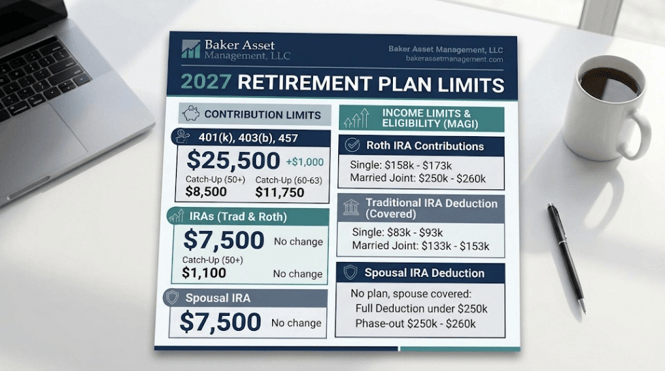
The IRS has raised the 2027 employee contribution limit for 401(k), 403(b), and most 457 plans to $25,500, up $1,000 from 2026. If you want to take full advantage of the higher limit, review your payroll deferral percentage before the new year so your 2027 contributions are set up the way you intend.
Here are the specific numbers you need to know for your 2027 strategy:
| Account Type / Rule | 2027 Limit | Change from 2026 |
| 401(k), 403(b), 457 Plans | $25,500 | +$1,000 |
| Workplace Catch-Up (Age 50+) | $8,500 | +$500 |
| Workplace Catch-Up (Ages 60–63) | $11,750 | +$500 |
| Traditional & Roth IRAs | $7,500 | No change |
| IRA Catch-Up (Age 50+) | $1,100 | No change |
| Spousal IRA (Non-Covered Spouse) | $7,500 | No change |
Income Limits and Eligibility for 2027
To ensure your contributions remain tax-efficient and compliant, be aware of the new income phase-out ranges for 2027:
- Roth IRA Contributions: The ability to contribute directly to a Roth IRA phases out at Modified Adjusted Gross Incomes (MAGI) between $158,000 and $173,000 for single filers, and between $250,000 and $260,000 for married couples filing jointly.
- Traditional IRA Deductions: If you are covered by a workplace retirement plan, your ability to deduct Traditional IRA contributions phases out between $83,000 and $93,000 for single filers, and between $133,000 and $153,000 for married couples filing jointly.
- Spousal IRA Deductions: If you are not covered by a workplace plan but your spouse is, your full deduction is permitted with a joint MAGI of $250,000 or less. The deduction phases out completely at $260,000.
Please comment or send an email if you have any questions.
Joe Baker, CFP®
Baker Asset Management, LLC
joebaker@bakerassetmanagement.com

