Letter of Final Instruction – Don’t Leave This World Without It

Stairway to the sky

The Letter of Final Instruction (LOFI) should be a major part of everyone’s estate plan.  Unfortunately, I rarely see one when reviewing a client’s financial documents.

The LOFI isn’t a legal document like a will or trust.  It is simply a document that provides your family with guidance upon your death on little things that wouldn’t necessarily go into a legal document.  It is a godsend for family members, especially after a sudden, unexpected death. I have seen many a family become completely stressed out and overwhelmed when dealing with the aftermath of a death in the family.

The LOFI provides important information to heirs, such as location of safe deposit box keys, insurance policy info, financial account numbers, online passwords, etc.  It also allows you to direct where you want your personal belongings to go to, such as your 100 year old china set or your vintage ‘65 Mustang. These items typically aren’t specified in a will or trust.  However, you can reference a LOFI in a will or living trust. That way, if you need to make changes, you can simply change the LOFI without having to amend the will or trust, since that takes the assistance of an attorney.

The LOFI should be distributed to all immediate family members and updated annually, if needed.  I also keep mine as a pdf file on my computer as well as a hard copy that I leave on my desk when I travel. 

If you want to get started on writing up your LOFI, here is a link to a very comprehensive checklist of what you should include: https://www.cals.uidaho.edu/edcomm/pdf/CIS/CIS0958.pdf.

You can also just do an internet search for letters of final instructions and you’ll have a bunch of resources to use.

Get going on this, even if you don’t have a will.  Something is better than nothing. Having a LOFI for your family will give you peace of mind and will help your heirs deal with settling your estate without all the stress and confusion.

Joe Baker, CFP®

Baker Asset Management, LLC

joebaker@bakerassetmanagement.com

Are Tariffs Good for America?

tariff concept

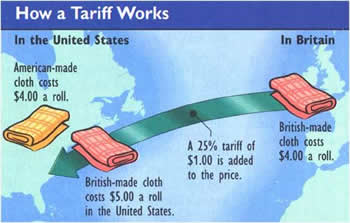
There is a lot of talk in the news recently about tariffs, which was initiated by President Trump last week when he said that we will impose a 25% tariff on imported steel and a 10% tariff on imported aluminum. Tariffs are basically a tax imposed by a country on imports from other countries as a way to make their domestic industries more competitive with the rest of the world. Here’s is a simplistic illustration of how tariffs work:

tariff (1)

So, for example, this would make Nucor, an American steel company, prices more in line with prices charged by steel companies from, say China. You can see that this would help our domestic companies that produce the raw materials needed to manufacture finished goods for consumers. Their prices would be more competitive and, therefore, should be able to sell more product.
But, you’ll probably also realize that the prices for those finished goods will now go up. So, a car made here will now cost more than a car made in Mexico. All else being equal, consumers usually will buy the same car for the cheapest price. This would hurt US car makers, including foreign ones that have plants here. Less demand means less production means less jobs. And there are a lot more jobs in the finished goods sector than the raw materials sector. So, overall tariffs typically end up being a bad thing for the US economy.

Many economists are afraid that tariffs will cause trade wars with our trading partners. This is certainly a possibility. The good thing is that most countries need us more than we need them. This means that tariffs can be a good negotiating tool as we try to reverse our trade deficits with so many countries.
In fact, the tariffs might convince more foreign companies to build plants in the US. We already have much lower fuel costs than in most parts of the world and shipping costs will be much lower as well.

It will be interesting to see how this plays out. I can’t imagine that we will have a blanket tariff for every country. If the tariffs do get approved, expect to see some countries exempted or with a reduced tariff before everything gets finalized.

Please feel free to contact me with any questions.

Joe Baker, CFP®
Baker Asset Management, LLC
joebaker@bakerassetmanagement.com

Monthly Update – March 2018

march-2013-bdays-color.jpg

Stocks got whipsawed in February, dropping 10% in the first week of the month. They then proceeded to quickly recover those losses, recovering nearly 70% of those losses in just 6 days. It was pretty dramatic and felt even worse because we haven’t had any big swings in the markets in such a long time so I think a lot of investors were taken by surprise.

For long term investors, these dips are non events but do become great buying opportunities for certain investments.

After all the wild gyrations, the S&P 500 ended down 3.5% for the month, snapping a 10 month win streak.

It seems like investors are coming to the realization that interest rates are not going to stay at all-time lows forever and are figuring out what to do. The good news about rising interest rates is that it means the economy is doing well. Subsequently, in a rising interest rate environment, stocks tend to go up as well. We just have to watch how fast they go up because that is what really influences the markets.

Bonds of all varieties continued to drop in price in February as interest rates continue to creep up. This is a longer-term trend that should play out over several years. So, if you are investing in bonds, make sure their maturity is 3 years or less. Also, try to avoid investment vehicles that have no maturity constraints, such as bond mutual funds. Please read my recent blog on this topic for more details: Why Bonds May Be More Riskier Than Stocks.

The new Federal Reserve chairman Jerome Powell, held his first testimony in front of Congress this week and hinted that the Fed plans on raising interest rates incrementally this year, probably about 4 times by the end of 2018. Remember, the Fed only controls the Fed Funds Rate, which is the rate banks charge each other for overnight loans. However, this rate does influence pretty much every other interest rate out there. So, when the Fed raises the FFR, you can be pretty certain your credit card rate and variable rate on loans will be going up as well. As an example, my HELOC’s variable rate has been increasing in step with the FFR increases, so I have been paying it down more aggressively.

For those who weren’t around in the late 70’s/early 80’s and think rates are getting too high, here’s a nice 55 year chart of the interest rate of the US Treasury 10 year note to put it into perspective how low rates are right now: http://www.macrotrends.net/2016/10-year-treasury-bond-rate-yield-chart.

On the savings side, rates are starting to creep up with a little more speed but they’re certainly in no hurry.

Currently, the average money market/savings account is paying 0.84%.

The 1 year CD interest rate is now averaging 1.92% (up from 1.85% last month) and the 5 year CD rate is at 2.39%(up from 2.31% last month).

Mortgage rates have moved above 4%, with the 30 year rate at 4.28%.  These rates could accelerate higher if we start to see increased wage growth and consumer price inflation. These higher rates seem to be affecting home builder stocks. I think this is crazy. Mortgage rates are still lower than when my dad bought our house in 1965 (rate was 6%).

Oil prices finally took a breather, dropping about 5% in February. Price per barrel now sits at $62.87.

As little as 5 years ago, all the conflict occurring now in the in the Middle East would have caused oil prices to rise and stay high for a long period of time. It is very obvious now that the impact of increasing the production of our own oil, as well as Mexico and Canada, has dramatically lessened the affect that the Middle East region (OPEC) has on oil prices. Hopefully, this will continue even as we transition to cleaner and renewable energy sources.

Nationally, gasoline prices are averaging about $2.52 per gallon.  FYI, a year ago, we were paying $2.29.  El Paso, TX has the cheapest gas in the country at $2.18.

Check out the prices at the pump in your area: Gas Buddy.

Outlook

Events on the horizon that could move the markets in the near term:

  • Russian Investigation: This continues to heat up. More charges were filed against Manafort and Flynn as well as some Russian Nationalists. I don’t know if it will ever get all the way up the chain of command but it feels like somebody is going to succumb to the pressure and start singing.

  • Escalating Tensions with North Korea: Now that the Olympics are over, North Korea seems to be feeling the love and wants to start talking. I’d love if we just backed away and let South Korea handle this. We have enough on our plates stateside.

  • Tax Law Effects: Warren Buffet gave his blessing on the new tax law but why wouldn’t he. His company made a cool $29 billion due to the tax code changes. Hopefully, we’ll see some decent increases in wages and some new jobs as a result of these changes, not just share buybacks and insane salaries for CEOs.

  • Infrastructure Bill: No progress on this item since last month. The details on this are few and far between but if Congress and the president can put something together before the end of the summer, we could see a big job creator and another rally starter for stocks.

Joe Baker, CFP®

Baker Asset Management, LLC

joebaker@bakerassetmanagement.com

Why Bonds May Be More Riskier Than Stocks

stocks v bonds

In the current environment of rising interest rates, I wanted to make sure that you were of aware of the potential risks of owning bonds, particularly bond mutual funds and bond exchange traded funds.

The general consensus among investors is that bonds are typically considered safer than stocks.  A couple of the reasons include:

  • Bond investors are higher in the pecking order than stockholders to get their initial investment back if the company goes bankrupt.
  • Companies that issue bonds have an obligation to pay the promised interest rate to investors.  Companies do not have an obligation to pay dividends to stockholders.
  • Bond prices are usually less volatile than stock prices.

Bonds trade just like stocks: their prices fluctuate as investors buy and sell them throughout the day.  Also, when a bond price changes, so does its interest rate, but in the opposite direction.  So, if a bond price goes up, its interest rate goes down, and vice versa.

As we said, interest rates are rising right now.  This affects bond prices because new bonds will have higher interest rates than older bonds.  Bonds with higher interest rates are more desirable, all else being equal.  That means the lower interest rate bond prices drop because there is less demand for them.  This isn’t a big deal if you buy an individual bond and hold it until it matures – the date when the bond goes away and you get your original investment back.

The problem occurs when you own bonds in a mutual fund or etf.  Technically, these investments have no maturity date because they continuously buy bonds.  This is risky when interest rates are rising because this will cause the mutual fund price to drop.  Most of the time, I find this situation when reviewing someone’s holdings in their 401k plan.  They usually own some type of bond fund as part of a general strategy that their 401k provider has shown them.

Since it looks like we are at the beginning of a rising interest rate period, you definitely want to evaluate your bond strategy in current investment portfolio.  If you do want to own bonds, please consider owning individual bonds that you plan on holding until maturity and make sure the maturity date is 2 years or less.  If you must use bond funds, use funds that only buy short term maturity bonds.  These bonds are less affected by rising interest rates.

This strategy can be a little confusing to understand so if you have any questions, please let me know.
Joe Baker, CFP®
Baker Asset Management, LLC
joebaker@bakerassetmanagement.com

Bumper Crop in 2018: Pot?

pot

Marijuana legalization looks set to “blaze” across the United States in 2018.  Currently, there are at least 12 states considering legalizing pot this year.  They could join the 30 states and D.C. that already have laws legalizing marijuana in some form.

There is strong support for full legalization with over 60% of Americans wanting marijuana law reform to be passed at both the state and federal level.

Personally, I think it is only a matter of time, say 2-5 years, that pot will be legal across the country, regardless of the current administration’s resistance to legalization.  The demand is just too strong.

They’ll just have to have some strict controls on it, similar to the ones already in place for alcohol products.  For instance, you know how strong a certain liquor is by the Proof noted on the bottle.  There should be something similar to let you know how much THC is in the pot brownie you are about to eat.  I know they already have this in place in many of the states that already legalized it but there needs to be some federal guidelines once they legalize it on the federal level.

The following link includes a great interactive map of where marijuana is currently legal or in the process of becoming legal for both medical and recreational uses (updated as of 01/08/18):

http://www.governing.com/gov-data/state-marijuana-laws-map-medical-recreational.html

Once the big tobacco and agricultural companies know the fed is going to legalize it, they will be getting into the industry in a big way and marijuana will be mainstream.  Their lobbyists will know way before we do.

I think the best way to invest in this sector is either via an actively managed mutual fund that specializes in the cannabis industry or an ETF that holds the major players, many of who are based in Canada.  This is an industry in its infancy so you have to do some extensive research in order to make a sound investment decision.

Please feel free to contact me with any questions.

Joe Baker, CFP®

Baker Asset Management, LLC

joebaker@bakerassetmanagement.com

Stock Market Craziness

Stock-Market-Craziness.jpg

The last couple of days have been absolutely wild in the stock market.  The S&P 500 has given back all of its gains for the year and then some.  So, is it time to sell everything and go sit on the sidelines for awhile?  Of course not.

Here’s some of my thoughts on stock market dips and how to handle them:

  • Hopefully, your investment plan takes into account that the money you have invested in the stock market is money that you aren’t planning on using for at least a few years.  If it doesn’t, then you need to get a new plan.
  • To say this drop is overdue is an understatement.  It’s been so long since we have had a 5-10% correction that people forget that stocks don’t go up in a straight line.  Also, the longer they rise without a pause, the more violent the fall.  Hence, what is happening now.
  • It is always better to sell when you want to and not when you have to.  Over the past few years, it would have been hard not to make money in the stock market.  There’s nothing wrong with selling a small percentage of your investments to lock in gains and raise cash for times when the markets go down, like now.
  • Stocks always take the stairs up and the elevator down.  When stock prices go up, they tend to do this in a slow, methodical way with pauses in between, like walking up stairs.  However, when stocks drop, they tend to do it quickly.  This is why bull markets tend to last a lot longer than bear markets.
  • Most of the media and the experts focus on the short term, because that’s what sells.  This type of information applies to traders, not investors.  If you are a trader, meaning you buy and sell stocks only for a short period of time, then yes, you are getting crushed.  If you are an investor, then market drops like these provide opportunities to buy in at a better price.
  • Most people remember the huge drop in 2008/2009 but do you remember the big dips in the S&P 500 in 2014, 2015, and 2016?  They were pretty bad but we recovered quickly and continued higher.  I suspect people will forget about this dip in the near future as well.


Please feel free to contact me with any questions.

Joe Baker, CFP®

Baker Asset Management, LLC

joebaker@bakerassetmanagement.com


Monthly Update – February 2018

Stocks had one of the strongest months that I have seen since the late 1990’s. The S&P 500, which tracks the 500 largest US stocks, rose nearly 5% in January. That’s what many analysts thought would be the gain for the entire year in 2018.

Historically, how stocks perform in January is a good indicator of how they’ll perform for the rest of the year. In fact, this barometer has an 87% accuracy rate over the last 67 years. I don’t put too much faith in these indicators but I do like when it coincides with other market catalysts, like the tax reform and the possible infrastructure bill.

The main catalyst for the big surge this past month was most likely the new tax reform law going into effect, particularly regarding corporate taxes. This will bump net profit for most companies, particularly the small to medium size companies with operations strictly in the US.

As far as earnings go, the reports for the fourth quarter of 2017 have been decent. But stock prices are moving based on how the new tax law will benefit companies’ bottom lines in the future.

Bonds took a dive in January as interest rates, both short-term and long-term, rose significantly. This is a longer-term trend that should play out over several years. So, if you are investing in bonds, make sure their maturity is 3 years or less. Also, try to avoid investment vehicles that have no maturity constraints, such as bond mutual funds.

The Federal Reserve just concluded their first meeting of the year and kept rates unchanged. However, they did lay the foundation for raising rates at least two or three times this year. This is a good thing because they believe our economy is growing and they want to make sure that it doesn’t overheat, creating excessive inflation.

For those who weren’t around in the late 70’s/early 80’s and think rates are getting too high, here’s a nice 55 year chart of the interest rate of the US Treasury 10 year note to put it into perspective how low rates are right now: http://www.macrotrends.net/2016/10-year-treasury-bond-rate-yield-chart.

On the savings side, rates are starting to creep up with a little more speed but they’re certainly in no hurry.

Currently, the average money market/savings account is paying 0.82%.
The 1 year CD interest rate is now averaging 1.85% (up from 1.70% last month) and the 5 year CD rate is at 2.31%(up from 2.20% last month).

Mortgage rates have moved above 4%, with the 30 year rate at 4.10%. These rates could accelerate higher if we start to see increased wage growth and consumer price inflation.

Oil prices rose over 8% in January, continuing its upward trend since bottoming in June. Price per barrel now sits at $65.50.

This increase in fuel prices causes less money to be in our pockets as we pay more for fuel, airfare, produce, etc. Although it isn’t factored into how the government calculates inflation (someone please tell me why), rising energy prices affect everyone’s bottom line.

Nationally, gasoline prices are averaging about $2.58 per gallon. FYI, a year ago, we were paying $2.27. Albuquerque, NM has the cheapest gas in the country at $2.24.

Check out the prices at the pump in your area: Gas Buddy.

Outlook

Events on the horizon that could move the markets in the near term:

Russian Investigation: This is ramping back up again. The FBI Deputy Director just stepped down and rumors are floating that Trump wanted to fire Mueller. It’s tough to keep up. The good news is that any market pullback from this should be short lived (less than 6 months) and will provide a buying opportunity for long term investors.

Escalating Tensions with North Korea: With the Winter Olympics being held this month in North Korea’s backyard, I think we’ll see tensions ease up between Kim and Trump……I hope.

Tax Law Effects: Say what you want about the circus in D.C., but you can’t deny that they did get something positive done. This tax reform for US companies is going to be better than expected based on initial reports by some of the biggest corporations.

Infrastructure Bill: The details on this are few and far between but if Congress and the president can put something together before the end of the summer, we could see a big job creator and another rally starter for stocks.

Joe Baker, CFP®

Baker Asset Management, LLC

joebaker@bakerassetmanagement.com

What the Government Shutdown Means For Your Investments

gov't shutdwon

The government shut down this past Friday night after the Senate failed to pass a budget bill to continue funding government operations. The federal government has ceased all but essential services until Senate Democrats and Republicans can strike a compromise and pass a bill.  They better not be considered essential personnel!

Here’s a quick synopsis of what this means for you and me:

  • Non-essential government employees are furloughed, meaning they are told to not report to work. These employees include the Internal Revenue Service and Centers for Disease Control and Prevention among many others.
  • Mail will still be delivered, and airports will operate as normal.  The military will not shut down—it is considered an essential function, so all active duty members will work as usual.
  • Medicaid and Medicare will continue to insure senior, low-income and disabled people during the shutdown. The Children’s Health Insurance Program (CHIP), a central issue in the current spending bill, will still be funded, though some states will run out of money by the end of the month unless an agreement is made on how to continue it.

The last time the government shut down was in October 2013, when Congress was embroiled in a debate over funding Obamacare. The 16-day shutdown cost an estimated $24 billion in economic output, and left around 800,000 “non-essential” federal employees furloughed. The national parks system lost about 700,000 visitors per day, and NASA ceased operations.

If this happens again, I think stocks will take a dip, which is long overdue anyway.  Then, once they come to an agreement and everyone comes back to work, the markets will recover.  So, if you’re worried about the shutdown hurting your investments, don’t.  Unless you need that money in the next couple of months, it will be easier for you to stay invested than selling and trying to time the market to get back in.

Please let me know if you have any questions.
Joe Baker, CFP®
Baker Asset Management, LLC
joebaker@bakerassetmanagement.com
Another Factor To Consider When Planning For Retirement

retirement just ahead

As I’ve said in previous posts about retirement planning, there are so many variables that come into play when trying to figure out how much money you’ll need to do what you want to do during your retirement years.

The one that I wanted to focus on today is the withdrawal rate of your retirement accounts.  That is, how much will you need to take out of your IRA, 401k, etc., to live the life that you desire during retirement.

The most common method is to figure out what your expected monthly expenses will be and then determine if you’ll have enough in your accounts to cover those expenses for the rest of your life.  For example, if you expect to need $6,000 per month in retirement over the next 30 years, you’ll need a about $1,300,000 to start with in your retirement savings.  This accounts for everything, including all the fun that you’re going to have: trips, vacations, etc.

What most people, and their advisers, don’t account for is their activity levels throughout retirement.  That’s why I feel this method for calculating your “number” is kind of misleading.

Using the same example, you might only need that $6,000 monthly amount for, say, the first 15 years of retirement.  Then, after all that partying, you might want to take it down a notch.  So, let’s make it $4,000 per month that you’ll need for the remainder of your retirement years.  It turns out in this scenario, that you’ll only need about $1,080,000 to start with, or about $220,000 less than if you just used the same monthly amount for your entire retirement.

Of course, the bigger the number that you can start with, the better.  So, the next time you want to calculate your retirement “number”, consider making the adjustment above.  It might make you realize that you are doing all the right things to prepare for the future and will take some stress out of your life today.

Joe Baker, CFP®
Baker Asset Management, LLC
joebaker@bakerassetmanagement.com
One Way To Still Save On Your 2017 Taxes

Save on taxes

2017 has come and gone but there is still time to reduce your taxable income for last year.

Make a contribution to your IRA.

If you qualify, an IRA contribution can be a great way to reduce your 2017 taxes.  You are allowed to contribute up to $5,500, or even more if you are an old-timer like me: $6,500 for people age 50 and over.

Plus, if you are married, you can double up the amount with a spousal IRA.

If you are not covered by a retirement plan at work, you can deduct the full amount of your contribution, regardless of how much money you make.

If you do have a retirement plan at work, there are restrictions and limitations to qualify for the full deduction.  Here’s a table that summarizes these rules.  They are confusing so feel free to shoot me an email with any questions.

2017 Traditional IRA deduction limits

Filing Status Modified adjusted gross income (MAGI)* Deduction Limit
Single individuals ≤ $62,000 Full deduction up to the amount of your contribution limit
> $62,000 but < $72,000 Partial deduction
≥ $72,000 No deduction
Married (filing joint returns) ≤ $99,000 Full deduction up to the amount of your contribution limit
> $99,000 but < $119,000 Partial deduction
≥ $119,000 No deduction
Married (filing separately) < $10,000 Partial deduction
≥ $10,000 No deduction
Non-active participant spouse (i.e., those with spouses who earn no income) ≤ $186,000 Full deduction up to the amount of your contribution limit
> $186,000 but < $196,000 Partial deduction
≥ $196,000 No deduction

Joe Baker, CFP®
Baker Asset Management, LLC
joebaker@bakerassetmanagement.com