Monthly Update – February 2019

february

Stocks had a great January, with the S&P 500 rising about 8%, its best performance since 1987.  This comes off the heels of the worst December since the Great Depression.

Market performance in January tends to be a pretty accurate predictor of how the market will perform for the rest of the year.  Since 1950, it has been correct 75% of the time. By the way, last year was one of those times that the January barometer was wrong.  The S&P 500 had a great positive January in 2018 but ended the year in the red.

There are always many things that influence the markets in the short term and right now we have no shortage of that stuff: Trump investigations and trade tariffs, to name a few.  But how stocks perform over the long term always boil down to how profitable companies are now and in the future. Finding these companies early in their profit cycle and avoiding all the short term noise is one of the keys to being a successful investor.

Bonds were big winners in January.  Low risk government bonds and blue chip corporate bonds rose in price, as well as higher risk (junk) corporate bonds.  Once bond investors got the word that the Fed was pulling back on its rate increases, they started to get back into the market.  In this environment, it is a good idea to own bonds that mature in 1 or 2 years and to hold them to maturity. That way, you don’t have to worry about these big price moves during your holding period.

Interest rates have risen enough over the last few years that a pause is a good thing, but odds are still better for rates to move up than to move down.  So, if you are investing in bonds, make sure their maturity is 3 years or less and expect to hold the bonds until maturity. Also, try to avoid investment vehicles that have no maturity constraints, such as bond mutual funds.

On the savings side, rates have started to level off as the Fed pumps the brakes on raising short term rates.  This is reflected in the rates for savings accounts, money markets, and CDs.

Currently, the average savings account is paying 1.23%, down quite a bit from 1.53% last month.

The 1 year CD interest rate is now averaging 2.71% and the 5 year CD rate is at 3.05%, both slightly slower than at the beginning of the month.

Mortgage rates have reversed course, although the 30 year still remains firmly above 4%.  Currently, the 30 year rate is at 4.40%, down from 4.60% last month. These rates are responding to the slow down in home sales, the government shutdown, and the effects that the tariffs are having on our economy.  Rates are responding the right way, so there’s no surprises here.

Oil prices stopped its 2 month slide in January, rising almost 20%.  Prices finally settled at around $54. This was oil’s biggest increase in the month of January ever.  The main reasons for the huge upswing were production cuts by OPEC and the dumpster fire that is Venezuela, which surprisingly, has the largest oil reserves in the world.

Obviously, higher prices is good for producers and since the U.S. is the biggest oil producer in the world now, it is good for our economy.  But, we are also the world’s biggest oil consumer, so higher prices hurts us as well. It’s a blessing and a curse. Prices right now are in a nice sweet spot, between $50 and $75.  Hopefully, they’ll stay there for awhile.

Nationally, gasoline prices haven’t jumped up that much with the increase in oil prices.  Prices at the pump are averaging about $2.29 per gallon, only 3 cents higher than a month ago.  Missouri has the cheapest fuel again, at $1.91. FYI, a year ago, we were paying $2.59.

Check out the prices at the pump in your area: Gas Buddy.

Outlook

Events on the horizon that could move the markets in the near term:

  • Russian Investigation: Okay, this is turning into a James Michener/Tom Clancy novel.  Here’s a progress report: There have been 34 people and 3 companies that have either been indicted or have plead guilty so far in this investigation.  This doesn’t even include all the people that federal and state prosecutors are investigating regarding the Trump Organization and the Trump inauguration.  When the investigation finally concludes, there is still going to be a battle over how much of the report gets released to the public. So, I think this event is going to be on the horizon for awhile and could cause huge market swings this entire year.
  • Trade Wars: Things just got a little more complicated with trade negotiations between the U.S. and China.  Right now, we’re trying to extradite Huawei’s CFO from Canada. She has been charged with stealing industrial secrets and doing business with Iran, among other things.  Huawei is the world’s largest mobile phone and network equipment provider and is a China-based company. I know the trade deals will get done but resolving this issue will certainly become part of the negotiations.  A resolution will give the market a nice boost.
  • Federal Reserve: As I’m typing this, the Federal Open Market Committee (FOMC) meeting just ended and the Fed has said that they will keep a hold on raising interest rates.  More importantly, they pledge to maintain a patient approach. That’s all I want to hear. Keep it simple (I’m talking to the Fed): let your actions get absorbed into the economy for a few months and watch the data before making any policy changes.


Joe Baker, CFP®

Baker Asset Management, LLC

joebaker@bakerassetmanagement.com

4 Easy Things To Do To Avoid Probate

probate
Recently, I have had a lot of first hand experience in the probate process.  Both of my parents passed away in 2018 and I wanted to pass on some of the tips that I learned as me and my siblings settled their estates.

Probate is the legal process through which a deceased person’s estate is properly distributed to heirs and designated beneficiaries and any debt owed to creditors is paid off. In general, probate property is distributed according to the decedent’s last will and testament, if there is one, or according to state law if no will exists.  By the way, I dealt with the probate laws in the state of Florida.

First, property that goes through probate isn’t a bad thing.  It’s just that it takes time, attorneys, and a good amount of paperwork.  You can avoid probate almost entirely by creating a living trust and placing all of your assets inside that trust.  But again, this takes time, attorneys, and a good amount of paperwork.

The good news is that you can do a few things on your own that require little time and paperwork to avoid the probate process.

  1. Make sure that all accounts that allow beneficiaries have one assigned.  Examples of these accounts are retirement accounts (IRA, 401k, etc.) and life insurance policies.  If you don’t name a beneficiary, these assets get passed to your estate, which will then have to be included in the probate process.
  2. For taxable brokerage accounts, retitle the account to a transfer-on-death (TOD) account.  This allows you to assign beneficiaries to this account, thus avoiding probate.
  3. For bank accounts, change to a payable-on-death account.  Just like a TOD account, this allows you to assign beneficiaries to this account, thus avoiding probate.
  4. For your home, you can add an heir to the deed as a joint owner.  That way, your portion of the house will go directly to the joint owner, avoiding probate.  This would be considered a gift for tax purposes, but as long as your house isn’t worth over $20 million, you can avoid any taxes by applying the gift to your lifetime exemption of $11.4 million.

Making these easy changes now to your parents’ accounts and to yours can save you time and money, but most importantly, give you and your family peace of mind knowing that your affairs are in order.

Please feel free to contact me with any questions.


Joe Baker, CFP®

Baker Asset Management, LLC

joebaker@bakerassetmanagement.com
 

Fun Facts About Electronic Payments


payments_webinar_01092019

I recently attended a seminar on the electronic payments industry and where it is heading.  Sounds exciting, right? I admit it was a bit of a snoozer but there were some points that I thought you might find interesting.  For instance, here is one stat that I found pretty surprising:

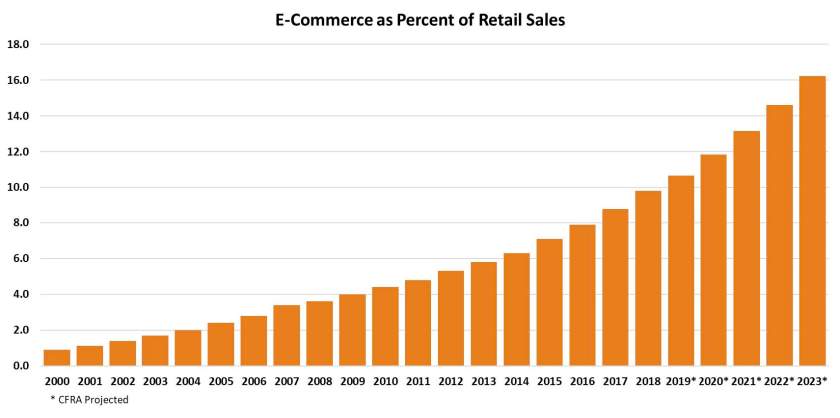
e-commerce sales only make up about 10% of total retail sales, as of 2018 (see graph above).

I thought that percentage would have been much higher, just based on my household’s monthly online purchases.  I actually believe that graph is underestimating e-commerce growth over the next 5 years.

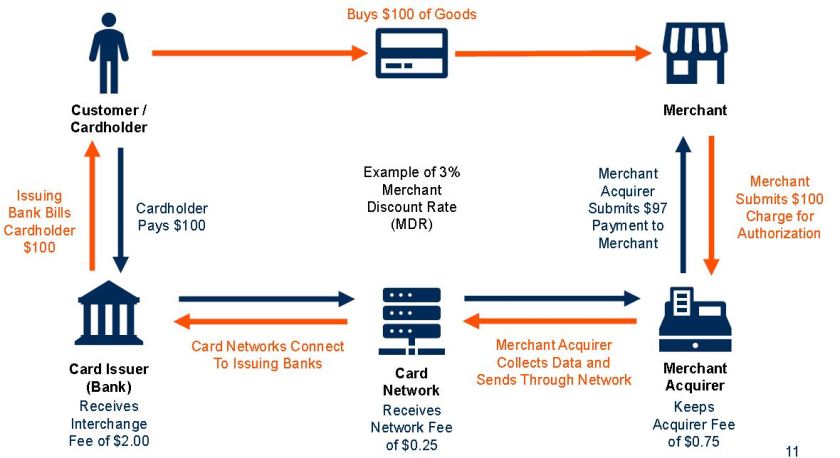
Another chart that piqued my interest was the process of how a non-cash payment gets processed:

cc process

You can see how many different parties are involved in a simple electronic transaction.  Now, picture this happening over 13,000 times per second every day! You can see that multiplying that number of transactions by those small fees shown above x 60 seconds x 60 minutes x 24 hours x 365 days is…. a lot of revenue generated annually for all of those players in the process.  Knowing this and the expected growth of this industry makes for a good starting point for investment opportunities.

There are a lot of companies involved in moving money electronically, from card issuers to the companies that make the technology to make it all happen.  As with any high growth sector, there are going to be winners and losers (Apple and Blackberry in the smartphone market). You definitely want to do your research and never place your all your bets on one company.

Let me know if you have any questions.

Joe Baker, CFP®
Baker Asset Management, LLC
joebaker@bakerassetmanagement.com
What To Do About This Crazy Market

roller coaster 20190107

The last few months have been pretty turbulent for investors and there doesn’t seem to be an end in sight.  We have to deal with government shutdowns, tariffs, investigations, wars, and a lot of tweets. Trying to keep up with all the news is like drinking from a fire hose.  It’s times like these that test an investor’s intestinal fortitude.

For investors that don’t have a crystal ball, you are probably asking yourself, “Do I sell now and hope to time it right when I buy back in?”.  That is tough to do and I don’t know anyone that has ever been successful at it.

If you have a plan in place, the money that you have invested right now should be money that you won’t need for at least 2-3 years.

Money that you need in the next few years shouldn’t be invested in risky investments like commodities, real estate, stocks and most bonds, because you might not have enough time to recover from drops like the one that is happening right now.

For those that have investments with no need for that money for, say 5 years or more, stick to your plan.  If you have cash set aside for market dips, this is a good time to start buying a little bit on the cheap. For people contributing to a retirement plan every paycheck, you should be loving these market drops because you’re getting more shares for the same dollar amount coming out of your pay than you were a month ago.

Sure, stock prices could go lower, but anyone who bought after the tech wreck at the beginning of this century or in 2009 after the financial crisis is very happy they had the conviction to buy when everybody else was selling.

Hang in there and don’t let your emotions drive your investment decisions.  Stick with your plan and stay the course. Your future you will thank for it.

By the way, the roller coaster pictured above is called the Boomerang in Siam Park, Bangkok. Yikes!

Joe Baker, CFP®
Baker Asset Management, LLC
joebaker@bakerassetmanagement.com

 

Monthly Update – January 2019

january

Stocks took a good, old-fashioned shellacking in December, as investors continued to shed their stock holdings.  The S&P 500 dropped almost 10% this December, capping off a rarely seen 4th quarter slide which put the major index in the red for the year by nearly 7%.

The combination of rising interest rates, trade wars, and all the investigations into Trump’s activities (currently, over a dozen) have spooked many investors.  The remedy to bringing confidence back to the markets will be to get some clarity on one or more of these situations. Interest rates and trade wars will be the easy ones, in my opinion.  The investigations are the big unknowns and will only be getting more complicated with a democratic controlled House of Representatives. The good news is that great companies will continue to be great companies, regardless of what is going on in DC.  So, try not to focus on all of the distractions and stick to your investment game plan.

Bonds were a mixed bag once again this past month.  Low risk government bonds and blue chip corporate bonds rose in price while higher risk corporate bonds dropped in price.  This makes sense as investors continued to lower their portfolio risk by moving to more conservative investments. As I said the last two months, this type of price action can be interpreted as a flight to safety by big institutional traders.  They’re putting their sales proceeds from stocks and longer term bonds into some short term low risk government bonds until things settle down so they can get back into the higher risk markets. This is what the big firms do so they don’t have to show positions in stocks or bonds that have gone down so much in price on their holdings sheet.  It’s a silly practice but it provides a great opportunity for astute investors to get on the other side of that trade.

Rising interest rates is still the path of least resistance over the next several years so if you are investing in bonds, make sure their maturity is 3 years or less and expect to hold the bonds until maturity.  Also, try to avoid investment vehicles that have no maturity constraints, such as bond mutual funds.

On the savings side, rates continue to rise, but at a nice, steady pace.  I don’t like seeing any kind of interest rate changing too quickly. Slow and steady typically translates into a solid economy.

Currently, the average savings account is paying 1.52%, down slightly from 1.58% last month.

The 1 year CD interest rate is now averaging 2.73% and the 5 year CD rate is at 3.08%, both slightly higher than at the beginning of the month.

Mortgage rates remain firmly above 4%, with the 30 year rate at 4.60%, down slightly from 4.68% last month.  These rates could accelerate higher if we start to see increased wage growth and consumer price inflation.  Historically, rates are extremely low but the path of least resistance is still up, for right now. There is solid evidence of downward pricing pressure in the housing industry, especially on the coasts.  This should help keep mortgage rates from rising too quickly.

Oil prices continued to nose dive in December, dropping another 11% after losing 22% in November.  Prices finally settled at around $46.25. Prices are now down over 19% for the year. One of the big reasons for the drop is that the U.S. is now running neck and neck with Russia and Saudi Arabia for being the largest producer of oil in the world.  That’s great news, but If prices stay below $50 for an extended period of time, it will be more hurtful to our economy than helpful, since this will cause the energy industry to cut jobs, etc.

Nationally, gasoline prices are reflecting the drop in oil prices, averaging about $2.26 per gallon.  That’s another big monthly dip from $2.49 in November. Missouri has the cheapest fuel, at $1.85. FYI, a year ago, we were paying $2.48.

Check out the prices at the pump in your area: Gas Buddy.

Outlook

Events on the horizon that could move the markets in the near term:

  • Russian Investigation: It’s looking more and more likely that this investigation is going to produce some major bombshells.  I still think that Individual 1 will not be removed from office, even if the impeachment process is initiated.  However, with this hanging over Trump’s head, along with Mattis and Kelly gone, I believe the White House will be even more unstable in 2019, if that’s even possible.  This stuff is not good for Wall Street or Main Street.
  • Trade Wars: Each time there is a rumor of a trade deal between the U.S. and China, stocks get a boost but then fall back when nothing gets done.  A deal will get done, but until it happens, market volatility will remain high.
  • Federal Reserve: I like that the Federal Reserve wants to be transparent when it comes to its next moves on interest rates, but they shouldn’t be telling us how many times they are going to raise rates over the next year or so.  Just tell us that they will be making their moves based on the data available at the time. Their current policy is causing unnecessary volatility in the markets. Having said that, it appears that the Fed will be pumping the brakes in raising rates in the near future, which should ease market anxiety.


Joe Baker, CFP®
Baker Asset Management, LLC
joebaker@bakerassetmanagement.com

Wash Sale Overview

wash 2

This is the time of year that many investors sell some loser investments to offset their income or other capital gains, sometimes referred to as tax-loss harvesting.  Their is an obscure tax rule, known as the wash sale rule, that could affect how the IRS views these trades. So, here is a brief summary of the wash sale rule.

The wash sale rule was designed to discourage people from selling securities at a loss simply to claim a tax benefit.

wash 1
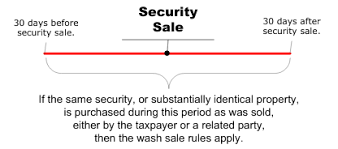
A wash sale occurs when an investment is sold at a loss and, within a period of 30 days before or 30 days after the sale, the identical or “substantially identical” investment is purchased again.

Under such circumstances, that loss will be “disallowed” and may not be considered in calculating a taxpayer’s losses for income tax purposes.

An example is the easiest way to explain this rule:

Suppose Joe has a taxable brokerage account that holds 50 shares of XYZ stock with a cost basis of $500 because he bought the stock when it cost $10 per share. The stock is worth only $5 per share on July 31, and he sells all 50 shares. It produces a capital loss of $250.
If Joe purchases new shares in XYZ within 30 calendar days before the sale or up to 30 calendar days after the sale, his capital loss is deferred until he sells these new, replacement shares.

As you can see in the example, you lose the tax benefit of the realized loss, but you get it back when you eventually sell the newly purchased shares.  The only time that you lose the loss permanently is when you sell an investment in a taxable account and you buy it back in an IRA.

If it sounds confusing, don’t worry.  It is. That’s just our tax code. Just shoot me an email if you have any questions.  Thanks.

Joe Baker, CFP®
Baker Asset Management, LLC
joebaker@bakerassetmanagement.com

Market Mania! Should You Stay The Course?

Stormy sea

With the markets acting more like an amusement park ride than a leading economic indicator, you’re probably questioning whether or not to bail on your investments right about now.  It seems like the market can’t go up, no matter what happens.

First, let me tell you that you shouldn’t be looking at your accounts, or the stock market, every single day.  It will make you crazy during turbulent times like we are having right now.  Having said that, this is also a good time to review your portfolio.  There might be some great companies that you don’t own that have dropped in price that now look reasonable to buy.

Regardless, you should have a plan in place that will remove emotion from your investment decisions.  If you’re plan says to stick to your investments, then stick to your investments. It is a fool’s game to punch out of the markets now and then try and decide when to get back in.  There are investors still trying to pick their entry point after bailing out during the great recession in 2008/2009.

Finally, here is a good rule of thumb: Any money that you need to use within the next 18 months should never be in the stock market.  Keep it in your money market or checking/savings accounts. That way, you can weather any storm (see picture above) the market throws at you without having to sell when you shouldn’t.

Stop fretting and enjoy the hap, hap, happiest time of the year!!

Joe Baker, CFP®
Baker Asset Management, LLC
joebaker@bakerassetmanagement.com
Monthly Update – December 2018

December

Stocks continued to drop through the month of November until Thanksgiving.  Then, we got a nice little rally that helped most stock market averages end positive for the month.  The S&P 500 ended November with a 2.9% gain and is now positive for the year again, at 2.4% on the plus side.

Who knows if this will last, but historically speaking, we are at the start of the best time of year to be invested in stocks.  I feel like investors that were waiting on the sidelines finally jumped in during the last week of November, giving investors some relief.

The elections came and went with no major surprises.  The biggest influences on the markets going forward will be the Federal Reserve, commodity prices, especially oil, and to a lesser degree, the Mueller investigation.  See the Outlook section below for more details. Retail stocks should do well this month based on the amount of shopping that’s being done both online and, surprisingly, at brick and mortar shops.

Bonds were a mixed bag this past month.  Low risk government bonds rose in price while higher risk corporate bonds dropped in price.  This makes sense as investors dumped stocks and looked for a safe place to put their cash. As I said last month, this type of price action can be interpreted as a flight to safety by big institutional traders.  They’re putting their sales proceeds from stocks and longer term bonds into some short term low risk government bonds until things settle down so they can get back into the higher risk markets. This is what the big firms do so they don’t have to show positions in stocks or bonds that have gone down so much in price on their holdings sheet.  It’s a silly practice but it provides a great opportunity for astute investors to get on the other side of that trade.

Rising interest rates is still the path of least resistance over the next several years so if you are investing in bonds, make sure their maturity is 3 years or less and expect to hold the bonds until maturity.  Also, try to avoid investment vehicles that have no maturity constraints, such as bond mutual funds.

On the savings side, rates continue to rise, but at a nice, steady pace.  I don’t like seeing any kind of interest rate changing too quickly. Slow and steady typically translates into a solid economy.

Currently, the average savings account is paying 1.58%, up from 1.22% last month.

The 1 year CD interest rate is now averaging 2.65% and the 5 year CD rate is at 3.05%, both higher than at the end of October.

Mortgage rates remain firmly above 4%, with the 30 year rate at 4.68%, down slightly from 4.73% last month.  These rates could accelerate higher if we start to see increased wage growth and consumer price inflation.  Historically, rates are still extremely low but the path of least resistance is still up, for right now. Recently, there have been signs of downward pricing pressure in the housing industry, particularly on the east and west coasts.  This should help keep mortgage rates from rising too quickly.

Oil prices plummeted 22% in November, settling at $50.93.  That is a huge drop! This is way more than the normal seasonal drop for this time of the year.  In fact, it was the worst month for oil since 2008. Prices are now down over 12% for the year. One of the big reasons for the drop is this fact: the U.S. is now producing almost 12 million barrels per day. If prices head any lower, it will be more hurtful to our economy than helpful, since this will cause the energy industry to cut jobs, etc.

Nationally, gasoline prices are averaging about $2.49 per gallon.  That’s a pretty big drop from $2.80 last month. FYI, a year ago, we were paying exactly the same, $2.49.

Check out the prices at the pump in your area: Gas Buddy.

Outlook

Events on the horizon that could move the markets in the near term:

  • Russian Investigation: As everyone expected, once the elections were over, Mueller has become very active.  There are so many moving parts in this investigation, it’s hard to keep track but it does seem like the circle is closing around the Trump family and its dealings with Russia.  Any indictments of a member of the Trump family will be a negative for stocks.
  • Trade Wars: As I’m writing this update, world leaders are meeting in Argentina and focusing on trade, especially between the U.S. and China.  If they come away from this summit with a deal, the markets are going to respond very positively. If there’s no deal, it will keep a lid on any market upswings.
  • Federal Reserve: Many of the federal reserve members have been speaking over the last few weeks and the consensus is that interest rates are at a pretty good level right now, based on price inflation and wage growth.  This has helped stocks recover a little bit after the beating they took this past month. They’ll still raise rates another 25 basis points at their December meeting but that might be it for awhile, which will be positive for stocks.


Joe Baker, CFP®
Baker Asset Management, LLC
joebaker@bakerassetmanagement.com

End of Year Tax Tips

year-end-tax-planning

Thinking about year end tax planning is about as much fun as waiting in line at the DMV, but it is something that could save you some money so it’s always a good thing to take a look at your financials before the end of the year.

Below are some items that may help you lower your 2018 taxes:


1. Spend any leftover cash that is in your flexible spending accounts.


As you probably already know, you don’t pay taxes on money that you put in an FSA, but that tax-free money must be spent on qualified medical expenses before the end of the year.

So, you should make sure to use this money for qualified expenses such as copays, eyeglasses, prescription medications, medical equipment, dental exams, etc.

2.  Max out your retirement plan contributions to lower your taxable income.

Lowering your taxable income means paying less tax and it could also reduce the amount of Social Security subject to tax or any net investment income tax.

Contributing to a pre-tax retirement plan lowers both your adjustable gross income (front of the 1040 form) and your taxable income (back of the 1040 form) . These plans include 401(k)s, 403(b)s, deductible IRAs, SIMPLE IRAs and SEPs.  You have until Dec. 31st to make contributions to 401(k)s and 403(b)s for 2018. But for most other plans and IRAs, you can wait until when you file your taxes to make the contribution.

3.  Sell your investment losers.

If you have realized capital gains this year, you might want to sell some of your losers in your stock, bond, or real estate portfolio to realize a loss before year end. This strategy, called “tax loss harvesting”, can reduce the amount of capital gains subject to tax.  However, don’t sell just for this tax benefit. Make sure it makes sense based on your overall investment strategy.

4.  Update paycheck withholding.

Tax reform and paycheck withholding changes almost always upset the balance that you want between the size of your tax refund and the size of your paycheck.  Whenever there are changes to the tax code that affect your take home pay, you need need to update your W-4 with your employer so you can continue to get the balance you want.  For this year, it’s too late in the year to meaningfully impact your 2018 return, but updating your W-4 now means you can start off 2019 just how you want.


Joe Baker, CFP®
Baker Asset Management, LLC
joebaker@bakerassetmanagement.com

Election Results and Their Impact on The Markets

Election-Results


The mid-term elections have come and gone.  As investors, we now have to digest what has changed and make adjustments to our portfolios, if necessary, to help achieve our financial goals.

The biggest change is that the Democrats have taken control of the House of Representatives while the Republicans have retained power in the Senate.  This was considered the most likely outcome so no surprises here. What this shift means is that Trump will now have a tougher time pushing his agenda through Capitol Hill, like building a wall, more tax cuts, etc.  For the markets, it means that not much will get done in DC (not a shocker) so that is one less risk that investors have to worry about.

However, there is a lot more impeachment chatter going on now that the Dems will have the house in 2019.  This, I believe, would hurt stocks and help bonds, but there is such a small chance of this happening. Even if the House did impeach Trump, that is only the first step.  To remove a president, there has to be a trial and then a vote in the Senate, where ⅔ have to approve for removal. There’s no way that will happen, unless Mueller turns up some bad stuff on Trump.

Some good that may come from a split Congress is that there are some agenda items that both parties can agree on, the most pressing being the country’s crumbling infrastructure.  I was disappointed that nothing was done on this when Republicans controlled everything these past 2 years. I do still hold out some hope that with new blood on the Hill, they can make something happen because it will help both parties, but more importantly, it will help America and its people (which should always be the goal).  This would certainly give the markets a boost.

The infrastructure deal would be big but will take some time for everyone to agree on it.  A quick way to boost the markets is for us to get some trade deals done with the rest of the world, especially China.  I agree that we needed to rework these trade agreements but we’re going about it the wrong way, in my opinion. We’re taking a one winner-one loser mindset into these trade negotiations versus trying to make it a win-win for both parties.  I believe we can get something done prior to the end of the year and help prevent further layoffs and plant shutdowns from occurring, particularly in the automotive and farming industries.

Seasonally, this is usually the best time of the year to invest.  If our Congress can roll up their sleeves and work together, they can certainly help continue this trend.


Joe Baker, CFP®
Baker Asset Management, LLC
joebaker@bakerassetmanagement.com